
Spinning Mill Cost Calculation

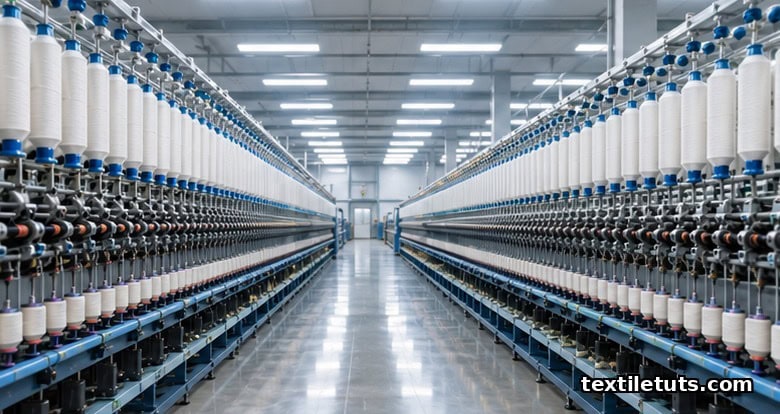
A spinning mill producing 30s cotton yarn at 10,000 kg per day operates at a total yarn cost of $3.20 to $4.50 per kg, where raw fiber accounts for 55 to 65 percent of total cost, ring-frame power consumption is 0.5 to 0.8 kWh per kg of yarn, and direct plus indirect labor contributes 8 to 12 percent of total cost.
This cost structure shifts with machine efficiency, spindle speed, raw material price, and energy tariffs, all of which change by mill location, equipment age, and yarn count produced.
This article walks through the standard costing framework used in yarn manufacturing, the line items that consume the budget, and the formulas textile engineers use to convert spindle hours and machine output into a per-kilogram yarn cost.
Why Spinning Mill Cost Calculation Matters
Yarn selling price is set by the market, but profitability is set inside the mill. A 1 percent drop in conversion cost moves directly to the bottom line because raw material cost is largely locked once the fiber is purchased. Spinning mill managers therefore track conversion cost per kilogram of yarn, cost per spindle hour, and cost per shift as their primary operating metrics.
For a ring spinning mill running 25,000 spindles at 80 percent machine efficiency, a single percentage point of conversion cost saved equals roughly $40,000 to $60,000 per year at current cotton prices. The same metric drives investment decisions on machine upgrades, energy retrofits, and labor automation, since each option changes a different line item in the cost sheet.
Cost accounting in a spinning mill is also tied to quality. Yarn count variation, imperfection counts, and hairiness all feed back into production efficiency, and lower efficiency pushes conversion cost up. The cost sheet therefore doubles as a quality control tool: when cost per kilogram rises without a raw material price change, the cause is almost always a machine or quality issue.
The Main Cost Components in a Spinning Mill
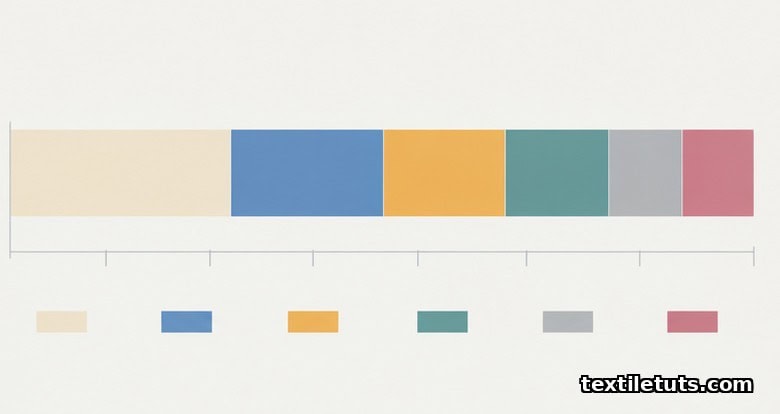
A standard cost sheet for a ring spinning mill breaks total yarn cost into raw material cost and conversion cost. Raw material is the largest line and is set by cotton or synthetic fiber market prices. Conversion cost includes every cost incurred from bale opening to yarn package, and textile engineers group it into five standard buckets plus overhead.
| Cost Component | Share of Total Yarn Cost | Share of Conversion Cost |
|---|---|---|
| Raw material (cotton or synthetic fiber) | 55 to 65 percent | not part of conversion cost |
| Labor (direct plus indirect) | 8 to 12 percent | 22 to 30 percent |
| Power (electricity) | 8 to 10 percent | 20 to 26 percent |
| Maintenance and spares | 3 to 5 percent | 8 to 12 percent |
| Depreciation (machinery plus building) | 4 to 6 percent | 10 to 14 percent |
| Other overheads (admin, R&D, packaging) | 10 to 15 percent | 25 to 35 percent |
The conversion cost typically lands between 35 and 45 percent of total yarn cost. Higher-count yarns (finer counts such as 60s and 80s) carry a higher conversion cost share because production speeds are lower, end-breakage rates are higher, and machine efficiency drops by 8 to 15 percent compared to coarser counts like 20s and 30s.
How to Calculate Cost per Kilogram of Yarn
The standard formula used in yarn costing combines raw material cost per kilogram with conversion cost per kilogram. Both inputs come from the mill’s own production data, multiplied by the unit cost of each input.

Yarn cost per kg = Raw material cost per kg + Conversion cost per kg
Conversion cost per kg is itself the sum of six buckets divided by total yarn production in kilograms:
Conversion cost per kg = (Labor + Power + Maintenance + Depreciation + Overhead) / Production (kg)
For a mill producing 10,000 kg of 30s yarn per day with monthly costs of $45,000 in labor, $35,000 in power, $20,000 in maintenance, $25,000 in depreciation, and $40,000 in overhead, the monthly conversion cost works out as follows:
- Monthly production: 10,000 kg/day × 26 days = 260,000 kg
- Total monthly conversion cost: $45,000 + $35,000 + $20,000 + $25,000 + $40,000 = $165,000
- Conversion cost per kg: $165,000 / 260,000 kg = $0.634 per kg
Add a raw material cost of $2.80 per kg (cotton at market plus 4 to 6 percent waste allowance), and total yarn cost lands at approximately $3.43 per kg. Selling price typically carries a 5 to 10 percent margin over this figure, depending on yarn quality, count variation, and order volume.
For blended yarns such as polyester-cotton 65/35, the calculation is the same, but raw material cost is weighted by the fiber blend ratio. A 65/35 PC yarn using polyester at $1.40 per kg and cotton at $2.80 per kg has a weighted raw material cost of $1.91 per kg before waste allowance.
Cost per Spindle Hour
Spinning mill managers use cost per spindle hour to compare performance across mills and to benchmark against industry standards. The formula is:
Cost per spindle hour = Total cost / Total spindle hours
Total spindle hours equals the number of spindles multiplied by hours operated. For a 25,000-spindle mill running three shifts (24 hours per day, 26 days per month):
- Total spindle hours per month: 25,000 × 24 × 26 = 15,600,000 spindle hours
- At a conversion cost of $165,000 per month, cost per spindle hour is $0.0106
Industry benchmarks put the figure between $0.008 and $0.015 per spindle hour for ring spinning, with finer counts and older machinery pushing the number toward the upper end. A rotor spinning position typically costs 30 to 40 percent less per spindle hour because rotor speeds are higher (60,000 to 90,000 rpm versus 15,000 to 18,000 rpm on ring frames) and labor per kilogram of yarn is lower.
Cost per spindle hour is the metric used to compare the financial efficiency of ring spinning versus rotor spinning versus air-jet spinning for a given yarn count. When the cost per spindle hour for a fine-count ring frame approaches the cost per rotor position, the mill has a clear signal to evaluate whether rotor or air-jet spinning can deliver the same yarn quality at lower cost.
Power Consumption by Spinning System
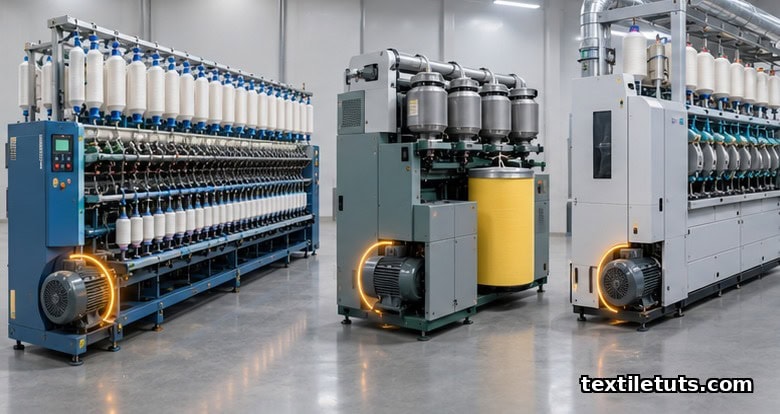
Power is the second-largest conversion cost line in most spinning mills. Power consumption varies significantly by spinning system, and the mill’s energy bill can swing 40 percent depending on which technology dominates.
| Spinning System | Power Consumption (kWh per kg of yarn) | Production Rate |
|---|---|---|
| Ring spinning | 0.5 to 0.8 | 30 to 50 g per spindle per hour |
| Rotor spinning | 0.3 to 0.5 | 80 to 150 g per rotor per hour |
| Air-jet spinning | 0.6 to 0.9 | 200 to 400 g per position per hour |
| Compact ring spinning | 0.55 to 0.85 | 25 to 45 g per spindle per hour |
Energy audits on ring spinning mills commonly find that the ring frame itself consumes 35 to 45 percent of total mill power, with preparatory machines (blowroom, card, draw frame, roving frame) accounting for 40 to 50 percent and auxiliary equipment (lighting, compressed air, HVAC) accounting for the balance. Voltage optimization, inverter drives on motors, and premium-efficiency motors are the standard retrofits used to push power cost per kilogram toward the lower end of these ranges.
At an industrial electricity tariff of $0.08 per kWh, the table above translates to a power cost of $0.024 per kg on rotor spinning (0.3 kWh × $0.08) up to $0.072 per kg on air-jet spinning (0.9 kWh × $0.08). Although air-jet spinning has higher power consumption per kilogram, its much higher production rate means cost per spindle position is competitive for coarse counts.
Labor Cost Analysis
Direct labor in a modern spinning mill runs at 0.08 to 0.12 worker-hours per kilogram of yarn, depending on automation level. A fully automated mill with auto-doffer ring frames and linked winding can hit 0.08 worker-hours per kg, while a mill with manual doffing typically sits at 0.10 to 0.12 worker-hours per kg.
For a 25,000-spindle mill producing 260,000 kg per month at 0.10 worker-hours per kg, total monthly labor requirement is 26,000 worker-hours. At a loaded labor cost of $1.80 per hour (wages plus benefits plus insurance), monthly labor cost is $46,800, matching the $45,000 figure used in the example calculation above.
Indirect labor (supervisors, quality control, maintenance technicians) typically adds another 25 to 35 percent on top of direct labor. Textile engineers include both figures in the labor line item when running cost analysis. Skilled positions such as ring frame operators and quality controllers command a 10 to 20 percent premium over helper positions, which is why the loaded labor rate is higher than the minimum wage in any region.
Depreciation and Fixed Cost Allocation
Depreciation cost in a spinning mill is calculated using the straight-line method over the useful life of the asset. A ring spinning frame with a 20-year useful life depreciates at 5 percent of capital cost per year, and a card with a 15-year life depreciates at 6.67 percent per year. Building and land improvements are depreciated over 30 to 40 years depending on construction type.
For a 25,000-spindle ring spinning mill with a capital investment of $25 million (machinery $18 million, building $5 million, auxiliaries $2 million), annual depreciation works out to approximately $1.4 million, or $0.45 per kg of yarn at 260,000 kg per month production. This figure stays fixed regardless of production volume, which is why depreciation cost per kilogram rises sharply when the mill runs below capacity.
Mill managers track this as cost per spindle per year, which typically falls between $50 and $80 per spindle per year for ring spinning installations. A higher figure signals either a more capital-intensive installation (compact spinning, auto-doffer ring frames) or underutilization of capacity.
Frequently Asked Questions
What is the average cost of producing 1 kg of cotton yarn?
For a ring spinning mill producing 30s cotton yarn at 25,000-spindle scale, total yarn cost lands between $3.20 and $4.50 per kg, with raw material at $2.40 to $3.20 per kg and conversion cost at $0.50 to $0.80 per kg. Finer counts such as 60s and 80s push total cost 15 to 30 percent higher because of lower machine efficiency and higher waste rates during spinning.
How is conversion cost calculated in a spinning mill?
Conversion cost per kilogram equals the sum of monthly labor, power, maintenance, depreciation, and overhead costs divided by total monthly yarn production in kilograms. For a mill with $165,000 in monthly conversion costs producing 260,000 kg, the conversion cost is $0.634 per kg. This figure is recomputed monthly because power tariffs, labor rates, and maintenance spend shift through the year.
Which cost component has the largest share in yarn manufacturing?
Raw material cost has the largest share, at 55 to 65 percent of total yarn cost. Cotton or synthetic fiber prices move with global commodity markets, so mills hedge raw material cost through forward contracts and supplier agreements rather than through operational changes inside the mill. Within conversion cost, labor and power are the two largest buckets at 8 to 12 percent and 8 to 10 percent of total cost respectively.
How much power does a spinning mill consume per kg of yarn?
Ring spinning mills consume 0.5 to 0.8 kWh per kg of yarn, rotor spinning mills consume 0.3 to 0.5 kWh per kg, and air-jet spinning mills consume 0.6 to 0.9 kWh per kg. At an industrial tariff of $0.08 per kWh, power cost per kilogram of yarn works out to $0.024 to $0.072, which represents 4 to 10 percent of total yarn cost. Older mills with standard-efficiency motors typically sit at the upper end of these ranges.
How do you reduce spinning mill cost without changing raw material?
Mill managers target the conversion cost line: power savings through inverter drives and voltage optimization (10 to 20 percent power reduction), labor savings through auto-doffer ring frames and linked winders (15 to 25 percent labor reduction), and maintenance savings through predictive maintenance on ring frames and rotors (5 to 10 percent maintenance reduction). Combined, these measures can drop conversion cost by 8 to 15 percent without changing raw material specifications or yarn count.
References
- ASTM International. ASTM D2256/D2256M-21: Standard Test Method for Tensile Properties of Yarns by the Single-Strand Method. https://www.astm.org/d2256_d2256m-21.html — Reference standard for verifying tensile properties of spun yarn output.
- International Organization for Standardization. ISO 2060:1994 — Textiles — Yarn from packages — Determination of single-end breaking force and elongation at break using constant rate of extension (CRE) tester. https://www.iso.org/standard/3469.html — International standard used for yarn quality verification in mill labs.
- AATCC. AATCC Test Method 20: Fiber Analysis: Qualitative. https://www.aatcc.org/ — Reference test method for fiber identification in blended yarns.
- MDPI Energies. Energy Consumption and Energy Efficiency in the Textile Industry. https://www.mdpi.com/journal/energies — Peer-reviewed journal covering industrial energy benchmarking studies, including spinning mill power consumption.
- ResearchGate. Cost Analysis of Cotton Yarn Manufacturing in Ring Spinning. https://www.researchgate.net/ — Peer-reviewed paper on spinning mill cost structure and benchmarking.
- Springer. Handbook of Textile Fibre Structure. https://link.springer.com/referencework/10.1007/978-1-84882-484-7 — Academic reference covering fiber properties, yarn structure, and manufacturing economics.
This article is the working reference for spinning mill cost calculation. Editorial by Iftay Khairul Alam, TextileTuts. Sources: ASTM D2256, ISO 2060, AATCC TM 20, MDPI Energies, ResearchGate, and Springer as cited.


