
Spindle Tape and Bearing Issues

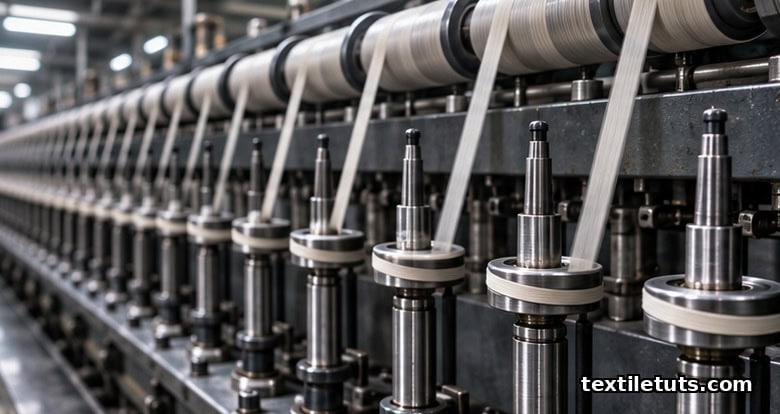
A spindle tape is a short endless textile belt, typically 6 to 8 mm wide and 1.0 to 1.2 mm thick, made from twisted polyamide or polyester cords, that drives each spindle at 15,000 to 25,000 rpm on a modern ring spinning frame, and a single slack or frayed tape can introduce yarn count variation of 8 to 15% across the bobbin while accelerating bearing wear inside the same spindle. Bearing wear and tape wear usually appear together, because the tape is the soft part of a system that, when it loses tension, lets the spindle whiplash and overloads the front bearing race. This article explains how spindle tapes and bearings fail, how those failures show up in the yarn, and what the documented inspection and replacement procedure looks like for ring frames running fine and coarse counts.
What a Spindle Tape Does and Why the Specifications Matter
A spindle tape sits in the tape race of a ring frame’s spindle rail, runs from a common drive pulley, sometimes called the tin roller, under each spindle whorl, and transmits the rotational drive to the individual spindle. The tape must be dimensionally stable, abrasion resistant, and capable of carrying the design tension at full machine speed without slipping, stretching, or shedding lint. ISO 9902-1, the safety standard for textile machinery, treats the drive system as a guarding-relevant assembly because tape failure can release a moving part at full speed.
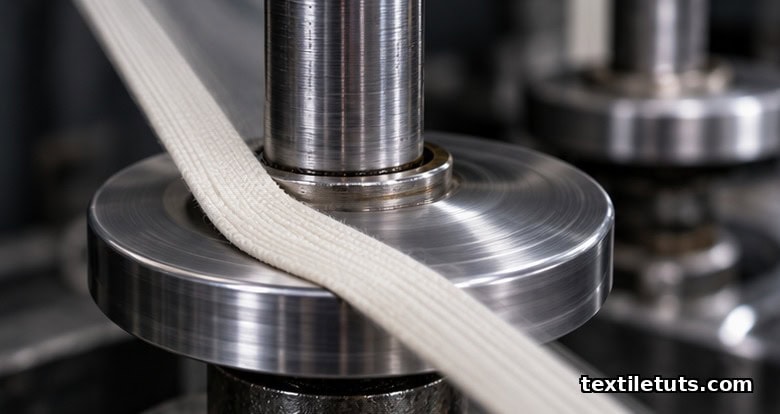
Modern ring frames use cord-wrapped polyamide or polyester tapes with a breaking strength of 1,800 to 4,000 N and an elongation at break of 8 to 15%. Tape width is matched to the whorl diameter and the spindle pitch, and the operating tension is set by the weight arm on the tape tensioner at the end of the rail. Under-tensioning causes slip and an increase in roving break rate; over-tensioning accelerates stretch and shortens tape life. Most mills replace tapes on a planned cycle of 18 to 24 months rather than waiting for breaks, because a single tape failure on a 1,000-spindle frame can halt the entire machine.
Bearing Failure Modes in Ring Spindles
Spindle bearings are small, high-speed deep-groove ball bearings, generally of the 6201, 6202, or 6203 series, running at 15,000 to 25,000 rpm with a reference speed that drops as load increases. ISO 15243, the international classification of rolling-bearing damage, lists six main failure modes, four of which appear in service-life audits of ring-frame spindles: fatigue spalling, wear, corrosion, and lubrication failure.
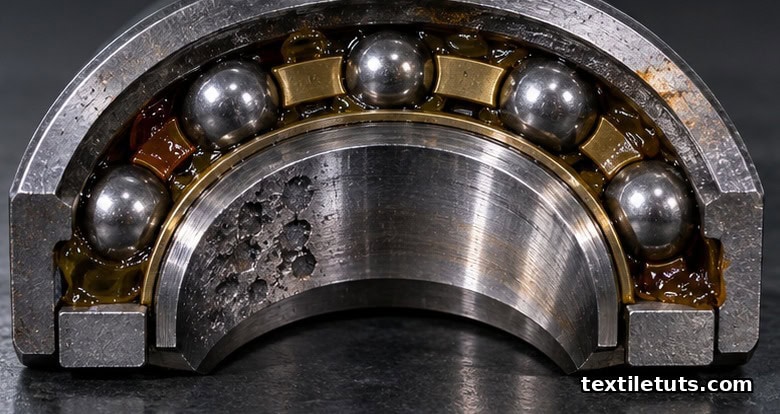
Spalling, where subsurface cracks break through the raceway as small craters, is the dominant failure mode once a spindle passes its rated L10 life. Wear shows up as burnished or scored raceways and is normally a symptom of contamination rather than age. Corrosion, sometimes called rust staining or fretting corrosion, appears when water or humid process air enters the bearing housing; this is common in humid spinning halls where relative humidity is held at 65 to 80%. Lubrication failure covers both under-greasing, visible as overheating and discoloration of the cage, and grease degradation, which on a spindle bearing happens faster than on slower machinery because the grease is sheared at high frequency.
How Tape and Bearing Problems Show Up in Yarn Quality
The first signal of a worn tape is usually not mechanical: it is the yarn. An under-tensioned tape slips intermittently on the whorl, which makes the spindle momentarily slow and produces a periodic thick place in the yarn. A stretched tape, in contrast, slips continuously and produces finer-than-target yarn with a higher U%, or coefficient of variation of mass. Mills running Uster statistics find that a single bad tape can raise the CV% of a 30 Ne cotton yarn from a baseline of 14 to 16% to 19 to 22% over the affected bobbin.
Bearing wear produces a different signature. As the bearing loses preload, spindle concentricity worsens, the traveller orbit becomes elliptical instead of circular, and yarn breakage rate climbs. A spindle with a damaged front bearing typically runs 3 to 5 °C hotter than its neighbours, which is detectable by infrared spot checks. Worn bearings also change the yarn twist: twist multipliers drift by 0.5 to 1.0 units when spindle speed falls 1 to 2% because the bearing is dragging.
Root Causes: Why Tape and Bearing Issues Cluster Together
Tape wear and bearing wear are not independent. A tape that has lost 10% or more of its original length, either through permanent stretch or because the join slipped, runs at a lower tension than design. The whorl then slips against the tape rather than the tape driving the whorl, and the spindle accelerates and decelerates as it picks up and sheds load. That repeated shock loading is absorbed by the front bearing race, and fatigue spalling starts earlier than the rated L10 hours suggest.
Other root causes include contamination from fly, dust, and short-fibre lint carried by the air stream into the tape race and the spindle housing; incorrect re-greasing intervals, either under-greasing, which starves the bearing, or over-greasing, which raises running temperature and degrades the grease faster; and oil migration from the spindle bolster, which can soften the tape backing if the wrong grease family is used. ISO 15243 documents these as secondary failures: the bearing is the damaged part, but the cause is external to the bearing itself.
Inspection and Replacement Procedure
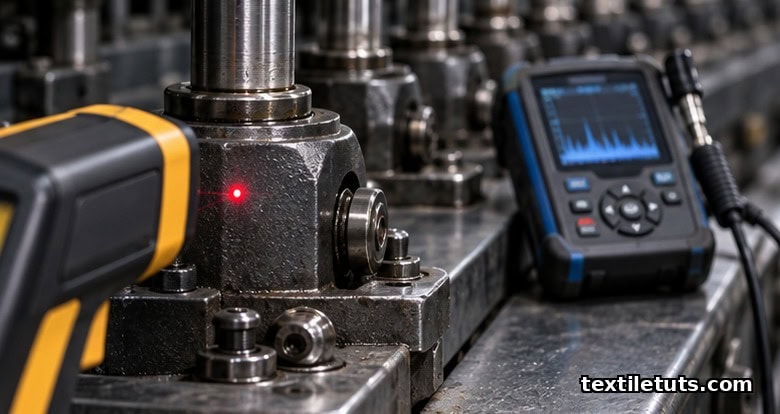
A preventive routine is the cheapest defence. The standard approach on modern ring frames combines three checks: a weekly tape tension sweep with a tension gauge, a monthly spindle-temperature spot check with an infrared thermometer, and a quarterly vibration sample of representative spindles. Vibration analysis here is simple: a healthy spindle running at 18,000 rpm has a stable velocity RMS of around 0.7 to 1.2 mm/s; values above 2.8 mm/s on the ISO 10816-3 severity chart for medium machines indicate bearing damage.
Replacement procedure for a single spindle: stop the frame, lock out at the isolator, mark the spindle position, remove the bobbin and traveller, slacken the tape tensioner, lift the old tape off the whorl, fit the new tape and re-tension to the gauge value, rotate the spindle by hand and check that it turns freely without endplay, then return the frame to service. Lubrication of the bearing follows the spindle maker’s specification, typically 2 to 4 g of lithium-complex or polyurea grease per spindle on a 12 to 18 month re-grease cycle. Bearings that are scored, discoloured, or that fail the free-spin test should be replaced in pairs to keep the load symmetrical on the bolster.
Frequently Asked Questions
How long does a spindle tape last before it needs replacement?
On a modern ring frame running 24/7 at 18,000 to 22,000 rpm, polyamide and polyester spindle tapes last 18 to 24 months when tension is kept within the maker’s specification. Failure modes that shorten life include running the tape below design tension (slip wear), above design tension (permanent stretch), or with contamination from fly and short-fibre lint. Planned tape replacement every 18 months is cheaper than running to break.
What temperature is too hot for a spindle bearing?
A healthy spindle bearing runs 5 to 15 °C above ambient hall temperature. Sustained bearing temperatures above 70 °C on the housing indicate lubrication failure, over-greasing, or early-stage bearing damage, and the affected spindle should be removed from production and inspected. Infrared spot checks across the rail quickly find the outliers in a 1,000-spindle frame.
Can a worn spindle tape damage the spindle bearing?
Yes. A tape that has stretched or slipped lets the spindle whiplash under roving tension, and the front bearing absorbs that shock on every revolution. ISO 15243 documents this as a secondary failure: the bearing is the part that visibly fails, but the cause is upstream in the drive system. This is why bearing failures in clusters of 3 to 5 spindles usually point to a tape or tensioner problem, not bad bearings.
What is the right tension for a spindle tape?
Tension depends on tape cross-section, spindle pitch, and whorl diameter, but most modern ring frames are designed for a static tape tension of 20 to 40 N at the tensioner. The tensioner weight arm is set by the maker; the running check is that the tape does not slip on the whorl under full load, and that the spindle can be stopped by hand-braking without the tape jumping on the drive pulley. A tension gauge, either spring or digital, is the reliable method, not feel.
How do I know whether to replace the bearing or replace the whole spindle?
On most modern frames the bearing is replaced as a sub-assembly rather than the full spindle. The decision is economic: if the spindle shaft, whorl, and bolster are undamaged and within dimensional tolerance, replacing the bearing, typically a 6202 or 6203 series, takes 15 to 25 minutes per spindle, while a full spindle replacement costs 4 to 6 times as much in parts. Damage to the bearing seat on the shaft, or visible wear on the bolster, pushes the choice toward a full spindle swap.
References
- International Organization for Standardization. ISO 9902-1:2014 — Textile machinery — Safety — Part 1: Common requirements. https://www.iso.org/standard/51024.html — Safety standard covering drive systems and guarding on textile machines including ring spinning frames.
- International Organization for Standardization. ISO 15243:2017 — Rolling bearings — Damage and failures — Terms, characteristics and causes. https://www.iso.org/standard/63413.html — Reference classification of rolling-bearing failure modes including fatigue, wear, corrosion, and lubrication failure.
- International Organization for Standardization. ISO 10816-3:2009 — Mechanical vibration — Measurement and evaluation of machine vibration — Part 3: Industrial machines with nominal power above 15 kW and nominal speeds between 120 r/min and 15 000 r/min. https://www.iso.org/standard/43925.html — Vibration severity chart for medium industrial machines used in bearing condition monitoring.
- IntechOpen. Ring Spinning — chapter in Textile Manufacturing Processes. https://www.intechopen.com/chapters — Open-access book chapter describing ring frame components, drive systems, and maintenance practice.
- ResearchGate. Vibration-based condition monitoring of spindle bearings in ring spinning. https://www.researchgate.net — Peer-reviewed paper covering vibration signatures of healthy and damaged spindle bearings.
- Springer. Maintenance Engineering of Textile Machinery (textile science and clothing technology series). https://www.springer.com — Reference text on preventive maintenance programs and bearing-life calculations for spinning machines.
Editorial by Iftay Khairul Alam, TextileTuts. Sources: ISO 9902-1, ISO 15243, ISO 10816-3, IntechOpen, ResearchGate, and Springer as cited above.


