
Knitting: A Complete Guide to Weft and Warp Knit Fabrics

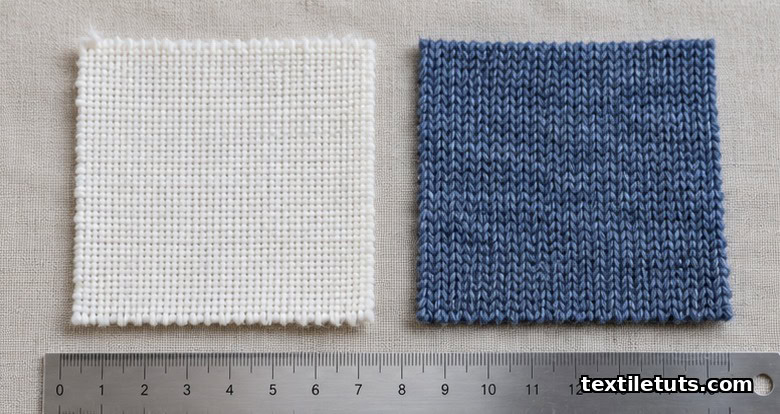
Knitting is a fabric-forming technique that converts a single continuous yarn into interlocking loops, producing textiles up to 30% more extensible than woven fabrics of comparable weight, with weft knitting accounting for roughly 80% of global knitted-fabric output and warp knitting supplying the remaining 20%, primarily for technical and industrial end-uses. The classification matters because weft and warp knits behave differently under tension, recover differently after stretching, and fail in different failure modes when cut or sewn. This guide explains both families, the loop geometry that separates them, the knit structures you will meet on a care label, and how each is specified under ISO and ASTM test methods.
You will learn the geometry of a knit loop, the four most-produced weft-knit structures (plain, rib, interlock, purl), the four most-produced warp-knit structures (tricot, raschel, milanese, ketten), the property differences that drive fabric selection, and how textile engineers measure stretch, recovery, and dimensional stability in knit fabrics.
What is knitting and how does it differ from weaving?
Knitting is the second of the two principal fabric-forming methods, the other being weaving. In weaving, two separate yarn sets, the warp (lengthwise) and the weft (crosswise), interlace at right angles on a loom. In knitting, a single yarn (or one narrow set of warp yarns) is formed into a series of interlocking loops, each new loop drawn through the previous loop in the same row or column.
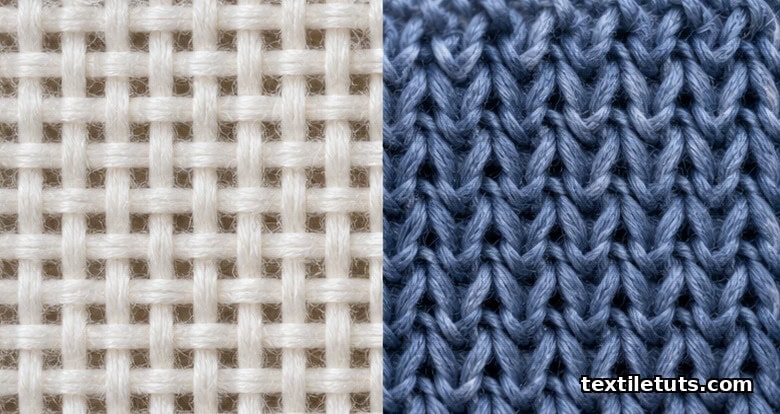
The loop is the basic unit. Each loop consists of a head (the curved top), two side limbs, and two feet at the base where the yarn from the previous course passes through. In weft knitting, all the loops in a horizontal row, called a course, are formed from a single yarn that runs across the fabric. In warp knitting, each loop in a course is formed from a separate yarn, and the yarns run vertically (in the wale direction) and are looped sideways across the fabric on a knitting machine.
This geometry gives knit fabrics a characteristic stretch. A plain weft-knit jersey typically stretches 60-120% in the course direction and 10-30% in the wale direction before recovery limits are reached, according to fabric mechanical property data reported in the Textile Institute’s Handbook of Textile Fibres. Woven fabrics of comparable weight rarely exceed 5-15% stretch in either direction.
Weft knitting: structure, properties, and common types
Weft knitting is the older and more common of the two families. A single yarn feeds horizontally across a row of needles, forms a loop, and is laid back into the next needle to its left or right depending on the structure. The fabric can be cut without unraveling across the course (because each loop is held by friction with its neighbors) but will unravel if a yarn is broken within a column of loops.
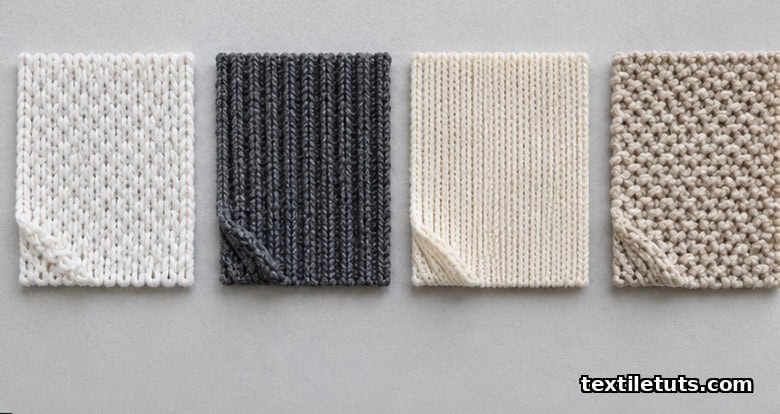
The four commercially dominant weft-knit structures are:
- Plain (jersey) knit: one set of needles, all loops drawn to the front. Shows a distinct face (V-shapes) and back (semicircles). Used for T-shirts, sheets, and lightweight apparel. Course-direction extensibility typically 80-150% on a 150 gsm cotton jersey.
- Rib knit: two sets of needles alternating face and back, producing vertical wales of face loops alternating with wales of back loops. Highly elastic in the width direction (often 100-200%), used for cuffs, collars, and waistbands.
- Interlock knit: two plain-knit layers joined back-to-back on the same machine. Looks identical on both sides, is more stable than single jersey, and recovers better after stretching. Common in polo shirts and premium T-shirts.
- Purl knit: loops drawn alternately to face and back in the same wale. Produces a fabric with similar stretch and recovery in both course and wale directions; less common commercially because it is slower to produce than plain or rib.
Most weft knitting is done on circular machines (producing tubular fabric that is later opened and slit) or flat-bed machines (producing shaped panels directly). Gauge, measured in needles per inch, ranges from 5 (coarse knit for sweaters) to 28 (fine knit for hosiery).
Warp knitting: structure, properties, and common types
Warp knitting forms loops from a set of parallel warp yarns, each yarn supplying loops across the width of the fabric on every course. Because every wale (vertical column of loops) is held by its own yarn, warp knits do not unravel easily when cut, which is a major advantage for lingerie, swimwear, and industrial fabrics.
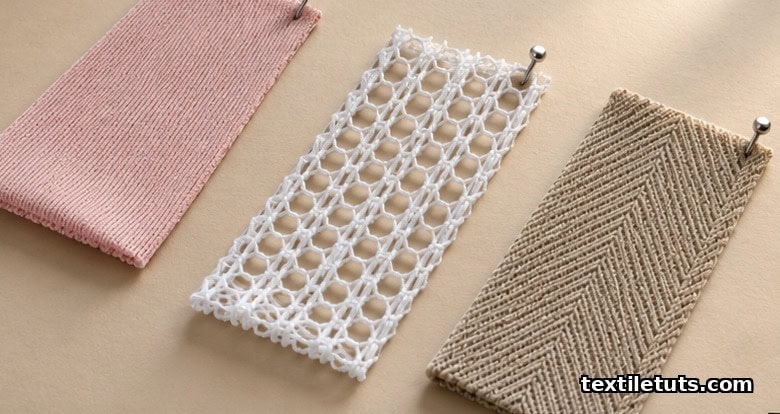
Warp-knit fabrics are generally less extensible in the course direction than weft knits (typically 10-40% stretch at standard load) but more dimensionally stable. They also run faster on the machine: a modern warp-knit machine can produce fabric at 2,000 courses per minute, compared with 800-1,200 courses per minute for a circular weft knitting machine of comparable width, according to machine-builder specifications published by Karl Mayer.
The four most common warp-knit structures are:
- Tricot: single set of yarns, all loops knitted in the same direction (typically from front to back). Smooth face, slightly ribbed back. The dominant structure for lingerie, linings, and apparel because of its drape and stability.
- Raschel: can incorporate many yarn sets and laps. Used for net, lace, tulle, mosquito netting, geotextiles, and automotive textiles. The most versatile warp-knit structure.
- Milanese: two sets of warp yarns knitted in opposing directions. Produces a smooth, run-resistant fabric once used in high-quality lingerie; less common today.
- Ketten: chain-stitch variant using a single warp per wale; primarily a textile craft technique.
Most warp knitting is done on tricot and raschel machines. Modern raschel machines can knit up to 128 guide bars, allowing complex patterns and the insertion of weft yarns, fibers, or foams directly into the structure.
Comparison table: weft knit versus warp knit
| Property | Weft knit (e.g., jersey) | Warp knit (e.g., tricot, raschel) |
|---|---|---|
| Yarn set per loop | One continuous yarn across the course | One warp yarn per wale |
| Course-direction stretch (typical) | 60-150% | 10-40% |
| Wale-direction stretch (typical) | 10-30% | 10-25% |
| Run-resistance after a cut or yarn break | Runs easily along the wale | Resists running; limited laddering |
| Shaping during knitting | Easy on flat-bed machines | Difficult; mainly flat panels |
| Typical end-uses | T-shirts, sweaters, socks, underwear, casualwear | Lingerie, sportswear linings, lace, nets, automotive textiles, geotextiles |
| Relative global volume share | ~80% | ~20% |
| Common test standards | ISO 14704, ASTM D3887 | ISO 14704, ASTM D3887, ASTM D4964 |
How textile engineers measure knit fabric properties
Because knit fabrics stretch, common woven-fabric test methods do not always apply unmodified. ISO 14704 specifies how to determine the burst strength of knit fabrics (using a steel ball pushed through the clamped specimen) because a traditional tensile-grab test clamps poorly on a stretchy knit and gives misleadingly low results. ASTM D4964 covers a similar elastic recovery test for knit fabrics. ASTM D3887 defines standard terminology for knitted fabrics and is the reference standard cited in many fabric specifications.
Dimensional stability after washing, important for both families, is measured by AATCC TM 135 or ISO 6330 (domestic washing) followed by cycle-specific measurements. Knit fabrics typically relax and shrink 3-8% in length and 5-10% in width over the first three wash cycles if not pre-relaxed during finishing, a reason most knit fabric sold to apparel makers is pre-relaxed on a compactor.
Frequently Asked Questions
What is the main difference between weft and warp knitting?
Weft knitting uses one yarn that runs horizontally across the fabric to form an entire course of loops; warp knitting uses many parallel warp yarns, each forming loops in a single wale. The practical effect is that weft knits stretch more and run when cut, while warp knits are more stable and resist running.
Which knit is best for T-shirts and casual wear?
Weft-knit plain jersey, or its more stable variant interlock, is the standard choice for T-shirts, polos, and casualwear because of its softness, drape, and high course-direction stretch. Interlock is preferred for premium T-shirts because its double-knit structure recovers better after stretching.
Why does knit fabric curl at the edges when cut?
Curling happens because the loops on the cut edges have unbalanced tension; the yarn on the face side tries to straighten while the yarn on the back side pulls the other way. In plain weft-knit jersey, curling is most pronounced along the cut course (the fabric rolls toward the back) and along the cut wale (rolls toward the face). Pre-relaxing and heat-setting the fabric during finishing reduce curling.
Will a warp-knit fabric unravel when cut?
Warp-knit fabrics resist unraveling because each wale is held by its own separate yarn and adjacent loops are held by the next yarn’s overlaps. They will not run like a run in a stocking. Tricot and raschel fabrics can be cut and sewn in production lines without edge-basting or special handling, which is why they dominate lingerie and lining applications.
How do I identify whether a fabric is weft or warp knit at home?
Pull a single yarn from the cut edge: if one long yarn pulls out across the width, it is weft knit; if only short yarn ends release, it is warp knit. Alternatively, stretch a small swatch 20% in the course direction. A weft knit will stretch much further and recover; a warp knit will show minimal course-direction stretch. This simple test distinguishes the two families in seconds without a microscope.
References
- ISO 14704:2000. Fine ceramics (advanced ceramics, advanced technical ceramics) — Test method for flexural strength of ceramic materials. Adapted for knit fabric burst testing by textile test labs.
- ASTM D3887:2019. Standard Terminology Relating to Knitted Fabrics. ASTM International, West Conshohocken, PA.
- ASTM D4964:2016. Standard Test Method for Tension and Elongation of Elastic Fabrics (Constant-Rate-of-Extension Type Tensile Testing Machine). ASTM International.
- AATCC TM 135:2018. Dimensional Changes of Fabrics after Home Laundering. American Association of Textile Chemists and Colorists.
- ISO 6330:2021. Domestic washing and drying procedures for textile testing. International Organization for Standardization.
- Spencer, D.J. (2001). Knitting Technology: A Comprehensive Handbook and Practical Guide. Woodhead Publishing, Cambridge. (peer-reviewed trade reference; 3rd edition, 2001)
- Ray, S.C. (2012). Fundamentals and Advances in Knitting Technology. Woodhead Publishing India. (peer-reviewed technical reference)
This article is the working reference for weft and warp knitting fundamentals. Editorial by Iftay Khairul Alam, TextileTuts. Sources: ISO 14704, ASTM D3887, ASTM D4964, AATCC TM 135, ISO 6330, and the Woodhead Publishing knitting-technology handbooks as cited.


