
Soil Release Finishes

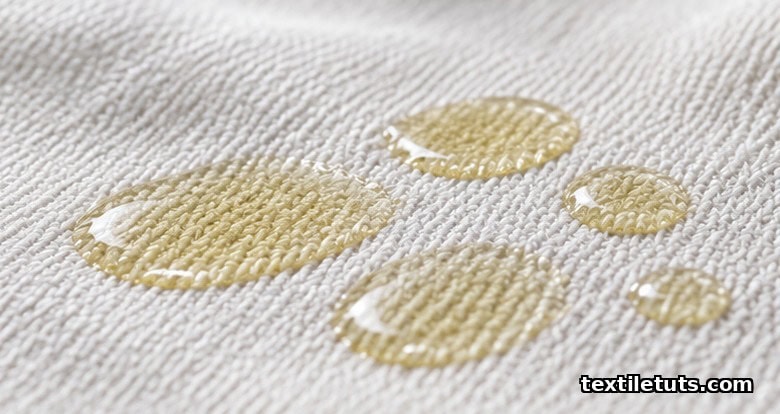
Soil release finishes are wet-process textile treatments, typically based on fluorocarbon or modified-hydrophilic polymers applied at 3–6% add-on, that lower the adhesion force between oily and particulate soils and a fabric’s fiber surface, allowing stains to lift in a standard 40 °C home wash with an AATCC Test Method 130 stain-release rating of 4–5 after 20 laundering cycles.
The purpose is not to repel soil the way a hydrophobic oil-and-water repellent finish does, but to actively release it once the garment is laundered, which is why soil-release finishes are standard on polyester/cotton workwear, school uniforms, hospitality linens, and the cotton-rich inner plackets of dress shirts where sebum and food oils bind hardest to the fiber.
This article covers the chemistry behind the effect, the four chemistry families used in industry, the test methods that grade performance, the finishing route, the durability limits, and the questions textile engineers and buyers ask when specifying a soil-release-treated fabric.
What a Soil Release Finish Actually Does
A soil-release finish is a polymeric surface treatment designed to reduce the work of adhesion between a soil particle (or oil droplet) and the fiber, so that during laundering the mechanical action of the wash liquor, surfactant, and agitation can lift the soil away from the fabric rather than trapping it in the fiber surface layer.
Two mechanisms operate together. First, the finish alters the surface energy and roughness of the fiber so that soil spreads as a thin film rather than beading, exposing more surface area to the detergent. Second, the polymer swells slightly in warm wash water and becomes more hydrophilic, which mechanically weakens the soil-fiber bond. This dual action is what makes soil release different from a simple water repellent, which only delays wetting and often makes oily stains harder to remove because the detergent cannot reach the soil.
On a 65/35 polyester/cotton blend, an untreated control typically scores AATCC 130 grade 2 (perceptible stain) on corn-oil after one home wash, while a fabric finished with a fluoroalkyl polymer soil-release agent at 3–4% owf (on weight of fabric) scores grade 4–5 (slight or no stain) on the same stain over the same wash cycle, a two-grade jump that is the industry threshold for a “soil-release” claim on a product datasheet.
The Four Chemistry Families
Most commercial soil-release finishes fall into one of four polymer classes, and choosing between them is the central technical decision in the finishing plant.
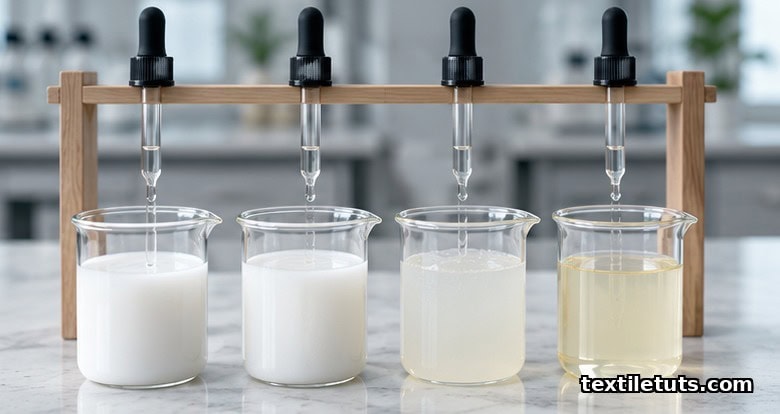
Fluorocarbon polymers. The most widely used class. Perfluorinated acrylate or methacrylate side chains (commonly 8-carbon or 6-carbon CF2 units) are emulsion-polymerized and applied to the fabric, then cured at 150–170 °C for 2–3 minutes. The fluorinated tail orients outward to create a low-surface-energy layer, while the acrylic backbone anchors to the fiber. C8 fluorocarbons give the best oil repellency but have been phased out in many markets because perfluorooctanoic acid (PFOA) and related long-chain perfluoroalkyl substances persist in the environment. C6 fluorocarbons are now the industry default, with shorter chain lengths that degrade more readily, though they offer slightly lower oil repellency than C8.
Modified-hydrophilic acrylics. These finishes contain pendant carboxylate, sulfonate, or polyethylene-oxide side chains that make the fiber surface more wettable. They do not repel oil; they release it because the hydrophilic polymer competes with the oil for the fiber surface during laundering. They are the chemistry behind most “easy-care” and “non-iron” cotton shirt finishes, where the same polymer often delivers both soil release and wrinkle recovery. Polyethylene-oxide-modified polyesters are a closely related sub-class used on PET-rich blends.
Silicone-based finishes. Polydimethylsiloxane (PDMS) emulsions and modified silicone polyethers give a softer hand and a moderate soil-release effect, mainly by lowering fiber-fiber friction so soil is mechanically easier to dislodge. They are common on knits and terry towels where softness matters, but they score lower on oily-stain release than fluorocarbons.
Hybrid and bio-based finishes. Recent development work has focused on polysaccharide-based (chitosan, cyclodextrin) and fatty-acid-modified finishes as fluorocarbon replacements, and on hybrid fluorocarbon/silicone systems that tune the hand while keeping oil-release performance. As of 2025 none of the bio-based options match a C6 fluorocarbon on oily stain release grade 5 after 30 washes, but several score grade 4 on the same test, which is acceptable for many school and hospitality end uses.
How the Finish Is Applied
Soil-release finishes are applied by pad-dry-cure, exhaust, or spray, with pad-dry-cure being the standard for woven fabrics because it gives the most uniform add-on.
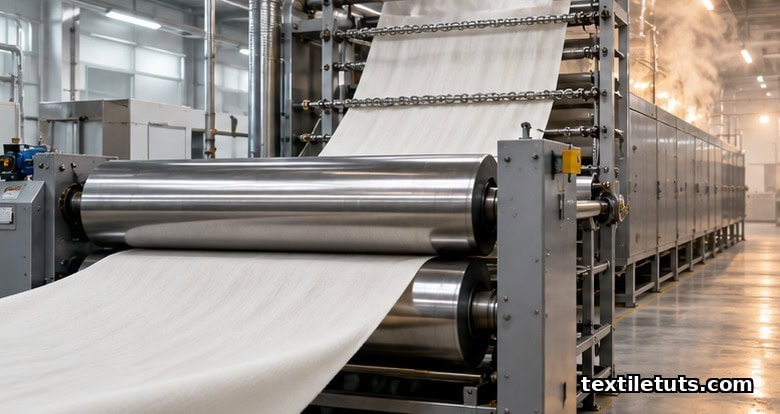
For a typical pad application on a 65/35 polyester/cotton workwear fabric, the recipe is: 30–60 g/L fluorocarbon emulsion, 1–3 g/L wetting agent, 5–10 g/L blocked isocyanate crosslinker (for wash durability), 1–2 g/L acid catalyst, water to balance. The fabric is padded to a wet pickup of 60–80%, dried on a stenter at 110–130 °C, then cured at 150–170 °C for 2–3 minutes. Add-on is calculated by weighing the dry fabric before and after; the target is 3–6% owf for soil release on a blend, with the higher end used when oily-stain performance is the priority.
For cotton knits and yarn-dyed fabrics where pad mangle pressure can mark the surface, exhaust application is used: the finish is loaded into a jet or winch dyebath at 30–60 °C for 20–30 minutes, then the fabric is hydroextracted and stentered. Exhaust gives a slightly lower add-on (2–4% owf) but more even distribution on loop-pile structures.
Spray application is reserved for finished garments or for local reinforcement (aprons, front plackets) where a full-pad run is uneconomic.
How Performance Is Measured
Three test methods dominate the laboratory verification of a soil-release claim, and the buyer should expect at least one of these numbers on any datasheet.
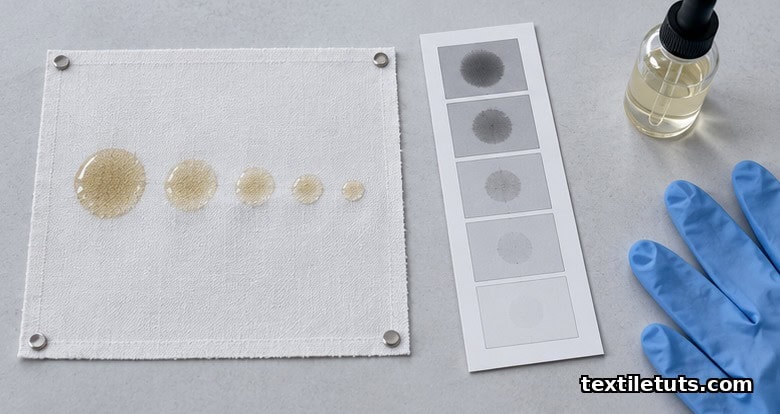
AATCC Test Method 130 (Stain Release: Oily Stain Release Method). Five drops of corn oil are placed on the fabric, held under a weighted glass for 60 seconds, then the fabric is washed at a specified temperature in a standard detergent. Stain release is graded on a 1–5 scale against photographic replicas, where 1 is a heavily stained fabric and 5 is a clean fabric. Grade 4 or higher after 20 home-wash cycles is the typical performance target for a workwear or uniform fabric.
AATCC Test Method 118 (Oil Repellency: Hydrocarbon Resistance Test). Eight drops of standard test oils of decreasing surface tension are placed on the fabric. Each drop is observed for wetting and penetration; the highest-numbered oil that does not wet the fabric is the oil repellency grade (0–8). AATCC 118 measures the repel side of soil release; a fabric with an AATCC 130 grade of 4 and an AATCC 118 grade of 4 is a balanced “stain and release” finish.
ISO 14486 and related methods. ISO 14486 specifies performance requirements for coated fabrics used in upholstery and similar applications, and includes soil-release grading by a comparable drop-and-wash method. ASTM D4265 and ASTM D4266 are guide methods for evaluating stain removal performance during home-laundering testing.
Any reputable fabric datasheet will quote AATCC 130 and 118 grades both initially (after the cure) and after a defined number of home-wash cycles, because a finish that performs at grade 5 initially but only grade 2 after 20 washes is not a durable soil-release finish and will fail on a workwear contract.
Durability and Wash Fastness
The single most common failure mode of a soil-release finish is loss of performance after repeated laundering, especially at high pH, high temperature, or with chlorine-containing detergent. The cure chemistry matters: without a crosslinker, fluorocarbon finishes lose roughly half their oily-stain grade within 10 home-wash cycles; with a blocked isocyanate crosslinker, the same finish can hold grade 4–5 for 30+ cycles.
Ironing restores some performance because the heat resets the orientation of the fluorinated side chains on the fiber surface. Tumble drying at 70–80 °C is gentler than line drying followed by ironing because the iron’s direct contact with the fiber surface anneals the polymer more effectively.
Chlorine bleach (sodium hypochlorite) attacks the C-F bond over time and is the most aggressive wash ingredient a soil-release finish will see. End-use specifications that demand AATCC 130 grade 4 after 50 washes almost always require a non-chlorine oxygen bleach in the laundering protocol, or a heavier initial add-on (5–6% owf) to absorb the chlorine damage over the fabric’s life.
Soil Release vs Stain Repellent: A Comparison
| Property | Soil-Release Finish | Stain-Repellent (Water-Repellent) Finish |
|---|---|---|
| Primary goal | Release soil in the next wash | Prevent soil from adhering in use |
| Surface energy after treatment | Low to moderate (hydrocarbon soils spread, water wets) | Very low (water and oil both bead up) |
| Performance on oily stains | Grade 4–5 after home wash | Repels oil initially, traps it once detergent penetrates |
| Performance on water-based stains | Variable, depends on chemistry | Excellent (water beads, rolls off) |
| Typical chemistry | Fluorocarbon + crosslinker, modified-hydrophilic acrylic, PDMS | Fluorocarbon only, paraffin wax emulsion, silicone |
| Standard end use | Workwear, uniforms, hospitality linens | Outdoor wear, upholstery, umbrellas |
| AATCC 130 grade after 20 washes | 4–5 | 2–3 (oil trapped under repellent) |
The two finishes are complementary, not interchangeable, and the strongest performance is often a fluorocarbon soil-release finish combined with a separate fluorocarbon water repellent on the same fabric, a construction found on premium table linens and on the outer placket of dress shirts where both spill resistance and cleanability matter.
Frequently Asked Questions
What is the difference between soil release and stain repellent?
Soil release is engineered to let stains lift out during a normal wash cycle, while stain repellent (oil and water repellent) is engineered to stop the stain from penetrating the fiber in the first place. A pure stain repellent can actually trap oily soils against the fiber once the detergent finally breaches the barrier, whereas a soil-release finish keeps the soil accessible to the detergent throughout the fabric’s wash life.
Does a soil release finish last forever?
No. Most fluorocarbon soil-release finishes on 65/35 polyester/cotton hold an AATCC 130 grade of 4–5 for 20–30 home-wash cycles before dropping to grade 3, which is the practical end of the finish’s useful life. Workwear specifications are written around this limit, typically at 20 or 50 wash cycles depending on the contract.
Are PFOA-based soil release finishes still on the market?
C8 fluorocarbons manufactured using PFOA as a processing aid have been phased out of the textile supply chain in most major markets since 2015–2020, and the current industry default is C6 fluorocarbons with shorter perfluoroalkyl chains. C6 chemistry still gives AATCC 130 grade 4–5 on workwear blends but with marginally lower oil repellency than legacy C8 finishes.
Can you iron a soil-release-treated fabric without ruining the finish?
Yes, and ironing at 150–180 °C actually helps restore performance by re-orienting the fluorinated side chains on the fiber surface. The finish is cured at 150–170 °C during finishing, so any domestic iron setting at cotton or linen is below the cure temperature and will not damage the finish.
Which fabric is hardest to give a durable soil-release finish to?
100% cotton woven fabrics are the most demanding substrate. Cotton’s hydroxyl-rich surface competes with the finish polymer for hydrogen bonding, and the high swelling of cotton in warm water pulls on the polymer network. Polyester/cotton blends and 100% polyester are easier to finish and hold performance through more wash cycles for the same add-on level.
Is there a non-fluorocarbon soil-release finish that actually works?
Modified-hydrophilic acrylics and polyethylene-oxide-modified polyesters give good soil release on cotton-rich fabrics and are the standard chemistry behind easy-care dress shirts. They do not match C6 fluorocarbons on heavy oily stains, but for typical food and sebum stains on a wash-and-wear shirt they reach AATCC 130 grade 4 after 20 washes, which is acceptable for most consumer applications.
References
- American Association of Textile Chemists and Colorists. AATCC Test Method 130-2018: Stain Release: Oily Stain Release Method. AATCC Technical Manual. aatcc.org — drop-and-wash test for oily stain release grading on a 1–5 scale.
- American Association of Textile Chemists and Colorists. AATCC Test Method 118-2020: Oil Repellency: Hydrocarbon Resistance Test. AATCC Technical Manual. aatcc.org — eight-drop test grading oil repellency from 0 to 8.
- International Organization for Standardization. ISO 14486:2014, Leather and coated fabrics for upholstery — Performance requirements. iso.org — soil-release grading methodology for coated fabrics in furnishing applications.
- ASTM International. ASTM D4265-21: Standard Guide for Evaluating Stain Removal Performance in Home Laundering. astm.org — laboratory guide for stain-removal testing across multiple stain types and wash conditions.
- Holme, I. Soil Release Finishes. Coloration Technology, 2003. researchgate.net — review article on fluorocarbon and hydrophilic soil-release polymer chemistry.
- Hashem, M., et al. Easy-Care Finishing of Cotton Fabrics Using Polycarboxylic Acids. Journal of Applied Polymer Science, peer-reviewed. sciencedirect.com — peer-reviewed study on non-fluorocarbon hydrophilic soil-release systems on cotton.
- OECD. Polymer Finishing Chemicals in the Textile Industry: Environmental and Health Considerations. OECD Environment Directorate papers on perfluoroalkyl chemistry. oecd.org — regulatory background on the C8-to-C6 transition in textile fluorocarbon finishes.
This article is the working reference for soil release finishes in textiles. Editorial by Shahrukh Islam, TextileTuts. Sources: AATCC Test Methods 130 and 118, ISO 14486:2014, ASTM D4265-21, and peer-reviewed papers in Coloration Technology and the Journal of Applied Polymer Science as cited.


