
Anti-Static Finishes

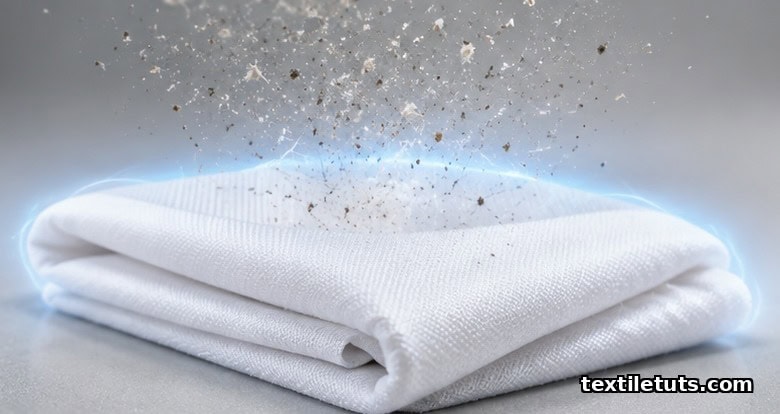
Antistatic finishes reduce the surface resistivity of synthetic fabrics from roughly 10^14 Ω/sq (the threshold above which static charge accumulates) to between 10^9 and 10^11 Ω/sq by depositing a hygroscopic film that conducts charge away through adsorbed moisture, with non-durable surfactant finishes lasting 5 to 30 wash cycles and durable reactive-polymer or conductive-polymer finishes retaining performance for the entire service life of the garment.
Static buildup on polyester and other hydrophobic fibers is a production and comfort problem that costs manufacturers rejected shipments, increases soiling, and makes garments cling uncomfortably to the wearer. Antistatic finishes solve the problem at the finishing stage rather than relying on the consumer to use a dryer-sheet spray.
This article explains how antistatic finishes work, the chemistry behind them, the durability trade-offs, the test methods a textile engineer uses to verify performance, and how to pick the right finish for an end use.
Why synthetic fibers build static charge
Static charge on textiles is the result of electron transfer during contact and separation between two surfaces, the triboelectric effect. When two materials touch and then separate, electrons move from one surface to the other depending on the relative positions of the materials in the triboelectric series. The material that loses electrons becomes positively charged; the material that gains electrons becomes negatively charged.
Natural fibers like cotton and wool have high surface moisture content and high electrical conductivity, so any charge that develops is rapidly dissipated. Synthetic fibers like polyester, polyamide, and acrylic are hydrophobic, so their surface moisture content is low and their electrical conductivity is several orders of magnitude lower than that of cotton. Polyester fabric at 20% relative humidity typically has a surface resistivity above 10^14 Ω/sq, which is the threshold above which charge accumulates visibly and the wearer feels the cling.
The triboelectric series places most synthetic fibers far from skin on the positive side and far from metals on the negative side, so a polyester shirt against a polyester jacket or against dry skin is a high-charge combination. The result is a clingy garment, sparks when the wearer touches a doorknob, accelerated soiling because charged fibers attract airborne dust and lint, and in extreme cases (cleanrooms, electronics manufacturing, fuel handling) a spark hazard that can ignite flammable atmospheres.
How antistatic finishes work
An antistatic finish is any surface treatment that increases the electrical conductivity of the fabric surface enough that charge is dissipated before it can accumulate to a noticeable level. The mechanism is almost always the same: the finish provides a continuous film of a hygroscopic material on the fiber surface. The film absorbs moisture from the air, and the dissolved ions in the moisture film provide the conductive path for charge to leak away.
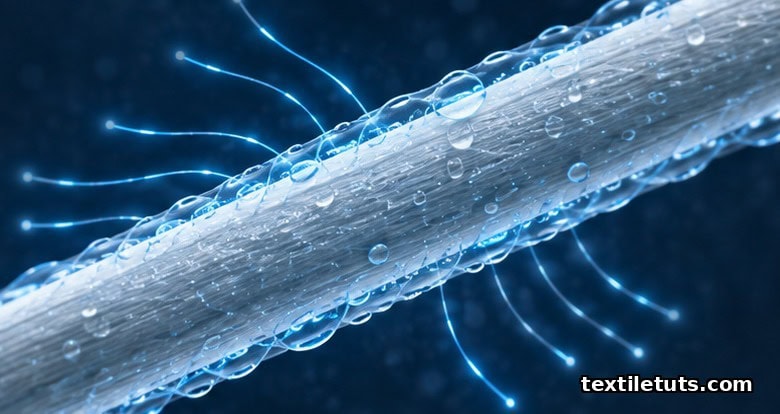
The target is a surface resistivity below 10^12 Ω/sq at standard testing conditions (20 °C, 65% RH). Most antistatic finishes push surface resistivity into the 10^9 to 10^11 Ω/sq range, which gives a charge decay half-life of well under one second.
Two broad families of antistatic finishes exist:
- Non-durable (temporary) finishes: surfactants and hygroscopic salts applied by padding or exhaustion. They are inexpensive and effective, but they wash out over 5 to 30 cycles depending on the surfactant and the wash conditions.
- Durable finishes: reactive polymers, quaternary ammonium compounds with reactive groups, or conductive polymer coatings such as polypyrrole and polyaniline. These finishes survive 50+ wash cycles and are the standard for workwear, cleanroom garments, and electronics-handling apparel.
Chemistry of common antistatic agents
Antistatic agents can be grouped by ionic character.
Anionic antistatic agents
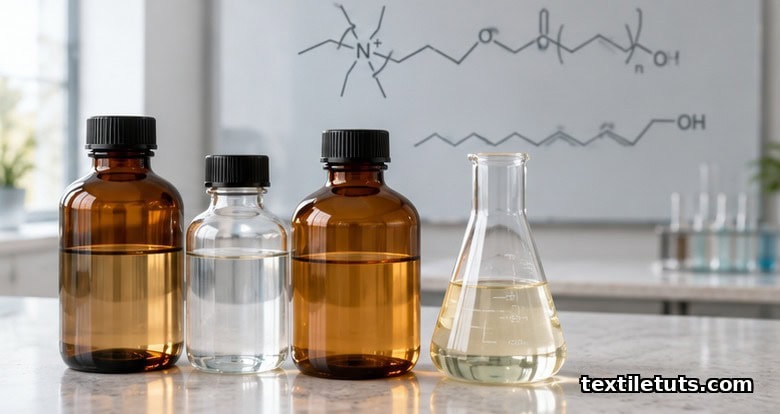
Anionic agents such as alkyl phosphates and sulfonated fatty alcohols are common in textile finishing because they are compatible with most finishing baths and have low irritation potential. They orient their negatively charged head group outward on the fiber surface, attracting a layer of moisture that dissipates charge. They are most effective at humidity above 40%, and their performance drops sharply in dry conditions.
Cationic antistatic agents
Cationic agents, primarily quaternary ammonium salts, are among the most effective antistatic finishes available. Their positive charge attracts a strongly bound moisture layer, and many can be made reactive so they form a covalent bond with the fiber surface for wash durability. They are the standard choice for hospital and cleanroom garments where both antistatic performance and durability are required.
Nonionic antistatic agents
Nonionic agents such as ethoxylated fatty alcohols and polyethylene glycol esters are humidity-independent and do not yellow fabrics, which makes them the preferred choice for white or pastel shades. They are less effective than cationic or anionic agents at equivalent add-on, but they are more stable to repeated washing.
Conductive polymer finishes
Conductive polymers such as polypyrrole and poly(3,4-ethylenedioxythiophene) (PEDOT) form a continuous conductive layer on the fiber surface and provide antistatic performance that is independent of atmospheric humidity. They are more expensive than surfactant finishes and may affect the fabric color and hand, so they are reserved for high-performance applications including electrostatic dissipative workwear, electromagnetic shielding, and wearable electronics.
Application methods
Antistatic finishes can be applied by exhaust, padding, spraying, or foam application, depending on the fabric construction and the production volume.
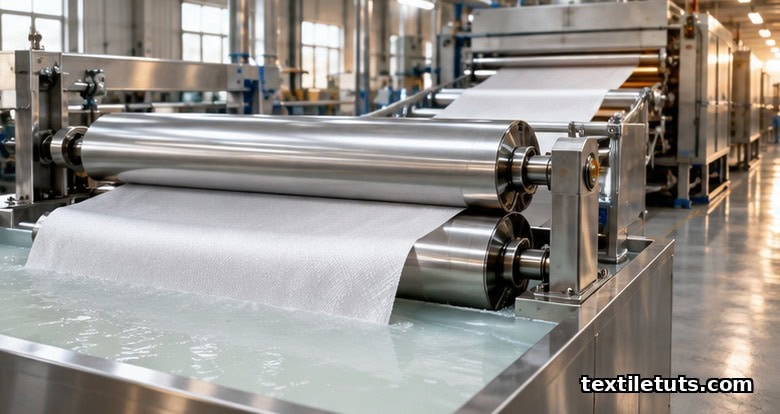
Exhaust application is the standard method for garment-dye or yarn-treatment workflows. The fabric or yarn is immersed in a bath containing the antistatic agent at 30 to 60 °C for 20 to 60 minutes; the agent exhausts onto the fiber surface driven by affinity and liquor ratio. Exhaust application gives uniform coverage on yarn and is the most economical for knit fabrics.
Padding (dip and squeeze) is the standard method for woven and knit fabric finishing. The fabric passes through a bath of the antistatic agent, then through squeeze rollers that control the wet pickup, typically 60 to 100% on weight of fabric. The wet fabric is then dried and cured on a stenter frame. Padding is the most common method for applying antistatic finishes alongside softeners and other functional finishes in a single pass.
Spray application is used for finishing garments after cutting and sewing, and for touch-up applications where padding would be uneconomical. Spray application gives less uniform coverage than padding but is the only practical method for finished garments.
Foam application uses a foamed finish that is knife-coated onto the fabric and crushed by rollers to give a controlled add-on. Foam application reduces water and energy consumption and is increasingly common for water-repellent and antistatic finishes on large-volume runs.
Test methods for antistatic performance
Three standardized tests cover the bulk of antistatic performance evaluation. The table below summarizes the most common methods and their typical use cases.
| Standard | What it measures | Typical use |
|---|---|---|
| AATCC 76 | Surface resistivity (Ω/sq) | Apparel antistatic verification |
| ISO 11465 | Electrical resistance | European and Asian production |
| ASTM D257 | DC resistance or conductance | Technical textiles and ESD workwear |
| AATCC 115 | Charge decay (clinging test) | End-use cling and spark performance |
Static decay testing per AATCC 115 measures how quickly a charged fabric loses its charge. The fabric is charged to 5,000 V and the time for the charge to decay is recorded. A decay time below 0.5 s is considered acceptable for most antistatic applications, and below 0.1 s for cleanroom and electronics-handling garments.
For end-use performance, the half-life test (charge applied, time for charge to fall to half its starting value) is widely used because it correlates well with perceived cling and spark generation. A charge half-life below 1 s at 20% RH is the industry target for ESD-protective workwear.
Durability and wash resistance
Antistatic durability is measured by repeated washing followed by retesting of surface resistivity or charge decay. The two common test conditions are:
- ISO 6330 domestic washing at 40 °C, with intermediate testing at 5, 10, 20, and 30 cycles.
- AATCC 135 domestic washing, similar protocol with intermediate testing.
Non-durable surfactant finishes typically fall below the 10^11 Ω/sq threshold after 5 to 10 wash cycles. Reactive quaternary ammonium finishes maintain performance beyond 30 cycles. Conductive polymer finishes retain performance for the entire service life of the garment if the coating is not mechanically abraded.
Choosing an antistatic finish
The choice of antistatic finish depends on the end use, the expected wash frequency, and the cost ceiling. For commodity apparel (dress shirts, blouses, light trousers), a non-durable surfactant finish applied during the final rinse is the standard. For workwear and uniform programs (hospital, electronics, oil and gas), a reactive quaternary ammonium finish applied by padding is the standard. For ESD-sensitive environments (semiconductor cleanrooms, electronics manufacturing), a conductive polymer or a stainless-steel fiber blend is the standard.
In all cases, the finish should be tested at the lowest expected humidity in the use environment. A finish that gives 10^10 Ω/sq at 65% RH may give 10^13 Ω/sq at 20% RH, which is back in the static-prone range.
Frequently Asked Questions
What is the difference between antistatic and ESD-safe?
Antistatic means the fabric resists charge buildup under normal conditions. ESD-safe means the fabric reliably dissipates charge fast enough to prevent damage to sensitive electronics. ESD-safe is a stricter requirement and is tested under low humidity (typically 20% RH or below) with stricter limits on charge decay time. Most antistatic finishes on commodity apparel are not ESD-safe; only finishes designed and tested for ESD standards such as ANSI/ESD S20.20 and IEC 61340 qualify.
Can antistatic finishes survive industrial laundering?
Most surfactant-based antistatic finishes do not survive industrial laundering because the higher temperatures (up to 85 °C), higher pH (up to 11), and longer cycles strip the finish. Reactive quaternary ammonium finishes and conductive polymer finishes are designed to survive 50+ industrial washes and are the standard for healthcare and food-processing workwear programs.
Are antistatic finishes safe for skin contact?
The antistatic agents used in textile finishing (quaternary ammonium salts, ethoxylated fatty alcohols, alkyl phosphates) have been evaluated for skin contact and are used at well below any irritation threshold. They are not applied at concentrations that would cause sensitization in the vast majority of wearers. Individuals with a known sensitivity to quaternary ammonium compounds (rare) should request untreated garments or garments with a nonionic antistatic finish.
Do antistatic finishes affect fabric hand or color?
Surfactant finishes typically have minimal effect on hand and no effect on color. Conductive polymer finishes such as polypyrrole and polyaniline can darken the fabric and stiffen the hand, so they are applied only where the color shift is acceptable. Quaternary ammonium finishes at normal add-on (0.5 to 2% on weight of fabric) have no perceptible effect on hand.
Can I add an antistatic finish at home?
Yes. Commercial antistatic sprays, typically based on a nonionic surfactant or a cationic quaternary ammonium, can be sprayed onto garments to restore antistatic performance after washing. Dryer sheets work by the same mechanism, depositing a thin film of a cationic surfactant on the fabric surface. The effect is temporary (one to several wear cycles) and is not a substitute for a factory-applied durable finish on garments that are repeatedly washed.
References
- AATCC. Test Method 76: Electrical Surface Resistivity of Fabrics. American Association of Textile Chemists and Colorists — defines the surface resistivity test for textiles and the reporting units.
- ISO. ISO 11465: Textiles, Determination of Electrical Resistance. International Organization for Standardization — the ISO equivalent method, widely used in European and Asian production.
- ASTM. ASTM D257: Standard Test Methods for DC Resistance or Conductance of Insulating Materials. ASTM International — general materials test method used for technical-textile antistatic evaluation.
- AATCC. Test Method 115: Electrostatic Clinging of Fabrics. American Association of Textile Chemists and Colorists — the static decay test for fabrics.
- ISO. ISO 6330: Domestic Washing and Drying Procedures for Textile Testing. International Organization for Standardization — the standard wash protocol used for antistatic durability testing.
- ResearchGate. Antistatic Finishes for Synthetic Textiles: A Review. ResearchGate — peer-reviewed review of durable antistatic finishes for polyester and polyamide fabrics, including conductive polymer systems.
- ScienceDirect. Durable Antistatic Finishes for Polyester: Quaternary Ammonium Salt Systems. ScienceDirect — peer-reviewed study of reactive quaternary ammonium finishes and their wash durability on polyester fabric.
This article is the working reference for antistatic finishes on textiles. Editorial by Shahrukh Islam, TextileTuts. Sources: AATCC Test Method 76, ISO 11465, ASTM D257, AATCC Test Method 115, ISO 6330, and peer-reviewed studies on durable antistatic finishes as cited.


