
Softening Finishes: Silicone vs Mechanical

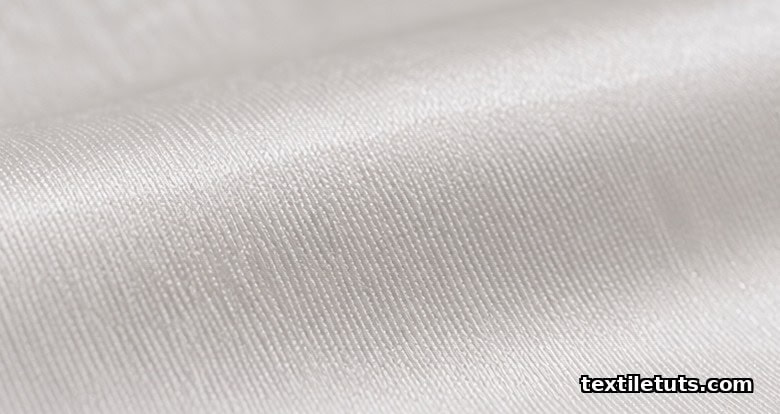
Silicone softeners applied at 0.3 to 1.0 percent on weight of fiber reduce the bending rigidity of cotton woven fabric by 20 to 40 percent and lower the fabric-to-fabric coefficient of friction by 30 to 50 percent, while mechanical softening through controlled tumbling typically delivers 15 to 25 percent improvement in subjective hand with 5 to 10 percent area shrinkage.
Both approaches aim at the same outcome, a softer, more pliable textile surface, but they work by fundamentally different mechanisms: silicone softeners deposit a thin polysiloxane film that lubricates fiber surfaces, while mechanical softening breaks inter-fiber bonds and relaxes yarn tension through physical action alone.
This article compares the two methods across chemistry, machinery, durability, cost, and sustainability so textile students, sourcing teams, and production engineers can pick the right finish for a given fabric and end use.
What Softening Finishes Do to a Fabric
Softening finishes are post-weaving or post-knitting treatments that improve the tactile handle of a fabric, the combination of smoothness, pliability, drape, and surface friction that a person perceives when touching cloth. They do this by reducing the inter-fiber and inter-yarn friction that causes stiffness, and by relaxing residual stresses introduced during spinning, weaving, and dyeing.
Hand is not a single measurable property. The Kawabata Evaluation System (KES-F), developed by Sueo Kawabata and published in 1980, decomposes it into 16 measurable parameters across tensile, shearing, bending, compression, and surface properties. Softening finishes move all of these parameters toward lower stiffness and lower friction, though the magnitude of each shift depends on whether the finish is mechanical, chemical, or both.
The two families covered here represent the two ends of that spectrum. Mechanical softening uses only physical energy; silicone softening uses chemical deposition of polysiloxane polymers. Most production lines in practice combine them: a tumble or sanforizing step before or after a silicone pad for both immediate softness and durability to washing.
How Mechanical Softening Works
Mechanical softening breaks the temporary hydrogen bonds and Van der Waals forces that hold cotton, wool, or synthetic fibers in a stiff configuration after weaving and heat-setting. Without adding any foreign chemistry, the action physically relaxes the fabric and lifts microfibers from the surface.
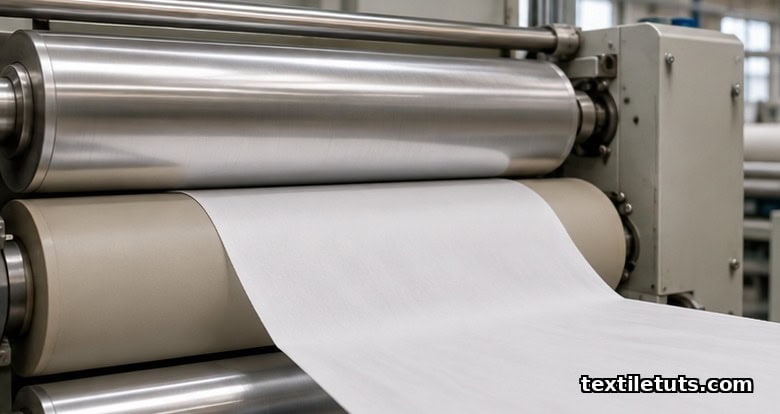
Common mechanical methods include:
- Tumble softening (also called garment washing or mechanical conditioning): wet or dry fabric is tumbled in industrial drums at 40 to 80 revolutions per minute for 20 to 90 minutes. Repeated impact against the drum wall and against other fabric pieces loosens yarn structure.
- Sanforizing (compressive shrinkage): the fabric is fed against a stretched rubber belt or apron, then released to relax. Primarily a shrinkage-control process, it also contributes 10 to 15 percent improvement in hand feel on cotton denim and twills.
- Calendering: passage through heated rollers under pressure flattens yarn crossovers. Calendering for softness uses a friction or chasing calendar at 120 to 180 degrees Celsius and line pressures of 20 to 60 kilograms per centimeter.
- Peach-skin finishing: high-speed abrasive rollers (often alumina or silicon carbide grits) lightly sand the fabric face. Used on polyester microfiber and cotton/poly blends for suede-like surfaces.
- Raising or napping: wire-covered or card-wire-covered rollers lift surface fibers. Found on flannels, fleece-back knits, and brushed cotton shirting.
Mechanical methods have no chemical residue, no yellowing risk, and no change to fiber chemistry. Their main drawback is dimensional change. Tumble softening in particular can produce 5 to 10 percent warp shrinkage, which must be allowed for in greige fabric width and cutting marker planning.
How Silicone Softening Works
Silicone softeners are polysiloxane (silicon-oxygen backbone with organic side groups) emulsions applied to fabric by exhaustion, padding, or spraying. After drying and curing at 140 to 180 degrees Celsius, the polysiloxane forms a thin, flexible film around individual fibers and at yarn crossovers, lowering the coefficient of friction and increasing fiber mobility within the yarn.
The softness performance depends on the silicone chemistry:
- Polydimethylsiloxane (PDMS) macroemulsions: the original softener type. Particle sizes above 1 micrometer. Cost-effective, moderate softness, modest wash durability (3 to 5 laundering cycles).
- Amino-functional silicones: PDMS chains with pendant amino groups (-NH2 or -NH-CH2-CH2-NH2). Amino groups hydrogen-bond to cotton and other fibers, giving the deepest hand and the best wash durability (typically 10 to 20 laundering cycles at 0.5 percent owf). Downside: yellowing under high-temperature curing on bleached white cotton, because amine oxidation forms colored chromophores.
- Epoxy-functional silicones: epoxy groups cross-link with cellulose hydroxyl groups, producing a durable, low-yellowing finish favored for white goods and export shirting.
- Microemulsions and nanoemulsions: particle sizes below 100 nanometers. Penetrate yarn structure more uniformly than macroemulsions and produce softer hand at the same add-on. Higher cost per kilogram is offset by 30 to 40 percent lower add-on required to reach the same handle.
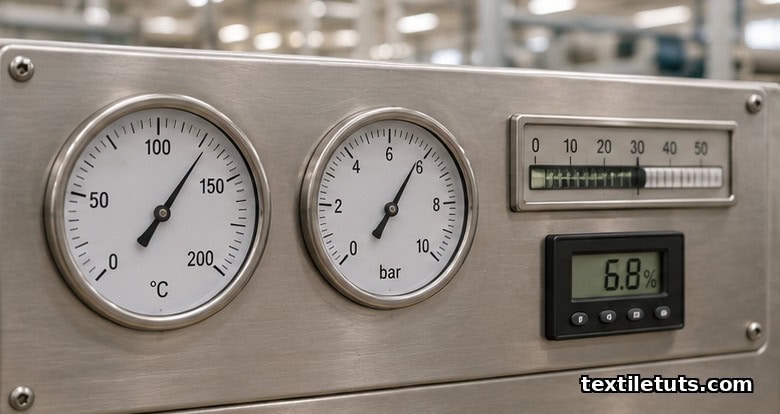
Application parameters matter as much as chemistry. Pad application uses 5 to 30 grams per liter pickup with 60 to 80 percent wet pickup, then dries and cures at 150 to 180 degrees Celsius for 60 to 180 seconds. Exhaustion application, used in jet and winch dyeing machines, runs at 30 to 50 degrees Celsius, pH 4 to 5 (acetic acid buffer), for 20 to 30 minutes.
Performance Comparison: Hand, Durability, and Process
The table below summarizes the difference between the two methods on cotton woven shirting, a reference fabric for finishing comparisons.
| Property | Mechanical Softening (Tumble) | Silicone Softening (Amino-functional microemulsion) |
|---|---|---|
| Add-on / process load | 20 to 90 min tumbling | 0.3 to 1.0 percent owf |
| Bending rigidity reduction | 15 to 25 percent | 20 to 40 percent |
| Surface friction (MIU, Kawabata) | 5 to 15 percent lower | 30 to 50 percent lower |
| Wash durability | Mostly permanent (mechanical change to fiber arrangement) | 10 to 20 laundering cycles (AATCC TM 135) |
| Dimensional change | 5 to 10 percent shrinkage | Less than 2 percent |
| Effect on tensile strength | 2 to 5 percent loss from abrasion | No significant change at recommended dosage |
| Yellowing risk | None | Moderate on bleached cotton (amino-functional) |
| Cost driver | Machine time, energy, labor | Softener chemical (0.20 to 1.50 USD per kg fabric) |
| Environmental load | Water and energy only | Effluent silicone load, possible AOX from emulsion stabilizers |
A combined approach is most common on premium goods. A typical sequence for a soft cotton or cotton-modal shirting is: desize, scour, bleach, dye, dry, tumble-soften (15 to 30 minutes), pad with amino-functional silicone microemulsion at 0.5 percent owf, dry, and cure. This pairs the immediate hand and dimensional stability of mechanical softening with the long-term lubricity of silicone.
Choosing Between Them in Production
Selection depends on the end use, not on one finish being universally better.
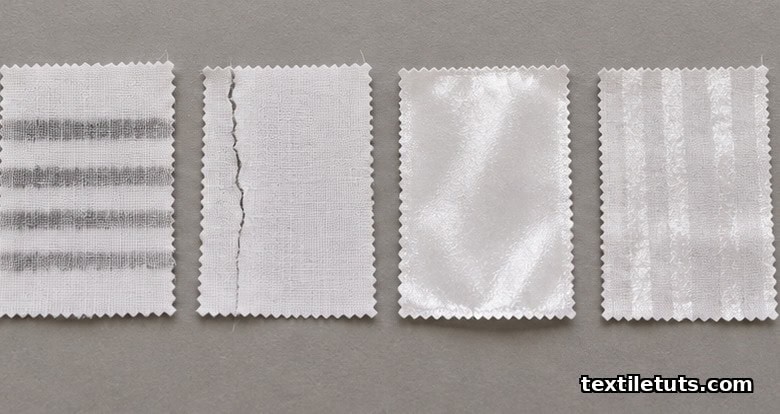
- Garments that will be stone- or enzyme-washed: mechanical softening alone is sufficient because the wash process itself breaks stiffness.
- White bleached cotton shirting: epoxy-functional silicone or PDMS macroemulsion, never amino-functional, to avoid yellowing under curing.
- Stretch knits and polyester microfiber: silicone microemulsion is preferred because mechanical tumbling can pill microfiber surfaces.
- Denim (selvedge or basic): mechanical hand-sanding or whiskering combined with a light silicone pad for premium lines.
- Technical textiles (medical, geotextile, filtration): softening is usually avoided; if required for sewability, low-add-on PDMS macroemulsion.
Process economics also matter. Tumble softening is capital-and-energy intensive (an industrial tumbler running 8 to 12 hours per day at 5 to 10 kilowatt hours per batch) but has zero chemical cost. Silicone softening is chemistry intensive but uses standard finishing machinery, often a stenter or padder the mill already owns.
Testing the Result
Subjective hand evaluation follows AATCC Evaluation Procedure 5, which standardizes how a panel of trained assessors ranks fabric softness, smoothness, and flexibility. Objective evaluation uses either KES-F instruments for full 16-parameter analysis or simpler single-property tests: ASTM D1388 for bending length, AATCC TM 135 for dimensional change after laundering, and ISO 6330 for reproducible domestic wash cycles. Conditioning and testing are performed in a standard atmosphere of 20 degrees Celsius and 65 percent relative humidity per ISO 139, since fabric stiffness and friction both shift with humidity.
Frequently Asked Questions
Which softening finish lasts longer through washing?
Mechanical softening produces a permanent change in fiber arrangement and survives any number of wash cycles. Silicone softening is finite: amino-functional silicone microemulsions typically retain hand through 10 to 20 laundering cycles, while unmodified PDMS macroemulsions begin losing effect after 3 to 5 cycles. For long-life garments, mechanical softening followed by a low-dose silicone pad gives the best of both.
Does silicone softening make fabric waterproof?
No. Standard silicone softeners form a sub-micrometer film that lubricates fibers but does not block the inter-yarn pores. Water can still pass through. For waterproofing, silicone is used as a hydrophobic emulsion in a separate finishing step, often with a fluorocarbon extender, applied at 2 to 5 percent owf.
Can I silicone-soften a fabric that has already been mechanically softened?
Yes, and most premium mills do. Mechanical softening first relaxes the structure and removes residual shrinkage, then a silicone pad locks in handle and adds surface lubricity. The two are complementary, not exclusive. Apply silicone after mechanical action, not before, because the silicone film would otherwise trap the mechanical deformation.
Is amino-functional silicone safe on white fabric?
Amino-functional silicones can yellow bleached white fabric during high-temperature curing (150 to 180 degrees Celsius), because amine groups oxidize to yellow chromophores. For whites, switch to epoxy-functional silicone, PDMS macroemulsion, or a low-amino-content modified silicone, and cure at the lower end of the recommended temperature window.
Does mechanical softening weaken the fabric?
Aggressive mechanical softening, especially peach-skin sanding or prolonged tumbling, can reduce tensile strength by 2 to 5 percent and create surface pilling on loosely spun yarns. For delicate knits or low-twist filament fabrics, shorten tumble time or skip mechanical action entirely in favor of a silicone-only finish.
References
- International Organization for Standardization. ISO 139:2005 Textiles — Standard atmospheres for conditioning and testing. iso.org — defines 20 °C and 65 percent RH as the reference atmosphere for all textile hand testing.
- International Organization for Standardization. ISO 6330:2021 Textiles — Domestic washing and drying procedures for textile testing. iso.org — sets the reproducible wash cycles used to evaluate softening durability.
- American Association of Textile Chemists and Colorists. AATCC Test Method 135-2018 — Dimensional Changes of Fabrics after Home Laundering. aatcc.org — the standard wash test referenced for silicone softener life-cycle claims.
- American Association of Textile Chemists and Colorists. AATCC Evaluation Procedure 5-2011 — Guidelines for the Subjective Evaluation of Fabric Hand. aatcc.org — the panel-test method for ranking perceived softness.
- ASTM International. ASTM D123-23 Standard Terminology Relating to Textiles. astm.org — canonical definitions for hand, softness, and related terms used in this article.
- Kawabata, S. (1980). The Standardization and Analysis of Hand Evaluation. Textile Machinery Society of Japan, Osaka — the source of the KES-F system and the 16-parameter decomposition of fabric hand.
- Textile Research Journal peer-reviewed literature on polysiloxane finishes, including studies on amino-functional and epoxy-functional silicone deposition on cotton and cotton-blend woven fabrics (search: silicone softener cotton hand).
This article is the working reference for softening finishes on woven and knit fabrics. Editorial by Shahrukh Islam, TextileTuts. Sources: ISO 139, ISO 6330, AATCC TM 135, AATCC EP 5, ASTM D123, Kawabata (1980), and Textile Research Journal literature on polysiloxane finishes as cited.


