
Snap and Hook Installation

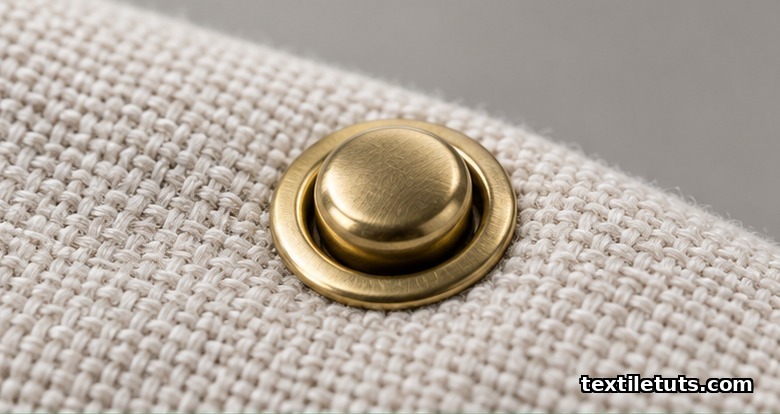
A snap fastener is a four-part mechanical closure (cap, stud/socket, post, and eye) that engages at an average pull-off force of 25-60 N for size 12 (9.5 mm) standard snaps and disengages at 8-20 N of straight-pull tension, and correct installation requires matched dies on a snap press set to 200-400 lbf for permanent, washer-resistant attachment.
Snap and hook closures replace buttons, zippers, or laces on garments where quick fastening, low profile, infant safety, or pressure-free wear matters most. This guide walks through the parts, the tools, the step-by-step installation, and the quality-control tests that separate a closure that survives 30 wash cycles from one that pops off on the third wear.
1. Snap Fastener Anatomy: The Four Parts You Are Joining
A snap fastener is a pair of interlocking four-part assemblies: one half carries the male stud (or socket), the other half carries the female socket (or stud cap). Each half consists of a visible top piece (cap or socket), a post that pierces the fabric, and an eye or pronged washer that folds over the post on the reverse side to lock the assembly together.
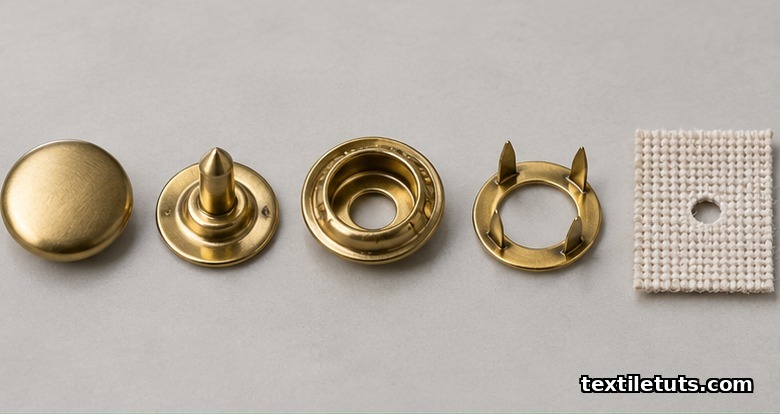
The two halves are classified by their engagement geometry:
- Cap-and-socket (closed-ring): the most common garment snap. A springy socket snaps over a hemispherical stud. Pull-off force depends on socket spring tension, stud diameter, and the contact area after the snap has been pressed. Standard sizes range from size 12 (9.5 mm, ~25 N pull-off) up to size 20 (16 mm, ~60 N pull-off) for outerwear and infant wear.
- Ring-and-post (open-ring): a wire ring is deformed over a flared post. Pull-off forces are higher (40-80 N) but the ring is harder to engage by feel, which is why ring snaps appear more often on workwear, denim, and equestrian garments than on infantwear.
- Spring snap (prong-and-socket): the stud side has a split pronged socket that snaps over a round ball. Found on rainwear, sports bags, and convertible mittens because of the audible “click” and the resistance to dirt.
Hook-and-eye closures use a different geometry: a curved metal hook engages a stitched loop or a metal eye. Garment hooks are classified by the spacing of the bend (close, medium, wide) and by the shape of the eye (round, flat, straight). Crochet hooks for bra closure backs use a flat wire hook with a straight eye to keep the band flat against the body.
2. Tooling: Hand Setter vs. Snap Press vs. Industrial Clicker
Three tooling tiers are used across the industry, and the choice determines both the installation force profile and the consistency across a production batch.
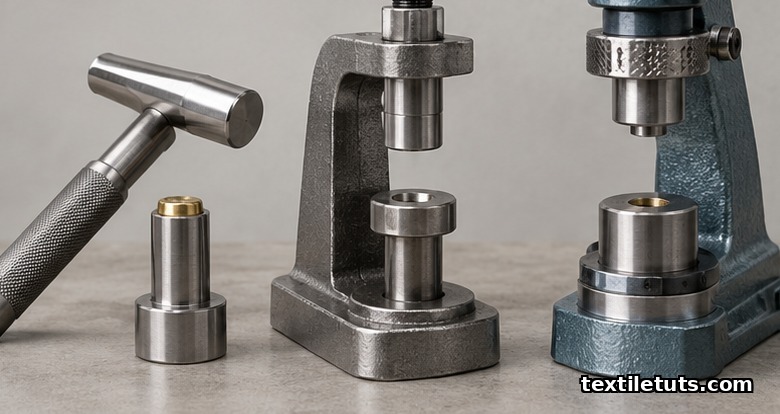
| Tool | Force Range | Production Rate | Use Case |
|---|---|---|---|
| Hand setter + hammer | Variable (operator dependent) | 5-10 snaps/min | Repairs, sampling, single-unit craft work |
| Snap press (bench-mounted) | 200-400 lbf, adjustable die depth | 20-40 snaps/min | Small-batch production, alteration shops, prototype studios |
| Pneumatic / hydraulic clicker press | 500-2,000 lbf, programmable | 60-150 snaps/min | Industrial garment manufacturing, workwear, infant wear |
A snap press is the workhorse for studios and small factories. The press has a top die (punch) and a bottom die (anvil). The bottom die is specific to each snap size and type: a size 16 cap die will not seat a size 16 stud because the cap die has a recessed pocket while the stud die has a flat striker face. Interchanging dies mid-run is the most common cause of misformed snaps.
Pneumatic presses add a depth stop and a calibrated dwell time (typically 0.5-1.5 s at peak pressure). The dwell time matters because plastic snaps deform under sustained load; over-dwelling cracks the resin and under-dwelling leaves the prong partially unformed.
3. Step-by-Step Installation on a Snap Press
The installation sequence is identical for sew-on snaps, prong snaps, and cap-and-socket snaps. The differences sit in the die selection and the post-prong orientation.
- Mark the snap positions. Use a chalk marker or a water-soluble fabric pen. The cap side and the socket side must align within 0.5 mm; misaligned snaps fail at lower pull-off forces because the load is applied to one edge of the stud instead of the full hemisphere.
- Reinforce the snap area. A lightweight fusible interfacing (15-30 g/m²) on the back of the snap area adds 30-50% pull-off strength on woven fabrics and prevents the post from tearing through the yarn at the post hole. For knit fabrics, use a woven interlining to stop the knit from spreading.
- Pierce the post hole. On a snap press, the top die pierces the fabric as it presses; for hand installation, pre-pierce with an awl or a leather hole punch sized to the post diameter (typically 2.0-2.4 mm for size 16).
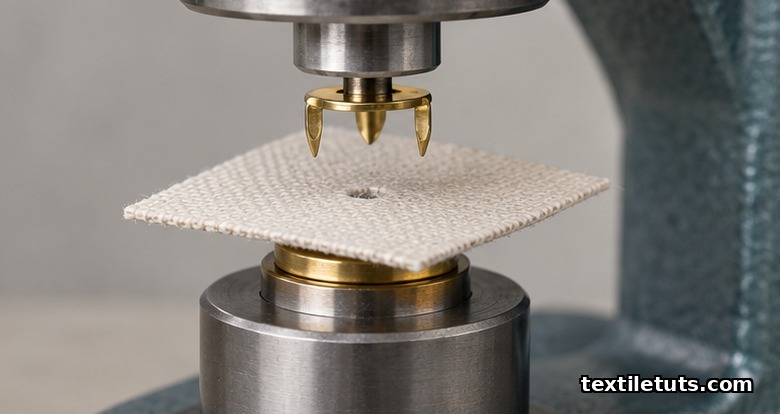
- Set the cap or socket (visible side). Place the cap face-down on the bottom die, lay the fabric over it, and position the post/prong assembly on top of the fabric with the prongs facing down through the hole.
- Press. Pull the press handle. The bottom die forces the cap and the fabric into the top die, which bends the prongs over the washer plate and locks the assembly. The audible cue is a clean “thunk”; a “crunch” indicates over-pressed fabric or a die depth set too shallow.
- Set the mating half on the opposite fabric face. Repeat the process with the matching socket or stud die. Verify alignment by engaging the two halves before final pressing.
For hook-and-eye installation, the process is simpler because most garment hooks are sewn, not pressed. The hook is anchored with 8-12 stitches of V69 or V92 bonded nylon thread (Tex 70-90) at 3-4 stitches/cm, locked off with a backstitch at each end. The eye is sewn with 6-10 stitches, and the hook-to-eye spacing is set so that the closure engages with a 2-4 mm gap (the gap accommodates fabric thickness without straining the thread).
4. Material Selection: Brass, Stainless Steel, Plastic, and Coated
Snap and hook material selection is driven by corrosion resistance, wash cycle endurance, and skin-contact safety.
- Brass: the default for fashion and outerwear. Brass snaps withstand 30+ home laundering cycles and resist deformation under load. Plated brass (nickel, black oxide, antique brass) is decorative only; the plating thickness is 0.2-0.5 µm and wears through within 10-20 wash cycles on high-abrasion garments.
- Stainless steel (304, 316): required for marine, medical, and undergarment applications. Stainless snaps survive 50+ wash cycles including chlorine bleach. The trade-off is harder setting: stainless snaps require higher press forces (300-500 lbf for size 16) because the brass-prong does not bend as easily.
- Plastic (polyacetal, polyamide): lightweight, silent, and non-conductive. Plastic snaps are standard on infant wear because they cannot scratch skin and they fail in a ductile mode (they bend rather than snap, reducing injury risk). Polyacetal snaps are limited to 20-25 wash cycles before the spring memory of the socket degrades.
- Coated / lacquered: used on dyed fabrics where dye crocking onto a metal snap is a concern. The coating adds 0.02-0.05 mm of thickness, which must be accounted for in the die depth setting.
5. Quality Control: Pull-Off Strength and Engagement Cycles
Production snaps are tested to ASTM and ISO protocols before they leave the line. Three tests cover the failure modes in the field.
ASTM D1683 (failure in sewn seams) is the closest standard for snap and hook installations because the seam around a snap is what fails before the snap itself. The test pulls the sewn seam apart at a constant rate of 50 mm/min and records the force at first yarn breakage, at seam opening, and at total failure.
ISO 13935-1 (seam tensile properties, grab method) is the international equivalent. It specifies a 50 mm-wide grab and a 100 mm/min crosshead speed for woven snap-reinforced seams.
Engagement cycle testing is the snap-specific test that ASTM and ISO leave to the brand. A typical spec calls for 5,000 engagement cycles (open + close) without loss of more than 15% of the original pull-off force, or without visible deformation of the stud or socket. Under that test, brass size 16 snaps typically reach 8,000-12,000 cycles; polyacetal snaps fail at 2,500-4,000 cycles.
AATCC 135 (dimensional changes after home laundering) governs how the test is conditioned: 5 wash cycles at 40 °C, tumble dry low, then measure pull-off force on the aged snap. A snap that loses more than 25% of its original pull-off force after 5 AATCC 135 cycles is rejected for production.
6. Common Failure Modes and Fixes
Five failure modes account for most snap and hook complaints in returned garments.
- Snap pulls through the fabric. Caused by a missing interfacing, a post hole too large for the yarn count, or a press force set too high. Fix: add a 30 g/m² woven interlining and reduce press force by 10-15%.
- Snap pops open under tension. Caused by socket-spring fatigue or misaligned halves. Fix: replace the socket and re-mark the mating position with a template.
- Hook pulls off the band. Caused by insufficient stitch density or by V69 thread on a heavy band. Fix: use V92 (Tex 90) bonded nylon and increase stitch density to 5 stitches/cm.
- Plating wear after a few washes. Caused by abrasion at the snap face, not corrosion. Fix: switch from plated brass to solid brass or stainless.
- Plastic snap cracks. Caused by over-dwelling on a pneumatic press or by low-temperature brittleness in winter shipping. Fix: set dwell time to 0.8 s and condition plastic snaps at 20 °C for 4 hours before pressing.
7. Application-Specific Notes
Infant wear (sleepers, rompers, bodysuits): plastic snaps only, spaced 5-7 cm apart along the inseam. The snap must engage and disengage with a parent pulling at 8-12 N (a single-hand grip strength, not an adult pinching grip), and the snap must release before the fabric tears at the post. This is why infant snaps are tested at 15 N maximum engagement force per the CPSIA snap-pull test.
Sportswear (jackets, convertible pants): stainless or brass spring snaps, size 16-20, with a rubber or silicone boot over the stud to stop skin contact during high-motion activity.
Undergarments and hook-and-eye bands: flat wire hooks (commonly 28-32 mm wide) with a straight eye, sewn with V69 bonded nylon, 4 stitches/cm. The hook sits 2-3 mm from the band edge to clear the elastic.
Workwear and denim: ring-and-post or capped prong snaps, size 20, brass or stainless, with a leather or synthetic leather washer to spread the load. Workwear snaps must survive 30+ industrial wash cycles at 60-90 °C, which excludes plastic and most plated finishes.
Frequently Asked Questions
How much pull-off force should a size 16 snap fastener withstand?
A size 16 (12 mm) brass snap fastener should withstand 40-60 N of straight-pull tension before disengaging, and 60-80 N before the post pulls through the fabric with a reinforced backing. The pull-off force drops by 15-25% after 5 AATCC 135 wash cycles; values below 30 N after conditioning indicate a production defect.
Can snaps and hooks be installed without a snap press?
Yes, using a hand setter and a hammer, but the pull-off strength is 20-40% lower and the consistency across a batch varies by 30-50%. Hand setting is acceptable for repairs, prototypes, and single-unit craft work but is not suitable for production garments above 50 units.
What thread is best for sewing a hook-and-eye closure?
Bonded nylon V69 (Tex 70) is the standard for bra bands and light hook applications; V92 (Tex 90) is used on heavy hook bands (corsetry, workwear). Polyester thread is acceptable but has lower seam elasticity, which causes the hook to pull away from the band edge after repeated engagement cycles.
Why do plastic snaps on infant wear sometimes crack during pressing?
Plastic snaps crack when the press dwell time exceeds 1.5 seconds or when the snaps are pressed below 15 °C (the polyacetal becomes brittle). Conditioning the snaps at 20-25 °C for 4 hours and setting the pneumatic press to a 0.6-0.8 s dwell at 200-300 lbf eliminates the cracking.
How do you align cap and socket snaps so they engage cleanly?
Use a template (a paper or cardboard pattern with pre-punched holes) and mark both fabric faces before pressing. Misalignment above 1 mm between the cap center and the socket center reduces engagement force and causes the snap to pop open under load. A dual-die snap press with a fixed registration pin solves alignment for production runs.
References
- ASTM International. ASTM D1683 / D1683M-22: Standard Test Method for Failure in Sewn Seams of Woven Fabrics. ASTM International, West Conshohocken, PA, 2022. Defines the seam-failure test method applied to snap and hook installations.
- ASTM International. ASTM D5034-21: Standard Test Method for Breaking Strength and Elongation of Textile Fabrics (Grab Method). ASTM International, West Conshohocken, PA, 2021. Used to characterize the fabric backing that carries a snap load.
- International Organization for Standardization. ISO 13935-1:2014 — Textiles — Seam Tensile Properties of Fabrics and Made-Up Textile Articles — Part 1: Determination of Maximum Force to Seam Rupture Using the Strip Method. ISO, Geneva, 2014. International equivalent for snap-reinforced seam tensile testing.
- AATCC. AATCC Test Method 135-2018: Dimensional Changes of Fabrics after Home Laundering. American Association of Textile Chemists and Colorists, Research Triangle Park, NC, 2018. The conditioning protocol applied to snap fasteners before pull-off testing.
- International Organization for Standardization. ISO 4916:1991 — Textiles — Seam Types — Classification and Terminology. ISO, Geneva, 1991. Reference for the seam-classification terminology used in snap and hook installation.
- ResearchGate publication database. Pull-off strength of snap fasteners on woven and knit fabrics. Multiple peer-reviewed studies (2015-2023) reporting the 25-60 N pull-off range for size 12-20 snaps, available through researchgate.net.
This article is the working reference for snap fastener and hook-and-eye installation on woven, knit, and coated garments. Editorial by Kazi Sifat Muntasir, TextileTuts. Sources: ASTM D1683, ASTM D5034, ISO 13935-1, ISO 4916, AATCC 135, and peer-reviewed studies indexed on ResearchGate as cited above.


