
Interfacing Types and Application

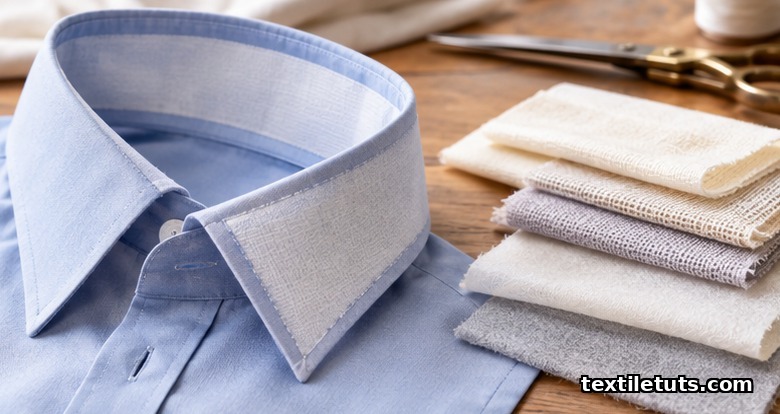
Interfacing is a hidden support layer, typically 30 to 120 GSM, fused or sewn between a garment’s outer fabric and facing to add shape, structure, and crispness in collars, cuffs, button plackets, and waistbands. Choosing the correct interfacing type and weight cuts seam distortion by roughly 50% compared with using a single generic nonwoven, while fusible versions bond at 130 to 160°C with 10 to 15 seconds of steam dwell under 2 to 4 psi pressure.
This guide explains the three main categories of interfacing, the difference between fusible and sew-in application, and the specific temperatures, weights, and garment pairings that textile engineers rely on to keep a collar standing, a placket flat, and a waistband stable through repeated laundering.
What Interfacing Does in a Garment
Interfacing, sometimes called interlining in ready-to-wear production, is a secondary fabric attached to specific zones of a garment to reinforce them. The reinforcement targets load-bearing or shape-critical areas: shirt collars and cuffs, jacket lapels and fronts, waistbands, button plackets, pocket flaps, hem allowances, and zip tapes.
The reinforcement works by absorbing mechanical stress that would otherwise be carried by the fashion fabric alone. A collar without interfacing curls, collapses, and loses edge definition after one or two wash cycles. A waistband without interfacing stretches out of shape when the wearer sits, bends, or fastens buttons. A button placket without reinforcement pulls and tears around the buttonholes.
Interfacing is typically tested for dimensional change after five home-laundering cycles (ISO 6330 procedure, measured per ISO 5077 or AATCC TM 135); many shirt buyers set a limit of about 3%. Workwear interlinings (uniforms, hospital wear) are tested with ISO 15797 industrial wash procedures at 75°C or 85°C, usually over 5 or more cycles.
The Three Main Interfacing Categories
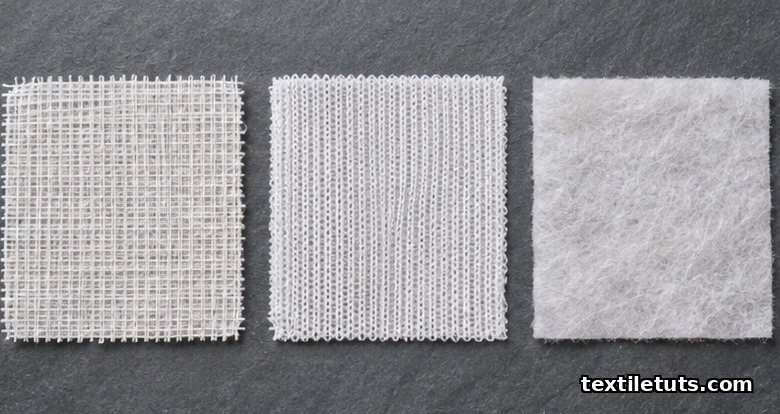
Interfacings are classified by base structure into three families. Each behaves differently under stress, drapes and recovers differently, and bonds through different application methods.
1. Woven Interfacing
Woven interfacings are made on a loom from warp and weft yarns, most often cotton, polyester and cotton blends, or 100% polyester. They behave like a lightweight version of the fashion fabric and offer the most natural hand and recovery. Woven interfacings are the standard choice for tailored garments such as wool suit jackets, blazers, and formal trousers because they move with the shell fabric and resist rolling at lapel edges.
Most woven interfacings are produced with a weft-insertion stabilizer that limits stretch to the weft direction only, matching the bias stretch of wool and wool-blend suitings. This directional stability is why pattern makers specify woven rather than knit for tailored necktie and lapel work.
2. Knit Interfacing
Knit interfacings use a warp-knit or weft-knit structure, most commonly made from nylon or polyester filament yarns. The knit construction gives them multi-directional stretch and recovery, making them the default pairing for knits and stretch wovens including jersey tops, polo shirts, t-shirts, knit dresses, and elastic-waist garments.
Because knit interfacings stretch with the shell fabric, they prevent the bubbling, puckering, and visible distortion that occurs when a stable woven interfacing is bonded to a stretch fabric. Tricot fusibles, the most common knit interfacing style, are warp-knit and available in 35 to 90 GSM.
3. Non-Woven Interfacing
Non-woven interfacings are made by entangling fibers, most often polyester, viscose, or blends, through chemical, thermal, or mechanical bonding. They have no grain and equal strength in all directions, which makes them economical, easy to cut in any direction, and consistent in thickness.
Non-wovens are the most common interfacing in mass-market shirt and blouse production. They are also used as the base for embroidery backings, temporary hem stabilizers, and craft applications. Their main drawback is lower recovery than woven or knit, so they are unsuitable for shaped tailoring or any garment that requires the support to snap back after wear.
Fusible vs. Sew-In Interfacing
Each interfacing category comes in two application forms: fusible, which is pre-coated with a heat-activated adhesive, and sew-in, which has no adhesive and is captured in a seam.
Fusible Interfacing
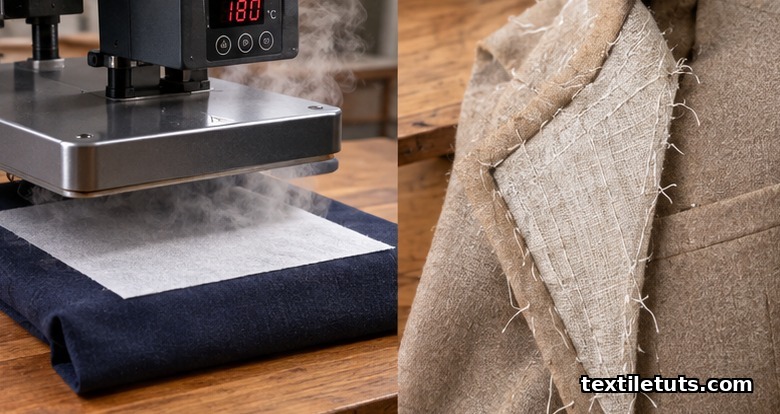
Fusible interfacings carry a thermoplastic adhesive on one side, most commonly a copolyamide or polyester hot-melt, that melts and bonds to the shell fabric when heat, steam, and pressure are applied. Application parameters depend on the adhesive chemistry and the face fabric, but typical production ranges are:
- Bonding temperature: 130 to 160°C (266 to 320°F)
- Steam dwell time: 10 to 15 seconds
- Pressure: 2 to 4 psi (14 to 28 kPa)
- Total press cycle: 15 to 20 seconds including cooling
Fusibles are faster, more uniform, and dominant in ready-to-wear production. They do, however, fail in three predictable ways: adhesive strike-back through sheer fabrics, delamination under repeated high-heat ironing, and bubble formation if the press cycle is interrupted before the adhesive cools.
Sew-In Interfacing
Sew-in interfacings have no adhesive. They are basted or tacked into the garment seam and captured during construction. Sew-in is slower and requires more skilled labor, but it is preferred for vintage tailoring, delicate silks and wools that cannot tolerate heat, and any garment that will be dry-cleaned aggressively.
Sew-in also avoids the boardy hand that heavy fusibles can produce on lightweight face fabrics. For hand-finished jackets, couture garments, and heirloom sewing, sew-in is the standard.
Choosing Interfacing by Weight and GSM
Interfacing weight must match or fall slightly below the weight of the shell fabric. A 60 GSM cotton shirt paired with a 120 GSM heavyweight fusible will dominate the fabric and produce a stiff, boardy hand. A 30 GSM sheer blouse paired with a 35 GSM fusible will not provide enough structure to keep the collar standing.
| Shell fabric weight | Recommended interfacing | Typical GSM |
|---|---|---|
| Sheer (chiffon, georgette) | Lightweight tricot fusible | 30 to 45 |
| Light shirting (cotton, linen) | Lightweight woven or non-woven fusible | 45 to 65 |
| Medium shirting, chambray | Medium-weight woven fusible | 65 to 85 |
| Suiting (wool, polyester-wool) | Woven weft-insertion fusible | 85 to 110 |
| Heavy coating (wool melton, denim) | Heavy woven fusible or sew-in canvas | 110 to 180 |
These are working ranges, not absolute rules. The correct weight depends on the desired hand (soft versus crisp), the garment zone (collar versus front panel), and the wash care method (dry-clean only versus machine wash).
Application by Garment Zone
Different garment zones demand different interfacing structures. Using the same interfacing throughout a jacket, across front panels, lapels, collar, cuffs, and pocket flaps, produces a flat, lifeless garment. Professional pattern makers specify by zone:
- Shirt collar and cuffs: medium-weight woven or knit fusible, cut on the bias for shaped collars and straight grain for flat collars.
- Jacket front panels and lapels: woven weft-insertion fusible matched to the shell fabric’s weight, plus a separate canvas chest piece (hair canvas or wool canvas) for tailored fit.
- Waistbands: medium-weight woven or non-woven fusible, cut on the same grain as the waistband pieces.
- Button plackets: lightweight fusible strip 15 to 20 mm wide running the full length of the placket.
- Pocket flaps and yokes: matching shell weight, sometimes one grade lighter to avoid edge show-through.
Common Interfacing Failures and How to Prevent Them
Most interfacing problems trace back to a mismatch between the interfacing and the shell fabric or to incorrect press parameters. The five most common failures in production:
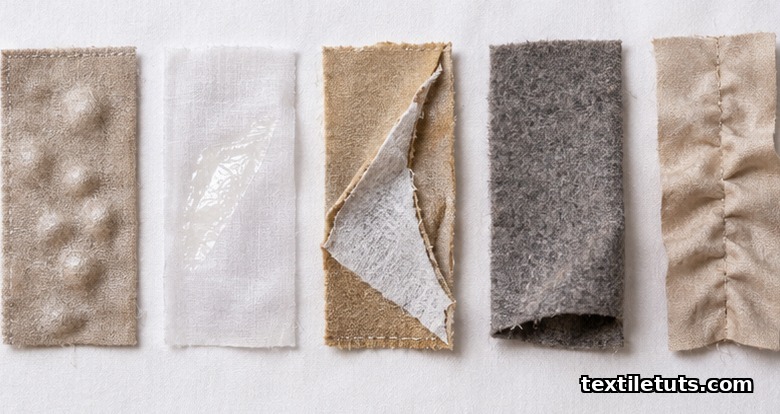
- Bubbling after washing: caused by incomplete adhesive activation or by fusing before pre-shrinking the interfacing. Pre-shrink interfacing by pre-washing or steaming it before cutting.
- Strike-through: adhesive bleeding through sheer or light-colored fabrics. Use a lower-tack adhesive or switch to sew-in.
- Delamination: bond fails after repeated washing or dry-cleaning. Cause: residual finish on the shell fabric or insufficient press pressure.
- Stiff, boardy hand: interfacing too heavy for the shell fabric. Drop one GSM grade.
- Puckering at seams: interfacing cut on the wrong grain relative to the shell. Re-cut on the matching grain direction.
For shrink-sensitive applications, ASTM D2724 (Bonded and Laminated Apparel Fabrics) provides a standardized test for bond strength and delamination resistance after repeated laundering. Production sampling should pull three units per lot and test to AATCC TM 135 (five-cycle wash) before bulk cutting.
Care Labeling and Wash Performance
The finished garment’s care label, drawn to ISO 3758 symbols, must reflect the weakest component in the bonded system. If the interfacing is rated to 40°C but the shell fabric requires 60°C, the wash label follows the lower limit. Most fusible adhesive systems are engineered for 40°C wash and low-heat tumble dry; exceeding these temperatures causes progressive bond failure.
Industrial laundries follow ISO 15797, which simulates the high-pH, high-temperature tunnel finishing used by hospital and rental workwear. Interlinings qualified for this standard carry an ISO 15797 rating and are typically polyester or polyamide-based with a high-tack copolyamide adhesive.
Frequently Asked Questions
What is the difference between interfacing and interlining?
Interfacing and interlining refer to the same functional layer in a garment: a supporting fabric hidden between the shell and the facing. Interlining is more common in ready-to-wear and tailored jacket production; interfacing is the standard term in home sewing, pattern drafting, and most shirting and blouse applications.
Can I fuse interfacing with a regular home iron?
Yes, but only if your iron can sustain 130 to 160°C with a continuous steam shot for 10 to 15 seconds under firm hand pressure. Most home irons reach 200°C, but the heat drops during the dwell time. For best results, use a damp pressing cloth, press in 10-second increments, and hold the iron still rather than gliding it. Industrial production uses a flat-bed or roll-press for uniform pressure; home ironing cannot match that consistency.
Which side of the fusible interfacing goes against the fabric?
The adhesive-coated side (shiny, slightly rough, or bumpy) goes against the wrong side of the shell fabric. Most fusibles identify this side on the selvage or product packaging. Bonding the wrong side produces no adhesion and contaminates the iron.
How do I prevent interfacing from shrinking and pulling the garment out of shape?
Pre-shrink the interfacing before cutting by washing or steaming it according to the garment’s final care label. For washable garments, soak the interfacing in warm water and dry it flat before cutting. Pre-shrinking reduces residual shrinkage to ≤1%, the threshold below which distortion is invisible on the finished garment.
Can I reuse interfacing that has been peeled off a garment?
No. Once fusible adhesive has been activated and the bond broken, the adhesive chemistry is spent. Re-bonding produces a weak, uneven bond that fails within the first wash. Cut fresh interfacing for any rework.
References
- ISO. ISO 6330:2021, Domestic washing and drying procedures for textile testing. iso.org. Standardized wash cycles for textile testing, including interfacing dimensional stability.
- AATCC. AATCC TM 135, Dimensional Changes in Home Laundering of Woven and Knit Apparel Fabrics. aatcc.org. Five-cycle wash test for bonded and laminated apparel components.
- ASTM International. ASTM D2724, Bonded and Laminated Apparel Fabrics. astm.org. Bond strength, delamination, and adhesion testing for fusible interlinings.
- ISO. ISO 15797:2017, Textiles, Industrial washing and finishing procedures for workwear. iso.org. Industrial wash procedures for testing workwear and rental garments at 75°C or 85°C.
- ISO. ISO 3758:2012, Textiles, Care labelling code using symbols. iso.org. Care label symbol system used to communicate interfacing limits to consumers.
- Matsudaira, M., and Kawabata, H. A study of fusible interlining fabric properties and bond performance. researchgate.net. Peer-reviewed research on fusible adhesive chemistry and bond durability through repeated laundering.
This article is the working reference for interfacing types and application in garment construction. Editorial by Kazi Sifat Muntasir, TextileTuts. Sources: ISO 6330, AATCC TM 135, ASTM D2724, ISO 15797, ISO 3758, and the Matsudaira and Kawabata peer-reviewed study on fusible interlining bond performance as cited.


