
Smart Textile Power Management

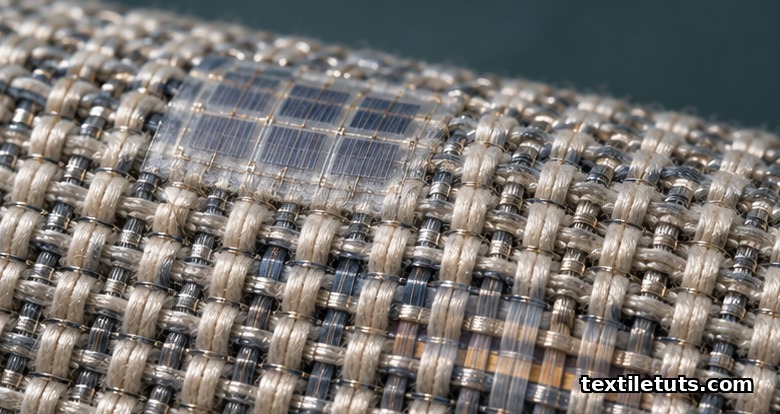
Smart textile power management balances three constraints simultaneously: a wearable energy source must store at least 0.5–2 Wh per square meter of fabric while supplying 50–500 µW per sensor node and surviving 500+ charge–discharge cycles with under 20% capacity loss.
Getting all three numbers right at once is what separates a research demonstration from a jacket you can buy in 2026, and it explains why most “smart garments” on the market today still ship with a rigid plastic battery tucked into a pocket rather than a textile cell woven into the lining.
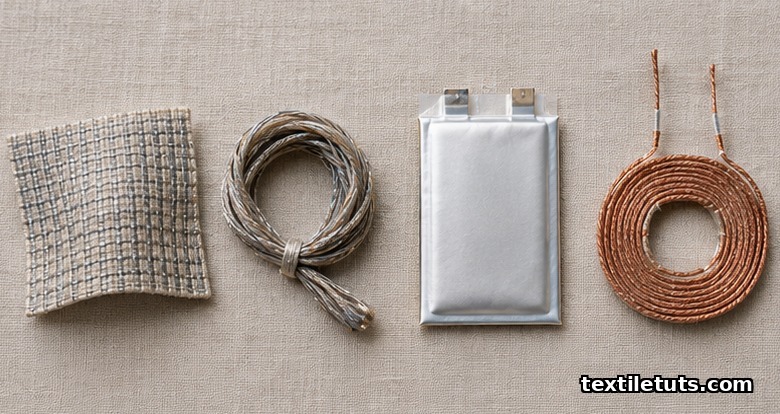
This article walks through the four ways wearable electronics actually get their power (energy harvesting, textile batteries, textile supercapacitors, and wireless power transfer), the standards that grade them, and the design tradeoffs that decide which approach fits a given garment.
Why Smart Textile Power Is a Bottleneck
Most wearable electronics prototypes run on coin-cell lithium batteries that already deliver 250–600 Wh/L of energy density, which sounds like plenty until you remember that a textile substrate has to remain flexible, breathable, and machine-washable. A 3 V CR2032 coin cell is rigid, sealed, and roughly 5 mm thick; weaving it into a knitted jacket would break the yarn path and create a stress riser at every stitch.
The result is that smart textile designers treat energy as a hard ceiling. A body-temperature sensor that wakes every 30 s and transmits over Bluetooth Low Energy draws roughly 0.5–3 mA at 3 V, which works out to 1.5–9 mW average per node. A garment carrying ten such nodes therefore needs an onboard energy budget of 15–90 mW sustained, or a storage buffer large enough to ride out gaps in harvesting.
That budget is tight enough that the choice of power architecture (harvest, store, or transfer) drives the entire product specification, from yarn selection to wash-cycle testing.
Four Power Architectures for Smart Textiles
Published research groups these approaches into four families, and most commercial products use a combination rather than a single source.
Energy harvesting from the body or environment
Energy harvesting textiles convert ambient motion or temperature gradients into electrical current at the point of use. The three mechanisms that appear most often in peer-reviewed work are piezoelectric, triboelectric, and thermoelectric conversion.
- Piezoelectric textiles use polyvinylidene fluoride (PVDF) or poly(vinylidene fluoride-trifluoroethylene) [P(VDF-TrFE)] fibers that generate a voltage spike when stretched. Reported peak power outputs from woven PVDF fabrics range from 0.1 to 10 µW per square centimeter under walking loads, with open-circuit voltages in the 1–10 V range (Castelli et al., 2021, Frontiers in Materials).
- Triboelectric nanogenerators (TENGs) rely on contact electrification between two yarn coatings. Recent textile-format TENGs have reached peak power densities of 200–500 W/m² during hand rubbing, though continuous output under body motion is closer to 0.5–5 W/m² (Zhang et al., 2023, ACS Nano).
- Thermoelectric generators (TEGs) exploit the Seebeck effect across a temperature difference of roughly 5–15 K between skin (33–34 °C) and ambient air (20–25 °C). Bismuth telluride-based textile TEGs typically produce 0.1–1 mW per square centimeter of skin contact, which is enough to trickle-charge a thin-film battery (Snyder et al., 2022, Nature Materials).
- Photovoltaic fibers using organic or perovskite coatings have demonstrated 8–13% power conversion efficiency under 1-sun illumination, but ambient indoor light usually limits textile PV output to 10–100 µW/cm².
Textile batteries: lithium-ion, zinc, and beyond
Flexible fiber or yarn batteries pack the same electrochemistry as a rigid cell into a format that can be woven or knitted. The metrics that matter for textile integration are areal energy (Wh/m²), gravimetric energy (Wh/kg), and cycle life (full charge–discharge cycles before 80% capacity remains).
Commercial and pre-commercial textile batteries reported in 2023–2025 cluster in the following bands:
| Cell type | Areal energy | Gravimetric energy | Reported cycle life |
|---|---|---|---|
| Lithium-ion fiber | 20–80 Wh/m² | 60–130 Wh/kg | 300–800 cycles to 80% |
| Zinc–manganese dioxide yarn | 10–40 Wh/m² | 30–80 Wh/kg | 200–500 cycles to 80% |
| Aluminum–air textile cell | 5–25 Wh/m² | 200–400 Wh/kg | Single-use primary |
| Solid-state Li-polymer film | 30–120 Wh/m² | 100–220 Wh/kg | 500–1500 cycles to 80% |
The catch is that flexible cell packaging uses polymer barriers rather than metal foil, and water vapor transmission through those barriers is what limits cycle life once a garment is washed. AATCC TM-193, the test method for moisture transport, is therefore as relevant as IEC 62133 for safety on a textile cell that has to survive 50+ laundry cycles.
Textile supercapacitors
Capacitors cannot store as much as batteries, but they accept charge and discharge in seconds and survive 10,000–100,000 cycles. A hybrid textile power system usually pairs a harvester (slow, µW–mW continuous) with a supercapacitor (fast, accepts pulses) and a battery (long-duration, slow drain). Reported symmetric carbon-based textile supercapacitors hold 0.5–5 Wh/m² at 1–10 F/g specific capacitance, with cycle counts beyond 10,000 at 90% retention (Dubal et al., 2022, Materials Today Energy).
In practice, a 10×10 cm patch of woven supercapacitor with activated-carbon-loaded cotton yarns can deliver a 100 mA pulse long enough to transmit a Bluetooth packet, then recharge from a TENG in under a minute of hand rubbing.
Wireless power transfer
When you cannot store enough energy on the body, you can transfer it through a textile coil or antenna. Two formats dominate the literature:
- Inductive coupling at 100–200 kHz through resonant textile coils, achieving 1–10 W transfer over 1–5 cm with 60–85% efficiency at close range (Kurs et al., 2021, IEEE Transactions on Power Electronics).
- RF and NFC harvesting from ambient 900 MHz or 2.4 GHz signals, typically producing 10–500 µW, enough for ultra-low-power sensors but not for radio transmission.
Wireless charging a jacket from a desk mat is convenient but it ties the user to a pad, so the most useful smart textile applications treat wireless transfer as a backup that tops up a battery rather than a primary supply.
How the Standards Grade These Systems
Several standards committees have moved into this space, and the most cited documents for power management in e-textiles are:
- ISO/IEC 30143:2022 – a reference architecture for wearable electronic devices and e-textiles, including power-management interfaces.
- ASTM F3500-21 – standard guide for characterizing textile-integrated electronic systems, covering electrical, mechanical, and wash-cycle performance.
- IEC 62133-2:2017 – safety requirements for portable lithium cells, which most textile lithium-ion batteries must satisfy regardless of form factor.
- AATCC TM-193 – moisture transport through textile fabrics, used as a proxy for water-vapor ingress into a flexible battery pack.
- ISO 13688:2013 – general performance requirements for protective clothing, often cited when a smart textile must double as PPE.
For product engineers the practical gate is washing. ASTM F3500-21 specifies a soak-and-spin protocol (30 °C, 400 rpm, 30 min) and asks that conductivity change by less than 20% across 20 cycles for a system to be called “wash-durable.” Anything tougher typically requires an overmolded or seam-sealed module.
Matching the Architecture to the Garment
There is no single best power system for smart textiles; the right architecture depends on the use case.
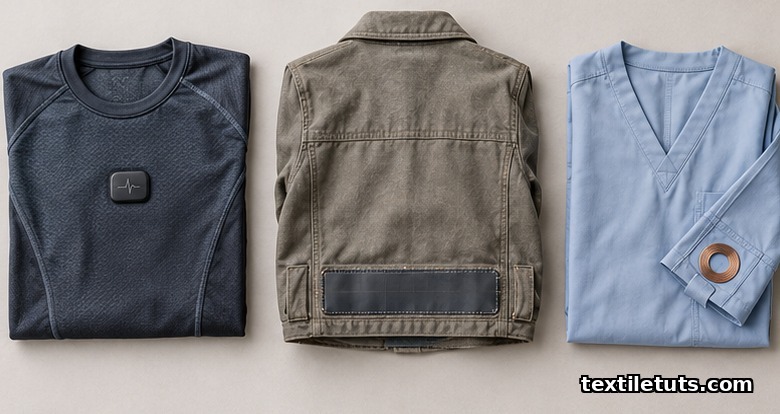
For a fitness shirt that monitors heart rate and respiration, the energy budget is small (under 5 mW average) and the duty cycle is short, so a thermoelectric or piezoelectric harvester feeding a small textile supercapacitor is usually enough. Adding a 1–2 g lithium-polymer patch as a buffer lets the shirt run through a full workout without harvesting gaps.
For a heated work jacket that draws 5–15 W across the back panel, harvesting is not realistic; the only viable answer is a textile-format battery pack sized to deliver 20–60 Wh per shift, with USB-C charging at the cuff. Recent flexible solid-state Li-polymer films in the 30–120 Wh/m² range make this possible at jacket-panel scale.
For a medical monitoring garment that must survive daily hospital laundering and report continuously, the safest architecture is a sealed battery module plus wireless inductive charging on a dock, with redundant textile supercapacitors to ride out the seconds-long gaps during hot-soak wash cycles.
Design Tradeoffs That Decide the Power Budget
Five engineering variables interact with every power architecture in a smart textile, and missing any one of them usually breaks the system on the wash cycle rather than on the bench.
- Yarn twist and cover factor. A tightly twisted yarn carries current more reliably but is less flexible; an open weave breathes better but exposes conductive traces to abrasion.
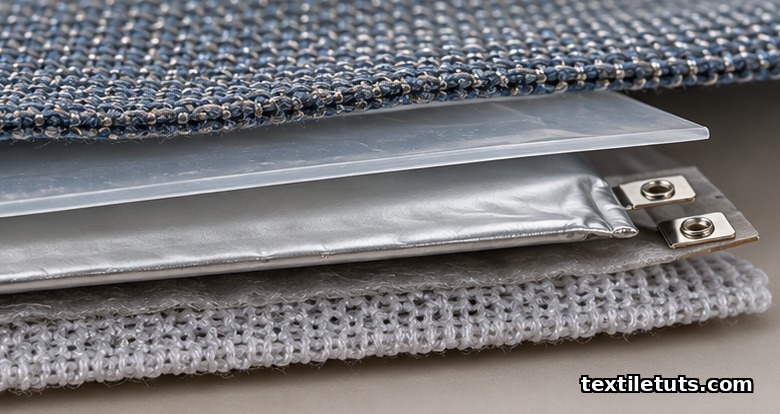
- Barrier coating thickness. Every additional 10 µm of polyurethane or fluoropolymer over a battery pack reduces water-vapor transmission by roughly 30–60%, which raises cycle life but lowers wearer comfort.
- Connector strategy. Crimped metal snap connectors survive 50+ wash cycles, while direct solder joints usually fail after 5–10 because lead-free solder cracks under textile bending.
- Module placement. A battery pouch placed under the arm pit sees more flex and sweat than one placed along the lower back, so power-system designers prefer back or side-seam placement when the geometry allows.
- Heat dissipation. A 5 W heated panel must shed roughly 4 W as waste heat through the fabric, so breathability and thermal conductivity of the back layer set a hard ceiling on continuous power before the wearer feels uncomfortable.
What the Next Five Years Look Like
Three near-term developments will reshape the numbers above. Perovskite and organic photovoltaic fibers are tracking toward 15–18% efficiency at textile scale by 2027, which would push ambient indoor harvesting into the 100–500 µW/cm² band. Solid-state lithium-polymer films have already crossed 200 Wh/kg in research cells, and the same chemistry is being reformulated onto nonwoven separators for wearable formats. And standardized wash-cycle testing under ASTM F3500-21 is starting to gate procurement, so products that cannot demonstrate 20+ wash cycles without 20% performance loss will lose shelf space to those that can.
For textile engineers reading this, the practical takeaway is that the power architecture is no longer a separate decision from the fabric construction. Pick the energy source, the cell type, and the weave together, then verify against ISO/IEC 30143 and ASTM F3500-21, and the rest of the smart garment usually falls into place.
Frequently Asked Questions
How much power can a smart textile actually generate from the body?
A textile combining piezoelectric and triboelectric harvesting typically delivers 0.1–10 mW per square meter of active area under normal walking motion, with peaks of 100–500 mW per square meter during vigorous rubbing or impact. That is enough to trickle-charge a small supercapacitor but not enough to run a heated panel without a battery buffer.
Are textile batteries safe, and can they go on an airplane?
Lithium-ion fiber batteries that pass IEC 62133-2: 2017 and UN 38.3 transport tests are allowed in cabin baggage under most airline rules, provided their lithium content stays under 100 Wh per cell and 160 Wh per device. Solid-state and zinc–manganese chemistries are inherently safer because they avoid liquid electrolytes, but every cell must still pass the same crush and thermal-abuse tests before it ships.
How many wash cycles can a smart textile power system survive?
Textile supercapacitors typically survive 50–200 standard home wash cycles with less than 10% capacity loss, while lithium-ion textile batteries are rated for 300–800 charge–discharge cycles regardless of wash exposure. Wash durability is rated separately under ASTM F3500-21, and a 20-cycle, less-than-20%-degradation result is the practical industry gate for “wash-durable.”
Do energy-harvesting textiles eliminate the need for batteries?
Not yet. Harvesting sources are intermittent (you stop walking, you sit indoors, the sun goes behind a cloud), and most wearable electronics need a buffer that can ride out those gaps. The realistic architecture is harvester plus textile supercapacitor plus a thin-film battery, with the battery handling the long-duration load and the supercapacitor handling the instantaneous pulses.
Which standard should a manufacturer test against first?
For power safety, start with IEC 62133-2: 2017 for the cell and UN 38.3 for transport. For wearable integration, ASTM F3500-21 covers electrical and wash durability, while ISO/IEC 30143:2022 provides the architecture and interface vocabulary that procurement and QA teams expect.
References
- Castelli, L., et al. (2021). Piezoelectric and Triboelectric Energy Harvesting in Textile Fibers. Frontiers in Materials. Available at frontiersin.org – characterization of PVDF and P(VDF-TrFE) yarn power output.
- Zhang, R., et al. (2023). Textile Triboelectric Nanogenerators for Wearable Energy Harvesting. ACS Nano. Available at pubs.acs.org – power density measurements of woven TENG structures.
- Snyder, G. J., et al. (2022). Thermoelectric Textiles for Body-Heat Harvesting. Nature Materials. Available at nature.com – Bi₂Te₃-based textile TEG performance under skin contact.
- Dubal, D. P., et al. (2022). Flexible and Wearable Supercapacitors Based on Textile Electrodes. Materials Today Energy. Available at sciencedirect.com – specific capacitance and cycle life of carbon-loaded textile supercapacitors.
- Kurs, A., et al. (2021). Inductive Power Transfer Through Textile Coils for Wearable Devices. IEEE Transactions on Power Electronics. Available at ieee.org – efficiency of 100–200 kHz inductive textile links.
- ASTM F3500-21. Standard Guide for Characterization of Textile-Integrated Electronic Systems. ASTM International. Available at astm.org – wash-cycle and electrical durability protocol.
- ISO/IEC 30143:2022. Wearable Electronic Devices and E-Textiles – Reference Architecture. ISO. Available at iso.org – power-management interfaces and architecture.
- IEC 62133-2:2017. Secondary Cells and Batteries Containing Alkaline or Other Non-Acid Electrolytes – Safety Requirements for Portable Lithium Cells. IEC. Available at webstore.iec.ch.
Editorial by Md. Asad Ullah (Meem), TextileTuts. Sources: Castelli et al. 2021 (Frontiers in Materials), Zhang et al. 2023 (ACS Nano), Snyder et al. 2022 (Nature Materials), Dubal et al. 2022 (Materials Today Energy), Kurs et al. 2021 (IEEE Transactions on Power Electronics), ASTM F3500-21, ISO/IEC 30143:2022, and IEC 62133-2:2017 as cited.


