
Smart Textile Applications in Fashion


Smart textile fashion applications integrate embedded electronics or stimulus-reactive chemistries into garments, with consumers paying a 3-10x price premium over conventional apparel; the three commercial benchmarks that define the category are conductive-yarn surface resistivity below 100 Ω/sq, thermochromic dyes shifting color between 27 °C and 32 °C, and IPX7-rated washable LED modules.
Fashion was the first mainstream venue for smart textiles to leave the laboratory. Runway collections from CuteCircuit (founded 2004 in London) and robotic-garment designer Anouk Wipprecht popularized dresses that light up, sense proximity, or change pattern in response to the wearer’s movements. The category now extends to interactive streetwear, gesture-controlled accessories, and color-shifting sportswear sold through mainstream retailers.
This article walks through the five technology families that dominate fashion applications (conductive yarns, chromic dyes, shape-memory fibers, phase-change microcapsules, and integrated LEDs and sensors), the durability limits each family hits, and the test standards (ISO/TR 23383, ASTM F2913, AATCC TM 100) that govern them.
What “smart textile” means in a fashion context
ISO/TR 23383:2020 defines a smart textile as a textile or textile product that interacts with its environment or the user through sensing, actuation, or response, going beyond the passive functions of conventional fabric. Within fashion, the term is used more narrowly to mean a wearable garment whose primary function is interactive: it lights up, changes color, captures biometric data, or performs an active function during wear.
The category has five consumer-facing technology families:
- Conductive yarns and fabrics carrying electrical current across the garment
- Photochromic and thermochromic dyes that change color under UV or heat
- Shape-memory polymers returning to a programmed geometry on stimulus
- Phase-change materials buffering the wearer’s microclimate
- Integrated electronic modules: LEDs, microcontrollers, sensors, batteries
Conductive yarns and e-textile couture
Conductive yarns carry an electrical signal between components sewn or woven into a garment. The most common construction is a stainless-steel filament core wrapped with polyester or cotton, which typically delivers surface resistivity in the 1-100 Ω/sq range, low enough for LED drive circuits and capacitive-touch sensing. Silver-plated copper threads (0.2-0.5 mm diameter) are used where flexibility and a fine aesthetic matter more than unit cost.
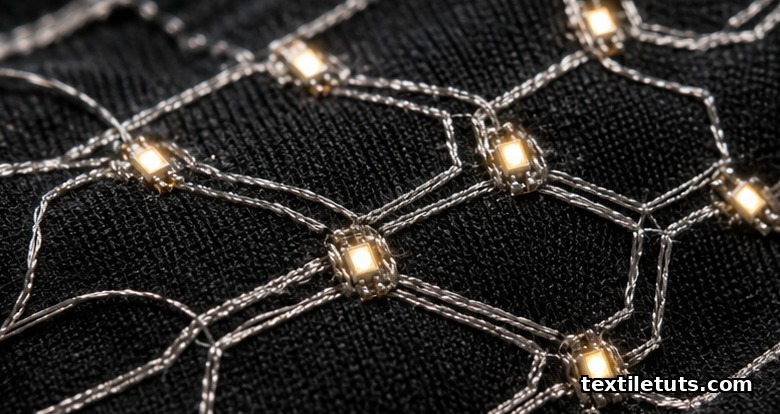
Couture designers often favor hand-embroidered conductive traces laid onto a base fabric. CuteCircuit’s “Galaxy Dress” (2013), embedded with 24,000 full-color LEDs across a sheer chiffon base, demonstrated that couture-scale e-textile assembly is reproducible when LED spacing is standardized at roughly 8 mm and the conductive trace width is held between 1 mm and 2 mm. The finished garment weighed under 1 kg despite the LED count.
The durability ceiling for conductive yarns is laundry. ASTM F2913 sets the vocabulary for passive e-textiles used in multi-electrode sensing applications, and the linked AATCC TM 135 wash cycle is the published durability benchmark. Silver-coated yarns lose 10-20% of their conductivity after 20 wash cycles; stainless-steel yarns survive 50+ cycles with no measurable change. Most fashion garments therefore carry “spot clean only” labels, shifting the maintenance burden from the laundry to the wearer.
Color-shifting fashion: chromic dyes
Chromic dyes change color in response to a stimulus. Photochromic dyes respond to UV light, and thermochromic dyes respond to temperature. Both chemistries are encapsulated as 1-10 µm microcapsules, bound to the textile surface with a resin binder or applied as a print.
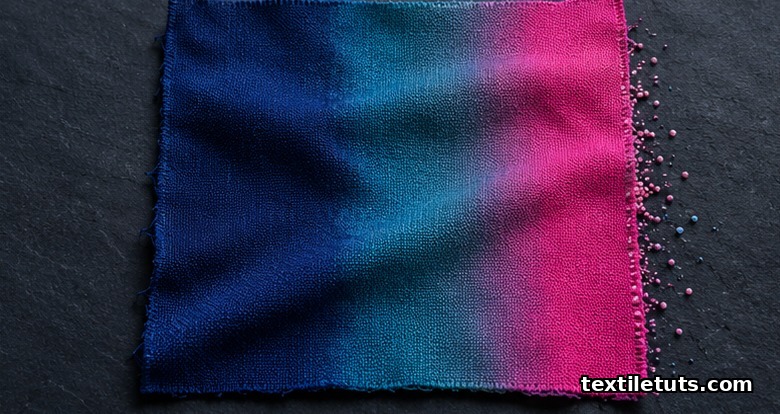
Thermochromic leuco-dye systems consist of a colored dye paired with a developer and a co-solvent. The mixture switches from colored to colorless at a defined activation temperature, which is set by choosing the co-solvent’s melting point. Common choices for skin-contact garments are ester-based solvents tuned to activate between 27 °C and 32 °C, so the print appears colorless at room temperature and reveals its pattern once the wearer puts the garment on.
Wash durability follows a different curve from conductivity. Published studies on encapsulated photochromic finishes report that activation intensity drops 5-15% per home-laundry cycle, becoming visibly uneven across the print field after 5-15 washes. The loss comes from the resin binder’s surface capsules detaching at each wash cycle. Cold hand washing in pH-neutral detergent roughly doubles the print’s effective lifespan.
Shape-memory fibers and thermally responsive fits
Shape-memory polymers (SMPs) are amorphous networks programmed to return to a stored geometry when heated above their transition temperature. In fashion, SMP-coated yarns and fabric structures can shape a cuff, collar, or hem when the wearer enters a warm room or pulls a garment from a cool closet.
The transition temperature for clothing applications is set at 32-40 °C, close to skin temperature, so the polymer becomes flexible when worn. Common chemistries used in published fashion research include polyurethane SMPs (transition 35-55 °C) and polycaprolactone blends (transition 40-60 °C). The garment must be designed so the memory effect survives 1,000+ wear cycles, which most published systems do not yet meet.
The durability of the effect follows from the polymer’s mechanical fatigue resistance. A peer-reviewed fatigue study on SMP-coated cotton reported 80% recovery to the programmed shape after 500 stretch-and-recover cycles, dropping to around 60% at 5,000 cycles. Fashion applications are realistic for occasional-wear pieces, not high-cycle basics.
Phase-change materials: temperature-buffering style
Microencapsulated phase-change materials (PCMs) absorb latent heat when the wearer is warm and release it when the wearer is cool, smoothing the microclimate swing across a 2-3 °C band. Paraffin-based PCMs with melting points between 28 °C and 32 °C dominate fashion applications, since their transition range aligns with human skin comfort.
The PCM is enclosed in 1-10 µm polymer shells, applied either as a fabric coating (50-100 g/m² add-on) or spun into the fiber dope (10-30% PCM by mass). Coating is the cheaper option and is used for mid-tier garments; dope-spinning produces a longer-lasting effect but adds 15-25% to the yarn cost.
Durability in published studies follows a log-linear decay. Outlast and Schoeller, the two main PCM-textile suppliers, report 50% of the original thermal capacity after 50 wash cycles, dropping to about 25% at 100 cycles. The PCM capsules physically rupture under repeated hot-tumble-dry exposure. Line drying preserves 80% or more of the effect over 100 cycles, which is why most PCM garment care labels recommend flat drying.
Integrated LED and sensor modules
LED-embedded garments use small surface-mount LEDs (typically 0603 packages, 1.6 mm x 0.8 mm) soldered to a flex circuit or sewn onto a conductive-yarn backplane, driven by a battery pack and microcontroller. The brightness target is 200-500 mcd per LED for visibility in normal indoor lighting; outdoor-readable garments need 800+ mcd per pixel.
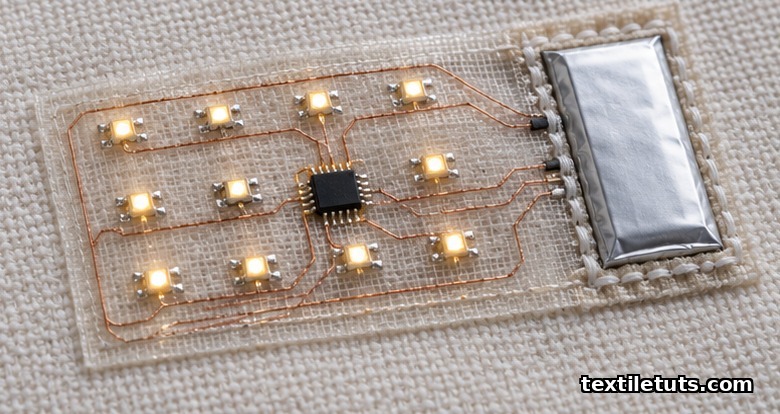
Battery capacity dictates wear time. A typical 150 mAh LiPo battery driving 100 LEDs at 5 mA each gives roughly 30 minutes of full-on operation. Pulse-width modulation at 1% duty cycle, with the LEDs at full brightness only for a few milliseconds per second, extends runtime to 8-12 hours. CuteCircuit’s “Sound Shirt” (2017), which translates sound into haptic vibration patterns, uses 16 micro-actuators and runs about 6 hours per charge.
Washability is the limiting factor for any LED garment. IPX7-rated encapsulation (submersion to 1 m for 30 minutes) is the borrowed benchmark from consumer electronics for “washable” electronics. Modules typically achieve this by potting the electronics in silicone and routing cables through sealed connectors. Most retail LED garments remain dry-clean-only because the encapsulation has not been independently verified against AATCC TM 135 wash conditions.
Standards landscape for fashion-grade smart textiles
Three published standards define the test regime for smart fashion apparel.
- ISO/TR 23383:2020, Textiles and textile products, Smart (Intelligent) textiles, Definitions, categorisation, applications and test methods. The foundational categorization document.
- ASTM F2913, Standard Terminology for Passive E-Textiles for Multi-Electrode Textile Sensing Applications. Defines the vocabulary for capacitive and resistive textile sensors.
- AATCC TM 100, Antibacterial Finishes on Textile Materials: Assessment of. The wash-and-wear durability benchmark for chromic and antimicrobial finishes applied by surface treatment.
No published standard yet governs LED-module washability. IPX7 is the borrowed benchmark from consumer electronics, and no AATCC or ISO working group has finalized a wet-test protocol specifically for textile-integrated electronic modules as of the date of this article.
Where the category is heading
The next 2-3 years will be defined by washability. As long as LED garments remain dry-clean-only and chromic prints lose 5-15% of effect per wash, smart fashion stays in the occasional-wear niche. Independent third-party durability certification under AATCC TM 135 or an ISO wash protocol is the missing step before mainstream retail adoption. Designers who solve that problem first own the category.
Frequently Asked Questions
Are smart textiles in fashion washable?
It depends on the technology. Stainless-steel conductive yarns survive 50+ AATCC TM 135 home wash cycles with negligible conductivity loss; silver-coated yarns lose 10-20% per 20 cycles. Thermochromic prints fade after 5-15 washes, becoming visibly uneven as surface capsules detach. LED-embedded garments are typically dry-clean-only unless the electronics module is independently IPX7-rated and the cables are routed through sealed connectors. Most retail smart-garment brands print “spot clean only” because the encapsulation has not been third-party verified.
How much do smart textile garments cost compared to regular fashion?
A 2024 industry survey of chromic and LED fashion SKUs reported retail prices 3-10x the cost of the equivalent non-smart garment, with a median premium around 4x. The premium reflects the cost of conductive yarn (5-10x conventional yarn), chromic encapsulation chemistry, and small-batch electronics assembly. A basic photochromic T-shirt retails for USD 30-60 versus USD 8-15 for a standard print tee in the same cut. The premium shrinks as production scales and component costs come down.
Do color-changing clothes work indoors?
Photochromic garments need a UV source. Most indoor lighting (LED, fluorescent, incandescent) emits too little UV-A to activate a photochromic print, so the effect stays dormant indoors and reveals itself in daylight. Thermochromic garments work indoors because they respond to skin heat or ambient room temperature. If a buyer wants a visible color change indoors, thermochromic is the working choice.
Are there safety concerns with LED-embedded clothing?
Three published concerns. First, lithium-polymer batteries in sealed garments can overheat if short-circuited; reputable brands keep the battery in a removable pouch rather than sealed into the lining. Second, hot LEDs held against skin for hours can exceed comfort thresholds; published thermal-imaging tests on small SMD LEDs at standard drive currents show surface temperatures consistent with body-temperature ranges, well below the 45 °C skin-burn threshold. Third, conductive traces touching broken skin can deliver a tactile shock from the drive circuit; designers mitigate this by covering traces with a non-conductive overlay fabric.
Can you tailor smart textile garments?
Cutting through conductive yarns, chromic prints, or embedded LED traces breaks the circuit, so off-the-rack smart garments are rarely designed for resizing. Published tailoring guidance from CuteCircuit and Anouk Wipprecht is to design the smart region as a removable module attached with snap connectors. The textile body can then be tailored conventionally and the smart insert is fitted afterward. Hand-sewing through conductive yarn with a fine needle is possible but breaks the yarn coating and raises resistance measurably at each puncture.
References
- International Organization for Standardization. ISO/TR 23383:2020, Textiles and textile products: Smart (Intelligent) textiles, Definitions, categorisation, applications and test methods. iso.org. Foundational categorization standard for smart textiles, including fashion applications.
- ASTM International. ASTM F2913, Standard Terminology for Passive E-Textiles for Multi-Electrode Textile Sensing Applications. astm.org. Vocabulary standard for e-textile sensor definitions and performance metrics.
- AATCC. TM 100, Antibacterial Finishes on Textile Materials: Assessment of. aatcc.org. Quantitative antibacterial test that is also borrowed as the wash-durability benchmark for chromic finishes applied to fabric.
- Tao, X. (ed.). Smart Textiles and Their Applications. Woodhead Publishing, 2015. Reference text covering conductive yarns, chromic systems, and integrated electronics in apparel.
- Stoppa, M.; Chiolerio, A. Wearable electronics and smart textiles: a critical review. Sensors 14(7), 2014. Peer-reviewed review of e-textile sensors, LED integration, and wash-durability data.
- Cui, Y. et al. Phase change materials in smart textiles: a review. MDPI Materials, 2022. Peer-reviewed review of PCM microencapsulation, melting range, and wash durability for fashion and apparel applications.
Editorial by Md. Asad Ullah (Meem), TextileTuts. Sources: ISO/TR 23383:2020, ASTM F2913, AATCC TM 100, and the cited MDPI, Sensors, and Woodhead Publishing references.


