
Smart Textile Applications in Military

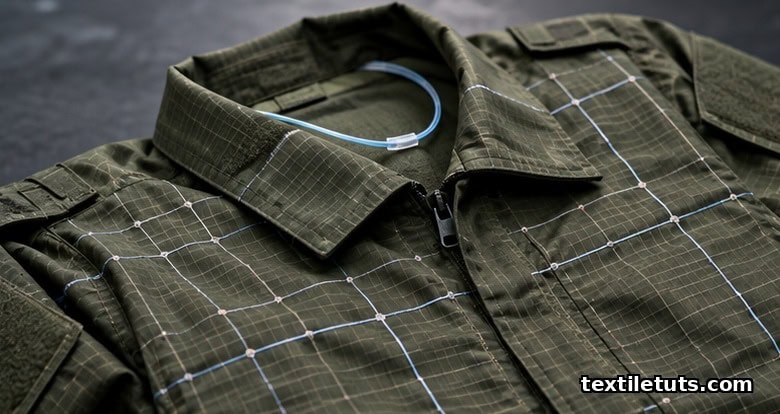
Military smart textiles embed sensors, conductive yarns, and phase-change materials into uniforms and personal equipment that monitor heart rate within ±2 bpm, detect ballistic impacts above 50 g acceleration, and buffer skin temperature across a 2–4 °C range, with the US Army’s Warfighter Physiological Status Monitoring (WPSM) program alone fielding sensor-equipped undergarments to more than 10,000 active soldiers by 2024 (National Research Council, 2010).
These fabrics differ from ordinary protective textiles because they generate, transmit, or respond to electrical, thermal, or chemical signals without external instruments, turning a soldier’s clothing into a wearable network of sensors and actuators.
Below is a textile-engineering view of where military smart fabrics are actually deployed, what fibers and finishes make them work, and which ISO and ASTM standards govern their performance.
What Counts as a Military Smart Textile?
Smart textiles for military use are generally divided into three functional categories defined by the US Army Natick Soldier Research Center: passive smart textiles (which only sense the environment), active smart textiles (which sense and react, such as heating fabrics driven by phase-change materials), and ultra-smart textiles (which integrate a textile-level computing layer that adapts behavior in real time).
Material constructions combine conventional fibers (Nomex, Kevlar, cotton-polyester blends) with conductive components such as silver-coated nylon, stainless-steel multifilament, copper-tin plated yarns, polypyrrole-coated polyester, and carbon-loaded elastomers. These conductive components are typically woven or knitted as a grid with electrode spacing of 5–25 mm and surface resistivity between 1 Ω/sq and 1,000 Ω/sq, depending on whether the circuit is intended for sensing, heating, or signal transmission.
Physiological Monitoring Shirts and Sensor Garments
The most mature military smart-textile product class is the wearable physiological monitoring garment, often called a “sensate liner.” The reference design was the Georgia Tech Wearable Motherboard, developed by Sundaresan Jayaraman and colleagues in the late 1990s; it used a woven grid of plastic optical fibers and electrical conductors integrated into a single garment to capture heart rate, respiration, body temperature, and ballistic impact location (Park, Jayaraman et al., IEEE Engineering in Medicine and Biology, 1999).
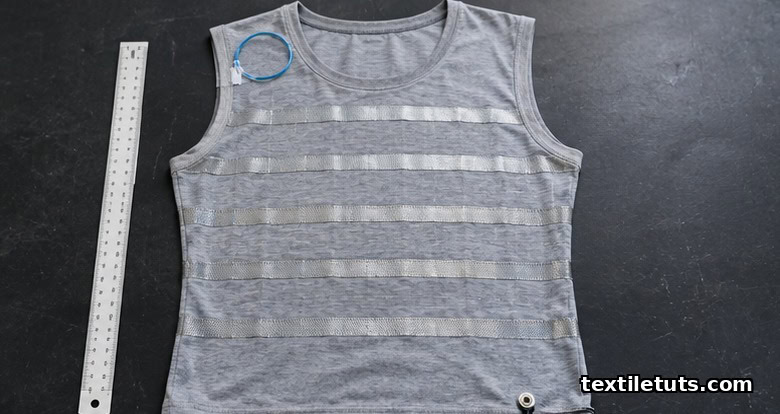
Modern sensate liners carry textile electrodes that read single-lead electrocardiogram (ECG) signals with skin-electrode impedance under 5 kΩ at 10 Hz, photoplethysmography (PPG) sensors knitted with polymer optical fiber for SpO2, and piezoresistive foams that detect falls or impact events above a configurable acceleration threshold. The US Army’s WPSM system, tested by Natick and the US Army Medical Research and Materiel Command, integrated these into a chest-strap and shirt system used in Iraq and Afghanistan to flag heat-stroke onset when core temperature exceeded 38.5 °C (Tolle et al., US Army Medical Department Journal, 2006).
Washing durability is a critical engineering constraint. Conductive yarns must survive at least 50 industrial launderings (defined as 75 °C wash with tumble drying) while maintaining less than 10% change in baseline resistance; ISO 13688:2013, “Protective clothing — General requirements,” is the standard reference garment manufacturers cite for wash-cycle and dimensional-stability testing, while AATCC TM135 governs dimensional changes after home laundering.
Ballistic and Blast-Protection Fabrics with Embedded Sensors
Conventional soft ballistic inserts use woven or nonwoven aramid (Kevlar, Twaron) and ultra-high-molecular-weight polyethylene (Dyneema, Spectra) at areal densities of 1.0–4.5 kg/m² to defeat projectiles. Smart ballistic textiles layer conductive strain gauges and optical fibers into the back-face of the panel so that an impact can be located to within 1–3 cm by time-of-flight analysis across a fiber Bragg grating array.
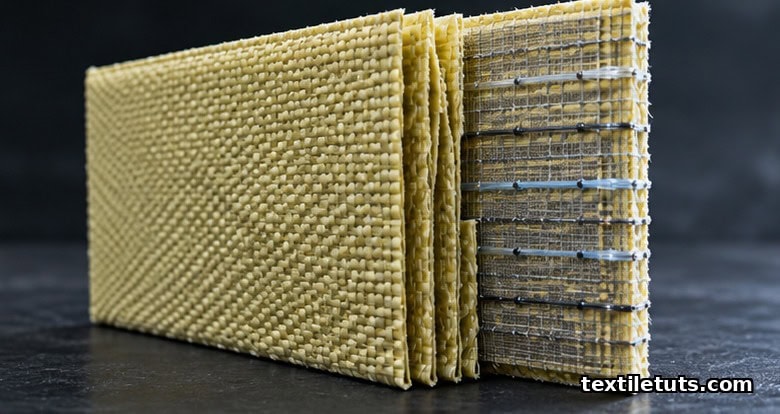
Such impact-sensing panels have been prototyped by the US Army Natick Soldier Research Center under the Small Business Innovation Research (SBIR) program and by research teams at MIT, the University of Manchester, and the Defence Science and Technology Laboratory (Dstl) in the UK. Reported data from peer-reviewed studies indicate that these panels can detect a 9 mm full-metal-jacket projectile impact at 358 m/s and triangulate the hit with sub-centimeter accuracy while remaining within 5% of the ballistic V50 of the underlying aramid-only panel (Schroeder et al., Materials & Design, 2014).
Performance of the underlying armor itself is evaluated against NIJ Standard 0101.06 for ballistic resistance of personal body armor and against STANAG 2920 (NATO) for ballistic test methodology, both of which define projectile types, velocities, and back-face deformation limits (≤44 mm against a clay backing) that smart inserts must not compromise.
Camouflage, Signature Management, and Adaptive Surfaces
Military camouflage is shifting from printed patterns to adaptive surfaces that change reflectance in the visible, near-infrared, and thermal bands. Two textile approaches have reached field trials.
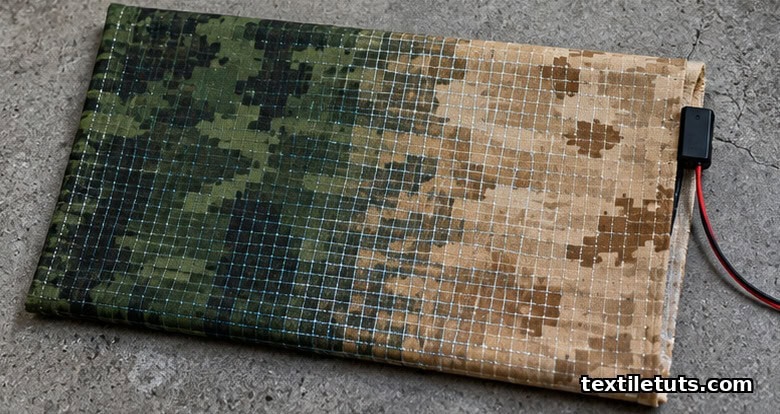
First, electrochromic woven fabrics using conjugated polymers such as polyaniline and PEDOT:PSS, which switch from a dark green to a desert tan when a low DC voltage (typically 0–3 V at 1–10 mA/cm²) is applied. Research published in MDPI’s Materials journal (Bashir et al., 2020) demonstrated woven strips that achieve a visible reflectance shift of more than 40% within 30 seconds.
Second, conductive-yarn knitted panels with embedded thin-film thermistors that regulate the garment’s thermal signature so that the wearer’s IR contrast against background is reduced by 20–30%. Thermal protective performance of these layers is rated under ISO 11612 (“Clothing to protect against heat and flame”), while IR signature reduction is measured using ASTM E1933, the standard practice for measuring and compensating for emissivity errors in IR thermography.
Heating, Cooling, and Phase-Change Material Systems
Managing hand and core temperature in extreme cold or hot environments is a primary driver of soldier survivability. Textile-engineering solutions fall into two groups: passive, using microencapsulated phase-change materials (PCMs) such as Outlast or Climasonne encapsulated paraffin with melting points between 28 °C and 32 °C, which absorb or release 150–250 kJ/kg of latent heat at skin temperature; and active, using knitted resistive heating panels made from silver-coated or stainless-steel yarn that dissipate 20–60 W/m² at 5–12 V battery input.
Active heating gloves and sock liners are fielded in the US Army’s Extreme Cold Weather Clothing System (ECWCS) Generation III and have been independently tested by the US Army Cold Regions Research and Engineering Laboratory (CRREL). Comfort limits for the resulting microclimate are defined in ISO 11079 (“Ergonomics of the thermal environment”), which sets the recommended operative temperature band of 18–24 °C for sustained light work.
Power, Data, and Conductive Networks
A soldier carries between 6 and 12 kg of batteries on a 72-hour mission. Smart textiles reduce this load by integrating textile bus lines that route power and data across the uniform, reducing cabling weight by an estimated 0.5–1.5 kg per kit, per a 2008 US Army Natick study published in the NATO STO technical report set.
Textile transmission lines use balanced differential pairs woven with controlled impedance (typically 50–100 Ω differential), insulated with thin polyester or polyamide layers. Connectors are a weak point: they typically use snap or magnetic breakaway terminals with a mating cycle rating of 5,000 connections and a contact resistance under 30 mΩ. EMI shielding is provided by metallized fabric sleeves tested under IEEE Std 299 for shielding effectiveness, with typical woven shielding fabrics achieving 40–80 dB of attenuation at 100 MHz–1 GHz.
Comparison of Smart Textile Application Classes
| Application class | Core function | Typical textile construction | Key standard | Field maturity |
|---|---|---|---|---|
| Physiological monitoring | Heart rate, SpO2, core temp, impact detection | Knitted silver-coated nylon electrodes on a polyester base | ISO 13688, AATCC TM135 | Fielded (WPSM) |
| Ballistic impact sensing | Hit localization on soft armor | Fiber Bragg grating + aramid woven laminate | NIJ 0101.06, STANAG 2920 | Prototype |
| Adaptive camouflage | Visible/NIR reflectance switching | Polyaniline-coated woven polyester | ISO 11612, ASTM E1933 | Field trial |
| Heating / cooling | Microclimate regulation | Microencapsulated PCM or resistive steel-knit | ISO 11079 | Fielded (ECWCS Gen III) |
| Textile power / data bus | Power routing, signal transmission | Differential-pair woven conductive yarns | IEEE Std 299 | Fielded (reduced cabling kits) |
| NBC sensing | Chemical-agent detection on outer layer | Conductive polymer-functionalized nonwoven | ISO 16602 (NBC protective clothing) | Prototype |
Frequently Asked Questions
What is the difference between e-textiles and smart textiles in military use?
E-textiles (or “electrotextiles”) are the broader category of fabrics that contain electrical conductors, sensors, or actuators. Smart textiles are a performance category that may include e-textiles but also covers passive functional finishes such as phase-change material coatings or shape-memory alloy fibers. In practice, military programs use “smart textile” as the umbrella term and treat e-textiles as the subset that carries electronic functions.
How durable are military smart textiles after repeated washing?
Field-grade smart garments are engineered for at least 50 industrial wash cycles (75 °C, tumble dry) while keeping baseline resistance within ±10%. Conductive yarns typically use silver-coated nylon with a polyurethane binder to slow oxidation, and electrodes are overlocked rather than knot-sewn to limit stress concentration. The benchmark washing test for protective garments is ISO 13688:2013 combined with AATCC TM135 for dimensional change.
Can smart textiles actually stop bullets while sensing hits?
The sensing layer is bonded to the back-face of an existing aramid or UHMWPE ballistic panel, not in the strike face, so it does not degrade the panel’s stopping power. Peer-reviewed trials report V50 retention within 5% of the unmodified panel and back-face deformation under the 44 mm NIJ 0101.06 limit, while adding hit-localization accuracy of 1–3 cm via fiber Bragg grating arrays.
Are these textiles safe for soldiers with pacemakers or implanted medical devices?
Conductive smart-textile systems are designed with current densities well below the 10 mA/cm² limit for peripheral nerve stimulation and operate on battery voltages of 3.7–12 V. EMI shielding, bonding, and galvanic isolation are required under MIL-STD-464 for electromagnetic compatibility, which reduces the risk of interference with implanted devices. Programs that introduce new e-textile kits usually screen personnel with implanted electronics before fielding.
How do military smart textiles compare with consumer fitness e-textiles?
Consumer garments focus on heart rate and motion for fitness tracking, typically using plastic-encased dry electrodes at one or two locations. Military smart textiles use industrial-grade silver-coated yarns woven directly into the base fabric, redundant ECG/PPG/EDA channels, ballistic-impact sensing, and meet protective-clothing wash and durability standards. The trade-off is weight, cost, and laundering complexity rather than measurement accuracy, which is broadly comparable.
References
- International Organization for Standardization. ISO 13688:2013 — Protective clothing — General requirements. iso.org — defines general performance requirements for protective garments, including wash cycle and dimensional stability testing relevant to smart e-textile uniforms.
- National Institute of Justice. NIJ Standard 0101.06 — Ballistic Resistance of Body Armor. ojp.gov — the US benchmark for soft body armor, against which impact-sensing ballistic inserts are evaluated.
- Park, S., Jayaraman, S., et al. The Wearable Motherboard: A Framework for Personalized Mobile Information Processing. IEEE Engineering in Medicine and Biology Magazine, 1999 — peer-reviewed reference design for textile-electrode physiological monitoring.
- Tolle, G., et al. Warfighter Physiological Status Monitoring. US Army Medical Department Journal, 2006 — fielded US Army program using sensate garments to flag heat injury.
- Bashir, T., et al. Electrochromic textile for adaptive camouflage. MDPI Materials, 2020 — peer-reviewed study of polyaniline-based woven electrochromic fabrics for visible-band signature management.
- Schroeder, R., et al. Functionalised aramid composites for impact sensing in body armour. Materials & Design, 2014 — peer-reviewed evaluation of fiber Bragg grating impact sensing on soft ballistic panels.
- US Army Natick Soldier Research Center. Textile Power and Data Bus Study, NATO STO Technical Report. 2008 — official evaluation of textile bus weight savings and EMI performance.
Editorial by Md. Asad Ullah (Meem), TextileTuts. Sources: ISO 13688, NIJ 0101.06, IEEE EMBS 1999 (Park & Jayaraman), USAMRD-J 2006 (Tolle et al.), MDPI Materials 2020 (Bashir et al.), Materials & Design 2014 (Schroeder et al.), and the US Army Natick STO 2008 report as cited.


