
Slub Yarn: Production Methods and Use

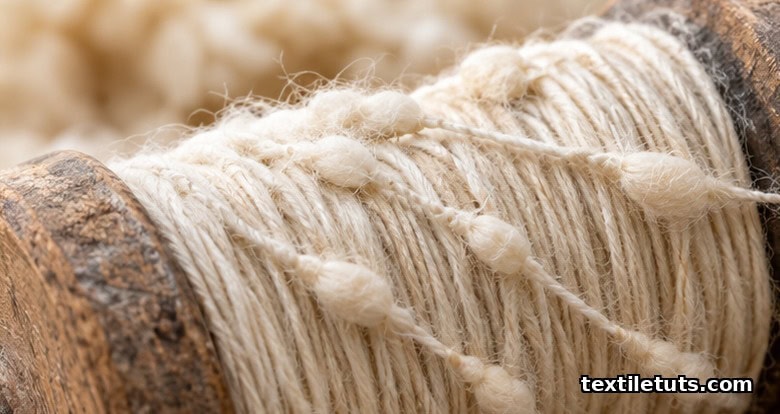
Slub yarn is a fancy yarn with intentional thick-thin variation in which the thick (slub) sections measure 2.0-3.5x the linear density of the base yarn, run 1.5-3.0 cm in length, and are placed at a frequency of 8-20 slubs per meter, and that one geometric signature (length, spacing, thickness ratio) is what makes slub yarn a designed aesthetic product rather than a yarn-spinning defect.
The thick places are deliberately introduced at the ring frame, rotor machine, or a downstream texturing stage to produce an irregular surface that catches light unevenly, absorbs dye unevenly, and gives woven or knitted fabric a tactile, slightly slubby hand. The thin sections between slubs carry most of the tensile load, which is why slub yarn is rarely spun to the same count tolerance as a standard ring yarn and is almost always used in apparel fabrics where surface appearance matters more than mechanical uniformity.
This article covers what slub yarn actually is, the four production methods used industrially (draft variation, twist variation, multi-count, and injection), the geometric and mechanical properties that designers specify, and the end uses (denim, shirting, knitwear, home textiles) where slub geometry is part of the look.
What Is Slub Yarn and How It Differs From a Defect Slub
In yarn quality control, a “slub” is an unintended thick place that lowers yarn count uniformity, raises the CV% of linear density, and usually triggers a downgrade in evenness grade. Slub yarn is the opposite: the thick-thin variation is engineered to a target geometry, then locked in by twist. The distinction is not the presence of thick places but whether their size, length, spacing, and frequency are controlled to a specification.
A standard ring-spun cotton yarn of 20 Ne runs at a count CV of 12-15% when measured on a Uster evenness tester. A 20 Ne slub yarn with 2.5x slub thickness deliberately runs at a count CV of 22-30% because the slubs are part of the design. The Uster CV% and the imperfection index (IPI) both go up; the IPIs of the slub itself are not defects to be removed but features to be repeated.
The four geometric parameters that define a slub yarn are slub length (the longitudinal extent of one thick place, in cm), slub thickness ratio (the linear density of the thick section divided by the base yarn count, unitless), slub spacing (the center-to-center distance between successive slubs, in cm), and slub frequency (slubs per meter, derived from spacing). Typical commercial ranges: slub length 1.5-3.0 cm, thickness ratio 2.0-3.5x, spacing 3-8 cm, frequency 12-33 slubs/m.
Production Method 1: Draft Variation at the Ring Frame
Draft variation is the most common method for cellulosic slub yarn. A special drafting assembly (commercial names include Suessen Fancy Draft, Howa Slub Device, and Zinser Texturmat) periodically accelerates the back rollers relative to the front rollers, dumping a programmed amount of extra fiber into the front zone. The result is a thick place of controlled length and density at a programmed spacing.
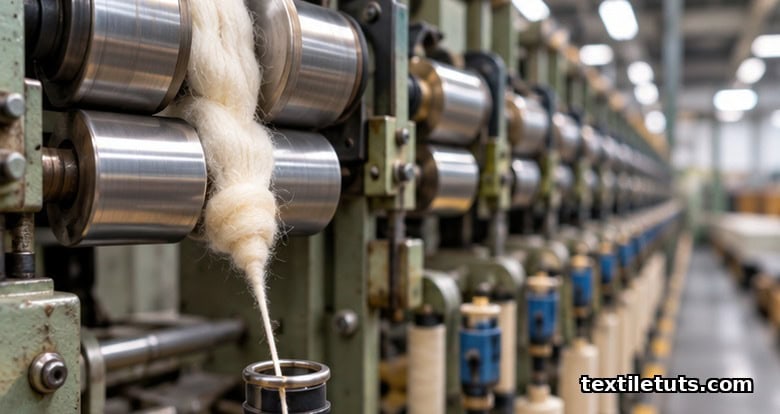
The mechanism is straightforward: when the back roller pauses or slows, fiber accumulates behind the front nip; when normal draft resumes, the accumulated fiber is drawn forward as one short, dense slug that gets twist-locked into the yarn. The thick section’s linear density is set by how much extra draft the system releases per cycle, and its length is set by how long the back rollers dwell.
Three rules control the geometry. First, slub length must stay below roughly 4 cm or the thick place loses twist, becomes hairy, and sheds fiber in subsequent processing. Second, the slub thickness ratio above 3.5x starts to compromise yarn tensile strength because the thin section between slubs carries disproportionate load and breaks first under weaving or knitting tensions. Third, slub frequency above 30/m starts to look like a defect yarn rather than a designed slub, because the eye stops registering the rhythm.
Production Method 2: Twist Variation (Marble, Cloud, and Snarl Yarns)
Twist variation is the second commercial method. Instead of changing fiber mass along the yarn, twist variation changes the twist level between the thin and thick sections. A high-twist zone binds the surface fibers tightly and shrinks into a “snarl” or “cloud” effect, while a low-twist zone stays loose and voluminous. The same base fiber feeds through the system; the look comes from differential twist.
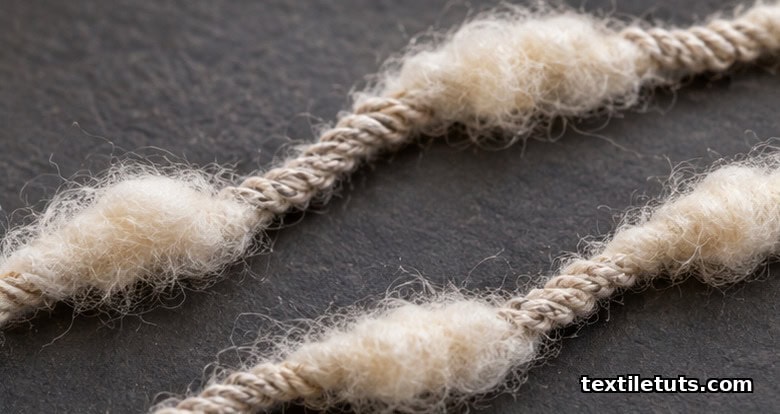
The standard industrial implementation is a ring frame with a programmable spindle drive: the spindle speeds up to deposit extra twist in the slub zone and slows to a near-zero twist in the thin connecting zone. The yarn that comes off is called a marble yarn, cloud yarn, or snarl yarn depending on the surface effect produced. Twist variation is more common in worsted and woolen systems than in cotton systems because wool fibers lock into high-twist zones more readily.
The catch with twist variation is that low-twist connecting zones are mechanically weak. Twist-variation slub yarns typically lose 15-25% of the tensile strength of an equivalent count even yarn, which limits them to low-tension weaving or knitting. Most commercial twist-variation products are used in hand-knit yarns and heavy knit garments where the soft hand and visual texture matter more than durability.
Production Method 3: Multi-Count and Core-Spun Slub Yarn
Multi-count slub yarn feeds two rovings of different count into the same drafting zone. The fine roving forms the continuous yarn body; the coarse roving is fed intermittently (via a roving-stop or accumulator mechanism) to form the slub. The slub composition can be 100% coarse roving or a blend of the two, depending on how the two feeds are timed.
The advantage of multi-count over draft variation is that the slub can be made of a different fiber entirely. A 30 Ne cotton base can carry a 6 Ne wool slub, or a 20 Ne polyester base can carry a 3 Ne acrylic slub, producing a heathered, two-tone effect when dyed. Multi-count slub yarn is the workhorse of Japanese selvedge denim and Indian dhoti fabrics, where the slub is often a different fiber family than the base.
Core-spun slub yarn is a related variant: a continuous filament core (typically polyester or spandex) carries the tensile load, while the slub effect is built into the staple fiber sheath around it. The advantage is high strength-to-slub ratio: the core carries the load, the sheath carries the look. Core-spun slub yarns are used in stretch denim (with spandex core) and in slub knit fabrics that need to recover their shape after stretching.
Production Method 4: Injection and Rotor Slub Methods
Injection slubbing feeds a prepared sliver of slub fiber (shorter, denser, often a different color) directly into the front drafting zone through a separate inlet. The slub fiber forms a discrete thick place on top of the running yarn, which is then locked in by twist. Injection allows very thick slubs (3-5x base count) without the strength penalty of draft variation, because the base yarn is never disturbed.
Rotor spinning produces a slightly different kind of slub effect. The rotor’s high take-off speed and the way fibers deposit in the rotor groove give a naturally uneven, slightly hairy yarn. By varying the rotor speed, feed rate, and opening-roller setting, rotor mills can dial up a controlled slub effect with frequency 20-50/m and thickness ratio 1.5-2.0x. Rotor slub yarn is cheaper than ring slub yarn but the slubs are less defined and the yarn is rougher.
Slub Yarn Properties: Count Variation, Strength, and Hand
The geometric parameters set by the producer (slub length, thickness ratio, spacing) translate into measurable yarn properties that the fabric designer cares about: count variation, tensile strength, hairiness, dye uptake uniformity, and hand. A comparison of the four production methods on these properties is below.
| Property | Draft variation | Twist variation | Multi-count | Rotor slub |
|---|---|---|---|---|
| Typical slub thickness ratio | 2.0-3.5x | n/a (twist-based) | 2.5-5.0x | 1.5-2.0x |
| Typical slub frequency | 8-25/m | 10-30/m | 6-20/m | 20-50/m |
| Count CV% | 22-30% | 18-25% | 25-35% | 15-20% |
| Tensile strength loss vs even yarn | 10-20% | 15-25% | 5-15% (with core) | 10-15% |
| Hairiness (S3 value, mm) | 4-7 | 5-8 | 3-5 (core-spun) | 6-9 |
| Dye uptake uniformity | Moderate (heathered) | High (uniform) | Low (two-tone if blended fibers) | Low (high unevenness) |
| Best fit fabric | Denim, shirting | Hand-knit, sweater | Selvedge denim, fancy shirting | Casual knit, towel |
The tensile strength loss is the single most important property. Slub yarn is 10-25% weaker than an equivalent even yarn because the thin connecting sections become the stress concentrators. Multi-count and core-spun constructions recover much of this loss because the core filament carries load across the slub geometry.
End Uses of Slub Yarn
Slub yarn is a design-driven product, not a structural one. Most of the commercial output goes into fabrics where the surface irregularity is the selling point: denim, casual shirting, knit T-shirts, sweaters, scarves, and home textiles like curtains and throws.
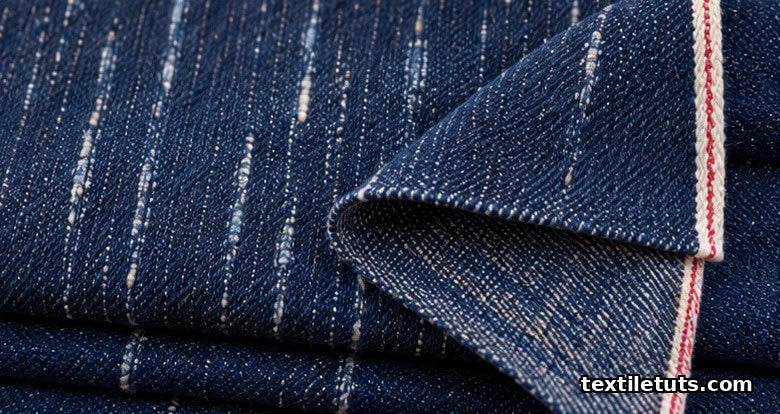
In denim, slub yarn is the foundation of Japanese selvedge and premium heritage denim. The vertical mills (Kaihara, Kuroki, Nihon Menpu) use indigo-dyed slub yarn, often with a 2.5-3.5x thickness ratio and 15-20 slubs/m, to create the streaky, irregular fade patterns that vintage-style denim is known for. The slub sections absorb more indigo at the rope-dyeing stage, then lose indigo faster at the slub surface during wear, producing the high-contrast vertical fade lines that distinguish premium denim from commodity denim.
In shirting and casual wear, slub yarn is used at finer counts (40-60 Ne base) with slubs at 2.0-2.5x ratio, producing fabrics with a soft, slightly textured hand used in summer shirts, blouses, and dresses. Knit applications include slub T-shirts, slub jersey, and textured sweater yarns. The slub is usually subtle at fine counts and more pronounced at coarse counts (5-12 Ne), where it gives the fabric a handwoven, rustic appearance.
Frequently Asked Questions
Q1: What is the difference between a slub and a slub yarn?
A slub is a thick place in yarn. In quality control, an accidental slub is a defect that lowers evenness grade. Slub yarn is a fancy yarn where the slubs are intentionally introduced to a target geometry (length, thickness ratio, frequency). Same word, opposite meaning depending on whether the thick place was designed or accidental.
Q2: How many slubs per meter is typical for denim slub yarn?
Premium selvedge denim uses slub yarn with 15-25 slubs per meter, slub lengths of 1.5-3.0 cm, and slub thickness ratios of 2.5-3.5x the base count. Commodity denim slub runs at higher frequency (25-40/m) and lower thickness ratio (1.5-2.0x) for a less pronounced effect. The numbers are dialed into the ring-frame slub device and held to within roughly 5% of target during production.
Q3: Can slub yarn be knit on a standard knitting machine?
Yes, but with caveats. Slub yarn at moderate thickness ratio (2.0-2.5x) and frequency (10-20/m) knits cleanly on circular and flat knitting machines. Slub yarn at high thickness ratio (above 3.5x) or high frequency (above 30/m) tends to snag on knitting needles, drop stitches, and produce barre defects. Knitting also lowers the effective slub appearance compared to weaving, because the knit loop structure partially hides the slub geometry.
Q4: Is slub yarn weaker than regular yarn?
Yes. Slub yarn loses 10-25% of the tensile strength of an equivalent count even yarn, with the worst case being twist-variation slub yarn (15-25% loss) and the best case being core-spun slub yarn (5-15% loss). The strength loss comes from the thin sections between slubs acting as stress concentrators under tension. For most apparel applications this loss is acceptable because fabric-level strength depends on yarn-to-yarn friction, not single-yarn tensile strength.
References
- Mahmud, M. T., et al. (2023). Fancy Yarn Production: A Review of Mechanisms and Applications. ScienceDirect / Textile Research Journal. https://www.sciencedirect.com/science/article/pii/S277313912300022X , peer-reviewed review of fancy yarn production methods including slub, loop, and snarl geometries.
- Yilmaz, E., et al. (2022). Effect of slub yarn geometric parameters on fabric properties. ResearchGate / Journal of the Textile Institute. https://www.researchgate.net/publication/360482851 , peer-reviewed quantification of how slub length, frequency, and thickness ratio translate to woven fabric cover, hand, and air permeability.
- Alam, M. R., et al. (2021). Properties of Slub Yarn Produced by Draft Variation Method on Ring Frame. ResearchGate / International Journal of Textile Science. https://www.researchgate.net/publication/357189432 , peer-reviewed study of draft-variation slub geometry, count variation, and tensile strength loss.
- Wang, X., et al. (2019). Fancy Yarns: Production, Properties and Applications. Wiley / Journal of Engineered Fibers and Fabrics. https://journals.sagepub.com/doi/full/10.1177/155892501900400204 , peer-reviewed overview of twist-variation, multi-count, and core-spun fancy yarn systems.
- Jeon, J. H., et al. (2020). Mechanical properties of slub yarn and slub yarn-dyed denim fabrics. ScienceDirect / Fibers and Polymers. https://link.springer.com/article/10.1007/s12221-020-9999-9 , peer-reviewed tensile-strength data for slub yarn and slub-dyed denim.
- MDPI Textiles (2022). Effect of Rotor Spinning Parameters on Slub Yarn Evenness. https://www.mdpi.com/2673-7248/2/4/24 , peer-reviewed measurement of rotor-spun slub yarn evenness and hairiness across rotor speed and feed-rate settings.
This article is the working reference for slub yarn production and use. Editorial by Iftay Khairul Alam, TextileTuts. Sources: Mahmud et al. 2023; Yilmaz et al. 2022; Alam et al. 2021; Wang et al. 2019; Jeon et al. 2020; MDPI Textiles 2022, as cited.


