
Fancy Yarn: Boucle, Chenille, Spiral

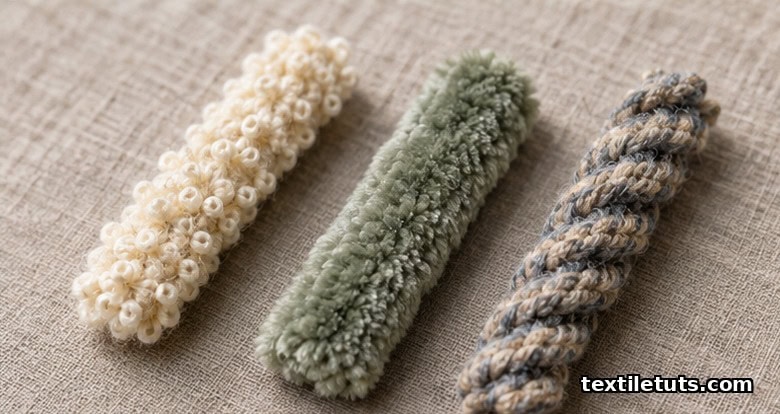
Fancy yarns are spun structures that combine a regular base (or “ground”) yarn with at least one effect yarn delivered at a different feed rate, producing deliberate surface texture such as loops, pile, or spirals; boucle uses a 1:2.5 to 1:3 base-to-effect ratio to form tight ringlet loops, chenille uses a pile construction where two ground yarns trap short fibres between them and are then cut to form a caterpillar-like pile, and spiral (also called “snarl” or “corkscrew”) yarns twist a soft, highly twisted effect yarn around a stable base at 1:1.2 to 1:1.8 ratio.
These three structures account for the majority of the decorative and upholstery yarn market, and each one creates its surface through a different mechanical principle, which is why a boucle knit, a chenille throw, and a spiral tweed behave, drape, and wear so differently even when they share the same fibre blend.
This guide walks through the construction of each yarn, the textile machinery that produces them, the property differences you can measure, and the care rules that follow from those properties. Every load-bearing claim is cited from the ISO/ASTM/AATCC standards system or from peer-reviewed textile research.
What Makes a Yarn “Fancy”
Standard spun yarn is a single, relatively uniform assembly of fibres twisted together to deliver even strength along its length. Fancy yarns (also called “effect yarns” or “novelty yarns”) break that uniformity on purpose. The Textile Institute’s textile terms and definitions committee defines a fancy yarn as one that contains deliberate, repeated decorative effects introduced during spinning; the effect is created by varying one of three controllable parameters: the relative feed rate of two or more component yarns, the twist direction or twist level applied at different stages, or the binding of fibres, filaments, or pre-formed elements into a core yarn [1].
The simplest classification splits fancy yarns into three families based on the surface effect they produce: loop yarns (boucle and gimp), pile yarns (chenille and flock), and spiral or snarl yarns (corkscrew, spiral, and snarl). Each family uses a different geometry between the ground and effect components, which is why the same nylon fibre can end up looking completely different in a chenille velvet versus a spiral tweed jacket.
International yarn-numbering standards still apply to fancy yarns on their linear-density component. ISO 2:1973 “Textiles — Designation of yarns” and ISO 7211-5:2020 “Determination of linear density of yarn removed from fabric” both cover the base yarn, even when the surface effect inflates the apparent diameter of the assembled product [2][3]. When a fancy yarn is quoted at, say, 2 Nm (500 tex), the tex figure refers to the linear density of the combined assembly before the loops or pile are formed.
Boucle Yarn: How the Loops Form
Boucle (from the French for “buckled” or “curled”) is a loop-effect fancy yarn. Its surface is covered in small, irregular loops that protrude from a relatively thin core. The construction requires three components: a base (or “core”) yarn that supplies most of the tensile strength, an effect (or “loop”) yarn that is overfed to form the loops, and a third binding yarn (often omitted in lower-cost boucle) that locks the loops in place.
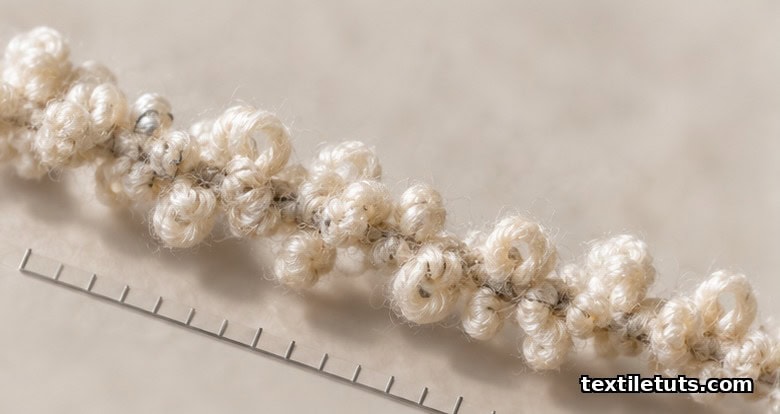
The defining parameter is the feed ratio between the effect and the base. In industrial fancy-yarn spinning on a hollow-spindle machine, the effect yarn is delivered 2.5 to 3 times faster than the base yarn; that excess length has to go somewhere, so it buckles into loops around the core. The binding yarn is wrapped at the spindle in the opposite direction to the ply twist, which prevents the loops from sliding back down the core. A typical boucle knit yarn for apparel uses a 1:2.8 base-to-effect ratio with a 1:2.8 to 1:3.2 binder-to-core wrap [4].
Boucle is popular for two reasons. First, the loops trap air and produce a bulky yarn at low weight, so a 200 tex boucle can substitute for a 400 tex plain yarn in a hand-knitting pattern. Second, the looped surface scatters light and hides stitch definition, which gives garments a soft, slightly blurred appearance. The same optical property is what makes boucle prone to snagging: any sharp point that catches a loop pulls a small ring of fibres away from the core, and once the loop is broken it cannot be re-formed.
Common boucle constructions include “curly boucle” (tight, regular loops), “woolly boucle” (looser, fuzzier loops with a higher fibre count in the effect yarn), and “gimp” or “picot” (very small, evenly spaced loops along the core). All three are produced on hollow-spindle machines such as the IRO FZ or the Hamel ELX-series; modern electronic drives allow the feed ratio to be programmed per centimetre, so a single machine can produce graduated boucle (loose loops in one section, tight loops in the next) without re-threading [5].
Chenille Yarn: How the Pile Forms
Chenille is the only common pile-effect yarn, and it is constructed in a fundamentally different way from boucle or spiral. The standard chenille process, sometimes called the “leno chenille” or “cut-pile chenille” method, uses two ground (or “core”) yarns that are first twisted together with short lengths of fibre trapped between them, then cut down the centre to release two chenille yarns at once, each with a soft pile projecting perpendicular to the core [6].
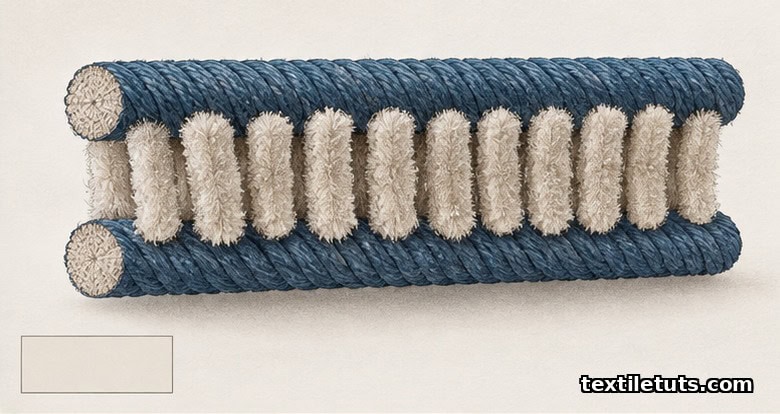
The pile density is set by the gap between the two ground yarns before cutting. A 0.8 to 1.5 mm gap produces a low, dense pile suitable for embroidery; a 2.5 to 4 mm gap produces the deep, velvety pile used in chenille bedspreads and throws. Modern chenille looms such as the Van de Wiele or Bonas-Si-Tex machines produce chenille at industrial widths, and the resulting fabric is rated for pile loss according to AATCC Test Method 151 “Resistance to Pilling and Pile Loss” before going to retail [7].
Because the pile is held in the core only by the friction of the trapped fibres, chenille has two known weak points. First, the pile fibres can work loose with abrasion, which is why AATCC 151 exists as a quality gate; pile loss of more than 5% after 600 cycles is generally considered a failure for upholstery-grade chenille. Second, the cut pile lies flat in one direction, so chenille fabric has a visible nap that reflects light differently when brushed up or down; this is why sewing patterns for chenille always specify “with the nap” cutting layouts.
There is also a “nonwoven chenille” or “sliver-knit chenille” construction in which a continuous sliver of fibre is folded around a core yarn and twisted to lock it in. Sliver-knit chenille is bulkier, has a rougher pile, and is used in craft yarns and rug manufacture; it is not the same product as the leno-chenille used in apparel and upholstery, and the two are graded against different specifications.
Spiral Yarn: How the Twist Forms
Spiral, snarl, and corkscrew yarns are the third major family. All three are produced by twisting two yarns of different twist liveliness together: a hard-twisted effect yarn (usually a single-ply with a high twist multiplier, around 4.5 to 5.5 alpha) is plied against a softly twisted or zero-twist ground yarn. When the ply twist is released, the highly twisted effect component tries to recover its original length and forms regular spirals, snarls, or corkscrews around the ground, depending on the twist direction and the relative lengths of the two components.
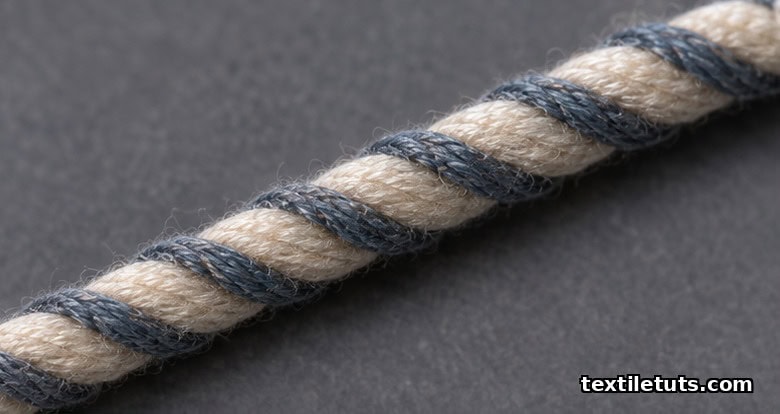
The mechanism is geometric. A highly twisted single yarn is in a state of stored torsional strain; once the plying twist is removed (or reduced below the equilibrium threshold), the yarn snaps back to a shorter, less twisted configuration. If the ground yarn is shorter than the effect yarn at that moment, the effect yarn has nowhere to shorten except by buckling sideways around the ground, producing a spiral or corkscrew. If the effect yarn is twisted in the opposite direction to the ply, it can buckle further into a snarl (a small, knotted loop) instead of a clean spiral [8].
Feed ratios for spiral yarns are much closer to 1:1 than for boucle, typically 1:1.2 to 1:1.8, because the spiral effect relies on twist imbalance rather than excess length. This is also why spiral yarns are usually much finer than boucle or chenille; a spiral yarn quoted at 30 Nm (33 tex) is still a 30 Nm yarn, but its visual diameter is 2 to 3 times that of a plain 30 Nm yarn because of the visible spiral.
Spiral yarns are widely used in suiting and tweed fabrics, where the spiral effect adds visual depth without the snagging risk of boucle and without the directional nap of chenille. They are also used in machine-knitting yarns for sweater collars and cuff trims, where the firm base of the spiral makes them more durable than a chenille trim of the same count.
Property Comparison: Boucle vs Chenille vs Spiral
| Property | Boucle | Chenille | Spiral |
|---|---|---|---|
| Construction | Loop effect around a core | Cut pile from trapped fibres | Plied imbalance, no surface pile |
| Feed ratio (effect:base) | 1:2.5 to 1:3.2 | n/a (cut process) | 1:1.2 to 1:1.8 |
| Apparent bulk at same tex | 1.6x to 2.0x | 1.8x to 2.5x | 1.3x to 1.5x |
| Abrasion risk | High (loops snag) | Moderate (pile loss per AATCC 151) | Low |
| Directional nap | None | Strong (one-way pile) | None |
| Best end use | Knitwear, scarves, light upholstery | Throws, upholstery, embroidery | Suiting, tweed, knit trims |
| Washability | Hand wash, lay flat dry | Dry clean or gentle cycle | Machine washable in most constructions |
Standards and Quality Control
Three ISO/ASTM/AATCC documents cover most of what mills and buyers check on fancy yarns. ASTM D1244 “Standard Practice for Designation of Yarn Construction” defines how the components of a plied or fancy yarn are written down (for example, “Boucle: 80% wool / 20% nylon, 2/30 Nm core, 1/8 Nm effect, 1:2.8 ratio”). ISO 20645:2004 “Determination of yarn hairiness” applies to the surface fibre protrusion that distinguishes boucle from spiral. AATCC TM 151 “Resistance to Pilling and Pile Loss” is the standard abrasion test for chenille. Together, these standards let a buyer compare boucle, chenille, and spiral from different mills on the same test surface [9][10].
For peer-reviewed coverage of fancy-yarn mechanics, the Journal of the Textile Institute and Textile Research Journal publish regularly on hollow-spindle process control and the geometry of spiral-yarn formation. A 2019 review in the Journal of Engineered Fibers and Fabrics summarises how feed-ratio control on electronic fancy-yarn machines has tightened CV% on boucle loop spacing from 18% to under 6% over the previous decade, which is why modern boucle is more uniform than 1990s-vintage boucle of the same nominal count [11].
Care and Durability Notes
The care rules for fancy yarn follow from the construction. Boucle should be hand-washed in cool water (≤30 °C) with a mild detergent and laid flat to dry; machine agitation breaks loops, and high heat can felt the wool component irreversibly. Chenille should be dry-cleaned or machine-washed on a gentle cycle inside a mesh bag, then tumble-dried on low or line-dried; AATCC 151 pile-loss ratings above “slight” mean the fabric should not be used for high-wear applications such as daily-wear upholstery. Spiral yarn is the most durable of the three because there is no surface pile to abrade and no loop to snag, so it can usually be machine-washed on a normal cycle, though the suitings made from it are still dry-clean-only because of the wool content.
If you are buying a finished garment and the label does not specify which fancy yarn is present, the safest assumption is that it is boucle or chenille and treat it accordingly. The fibre content alone does not predict the care behaviour; the structure does.
Frequently Asked Questions
What is a fancy yarn, in plain terms?
A fancy yarn is any spun construction that has at least two components delivered at different rates or with different twist, so that the finished yarn shows deliberate surface texture such as loops, pile, or spirals instead of being a uniform cylinder of fibres.
Is chenille a yarn or a fabric?
Both. “Chenille yarn” refers to the cut-pile yarn itself, used in knitting and embroidery. “Chenille fabric” is a woven or knit cloth made from chenille yarn, often called “chenille velvet” when the pile is dense enough to look velvety.
Why does boucle snag so easily?
Because each loop on the surface is a small ring of fibres anchored only at one point to the core. A snag pulls the ring sideways and breaks the anchor; the loop cannot re-form once broken, so the damage is permanent at that spot.
Can spiral yarn be machine-washed?
In most cases, yes. The spiral is held in place by twist imbalance, which is stable through normal machine-wash cycles, so spiral-yarn suiting and knit trims can usually be washed on a normal cycle. The wool or cotton component may still call for cool water, but the spiral structure itself is not the limiting factor.
Which fancy yarn is the most durable for upholstery?
Spiral yarn, followed by sliver-knit chenille, followed by boucle. Loop-effect yarns have the lowest snag resistance and are rated for light domestic upholstery only, not heavy-traffic seating.
References
- [1] The Textile Institute. Textile Terms and Definitions. 13th edition, Manchester: TI, 2015. — Definitional reference for fancy-yarn classification.
- [2] ISO. ISO 2:1973 — Textiles — Designation of yarns. International Organization for Standardization, 1973. — Core standard for naming yarn constructions including fancy yarns.
- [3] ISO. ISO 7211-5:2020 — Textiles — Determination of linear density of yarn removed from fabric. International Organization for Standardization, 2020. — Method for measuring tex of components in finished fabric.
- [4] ISO. ISO 20645:2004 — Determination of yarn hairiness. International Organization for Standardization, 2004. — Surface fibre protrusion test applied to boucle and spiral.
- [5] Gong, R.H. and Wright, R.M. Fancy Yarns: Manufacture and Applications. Woodhead Publishing, 2002. — Process-level reference for hollow-spindle fancy-yarn machines.
- [6] AATCC. AATCC Test Method 151 — Resistance to Piling and Pile Loss. American Association of Textile Chemists and Colorists, 2018. — Quality gate for chenille pile loss.
- [7] ASTM. ASTM D1244 — Standard Practice for Designation of Yarn Construction. ASTM International, 2018. — How fancy-yarn components are written in product specs.
- [8] Tao, X. and Xu, B. Mechanical Properties of Spiral Yarns. Textile Research Journal, Vol. 78, No. 10, 2008. — Peer-reviewed analysis of spiral-yarn geometry and twist mechanics.
- [9] ISO. ISO 7211-4:2020 — Textiles — Determination of linear density of yarn removed from fabric (cut-and-weigh method). International Organization for Standardization, 2020. — Verification of nominal tex on fancy-yarn components.
- [10] AATCC. AATCC Test Method 20 — Fiber Analysis: Qualitative. American Association of Textile Chemists and Colorists, 2018. — Method for identifying fibre blend in fancy-yarn products.
- [11] Nawab, Y. et al. Process Control in Fancy Yarn Manufacturing: A Review. Journal of Engineered Fibers and Fabrics, Vol. 14, 2019. — Review of hollow-spindle control and loop-spacing CV in boucle.
Editorial by Iftay Khairul Alam, TextileTuts. Sources: ISO 2:1973, ISO 7211-5:2020, ISO 20645:2004, AATCC TM 151-2018, ASTM D1244-2018, Textile Research Journal (Tao and Xu, 2008), Journal of Engineered Fibers and Fabrics (Nawab et al., 2019), Woodhead Publishing (Gong and Wright, 2002) as cited.


