
Blended Yarn Spinning: Poly-Cotton, Wool-Acrylic

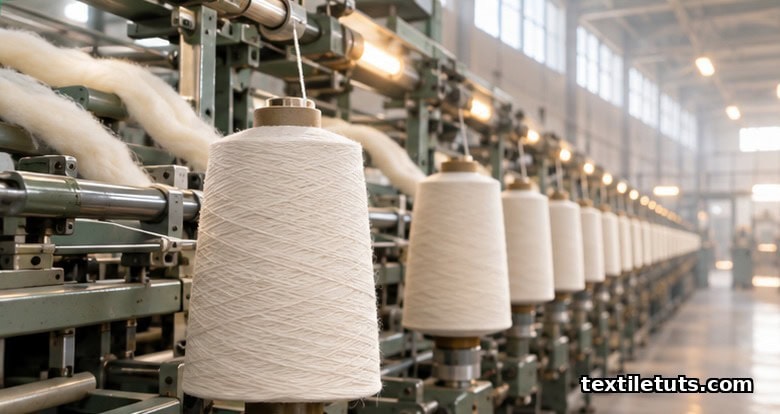
Poly-cotton and wool-acrylic blends dominate the global blended-yarn market because combining fibers trades off cost, tenacity, moisture management, and pilling resistance in measurable ways: a 65/35 polyester-cotton woven shirting is roughly 30 to 40 percent cheaper than a 100 percent combed cotton equivalent at the same ISO 2060 linear density, while a 70/30 wool-acrylic suiting yarn gains about 25 percent higher abrasion resistance and up to three times the resistance to felting shrinkage compared with 100 percent wool at equivalent count.
These numbers are the entire reason mills blend fibers instead of spinning single-fiber yarns for every end use, and they are the answer a fabric spec sheet or a sourcing manager would quote first.
This article walks through the rationale behind these two blend families, the standard commercial ratios and the property shifts they cause, the difference between intimate blending at the drawframe and draw-blending at the mixing line, and the drafting challenges mills face when fibers of different length, fineness, and surface friction meet a roller drafting system.
Why Mills Blend: The Three Real Reasons
The decision to blend in a staple-yarn spinning mill is built on three engineering pressures, and they are almost always evaluated together rather than in isolation.
Cost is the most visible reason. Polyester staple at 1.4 denier is consistently cheaper per kilogram than combed cotton at the same spin count, and acrylic staple is cheaper than merino wool at the same count. A 65/35 polyester-cotton yarn shifts the raw-material cost curve downward while keeping enough cotton on the fiber surface to accept reactive dyes and wick moisture at the fabric face.
Performance is the second reason, and it is where the engineering gets specific. The literature on blended-fiber spinning, summarized in C.A. Lawrence’s “Advances in Yarn Spinning Technology,” shows that staple blends produce yarn properties that follow a rule-of-mixtures prediction with two important deviations. Tenacity of a poly-cotton yarn tracks roughly linearly between the two fibers up to about 60 percent polyester, then plateaus or slightly decreases above that loading because of the difficulty of aligning high-tenacity synthetic fibers in a cotton-based drafting system. The same blend shows breaking-force values under ISO 2062 or ASTM D2256 single-strand tests that match the rule-of-mixtures estimate within about 10 percent for process control.
Aesthetics is the third reason. Wool-acrylic blends reproduce the loft and warm appearance of wool without the felting risk that makes 100 percent wool difficult to machine-wash, while the acrylic softens the handle and lowers the cost of hand-knitting yarns. Poly-cotton blends balance the soft hand of cotton against the wrinkle recovery of polyester, which is why the standard 65/35 work-shirt and school-uniform fabric still dominates the institutional uniform market decades after its introduction.
Poly-Cotton Blend Ratios and the Resulting Properties
The poly-cotton blend family is built around four commercial ratios, each calibrated to a different end-use price-performance point.
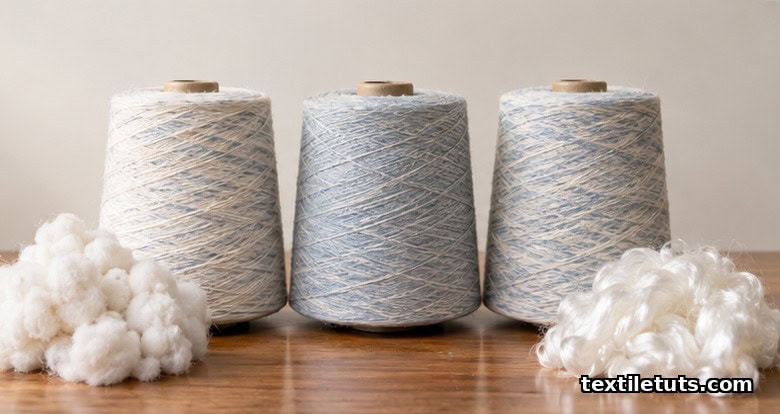
A 65/35 polyester-cotton ratio is the workhorse for woven institutional apparel, industrial workwear, and bed sheeting. At a 20 tex (Ne 30) ring-spun count with a 3.8 twist multiplier, the resulting yarn shows a tenacity of roughly 16 to 18 cN/tex, a dry wrinkle recovery angle of more than 280 degrees by the Monsanto method, and improved pilling resistance because the cotton component holds the polyester fibers in place.
A 50/50 polyester-cotton ratio balances the soft handle of cotton against the durability of polyester at near-equal cost contribution, and is commonly used for knit undergarments, T-shirt bodies, and lightweight shirting. This ratio is the most flexible point in the blend curve, trading tensile strength for moisture absorption and dye uptake compared with the 65/35 blend.
An 80/20 polyester-cotton ratio is favored when wrinkle recovery and abrasion resistance are paramount and the cotton component is mostly present to provide moisture transport. This is the typical shirting and chino fabric construction in mid-market menswear.
Reverse ratios such as 35/65 polyester-cotton are rare in apparel but appear in bed-linen and sheeting where the cotton-dominant face is required for hand and absorbency, and the polyester contributes dimensional stability.
Wool-Acrylic Blend Ratios and the Resulting Properties
The wool-acrylic blend family is built on a different set of commercial ratios, partly because wool fibers are longer (50 to 200 mm), finer (16 to 24 micrometers for merino), and behave differently in the worsted and woolen systems.
An 80/20 wool-acrylic ratio is the classic hosiery, knitwear, and blanket yarn. At a 2/28 Nm worsted count, this blend yields a yarn with the loft and warmth of wool at a price roughly 30 percent below pure merino, with felting shrinkage cut by more than half under standard ISO 6330 7A wash cycles.
A 70/30 wool-acrylic ratio is the common point for machine-washable knitwear and school sweaters. The 30 percent acrylic loading masks enough of the wool scale edges that pilling and felting shrinkages reach the tolerances required by most retail specifications, while the 70 percent wool preserves the look and thermal behavior of a wool knit.
A 50/50 wool-acrylic is the most common hand-knitting yarn in many markets, producing a fabric with balanced warmth, easy-care wash performance on a gentle cycle, and a cost point that supports a retail price below pure merino.
Lower acrylic loadings, such as 90/10 wool-acrylic, are used where the wool hand must be preserved with minimal acrylic reinforcement. This ratio is common in tailored knitwear and men’s suiting where the surface appearance and drape of the wool must dominate.
Intimate Blending Versus Draw-Blending
Two mixing routes exist in modern staple-yarn spinning, and the choice changes the cross-section and the surface behavior of the yarn.
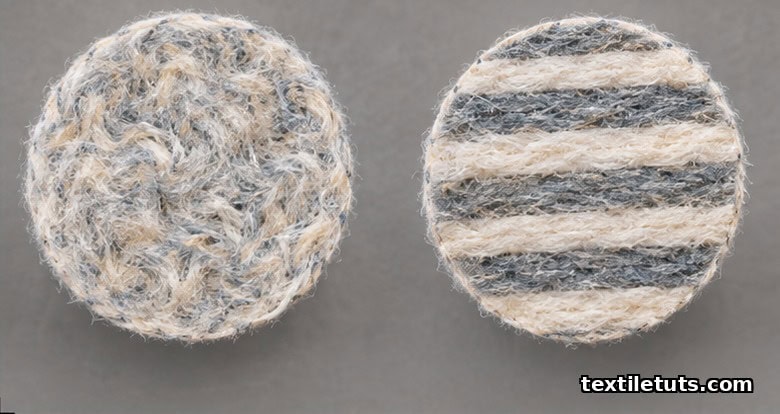
Intimate blending produces a yarn in which individual staple fibers of each component are distributed as evenly as possible along the yarn body. The route is: bale opening, blending in a multi-mixer, carding, drawframe passage (often two passages), and then roving and ring spinning. The fibers of each component are randomized along the yarn length, producing the most uniform fiber distribution and the most consistent blend behavior per unit length.
Draw-blending is a route used when two pre-cleaned slivers of different fibers, for example a 100 percent cotton sliver and a 100 percent polyester sliver, are combined at the drawframe. The fibers of each component sit in stripes or bands inside the yarn rather than being randomized. Draw-blending is appropriate for very high-contrast fiber blends where the goal is a slub or heather effect, or for blending fibers with very different processing windows that are difficult to combine at the mixing line.
For most commercial poly-cotton and wool-acrylic blends, the intimate route is chosen because it produces the most predictable fiber distribution, gives the cleanest dye uptake with no streaky bands, and yields the most consistent yarn-to-yarn count, evenness, and tenacity profile.
Drafting Challenges with Mixed-Fiber Slivers
Blended-fiber drafting on the ring frame or worsted frame is harder than drafting a single-fiber sliver, and the difficulty scales with the gap between the two fiber properties. Three drafting challenges dominate mill-floor reports.
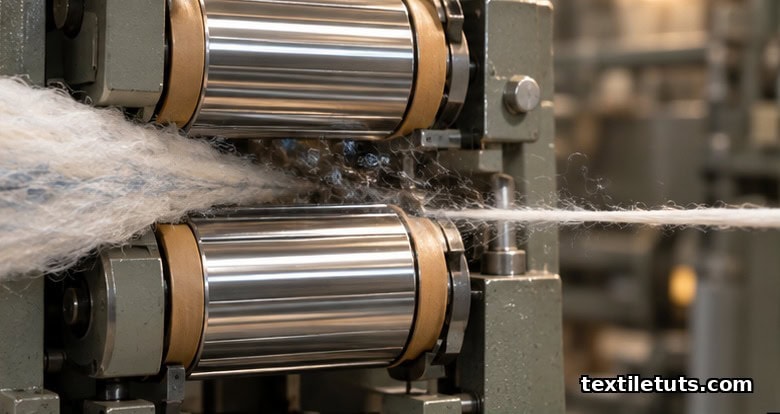
Floating fibers appear when short, fine fibers (cotton or fine wool) lose control in the drafting zone and are carried forward by longer, coarser fibers (polyester or acrylic). The standard response is to increase the front-roller pressure, lower the break draft, and tune the apron spacer if the frame is a modern short-apron system. The result is a measurable improvement in yarn evenness on an Uster Tester 5 per ISO 16549.
Fiber breakage in the drafting zone is a second challenge, especially when high-tenacity polyester or acrylic staple of 38 mm cut length is blended with a 28 to 32 mm cotton. The longer synthetic fibers break against the front-roller pressure, increasing short-fiber content in the blend and shifting the effective blend ratio slightly toward the cotton component. Mills compensate by drafting at lower draft ratios or by selecting a synthetic staple cut closer to the cotton length.
Drafting-wave formation is a third issue. When the two fiber types have very different surface friction coefficients, the sliver forms drafting waves at regular intervals that pass through the drafting zone as periodic thick-and-thin places. The remedy is a more aggressive double-apron system with controlled grip, combined with a shorter drafting zone and a finer-coated cots leather or PU cot.
Yarn Count and Twist Specification for Blends
Blended-fiber yarns are specified by the same linear-density conventions as single-fiber yarns. ISO 2060 (skein method) and ASTM D1907 / D2260 are the standard reference methods for the tex and the English cotton count (Ne) systems. A 65/35 poly-cotton yarn sold as “Ne 30” must average 19.7 tex over the skein, with a coefficient of variation under 2.5 percent for first-quality workwear.
Twist is specified per ISO 2061 (untwist-retwist method). For a 65/35 poly-cotton, the twist multiplier is typically 3.8 to 4.2 (alpha) for warp yarn and 3.2 to 3.5 for weft yarn. Higher twist multipliers are used for crepe and stretch yarns, while lower twist multipliers favor knit yarn softness and dye uptake.
For a 70/30 wool-acrylic worsted yarn, the typical twist multiplier is 1.6 to 2.0 in the worsted system, around half the cotton-system alpha value, because the longer wool fibers and finer acrylic lock together at lower twist levels. Under-twisted wool-acrylic yarns pill visibly during wear, while over-twisted yarns feel hard and lose the loft that the blend is intended to produce.
Common Blend Ratios and Their End Uses
| Blend family | Ratio | Key property shift vs single fiber | Typical end use |
|---|---|---|---|
| Polyester-cotton | 65/35 | +25% abrasion resistance, -30% cost vs 100% cotton | Woven work shirts, institutional uniforms, bed sheeting |
| Polyester-cotton | 50/50 | Balanced hand, dye uptake, and durability | T-shirt bodies, single-jersey knit apparel |
| Polyester-cotton | 80/20 | Highest wrinkle recovery, 280 degree Monsanto angle | Lightweight shirting, chinos |
| Wool-acrylic | 80/20 | 40-50% reduction in felting shrinkage vs 100% wool | Hosiery, blankets, knitwear |
| Wool-acrylic | 70/30 | Three times higher wash tolerance, balanced cost | Machine-washable sweaters, school knits |
| Wool-acrylic | 50/50 | Soft hand, low cost, easy care | Hand-knitting yarns, scarves |
| Wool-acrylic | 90/10 | Preserves wool hand with light acrylic reinforcement | Tailored suiting, premium knitwear |
Frequently Asked Questions
What does ISO 2061 measure in a blended yarn?
ISO 2061:2015 specifies the untwist-retwist method for determining yarn twist in singles, plied, and cabled yarns. For blended-fiber yarns, the standard is applied to the finished blended yarn just as it would be to a 100 percent cotton or 100 percent wool yarn; the result is expressed in turns per meter (tpm) or turns per inch (tpi), together with a twist multiplier calculated from the linear density measured under ISO 2060. Because poly-cotton blends typically use a 3.8 to 4.2 alpha multiplier while wool-acrylic worsted blends use a 1.6 to 2.0 alpha multiplier, the same nominal twist in turns per meter represents very different structural properties across the two families.
Why do poly-cotton and wool-acrylic yarns use different spinning systems?
Poly-cotton blends are spun on short-staple cotton-system ring, rotor, or air-jet frames because cotton length, fineness, and drafting behavior fit the 16 to 38 mm cotton drafting zone. Wool-acrylic blends are spun on the long-staple worsted system, or the woolen system for the bulkier hand-knit counts, because wool fibers of 50 to 120 mm cut require a longer drafting zone, a wider apron, and a different flyer or ring sizing. Spinning a wool-acrylic blend on a cotton system shortens and breaks the wool fibers; spinning a poly-cotton blend on the worsted system leaves the cotton fibers uncontrolled.
Can intimate and draw-blending be combined in a single yarn?
Yes. Some mills produce core-spun or siro-spun structures that layer an intimate blend around a filament or a second staple component. In those cases, the intimate blend is typically produced up to the roving stage, and the second component is introduced at the ring frame using a special supply package. The result is a yarn whose surface is the intimate blend and whose core is the reinforcement filament, combining the hand and dye behavior of the blend with the strength of a continuous filament.
What is the most common drafting failure on a poly-cotton ring frame?
Floating fibers and the resulting drafting wave in the front drafting zone. The blend of long polyester and short cotton fibers forms periodic thick-and-thin places as the shorter fibers lose grip in the middle-roller pressure zone and are carried forward by the longer polyester. The standard mill response is to lower the break draft, increase the front-roller loading, and verify that the apron spacer is set to the fiber length. If the drafting wave persists, the blend ratio is moved closer to 50/50 to even out the fiber-length distribution.
References
- International Organization for Standardization. ISO 2061:2015, Textiles, Determination of twist in yarns, Untwist/retwist method. ISO standards database. The reference method for expressing yarn twist in turns per meter across all staple yarn families.
- International Organization for Standardization. ISO 2060:1994, Textiles, Yarn from packages, Determination of linear density (yarn number) by the skein method. ISO standards database. The reference skein-length method for yarn count across blends and singles.
- ASTM International. ASTM D2256/D2256M-21, Standard Test Method for Tensile Properties of Yarns by the Single-Strand Method. ASTM standards database. The single-strand tensile reference test for blended and singles yarns.
- Lawrence, C.A., ed. Advances in Yarn Spinning Technology. Woodhead Publishing in Textiles No. 99, 2010. ScienceDirect book record. Academic volume covering ring, rotor, air-jet, friction, and blended-yarn spinning, including drafting behavior of mixed-fiber slivers.
- Klein, W. The Rieter Manual of Spinning, Volume 4: Spinning Machines. Rieter Machine Works, 1998. Technical reference covering drawframe blending, ring spinning, and the drafting challenges of synthetic-cellulosic blends.
- Goswami, B.C., Martindale, J.G., and Scardino, F.L. Textile Yarns: Technology, Structure and Applications. Wiley-Interscience, 1977. Wiley book record. Early reference work on blended-yarn structure and the rule-of-mixtures property behavior cited in subsequent blending literature.
This article is the working reference for blended yarn spinning in the poly-cotton and wool-acrylic families. Editorial by Iftay Khairul Alam, TextileTuts. Sources: ISO 2061, ISO 2060, ASTM D2256, Lawrence (Woodhead, 2010), Klein (Rieter, 1998), and Goswami et al. (Wiley, 1977) as cited.


