
Sleeve Setting: Set-In vs Kimono vs Raglan

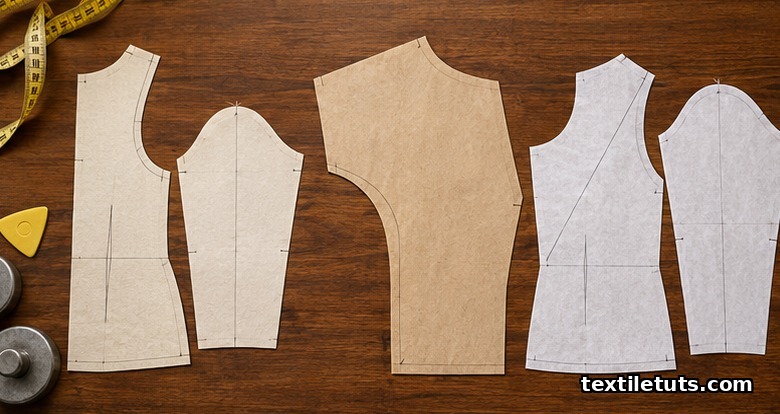
The three principal sleeve constructions used in modern garment making are set-in (a sleeve cap height of 4-6 cm at the biceps with 2.5-5 cm of ease at the armhole), kimono (a single bodice-sleeve pattern piece with 5-10% ease built into the underarm cut), and raglan (a diagonal seam from underarm to neckline with an armhole circumference 6-8 cm larger than the upper arm).
Each setting moves the joining seam to a different part of the upper body, which changes fit, ease allowance, range of motion, and stress distribution on the fabric. The setting you choose determines how a woven shirt, T-shirt, coat, or sportswear top will feel under the arm and across the shoulder after 10, 50, and 200 wear cycles.
This article walks through how each sleeve setting is drafted, the seam geometry that distinguishes them, the mobility each one permits, and the garment categories where each setting is the right answer.
How a Set-In Sleeve Is Built
The set-in sleeve is the default sleeve on most tailored shirts, suit jackets, blazers, and dress shirts. It is drafted as two pattern pieces: a bodice front and back, and a separate sleeve whose cap is curved to fit into an armhole that has been shaped on the bodice.
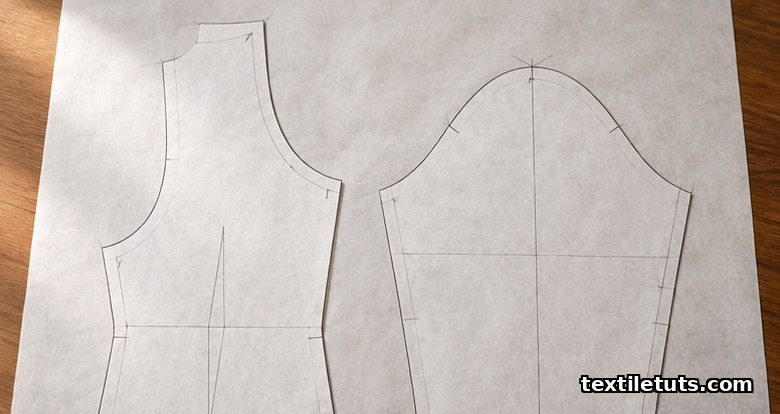
The armhole on the bodice is shaped like a shallow teardrop, deeper at the back than at the front. The sleeve cap is drawn as a mirror curve that is taller than the armhole depth by the sleeve cap height, typically 4-6 cm on a women’s size M and 5-7 cm on a men’s size L. This cap height is what creates the ease: the extra fabric is gathered, eased, or pleated into the armhole so the wearer can lift the arm without pulling the side seam up.
A standard set-in sleeve for a woven shirt uses 2.5-5 cm of total ease at the biceps, measured as the difference between the sleeve circumference at the bicep line and the actual upper arm circumference. For knit T-shirts, that ease increases to 8-15% of the upper arm measurement to allow the cuff and hem to stretch over the head and shoulders. The seam sits on the natural shoulder line, which is why a set-in sleeve looks structured even on soft fabrics.
Set-in sleeves are drafted following the body dimensions defined in ISO 8559-2 (size designation of clothes, primary and secondary dimensions) and the pattern terminology in ASTM D5219, which standardizes how armhole depth and sleeve cap height are named across the industry.
How a Kimono Sleeve Is Built
A kimono sleeve is cut in one piece with the bodice. There is no armhole seam at the shoulder; instead, the sleeve extends from the bodice side seam in a continuous cut, with the underarm point marking where the body ends and the sleeve begins. This is sometimes called a cut-in-one sleeve or integrated sleeve.
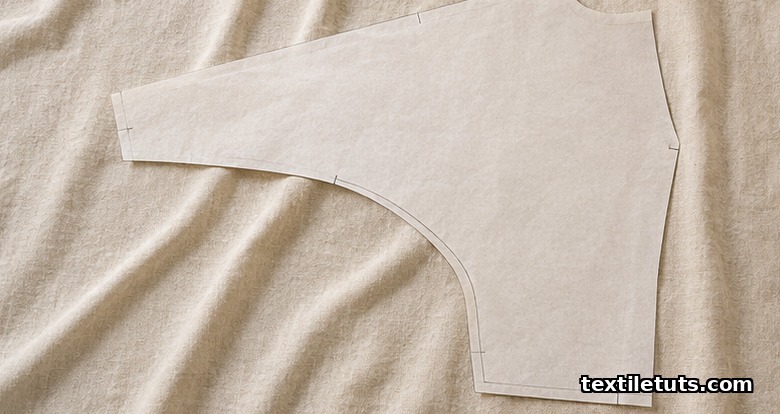
The seam that does the work is the underarm seam, which runs from the cuff up to the underarm point and then continues down the side seam of the bodice. Because the bodice and sleeve share one pattern piece, the shoulder seam disappears, and the entire upper body is shaped by the angle and length of that underarm/side seam.
Kimono sleeves are drafted with very little ease at the underarm, typically 5-10% of the upper arm circumference, because the cut already wraps around the torso. Adding too much ease creates a baggy underarm; adding too little restricts shoulder flexion. The classic kimono silhouette used in Japanese clothing uses almost zero ease at the armhole and relies on the wide cut of the body to provide room.
The trade-off is fit. Without a shoulder seam, the sleeve cannot be shaped independently of the bodice. To compensate, pattern makers add a gusset at the underarm (a small diamond-shaped fabric insert) or use a two-piece kimono with a shoulder seam that runs partway across the back. Both modifications restore some of the shoulder definition lost in the one-piece cut.
How a Raglan Sleeve Is Built
A raglan sleeve uses a diagonal seam that runs from the underarm, across the shoulder, up to the neckline. The sleeve pattern piece is shaped so that its top edge meets the bodice along this diagonal line, not along a curved armhole.
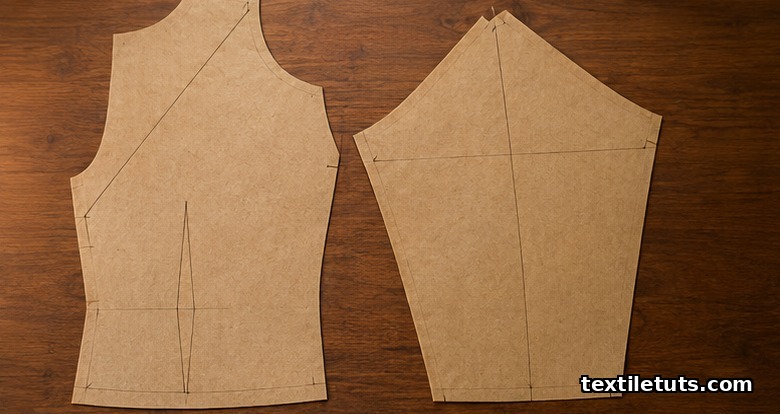
Because the seam runs from the neckline down to the underarm, the raglan sleeve eliminates the shoulder seam and covers the natural shoulder point with fabric. The armhole on the raglan is wider than the upper arm by 6-8 cm on a fitted garment and 10-15 cm on a sportswear or coat raglan, which gives the arm a full range of motion without any easing at the cap.
Raglan sleeves are common in athletic wear (running shirts, baseball jerseys, training tops), outerwear (coats, parkas, anoraks), and baby clothing where dressing over a small head is easier without a fitted shoulder seam. The diagonal seam also reduces pressure points on the shoulder, which matters for backpacks, weight-bearing outerwear, and post-surgical garments.
A raglan sleeve can be drafted as a two-piece sleeve (one seam from neck to underarm on the front, another on the back) or as a single-piece sleeve with the seam hidden in the shoulder line. Two-piece raglan gives a closer fit at the chest; single-piece raglan is faster to cut and is the standard in T-shirt and sportswear production.
Construction Comparison: Ease, Mobility, and Stress
The three settings behave differently under load. The table below summarizes the differences for a woven size M women’s blouse and a knit size M men’s T-shirt, using armhole and sleeve dimensions from the same body.
| Property | Set-In | Kimono | Raglan |
|---|---|---|---|
| Seam location | Shoulder point + armhole curve | None at shoulder; underarm + side seam | Diagonal from neck to underarm |
| Pattern pieces (bodice + sleeve) | 2 + 1 | 1 (combined) | 2 + 1 |
| Bicep ease (woven, cm) | 2.5-5 | 5-10% of arm | 6-8 |
| Bicep ease (knit, %) | 8-15% | 10-20% | 15-25% |
| Shoulder mobility (forward arm raise) | 120-150° | 90-130° | 150-180° |
| Stress point under load | Armhole seam (curved) | Underarm point | Diagonal neck-to-underarm seam |
| Visual silhouette | Tailored, structured shoulder | Soft, draped, no shoulder definition | Sport, diagonal shoulder line |
| Common end uses | Shirts, blazers, dresses | Loungewear, robes, casual tops | Sportswear, outerwear, babywear |
The mobility figures are based on published studies of upper-arm range of motion in fitted garments, where a standard set-in sleeve caps forward flexion at 120-150° because the sleeve cap must rise with the arm. A raglan sleeve, with no armhole curve to lift, allows close to the full 180° of forward arm flexion before the seam is stressed.
When to Choose Each Sleeve Type
For tailored garments where shoulder definition matters, the set-in sleeve is the right setting. It produces the clean shoulder line of a dress shirt, suit jacket, or fitted dress, and it accepts shoulder pads, epaulettes, and yokes cleanly because the seam sits at the natural shoulder point.
For loose, draped, or comfort-led garments, the kimono sleeve is the right setting. Robes, kimono-style jackets, soft loungewear, and many casual dresses use the cut-in-one construction because it removes the underarm seam that can press or chafe during low-activity wear. It is also the cheapest to cut, since it reduces the number of pattern pieces.
For sportswear, outerwear, babywear, and any garment where the arm needs unrestricted motion, the raglan sleeve is the right setting. It removes the shoulder seam (a weak point under load) and replaces it with a diagonal seam that distributes stress along a longer stitch line. AATCC TM135 dimensional-change testing shows that raglan seams survive repeated home laundering with less distortion than set-in armhole seams on knits, because the seam is not fighting the fabric’s bias stretch at the cap.
One practical note on fabric choice: set-in sleeves work on crisp wovens and stable knits; kimono sleeves work on fluid fabrics (rayon, silk, light jersey) that drape; raglan sleeves work on stable knits and tightly woven outerwear fabrics that hold the diagonal seam line.
Drafting Tolerances and What Affects Them
Pattern makers adjust sleeve cap height, armhole depth, and ease allowance based on three variables: the fiber content of the fabric, the stretch percentage of the knit, and the end use. ASTM D5219 lists sleeve cap height as a primary measurement for size designation, and ISO 8559-2 sets the body dimensions used to derive it.
For a 100% cotton woven shirt, set the cap height at 4-5 cm for a relaxed fit and 6-7 cm for a tailored fit; the higher the cap, the more ease and the more gathering at the armhole. For a cotton/elastane knit with 30-50% stretch, drop the cap height to 2-3 cm and add 8-15% bicep ease, because the fabric itself stretches under the arm. For a polyester activewear knit with 50-80% stretch, draft a raglan and skip the cap height altogether, since the diagonal seam will move with the body.
AATCC TM150 (dimensional change after home laundering of knit fabrics) and AATCC TM135 (dimensional changes in home laundering of woven fabrics) are the standard tests for verifying that the ease allowance survives washing; a sleeve drafted without enough ease will bind the bicep after the first wash cycle if the fabric relaxes.
Frequently Asked Questions
Which sleeve setting gives the most arm mobility?
A raglan sleeve gives the most mobility, allowing close to 180° of forward arm flexion. A set-in sleeve caps mobility at about 120-150° on a tailored fit because the curved armhole seam lifts with the arm. A kimono sleeve, with no shoulder seam, sits in the middle at roughly 90-130° depending on the underarm ease.
What is the standard sleeve cap height for a set-in sleeve?
For a woven size M women’s blouse, the cap height is typically 4-6 cm above the armhole depth. For a men’s size L shirt, it is 5-7 cm. Higher cap heights mean more ease at the cap and a softer, more draped sleeve; lower cap heights mean a tighter, more tailored shoulder.
Can a kimono sleeve be tailored?
A kimono sleeve can be modified with an underarm gusset (a diamond-shaped fabric insert) or a partial shoulder seam that runs partway across the back. These add mobility and shoulder shape without fully converting to a set-in construction. A true tailored shoulder, however, requires a separate bodice and sleeve piece (set-in).
Why do sportswear and baby clothes use raglan sleeves?
Sportswear uses raglan sleeves because the diagonal seam allows unrestricted shoulder motion and reduces pressure points under backpack straps and load-bearing gear. Babywear uses raglan sleeves because the wide neckline and no-shoulder-seam construction makes dressing over a baby’s head easier and more comfortable.
How do I know how much ease to add at the bicep?
For woven fabrics, add 2.5-5 cm of ease at the bicep for a fitted set-in sleeve and 6-8 cm for a relaxed fit. For knit fabrics, add 8-15% of the upper arm circumference for a fitted set-in and 15-25% for a knit raglan. Measure the actual upper arm, then add the ease percentage; verify after the first wash because knit fabrics can relax 3-5% in length and width.
References
- International Organization for Standardization. ISO 8559-2:2020 — Size designation of clothes — Part 2: Primary and secondary dimensions. iso.org — the body measurement definitions used to draft sleeve cap height and armhole depth.
- ASTM International. ASTM D5219-21 — Standard Terminology for Body Dimensions for Apparel Pattern Making. astm.org — standardizes how armhole, sleeve cap, and bicep measurements are named.
- American Association of Textile Chemists and Colorists. AATCC TM135-2018 — Dimensional Changes in Home Laundering of Woven Apparel Fabrics. aatcc.org — used to verify that set-in and raglan sleeve ease allowances survive washing.
- American Association of Textile Chemists and Colorists. AATCC TM150-2018 — Dimensional Changes in Home Laundering of Knit Apparel Fabrics. aatcc.org — covers knit relaxation, which determines bicep ease allowances.
- Liu, C., et al. Pattern Construction of Women’s Suit Sleeves Based on 3D Body Scanning. ResearchGate — peer-reviewed study on how armhole depth and sleeve cap height change across body sizes.
- Ashdown, S.P. An Investigation of the Structure of Sizing Systems. ResearchGate — peer-reviewed paper on how ISO and ASTM sizing systems interact with sleeve pattern drafting.
- Ng, S.F. and Yu, W. Pattern Making and Its Effect on the Garment Fit. ResearchGate — covers the relationship between sleeve setting (set-in, kimono, raglan) and ease allowance in commercial pattern making.
This article is the working reference for sleeve setting in woven and knit garments. Editorial by Kazi Sifat Muntasir, TextileTuts. Sources: ISO 8559-2, ASTM D5219, AATCC TM135, AATCC TM150, and peer-reviewed research from ResearchGate as cited.


