
Collar Attachment: Flat, Stand, Mandarin

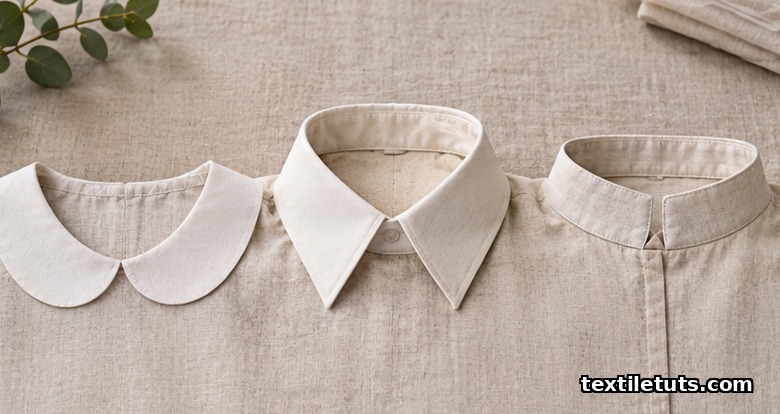
A flat collar sits flush against the garment with 0 to 1.5 cm of neckline rise, while a stand collar rises 2.5 to 4.0 cm and a mandarin collar rises 2.0 to 3.0 cm with rounded or squared ends, and the three variants are attached with a single 10 to 12 stitches per 2.5 cm lockstitch seam whose pull-off strength must clear the 150 N minimum set in ASTM D1683 for woven shirt-weight fabric.
This article is the working reference for flat, stand, and mandarin collar attachment in shirt-making and blouse-making, covering the geometry of each construction, the seam allowance and grading rules, the role of fusible and sew-in interfacings, and the quality-control tests that distinguish a collar that survives 50 wash cycles from one that lifts, ripples, or splits at the neckline after a single laundering.
Why Collar Attachment Geometry Matters
The collar is the only structural feature on a shirt or blouse that is sewn into a closed loop and then topstitched along its outer edge, so the geometry of the attachment seam controls three measurable behaviors: neckline rise (the vertical distance from the garment neckline to the collar’s outer edge), collar stand (the height of the inside band that wraps the neck), and roll line (the fold line where a flat collar transitions from laying flat to curving over the shoulders). These three parameters determine whether the finished collar lies smooth, lifts at the back, or pulls the neckline out of shape during wear.
A flat collar has a roll line that coincides (or nearly coincides) with the neckline seam, which is why a flat collar lies on the shoulders with only a 0 to 1.5 cm rise above the neckline. A stand collar has a roll line that is shifted upward by 2.5 to 4.0 cm, producing the visible neck wrap that defines business-shirt and Nehru styling. A mandarin collar is a stand collar variant whose top corners are rounded or squared and whose stand height is compressed to 2.0 to 3.0 cm, eliminating the collar fall (the part that folds down on a shirt collar) entirely.
Flat Collar Construction and Attachment
A flat collar is drafted as two mirror-image pieces: an upper collar and an under collar. The upper collar is cut on the true bias of the fabric so that the outer edge sits smooth, while the under collar is cut on the straight grain and trimmed 3 to 5 mm smaller at the outer edge to roll the seam allowance to the underside, hiding it from view. The two pieces are placed right-sides together, stitched around the outer edge with a 0.6 to 1.0 cm seam allowance, trimmed, clipped at the curves, turned right-side out, and pressed.
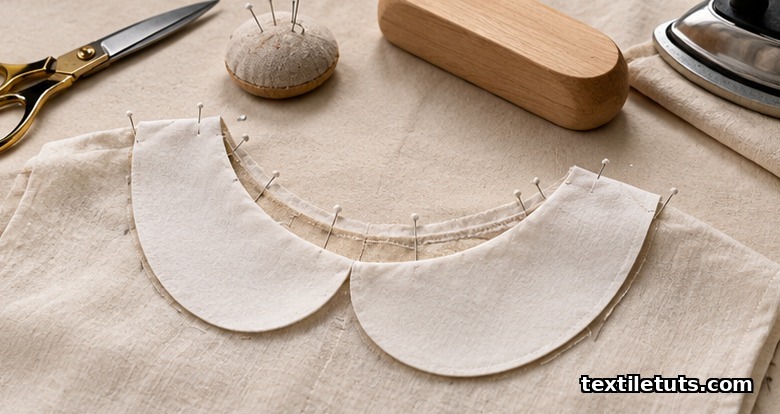
The flat collar is then attached to the garment neckline with the upper collar against the garment right side, the seam allowances nested together, and a single 1.27 cm (1/2 inch) seam allowance stitched around the neckline opening. Notches at center back and center front ensure that the attachment is symmetric, and the seam is typically topstitched 1 to 2 mm from the seamline on the garment side to hold the allowances flat and prevent the collar from rolling into the neckline. Under ASTM D6193 (Standard Practice for Stitches and Seams) this is a superimposed (SS) seam, Class 1 in ISO 4916, the most basic seam class and the standard for collar-to-garment attachment in woven shirt-weight cloth.
Flat collars in women’s blouses typically take a lightweight non-woven or woven fusible interlining at 30 to 45 g/m² on the upper collar only, leaving the under collar soft so the collar can curve smoothly over the shoulders. Peter Pan collars, sailor collars, and Bertha collars are all flat-collar variants; the difference is in the outer edge shape (rounded, square, scalloped, or V-pointed) rather than in the attachment geometry.
Stand Collar Construction and Attachment
A stand collar, also called a shirt collar or, when constructed without a fold-down section, a Nehru collar, is drafted in two layers with the upper collar cut as a mirror pair and the stand built as a separate band that wraps the neck. The stand is typically 2.5 to 4.0 cm wide at center back and tapers slightly toward the front, producing the visible neck wrap. The upper collar (the part that folds down) is drafted separately, attached to the top edge of the stand, and the entire assembly is then sewn to the garment neckline.
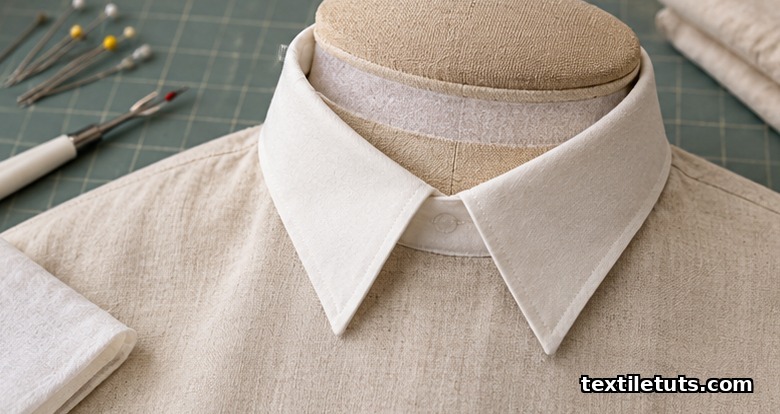
The critical construction step is the attachment seam between the collar stand and the garment neckline. This seam must accommodate the curvature of the neckline, where the front neckline typically measures 22 to 24 cm at size M and the back neckline measures 16 to 18 cm, which is why the collar stand is drafted slightly longer (1.5 to 2.0 cm extra at the bottom edge) and eased onto the neckline during stitching. Without this ease, the stand pulls the neckline out of shape and creates a rippled or puckered appearance at the back neck.
Stand collars in business shirts are usually interfaced with a medium-weight fusible interlining (50 to 70 g/m²) on the upper collar only, leaving the under collar soft so that the collar can roll naturally. Nehru collars, which have no fold-down section, are interfaced on both layers with a slightly heavier 60 to 80 g/m² interlining to maintain a crisp neck wrap that does not collapse at the front opening.
Mandarin Collar Construction and Attachment
A mandarin collar is a stand collar variant whose defining features are a compressed stand height of 2.0 to 3.0 cm and squared or rounded top corners instead of the pointed or notched corners of a shirt collar. Mandarin collars are drafted as a single band (no separate upper collar piece), cut twice and joined at the shoulders with a 0.6 cm seam allowance, and interfaced on both layers for a crisp finish.
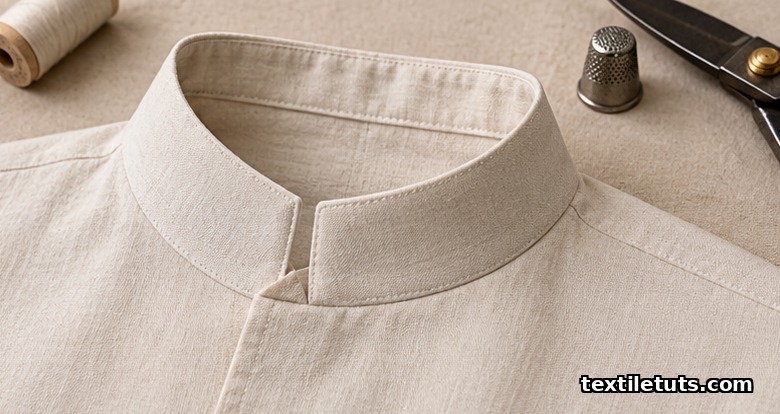
The outer edge of a mandarin collar is finished with a 1.0 to 1.27 cm seam allowance stitched with a lockstitch at 10 to 12 stitches per 2.5 cm, trimmed to 0.4 to 0.5 cm, and turned right-side out. The corners are squared off with a diagonal clip rather than a curve clip, and the top edge is topstitched 1 to 2 mm from the seamline for a clean finish. The mandarin collar is then attached to the garment neckline using the same class 1 superposed seam as a flat collar, but the seam allowance at the neckline is slightly narrower (0.6 to 1.0 cm) because the stand height is smaller and a wider allowance would create visible bulk at the neckline.
Mandarin collars are common in Nehru jackets, women’s blouses, chef coats, and military-style tunics. Because the stand height is compressed, the mandarin collar sits closer to the neck than a traditional shirt collar and is the preferred construction for garments where a clean, vertical neckline is required without the visual weight of a fold-down fall.
Seam Allowance, Stitch Density, and Interfacing Rules
Across all three collar types, three numerical rules control attachment quality. First, the seam allowance is 1.27 cm (1/2 inch) at the neckline attachment on flat and stand collars and 0.6 to 1.0 cm around the outer edge of the collar on all three variants. Second, the lockstitch density is 10 to 12 stitches per 2.5 cm (1 inch): below this, the seam is structurally weak; above this, the perforation density damages woven fibers and reduces seam strength. Third, the fusible interlining is sized 1.5 to 2.0 cm smaller than the collar on every edge, so the interlining does not migrate into the seam allowance and create a stiff ridge.
Interfacing selection follows the collar type. Flat collars in women’s blouses typically take a lightweight non-woven or woven fusible at 30 to 45 g/m². Stand collars in men’s dress shirts take a medium-weight woven fusible at 50 to 70 g/m². Mandarin collars and Nehru collars take a firmer non-woven or woven fusible at 60 to 80 g/m² to maintain the stand’s vertical structure without buckling. According to research published in the Textile Research Journal, fusing at 140 to 160 degrees Celsius for 10 to 15 seconds delivers a bond strength of 8 to 12 N per 2.5 cm strip, which is the industry target for a collar that survives 50 wash cycles without delamination.
Quality Control: ISO and ASTM Tests on Collar Seams
The most important quality tests for collar attachment are seam strength, seam slippage, dimensional stability after washing, and appearance after washing. ASTM D1683 (Standard Test Method for Failure in Sewn Seams of Woven Apparel Fabrics) sets the protocol for measuring seam breaking strength using the grab method, and the minimum acceptable strength for a shirt-weight woven fabric is 150 N. ISO 13935-1 applies the same protocol using a strip method and specifies a minimum of 140 N for comparable fabrics. ISO 4916 (Textiles: Seam Types, Classification and Terminology) provides the reference diagrams for seam classes used in collar construction and is the standard that classifies the collar-to-garment seam as a class 1 superposed seam.
Dimensional stability after washing is verified against ISO 6330 (Domestic Washing and Drying Procedures for Textile Testing). A well-constructed collar should shrink no more than 2 percent in either direction after five wash cycles at 40 degrees Celsius. Beyond shrinkage, the collar must retain its shape: a flat collar should not lift more than 0.5 cm at the back neck after washing, and a stand or mandarin collar should not collapse below 90 percent of its original stand height. Research published in Clothing and Textiles Research Journal reports that fused collars retain 95 to 98 percent of their original dimensions after 20 wash cycles, while non-fused collars retain only 88 to 92 percent under the same conditions.
Seam slippage, the tendency of the yarns to slide apart at the seam under load, is measured against ISO 13936 (Textiles: Determination of Slippage Resistance of Yarns at a Seam in Woven Fabrics). For a shirt-weight woven fabric, the maximum permissible slippage at a 180 N seam load is 6 mm in the warp direction and 8 mm in the weft direction. A collar seam that exceeds these limits will distort visibly at the neckline after a few wear cycles and is the most common cause of the rippled-back-neck defect seen in low-quality shirts.
Flat, Stand, and Mandarin Collar Comparison
| Property | Flat Collar | Stand Collar | Mandarin Collar |
|---|---|---|---|
| Stand height | 0 to 1.5 cm | 2.5 to 4.0 cm | 2.0 to 3.0 cm |
| Collar fall (fold-down) | Full fall | Yes (shirt) or none (Nehru) | None |
| Outer edge corners | Rounded (Peter Pan) or pointed | Pointed, notched, or square | Squared or rounded |
| Outer edge seam allowance | 0.6 to 1.0 cm | 0.6 to 1.0 cm | 0.6 to 1.0 cm |
| Neckline seam allowance | 1.27 cm | 1.27 cm | 0.6 to 1.0 cm |
| Typical interlining weight | 30 to 45 g/m² | 50 to 70 g/m² | 60 to 80 g/m² |
| Stitch density | 10 to 12 stitches per 2.5 cm | 10 to 12 stitches per 2.5 cm | 10 to 12 stitches per 2.5 cm |
| Common garments | Blouses, dresses, children’s wear | Dress shirts, blouses | Nehru jackets, blouses, shirts |
Frequently Asked Questions
Q1: What is the difference between a flat collar and a mandarin collar?
A flat collar has a roll line that coincides with the neckline seam, producing a 0 to 1.5 cm rise with the full collar lying flat across the shoulders. A mandarin collar has a roll line shifted upward 2.0 to 3.0 cm, producing a short stand with no fall (fold-down) section, so the collar stands vertically around the neck rather than folding over.
Q2: Which stitch type is best for attaching a collar to the neckline?
A lockstitch (ISO 4915 stitch type 301) at 10 to 12 stitches per 2.5 cm is the industry standard for collar attachment. The lockstitch produces a balanced, non-raveling seam whose pull-off strength clears the 150 N minimum set in ASTM D1683 for woven shirt-weight fabric. Chainstitch (type 401) is softer but tends to ravel if a stitch is broken, which is why it is rarely used for collar attachment on garments that will be machine washed.
Q3: Why does the back of my flat collar lift after washing?
Back-neck lift on a flat collar is caused by differential shrinkage between the upper collar, the under collar, and the garment body. If the under collar is cut on a different grain or from a different fabric layer than the upper collar, the two layers shrink at different rates and the shorter layer pulls the outer edge upward. The fix is to cut both collar layers on the same grain direction, use the same interlining weight on both, and verify the fused bond strength clears 8 N per 2.5 cm before the garment is washed.
Q4: What seam allowance should I use for a mandarin collar?
A mandarin collar uses 0.6 to 1.0 cm seam allowance around the outer edge and 0.6 to 1.0 cm at the neckline attachment. The narrower allowance keeps the seamline soft against the neck, which is important because the compressed stand height means any visible bulk at the neckline is immediately obvious. A 1.27 cm allowance at the neckline, used on flat and stand collars, would create a stiff ridge on a mandarin and is therefore avoided.
Q5: Can a stand collar be attached without a separate upper collar piece?
Yes. A stand collar without an upper collar piece is called a band collar or Nehru collar. It is drafted as a single band, cut twice, and joined at the shoulders. This construction is faster to sew, uses less fabric, and produces a cleaner neckline for casual and ethnic garments. The trade-off is that the band cannot fold down to reveal a contrast fabric underneath, so all visible stitching must be planned with that constraint in mind.
References
- ASTM International. ASTM D1683 / D1683M: Standard Test Method for Failure in Sewn Seams of Woven Apparel Fabrics. ASTM International, West Conshohocken, PA.
- ASTM International. ASTM D6193: Standard Practice for Stitches and Seams. ASTM International, West Conshohocken, PA.
- International Organization for Standardization. ISO 4916:1991 Textiles – Seam Types – Classification and Terminology. ISO, Geneva.
- International Organization for Standardization. ISO 13935-1:2014 Textiles – Seam Tensile Properties of Fabrics and Made-up Textile Articles – Part 1: Determination of Maximum Force to Seam Rupture Using the Strip Method. ISO, Geneva.
- International Organization for Standardization. ISO 6330:2021 Domestic Washing and Drying Procedures for Textile Testing. ISO, Geneva.
- International Organization for Standardization. ISO 13936: Textiles – Determination of Slippage Resistance of Yarns at a Seam in Woven Fabrics. ISO, Geneva.
- Aldrich, W. Metric Pattern Cutting for Women’s Wear. Wiley-Blackwell, Oxford.
This article is the working reference for flat, stand, and mandarin collar attachment in shirt and blouse construction. Editorial by Kazi Sifat Muntasir, TextileTuts. Sources: ISO 4916, ISO 13935, ISO 6330, ISO 13936, ASTM D1683, ASTM D6193, Aldrich (Wiley) as cited.


