
Plackets and Pockets: Types and Construction

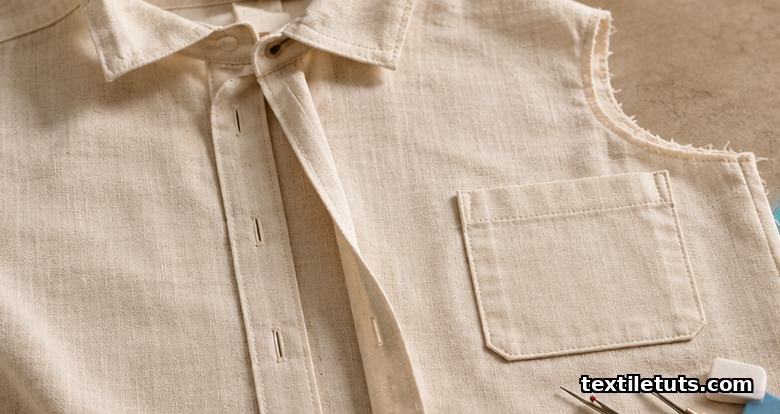
A shirt placket is a finished fabric opening reinforced with a separate strip and stitched at 12 to 15 stitches per inch (SPI), with seam geometry classified under ISO 4916 as a class 1 superimposed seam. The placket’s job is to hold a button or zipper closure flat against the garment, distribute closure stress across a strip wider than the cut edge, and survive 50 or more laundering cycles per AATCC TM88B without puckering or seam slippage.
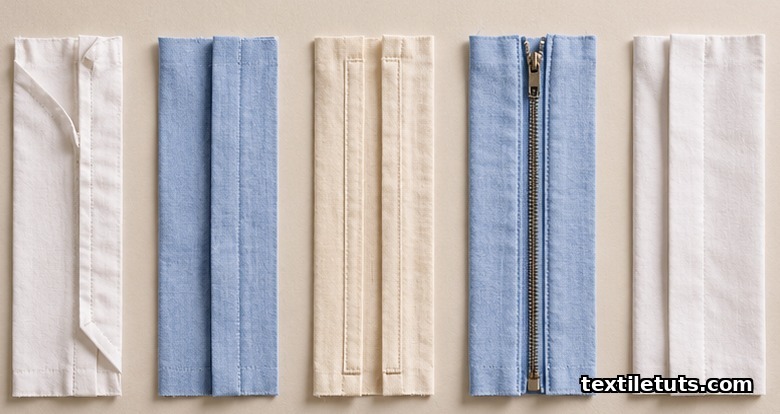
This guide walks through the five main placket constructions, the seven pocket types every garment maker meets in production, and the stitch and seam specifications in the ISO and ASTM libraries that govern their quality.
What a Placket Does, and Why the Geometry Matters
A placket is the bridge between a garment opening and its closure. Where a slit alone would fray and stretch, a placket binds the raw edge, anchors the closure hardware, and gives the front of a shirt, blouse, or jacket the body it needs to lie flat.
Three dimensions define every placket: strip width, seam allowance, and stitch density. Woven shirt plackets typically use a 35 to 55 mm wide strip with 6 to 15 mm seam allowance and a 12 to 15 SPI lockstitch (2.0 to 2.2 mm stitch length). Knit plackets use narrower strips, often 25 to 35 mm, because the fabric stretches and does not need as much binding area.
For seam classification, ISO 4916 groups placket seams under superimposed seam types, most commonly class 1.01 for a single-needle lockstitch joining two pieces with a superimposed edge. Quality control laboratories report seam efficiency, the ratio of seam strength to fabric tensile strength, as a percentage; woven cotton plackets tested under ASTM D1683 typically achieve 80 to 95 percent efficiency when stitched at 12 SPI with 100 percent cotton thread.
The Five Standard Placket Types
Garment factories work from a short list of placket constructions. Choosing between them is a balance of bulk, cost, and appearance.
1. Bound placket
A bound placket wraps a separate bias or straight-grain strip around the raw edge of the slit, producing a clean, flat finish on both sides of the garment. The bound placket is the standard on most dress shirts because it lies flat against the chest and does not add bulk under a tie. Stitching is typically 12 to 14 SPI with a 4 to 6 mm double-turned edge.
2. Continuous (one-piece) placket
The continuous placket is cut as a single extension of the garment front, folded back on itself to form the binding strip. This construction saves 8 to 12 cm of seam length compared with a bound placket and is the default on casual button-down shirts and blouses. Continuous plackets are common in production runs because they eliminate the need to align a separate binding strip.
3. Two-piece placket
The two-piece placket uses two separate fabric pieces, one for each side of the opening. It is the strongest of the five because both sides carry their own reinforcement strip, and it is the construction chosen for heavy shirt weights and uniform shirts where the placket must survive industrial laundering. The two-piece placket typically uses a 6 mm topstitch and a 4 mm under-stitch to anchor the binding.
4. Zipper placket
A zipper placket is a fly or front closure that hides a zipper behind a fold of fabric. Center-front zipper plackets on trousers and skirts are the most common form, with the topstitch running 6 to 8 mm from the fold. Standard fly construction uses a 12 to 14 SPI lockstitch for the seam and a separate bar tack at the bottom of the zipper tape to prevent slider slippage.
5. French placket
The French placket, also called a hidden or flat placket, has no visible stitching on the right side of the garment. The opening is created by a double-folded hem with a hand or blind machine stitch at 8 to 10 SPI. French plackets are used on fine dress shirts and blouses where a clean front is more important than reinforcement speed.
Pocket Anatomy and the Standards That Govern It
Every pocket has three parts: the pouch (the part that holds content), the opening (the entry), and the reinforcement (the stitching or hardware at stress points). The reinforcement is what separates a pocket that survives a season from one that pulls away after three washes.
Stress points are finished with bar tacks, a tight zigzag stitch typically 10 to 15 mm long and 1.5 to 2 mm wide, or with rivets and grommets. Bar tack strength on woven cotton pockets measured under ASTM D1683 typically exceeds 200 N pull-out force when stitched at 21 to 24 SPI on industrial lockstitch machines.
Standard atmospheres for testing these values are defined in ISO 139, which specifies 20 °C and 65 percent relative humidity for conditioning textiles before seam strength testing. Most commercial laboratories deviate by no more than ±2 °C and ±5 percent RH from these conditions.
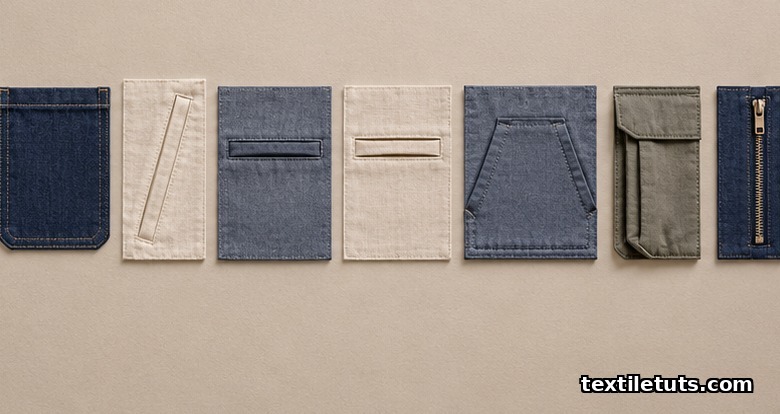
Seven Pocket Types You Will See in Production
1. Patch pocket
A patch pocket is sewn onto the outside of the garment with a visible topstitch. Patch pockets are the simplest pocket construction and dominate casual shirt and trouser production. Standard patch pocket dimensions range from 10 × 12 cm for shirt breast pockets to 14 × 16 cm for cargo trouser hip pockets, with 6 mm topstitching at 10 to 12 SPI.
2. Inseam (slash) pocket
An inseam pocket, also called a slash pocket, hides the pouch inside the garment seam, leaving only the opening visible. This construction is the standard on trousers, skirts, and tailored jackets. The opening is finished with two self-fabric welts and reinforced with bar tacks at each end.
3. Single welt pocket
A single welt pocket uses one folded strip of fabric across the top of the opening, with the pouch behind. The welt is typically 8 to 12 mm wide and topstitched at 6 mm. Single welt pockets are common on the back of trousers and on tailored jackets.
4. Double welt (jetted) pocket
A double welt pocket, also called a jetted pocket, has two parallel welts framing a 12 to 18 cm opening. This is the most formal pocket construction and is standard on suit jackets, blazers, and formal trousers. Precision is critical: the two welts must be parallel within ±1 mm, otherwise the pocket looks skewed.
5. Kangaroo pocket
A kangaroo pocket is a large front pouch sewn onto the front of hoodies, sweatshirts, and casual tops, with two hand-entry openings angled at 30 to 45 degrees. The pouch is typically 22 to 28 cm wide and 18 to 22 cm deep, with 6 mm topstitching that doubles as a structural seam.
6. Bellows (expansion) pocket
A bellows pocket adds a gusset, an expandable side panel, to a patch pocket to increase its volume. Bellows pockets are standard on cargo trousers, tactical clothing, and outdoor jackets, with side gussets 3 to 5 cm wide that expand the pocket capacity by 50 to 100 percent.
7. Zippered pocket
Zippered pockets combine an inseam opening with a zipper closure and are common on jackets, trousers, and travel bags. The zipper is typically 12 to 18 cm long with a 6 mm topstitch and a bar tack at each end of the zipper tape.
Stitch and Seam Specifications That Govern Quality
Garment engineers reference the same stitch library for every placket and pocket on the production line. The table below summarizes the stitches most commonly used in placket and pocket construction, classified per ASTM D6193 and ISO 4916.
| Construction | Standard stitch class | Typical SPI | Seam classification |
|---|---|---|---|
| Bound placket topstitch | ASTM D6193 class 301 lockstitch | 12 to 14 | ISO 4916 class 1 (superimposed) |
| Continuous placket fold | ASTM D6193 class 304 zigzag lockstitch | 10 to 12 | ISO 4916 class 1 (superimposed) |
| Pocket topstitch | ASTM D6193 class 301 lockstitch | 10 to 12 | ISO 4916 class 1 (superimposed) |
| Bar tack at stress points | ASTM D6193 class 304 zigzag (tight) | 21 to 24 | ISO 4916 class 6 (ornamental) |
| French placket blind stitch | ASTM D6193 class 308 blindstitch | 8 to 10 | ISO 4916 class 1 (superimposed) |
| Zipper placket topstitch | ASTM D6193 class 301 lockstitch | 12 to 14 | ISO 4916 class 1 (superimposed) |
For seam efficiency targets, woven shirt plackets and patch pockets tested under ASTM D1683 should reach 85 percent or higher of the base fabric tensile strength. Values below 70 percent typically indicate thread tension problems or insufficient SPI.
Common Construction Defects
Most placket and pocket failures fall into a small set of defect categories: puckering at the topstitch, skipped stitches at the fold, misaligned welts on jetted pockets, and bar tack failure at pocket corners.
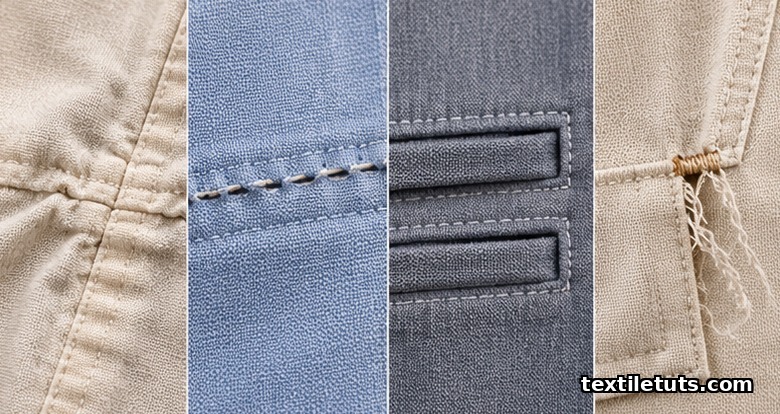
Seam pucker is measured per AATCC TM88B, which compares replicas of seams against photographic standards after a defined number of home laundering cycles. Pucker ratings below grade 3 (on the 1 to 5 AATCC scale) after five wash cycles usually signal a thread tension imbalance or a stitch length that is too long for the fabric weight.
Welt misalignment on jetted pockets is the most common cause of re-work in tailored jacket production. The fix is to baste the welts by hand at 4 SPI before the final topstitch, then machine-stitch at 12 SPI. This two-step process holds the welts parallel during the final pass.
Frequently Asked Questions
What is the difference between a placket and a slit?
A slit is a raw cut in the fabric, while a placket is a finished opening reinforced with a strip and stitching. Every placket contains a slit, but the placket adds binding, topstitching, and a closure anchor so the opening does not fray or stretch under load.
How wide should a placket strip be?
For woven shirt plackets, the strip is typically 35 to 55 mm wide with a 6 to 15 mm seam allowance. Knit plackets run narrower at 25 to 35 mm because the fabric has built-in stretch and needs less binding area to hold the opening flat.
What stitch length should I use for pocket topstitching?
Standard pocket topstitching on woven fabrics runs at 2.5 to 3.0 mm stitch length (8 to 10 SPI). Decorative topstitching on jeans and outerwear can drop to 4 to 5 mm stitch length (5 to 6 SPI) for a longer, bolder thread line.
How is seam strength measured on plackets?
Seam strength is measured per ASTM D1683, which specifies a grab or strip test on a sewn seam pulled to failure on a tensile testing machine. Placket seams on woven cotton should reach at least 85 percent of the base fabric tensile strength.
Can a French placket be sewn by machine?
Yes. A blind-hem machine or a blind-stitch attachment on a standard lockstitch machine produces a French placket at 8 to 10 SPI with no visible stitching on the right side. Production factories typically run French plackets at higher volumes this way than by hand stitching.
This article is the working reference for placket and pocket construction in woven and knit garments. Editorial by Kazi Sifat Muntasir, TextileTuts. Sources: ASTM D6193 (Stitches and Seams), ASTM D1683 (Failure in Sewn Seams of Woven Fabrics), ISO 4916 (Textiles – Seam Types), ISO 139 (Standard Atmospheres for Conditioning and Testing), and AATCC TM88B (Appearance of Seams after Home Laundering) as cited.


