
Slashing Dyeing vs Rope Dyeing

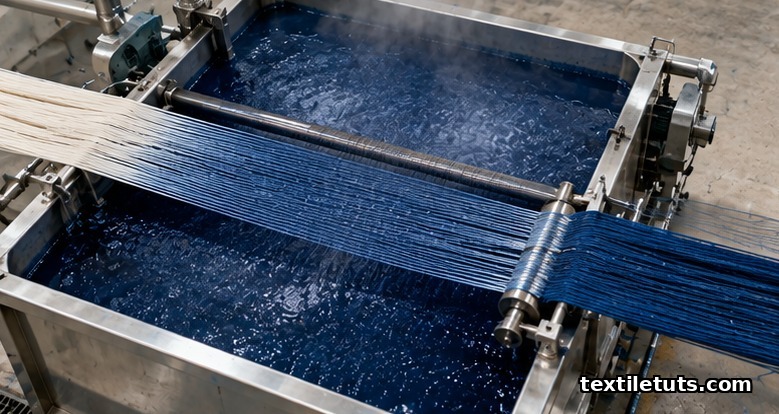
Rope dyeing immerses warp yarn bundles (typically 300 to 400 ends per rope) in indigo dye for 6 to 8 sequential dips with intermediate oxidation, while slashing (also called sheet dyeing) passes a flat sheet of 400 to 800 warp yarns through only 2 to 4 dye boxes before sizing on the same range. Rope-dyed denim reaches an average wash-fastness grade of 4 to 5 on the AATCC gray scale for color change after 5 home laundering cycles, compared with grade 2 to 3 for slash-dyed denim at the same starting depth of shade.
This guide explains the chemistry and mechanics of each method, the performance trade-offs mill teams weigh, and how to identify which process produced a finished pair of jeans or jacket.
How Rope Dyeing Works
Rope dyeing bundles thousands of warp yarns into ropes and dips them through a series of indigo dye baths. In a typical rope-dyeing range (often called a “long-chain” range because of its length, sometimes 60 to 80 meters from creel to beam), the yarns first pass through a wetting trough and a scouring zone to remove size and natural impurities. They then enter the first dye bath, where indigo in its reduced leuco form (yellow-green) penetrates the fiber. When the rope exits the bath and travels through air for 30 to 90 seconds, the leuco indigo oxidizes back to its insoluble blue form and fixes onto the fiber surface.
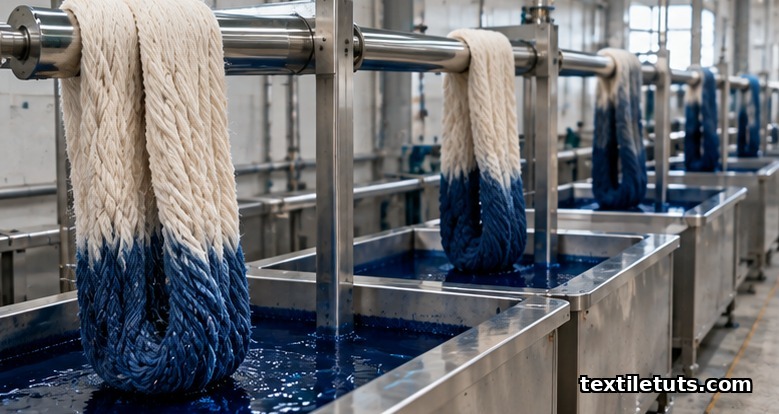
Each subsequent dip adds another thin layer of indigo onto the yarn, because vat dyes like indigo have very low affinity for cotton and build shade gradually. Most rope-dyeing ranges use 6 to 8 dye boxes for denim at commercial depths, although deep-black sulfur-dyed yarns may run through 10 to 12 boxes. Between every dip the rope passes over guide rollers and through squeeze rollers that express excess liquor and drive surface penetration.
After the final dip and oxidation, the ropes pass through a washing trough to remove residual alkali and loose dye, then through a softening bath (often a lubricating oil emulsion at 2 to 5 g/L) to reduce fiber-to-fiber friction before rebeaming. A rope opener then separates the ropes back into individual warp sheets, which are recombined on the sizing machine and finally onto the weaver’s beam.
How Slashing (Sheet) Dyeing Works
Slashing, also called sheet dyeing or warp-sheet dyeing, combines indigo dyeing and warp sizing on a single range. The warp yarns leave the creel as a flat sheet, pass through a size box, then enter the first indigo bath. Because slashing uses only 2 to 4 dye boxes (compared with 6 to 8 for rope), the indigo shade builds up quickly but with less depth into the fiber.
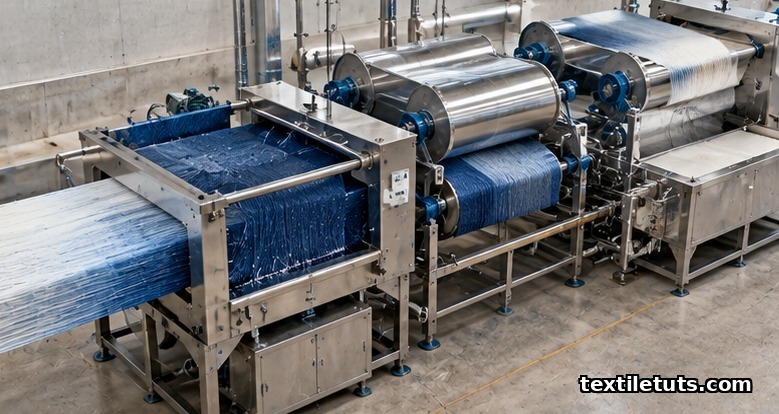
The oxidation zones between baths are short, typically 15 to 30 seconds, because slashing ranges are compact (about 25 to 40 meters end-to-end). After the dye boxes, the sheet passes through squeeze rollers and directly into a hot-air drying cylinder, where moisture is driven off at 110 to 130 °C. The warp then enters the size box, where starch or modified starch (often at 8 to 12% solids) and other sizing auxiliaries are applied. A typical size recipe includes a film-forming polymer, a lubricant, and an antistatic agent; the size is cooked at 90 to 95 °C and applied at 80 to 85 °C.
Slash dyeing is the dominant process for casual shirting and bottom-weight fabrics that need only a pale-to-medium indigo shade. It is also widely used for sulfur-dyed bottoms, where the dark base color masks the limited dye penetration that slashing produces.
Side-by-Side Comparison
| Property | Rope Dyeing | Slashing (Sheet) Dyeing |
|---|---|---|
| Yarn form during dyeing | Rope of 300 to 400 ends | Flat sheet of 400 to 800 ends |
| Number of dye boxes | 6 to 8 (denim), up to 12 (black) | 2 to 4 |
| Indigo shade depth achievable | Light to deep navy / black | Light to medium indigo only |
| Wash fastness (AATCC gray scale, 5 cycles) | 4 to 5 | 2 to 3 |
| Crocking fastness (AATCC 8, dry) | 3 to 4 | 2 |
| Range length | 60 to 80 m | 25 to 40 m |
| Water and chemical use | Higher | Lower (around 30% less) |
| Throughput (m/min) | 20 to 30 | 60 to 100 |
| Yarn surface appearance | Smooth, uniformly dyed rings | Rougher, streaky surface |
| Typical end uses | Premium denim, ringspun denim | Casual shirting, lightweight denim |
Color Fastness and Performance
Color-fastness data explain why rope-dyed denim dominates the premium and ringspun denim market. When tested under AATCC Test Method 61 (accelerated home laundering, 5 cycles at 40 °C), rope-dyed indigo warp yarn typically grades 4 to 5 for color change, which corresponds to a barely perceptible shift against the original. Slash-dyed yarn at the same starting depth grades 2 to 3, meaning a clearly visible shift after the same number of cycles. The difference comes from dye penetration: rope-dyed yarns have indigo fixed across more of the fiber cross-section, so as surface dye is washed away, deeper dye continues to show.
Crocking (dry and wet rubbing) shows the same pattern. Under AATCC Test Method 8, rope-dyed denim typically grades 3 to 4 dry and 2 wet, while slash-dyed denim at the same depth grades 2 dry and 1 to 2 wet. For consumers, this means rope-dyed jeans rub less blue onto car seats, upholstery, and skin, and they retain a richer mid-blue through repeated washing.
Light-fastness is closer between the two methods, because both use the same indigo molecule. Under ISO 105-B02 (exposure to a xenon arc lamp), both rope- and slash-dyed indigo typically grade 3 to 4 on the blue wool scale, with slash-dyed yarns sometimes grading slightly higher because of the lower total dye load exposed at the surface.
Cost, Capacity, and Mill Considerations
Rope dyeing is capital- and resource-intensive. A modern rope-dyeing range with 8 boxes costs roughly USD 4 to 6 million installed, requires a 60 to 80 meter long floor footprint, and consumes 25 to 40 L of water per kilogram of yarn processed. Slashing ranges are shorter, cheaper (USD 1 to 2 million), and use about 30% less water, energy, and chemicals per kilogram.
Throughput reverses the operating-economics picture: a rope range typically runs at 20 to 30 m/min, while a slash range runs at 60 to 100 m/min. Mills producing light-to-medium indigo at scale, especially for mass-market shirting and bottom-weight fabrics, choose slashing because the per-meter cost is lower despite faster wear. Mills producing ringspun denim, selvedge denim, and any product advertised as “premium indigo” tend to choose rope dyeing because the wash-down behavior and color retention justify a higher unit price.
Environmental loads follow the same split. Rope dyeing generates more chemical oxygen demand per kilogram of yarn than slashing, primarily because rope dyeing uses more sodium dithionite (hydrosulfite) as the indigo reducing agent and more rinse water between dips. Detailed life-cycle comparisons for indigo processing are summarized in textile chemistry references.
How to Tell Rope-Dyed and Slash-Dyed Denim Apart
Three quick checks help you tell the two finishes apart on a finished garment:
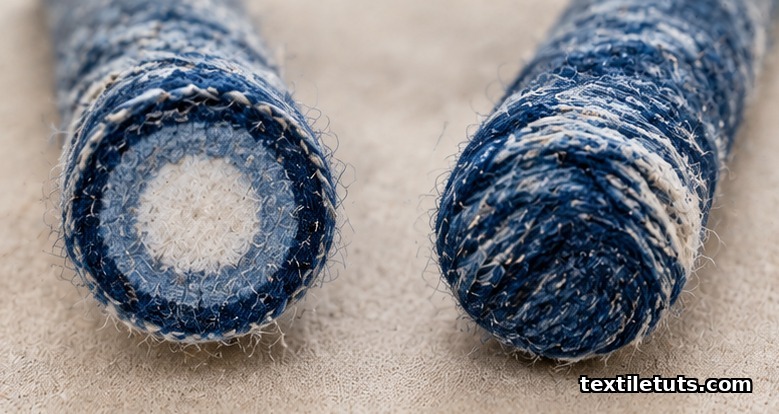
- Look at the yarn surface: rope-dyed yarns show concentric rings of indigo when viewed under magnification, with the white core faintly visible at the center. Slash-dyed yarns show streaky, uneven dye distribution because the limited dip count leaves parts of the fiber underdyed.
- Wash a swatch five times: rope-dyed denim fades evenly and retains a clear blue; slash-dyed denim loses more color in the first few washes and can develop a dull gray cast.
- Rub a white cloth on the surface: the rubbing test (AATCC 8) will transfer noticeably more indigo from slash-dyed denim than from rope-dyed denim, even at the same starting depth.
Selvedge denim is almost always rope dyed, because shuttle looms run at slow speeds that match rope-dyeing line speeds and because the premium selvedge market values the superior wash-down behavior rope dyeing produces.
Frequently Asked Questions
Which process produces deeper indigo shades?
Rope dyeing produces deeper, richer shades because of its 6 to 8 (or more) sequential dips, each adding a thin layer of indigo onto the yarn. Slashing is limited to 2 to 4 dips, which caps the achievable depth at medium indigo. For deep navy or near-black indigo, mills use rope ranges with extra boxes or switch to a combination of indigo and sulfur black.
Is rope-dyed denim always better quality than slash-dyed denim?
Not necessarily. Rope dyeing gives superior wash fastness and rub fastness, but slashing is appropriate, and often preferable, for lightweight indigo chambray, casual shirting, and any product where fast throughput and lower cost matter more than premium fade behavior. “Better” depends on the end use.
Do rope-dyed jeans always fade in the same way?
Within a single rope-dyed lot, the warp yarns share a similar dye profile, so fades are consistent across the fabric. Variation between garments comes mostly from yarn count, weave structure, finishing, and wear pattern, not from the dye process itself. Slash-dyed denim shows more within-lot variation in the starting shade, which carries through the fade.
Why does selvedge denim use rope dyeing?
Selvedge denim is woven on shuttle looms that run at 0.5 to 1.5 m/min, far slower than modern projectile or air-jet looms at 600 to 1000 m/min. Rope-dyeing line speeds of 20 to 30 m/min match shuttle looms, while slashing at 60 to 100 m/min would oversupply yarn. Rope dyeing also gives the rich fade and high rub fastness that selvedge consumers expect.
Are these processes used for dyes other than indigo?
Yes. Both rope and slash ranges can be configured for sulfur dyes (used for black and dark bottom-weight fabrics), vat dyes, and some reactive dye systems. The same trade-offs apply: rope dyeing gives deeper shades and better fastness at higher cost, while slashing gives lighter shades and faster throughput at lower cost.
References
- American Association of Textile Chemists and Colorists. AATCC Test Method 61: Colorfastness to Laundering, Accelerated. https://www.aatcc.org — five-cycle accelerated wash protocol used for the wash-fastness grading cited above.
- American Association of Textile Chemists and Colorists. AATCC Test Method 8: Colorfastness to Crocking. https://www.aatcc.org — dry and wet rubbing method cited for the crocking grades in this article.
- International Organization for Standardization. ISO 105-B02: Textiles, Tests for Colour Fastness, Part B02: Colour Fastness to Artificial Light (Xenon Arc). https://www.iso.org — light-fastness test method cited for indigo wash-down behavior.
- International Organization for Standardization. ISO 105-C06: Textiles, Tests for Colour Fastness, Part C06: Colour Fastness to Domestic and Commercial Laundering. https://www.iso.org — single-cycle domestic laundering reference for indigo yarn.
- Zollinger, H. (2003). Color Chemistry: Syntheses, Properties, and Applications of Organic Dyes and Pigments. Wiley-VCH. https://www.wiley.com — reference for vat dye chemistry, indigo reduction and oxidation, and affinity behavior of indigo on cotton.
- Bechtold, T., and Mussak, R. (Eds.). (2009). Handbook of Natural Colorants. Wiley. https://www.wiley.com — reference for natural indigo dye chemistry and life-cycle considerations for indigo processing.
Editorial by Shahrukh Islam, TextileTuts. Sources: AATCC Test Methods 8 and 61, ISO 105-B02 and 105-C06, Zollinger’s Color Chemistry (Wiley-VCH, 2003), and the Wiley Handbook of Natural Colorants (Bechtold and Mussak, 2009) as cited.


