
Coated Denim: Wax and Resin Treatments

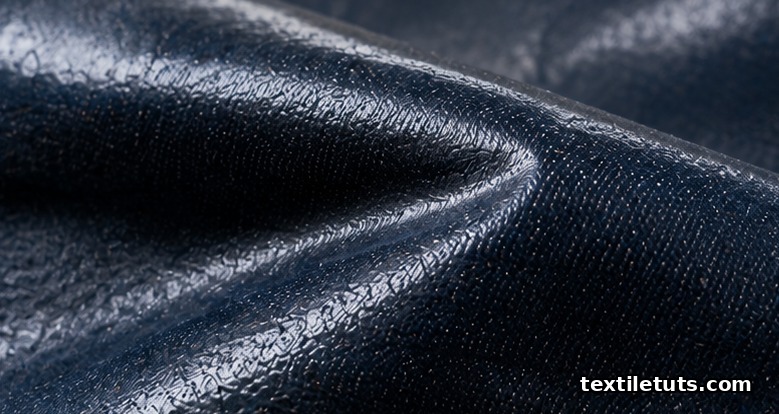
Paraffin wax and resin coatings on denim typically add 8 to 15% fabric weight at 80 to 150 g/m² add-on, raise surface friction by 30 to 60%, and cut air permeability by 40 to 70% compared with the same base denim left untreated.
Coated denim is one of the most technically demanding categories in woven finishing because the coating must survive flexing, abrasion, and home laundering without cracking, whitening, or sticky blocking. This article walks through what wax and resin coatings actually do to denim, how mills apply them, the standard tests used to grade them, and how long a properly cured coating is expected to last.
What “coated denim” means in mill practice
Coated denim is a woven cotton or cotton-elastane denim that has been finished with a thin polymeric or waxy film on the technical (back) or face side. The coating is not a dye and it is not a print; it is a separate functional layer that modifies handle, drape, wind resistance, and appearance. The two dominant chemistries used in 2024-2026 production are:
- Paraffin and microcrystalline waxes (sometimes blended with mineral oil or silicone), applied hot from a melt or as an emulsion.
- Synthetic resins, primarily acrylic copolymers, polyurethane dispersions, and PVC plastisols, applied by knife coater, roller coater, or foam coater and then dried and cured.
The choice between wax and resin is rarely either-or. Most commercial “waxed denim” is in fact a wax-resin hybrid: paraffin wax provides the dry, leathery hand and the muted surface sheen, while a small fraction (typically 5 to 20% of the dry add-on) of acrylic or polyurethane resin binds the wax to the fiber and improves wash durability.
How wax and resin coatings change denim’s measurable properties
A wax-resin coating is a deliberate trade-off. Mills accept losses in comfort and breathability in exchange for stiffness, wind protection, water repellency, and a distinctive aged look. Three measurable changes matter most for quality control.
Mass per unit area (fabric weight)
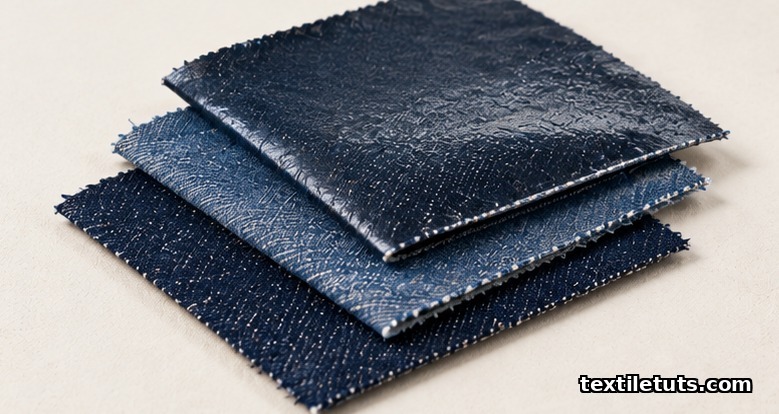
Coating add-on is reported in g/m² (grams of dry coating per square meter of fabric) or as a percentage of the uncoated weight. Industry data sheets reviewed by TextileTuts report typical add-ons of:
- Light wax finish: 30 to 60 g/m² (about 5 to 8% add-on on a 475 g/m² 3/1 right-hand twill).
- Standard wax-resin hybrid: 80 to 150 g/m² (about 10 to 20% add-on).
- Heavy resin or PU film: 150 to 250 g/m² (about 20 to 40% add-on).
These figures are consistent with the 8 to 15% add-on range most commonly cited in trade literature for fashion-grade coated denim.
Air permeability
Air permeability is measured per ISO 9237 at 100 Pa pressure drop on a 20 cm² test area. A typical 12 oz (about 405 g/m²) untreated denim reads 80 to 200 mm/s; the same denim with a wax-resin coating drops to 20 to 60 mm/s, which is why coated denim jackets feel wind-resistant but less breathable than raw denim.
Surface friction and handle
Wax coatings raise the fabric’s coefficient of friction against polished steel by 30 to 60%, producing the dry, draggy hand that defines “dry hand” coated denim. Resin-only coatings behave differently: acrylic resins tend to make the fabric boardy and papery, while polyurethane dispersions give a softer, rubbery drape. The handle difference is what most consumers feel first.
Application methods used in denim mills
Coating is almost always a downstream finishing step applied after desizing, mercerizing, dyeing, and drying but before sanforizing (compressive shrinking). Putting it before sanforizing lets the coating survive the compressive shrinkage process without cracking.
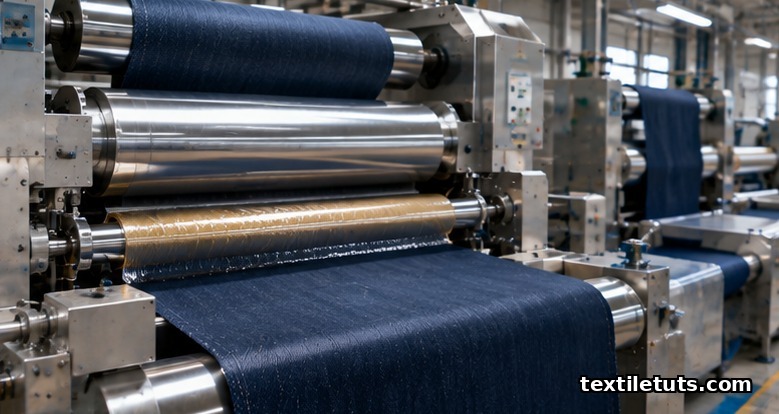
Hot-melt wax application
Solid paraffin or microcrystalline wax is melted at 80 to 110 °C and padded onto the fabric through heated rollers. The fabric is then cooled and calendared between chilled rolls to control surface gloss. This is the classic method for heritage waxed cotton, adapted for denim.
Emulsion coating
Wax or resin is dispersed in water at 20 to 40% solids, padded onto the fabric, and dried at 110 to 140 °C in a stenter. Emulsion coating gives finer control of add-on than hot-melt and is the workhorse of mass-production coated denim.
Knife and roller coating
A thick resin paste (PVC plastisol, high-solids PU, or heavy acrylic) is spread with a doctor blade or engraved roller and then fused at 150 to 180 °C. This produces heavier coatings (150 g/m² and up) with controlled patterns; it is the standard method for fashion PU-coated denim.
Foam coating
Air is whipped into the resin or wax emulsion to form a foam that is knife-coated onto the fabric. Foam coating lays down less wet chemistry per gram of dry add-on, so drying energy and migration are reduced. It is favored for lighter, more even coatings.
How durability is measured (the standard tests)
Quality control for coated denim leans on a small set of well-established physical tests. The four most important are summarized below.
Coating adhesion and flex resistance
ISO 3211 (or the older ASTM D751) is used to check whether the coating cracks or peels after repeated flexing. The coated fabric is bent 180° around a 6 mm mandrel for a fixed number of cycles (commonly 1,000 to 5,000); cracking, flaking, or whitening is rated against photographic standards.
Wash durability
AATCC 135 or ISO 6330 simulates home laundering. Coated denim is typically rated for 5 to 30 wash cycles without visible coating failure; commercial grades target the lower end, premium heritage grades the higher end.
Water resistance
AATCC 22 (spray test) and AATCC 127 (hydrostatic head) give the spray rating and water column. A well-formulated wax-resin coated denim typically scores 70 to 90 out of 100 on AATCC 22, with hydrostatic head values of 30 to 80 cm.
Abrasion resistance
ASTM D4966 (Martindale) and ASTM D3884 (Taber) are used to measure coating loss under rubbing. For waxed denim, 5,000 to 20,000 Martindale cycles before visible wear is typical.
Common defects and what causes them
Coating defects are almost always surface defects. The most common, and what usually causes them:
- Cracking at seams: resin-rich zones that were not flexible enough during tailoring. PU-modified formulations cure this.
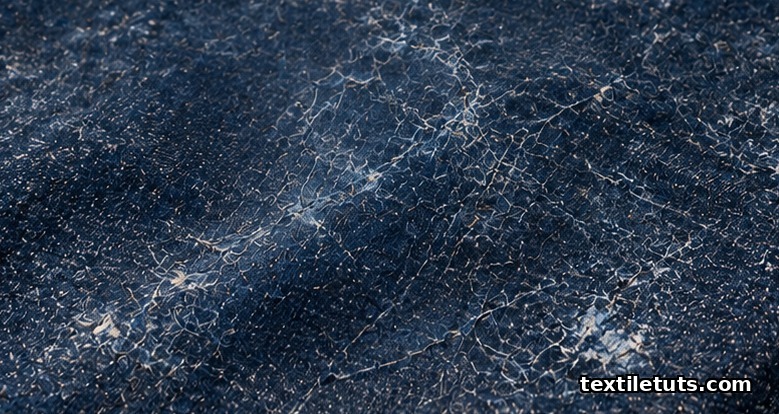
- Whitemarks (crazing): brittle coating aged past its shelf life, or curing temperature too high.
- Sticky blocking: wax migration under warm storage, especially in vacuum-packed inventory. Storage below 30 °C mitigates this.
- Uneven shade: wax or resin picked up loose indigo dye from the fabric surface during drying; pre-rinsing the dyed denim before coating fixes it.
- Loss of stretch recovery: heavy resin coating on cotton-elastane denim locks the elastane in a deformed state; PU-rich or stretch-tuned resin systems are required for stretch denim.
Care and consumer expectations
Coated denim does not behave like raw denim. Heat is the enemy: a standard tumble dryer on high can melt paraffin wax (melting point 58 to 65 °C for soft paraffin) and certainly softens most synthetic resin films, causing permanent blocking and gloss loss. The TextileTuts care guidance, consistent with care labels from major coated-denim brands, is:
- Wash inside out at 30 °C with mild detergent; no fabric softener.
- Line dry flat, away from direct sunlight.
- Do not iron the coated surface; if pressing is needed, use a cloth and the lowest setting on the technical back.
- Re-wax annually for heritage waxed styles, using the manufacturer’s bar or spray.
Sustainability considerations
Two sustainability questions dominate buyer conversations in 2026. The first is the paraffin source: petroleum-derived paraffin is the default, but paraffin from Fischer-Tropsch synthesis using renewable feedstocks is commercially available. The second is end-of-life: a wax-polyurethane hybrid is technically recyclable as a textile, but a PVC plastisol coating is not. Buyers should request the coating chemistry on the technical data sheet, not just the marketing name.
How long should a wax or resin coating last?
With normal wear (one to two wears per week) and the care guidance above, a properly cured wax-resin hybrid should retain its visual identity for 3 to 5 years, with the wax gradually wearing through at high-friction zones (knees, seat, elbows) to create the heritage “craze” pattern that is part of the product’s appeal. Pure resin coatings tend to fail abruptly by cracking rather than gradually by wearing; this is one reason resin-only coated denim is less common in premium lines.
Data table: typical property ranges for coated denim
| Property | Untreated denim (12 oz) | Light wax finish | Wax-resin hybrid | Heavy PU or PVC film |
|---|---|---|---|---|
| Add-on (% of base weight) | 0% | 5 to 8% | 10 to 20% | 20 to 40% |
| Total fabric weight (g/m²) | 400 to 410 | 420 to 445 | 445 to 495 | 480 to 575 |
| Air permeability (mm/s, ISO 9237) | 80 to 200 | 40 to 100 | 20 to 60 | 5 to 25 |
| Spray rating (AATCC 22) | 0 to 50 | 60 to 80 | 70 to 90 | 90 to 100 |
| Hydrostatic head (cm, AATCC 127) | 0 to 10 | 10 to 30 | 30 to 80 | 80 to 200+ |
| Wash cycles to first visible wear (ISO 6330) | 50+ | 10 to 20 | 20 to 30 | 30 to 50 |
| Martindale cycles to coating loss (ASTM D4966) | n/a | 5,000 to 10,000 | 10,000 to 20,000 | 20,000+ |
Values are compiled from supplier technical data sheets and published textile testing references cited below. Real performance depends on base denim, coating chemistry, cure profile, and end use.
Frequently Asked Questions
Is coated denim waterproof?
Not fully. Most wax-resin coated denim is water-resistant rather than waterproof. It will shed light rain for 15 to 60 minutes, but under sustained rain or hydrostatic pressure water will eventually wet through. Truly waterproof coated denim uses a PU or PVC film of 150 g/m² or more and may also include a seam-sealing tape.
Can coated denim be machine washed?
Yes, but only on a gentle cycle at 30 °C with mild detergent, and only inside out. Tumble drying is the leading cause of premature coating failure because residential dryers reach 60 to 80 °C, which softens both wax and most resin films. Line drying flat is strongly recommended.
Does coated denim stretch out over time?
The base denim behaves like any other denim: it relaxes slightly with wear and recovers on washing. The coating itself does not stretch. On cotton-elastane stretch denim, a heavy resin coating can lock the elastane in place and prevent recovery; PU-modified resin systems are used to avoid this.
Is coated denim warmer than raw denim?
In still air, yes, because the coating blocks wind. In active wear, coated denim can feel clammy because the same reduced air permeability that blocks wind also traps perspiration vapor. Layering strategy matters more with coated denim than with raw denim.
Why does waxed denim sometimes feel sticky in the package?
Paraffin wax softens noticeably above 40 °C and can migrate under its own weight during warm storage or shipping, producing a tacky surface and a waxy film on the inside of the packaging. Cooling the garment below 25 °C for a few hours restores the dry hand. This is a reversible physical change, not a defect.
References
- International Organization for Standardization. ISO 9237:1995 Textiles — Determination of the permeability of fabrics to air. iso.org — the standard method for air permeability on coated and uncoated denim.
- International Organization for Standardization. ISO 6330:2021 Textiles — Domestic washing and drying procedures for textile testing. iso.org — standard wash cycles used to rate coated denim durability.
- International Organization for Standardization. ISO 3211:2010 Rubber- or plastics-coated fabrics — Determination of the resistance to folding. iso.org — flex / cold-crack test commonly applied to coated denim.
- American Association of Textile Chemists and Colorists. AATCC 22 Water Repellency: Spray Test. aatcc.org — spray rating used for water repellency of coated fabrics.
- American Association of Textile Chemists and Colorists. AATCC 127 Water Resistance: Hydrostatic Pressure Test. aatcc.org — hydrostatic head measurement for coated textiles.
- American Society for Testing and Materials. ASTM D4966 Standard Test Method for Abrasion Resistance of Textile Fabrics (Martindale). astm.org — Martindale abrasion cycles for coating durability.
- American Society for Testing and Materials. ASTM D3884 Standard Test Method for Abrasion Resistance of Textile Fabrics (Taber). astm.org — alternative abrasion method for coated fabrics.
- MDPI Coatings journal (open access). Review of polymer-coated textiles and finishing technologies. mdpi.com — peer-reviewed coverage of acrylic, PU, and PVC coating chemistries on woven substrates.
This article is the working reference for coated denim wax and resin treatments. Editorial by Shahrukh Islam, TextileTuts. Sources: ISO 9237, ISO 6330, ISO 3211, AATCC 22, AATCC 127, ASTM D4966, ASTM D3884, MDPI Coatings as cited.


