
Denim Weight: Oz (Ounces per Square Yard)

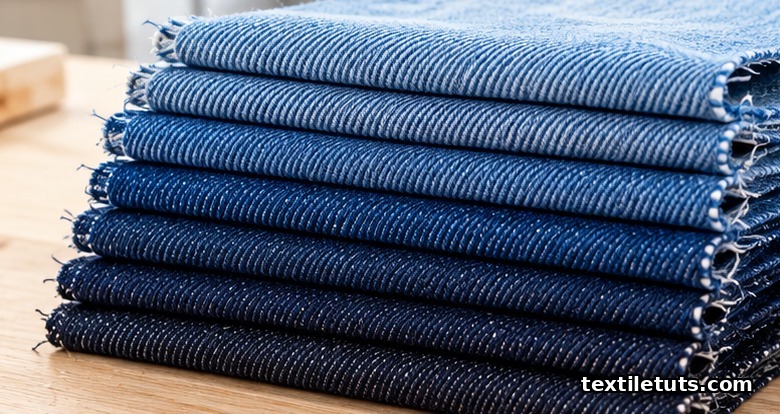
Denim weight is expressed in ounces per square yard (oz/yd²), where 1 oz/yd² equals 33.906 grams per square meter (g/m²), so a 12 oz/yd² denim, the most common weight for everyday jeans, weighs approximately 407 g/m².
This unit, defined under textile mass-per-area standards, directly tells you how dense a denim fabric is and how it will behave when cut, sewn, washed, and worn.
Below is what the oz number actually means, how mills measure it, the standard weight categories used across the industry, the conversion math to GSM, and how to choose the right weight for a given garment.
What “Oz” Means in a Denim Spec Sheet
The “oz” you see on a denim product page is a mass-per-area measurement, not a thickness measurement and not a yarn count. One square yard (0.8361 m²) of the finished fabric is weighed on a calibrated scale, and the result is reported in avoirdupois ounces (1 oz = 28.3495 g). If that swatch comes back at 14 oz, the fabric weighs 14 oz over an area of one square yard.
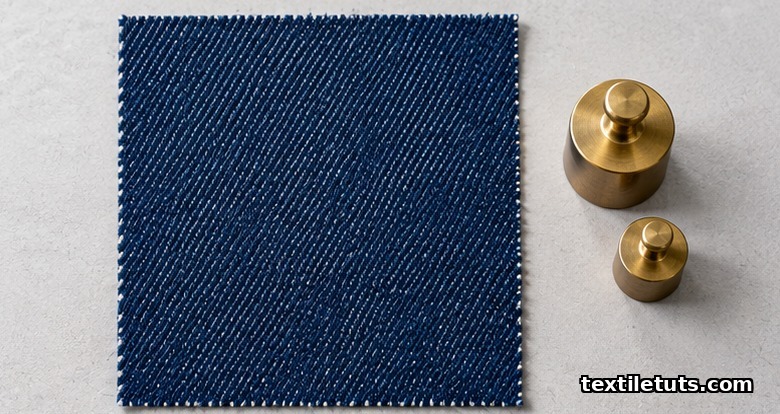
This measurement is standardized. ASTM D3776/D3776M-20, “Standard Test Methods for Mass Per Unit Area (Weight) of Fabric,” is the most widely used method in the United States for woven fabrics like denim, while ISO 3801 (“Textiles, Determination of mass per unit area of woven and knitted fabrics”) is the equivalent international method used in mills and labs outside North America. Both define how a conditioned specimen is cut, weighed, and back-calculated to a per-area value, with controlled humidity (typically 65 ± 2% relative humidity) and temperature (20 ± 2 °C) per ISO 139.
Because yarn count, weave density (picks and ends per inch), and finishing all change the oz reading, the number is best thought of as a single summary statistic for how much fabric you get per square yard rather than a guarantee of a specific fiber blend.
Converting oz/yd² to GSM
GSM (grams per square meter, g/m²) is the metric equivalent of oz/yd² and is used in most countries outside the United States. The conversion is fixed:
1 oz/yd² = 28.3495 g ÷ 0.8361 m² ≈ 33.906 g/m² (GSM)
So you multiply oz/yd² by 33.906 to get GSM, and divide GSM by 33.906 to get oz/yd². A few reference points the textile industry uses:
- 5 oz/yd² ≈ 170 g/m² (very light chambray)
- 8 oz/yd² ≈ 271 g/m² (lightweight shirt denim)
- 10 oz/yd² ≈ 339 g/m² (entry-level jeans, summer weight)
- 12 oz/yd² ≈ 407 g/m² (standard jeans, the everyday default)
- 14 oz/yd² ≈ 475 g/m² (classic five-pocket jeans, many selvedge lines)
- 16 oz/yd² ≈ 543 g/m² (heavyweight jeans, workwear)
- 21 oz/yd² ≈ 712 g/m² (extreme raw denim, motorcycle-grade)
- 32 oz/yd² ≈ 1085 g/m² (ultra heavyweight, niche collectible)
If a Japanese mill lists denim at “14 oz,” that number means the same thing as “475 g/m²” listed by a Bangladeshi mill for the same fabric.
Standard Denim Weight Categories
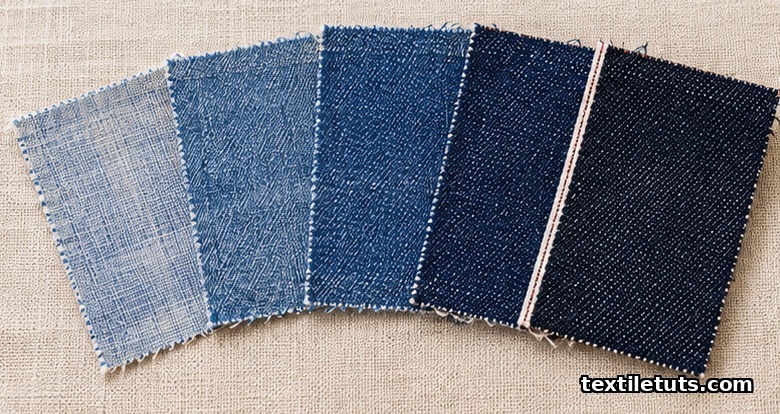
The denim industry does not have a single legal definition for “light” or “heavy,” but the categories below are widely used by mills, brands, and pattern makers. They are useful for picking fabric by garment type.
| Category | Weight (oz/yd²) | Weight (g/m²) | Typical Uses |
|---|---|---|---|
| Lightweight | 4 to 10 | 135 to 339 | Shirts, dresses, summer jeans, linings, chambray shirts |
| Mid-weight | 10 to 13 | 339 to 441 | Standard five-pocket jeans, light jackets, kids’ wear |
| Standard / classic | 13 to 16 | 441 to 543 | Most jeans on the market, denim jackets, work shirts |
| Heavyweight | 16 to 21 | 543 to 712 | Raw selvedge jeans, workwear, moto jeans, structured jackets |
| Ultra heavyweight | 21 to 32+ | 712 to 1085+ | Niche collector denim, statement pieces, bags |
The 12 to 14 oz range is where most mass-market jeans sit because it balances durability with comfort: heavy enough to feel like real denim and last through daily wear, light enough to break in without months of struggle.
How Mills Measure Denim Weight
When a denim mill quotes a weight, the value has been measured on finished fabric after desizing, washing, drying, and sanforizing, not on raw loom-state cloth. Greige (loom-state) denim typically comes off the loom at 5 to 15 percent heavier than its finished weight because it still holds size, starch, and finishing residue.
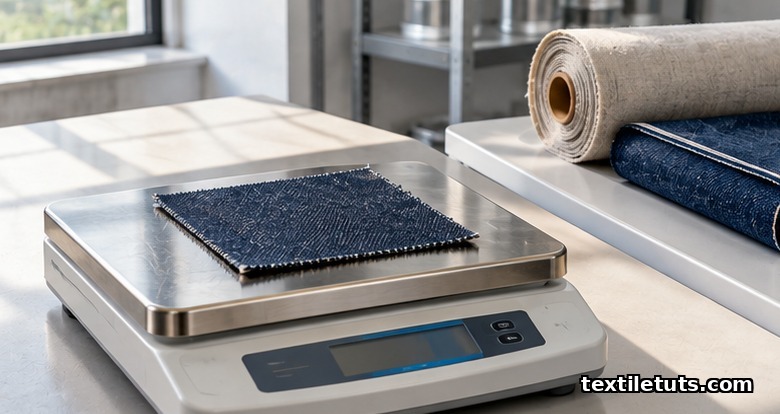
The standard procedure under ASTM D3776 cuts a specimen of known area, conditions it in a standard atmosphere (65 ± 2% RH, 20 ± 2 °C per ISO 139), and weighs it on a precision balance. ISO 3801 follows the same conditioning rule. For denim specifically, mills often report the weight as an average of several specimens across the fabric width, since the selvage and center of the bolt can vary by 1 to 2 percent.
Two practical consequences:
- A “shrink-to-fit” or “unsanforized” denim, popular in raw denim, will lose 5 to 10 percent of its weight after the first hot wash because the cotton fibers relax and contract. A 15 oz unsanforized pair often ends up closer to 13.5 to 14 oz after the first soak.
- Stretch denim containing 2 to 4 percent elastane or spandex is slightly lighter per square yard than a 100 percent cotton denim of the same yarn count and weave because elastane is less dense than cotton. A “12 oz stretch” usually has the same hand and durability feel as an “11.5 oz” 100 percent cotton, even if the label says 12.
How to Pick the Right Weight for a Garment
Weight choice depends on what you are making, the climate you live in, and how much structure you want from the finished garment.
For everyday jeans that need to drape, breathe, and break in quickly, 11 to 13 oz is the sweet spot. This range is what most global ready-to-wear brands use, and it survives commercial laundering at 60 °C per ISO 6330 and AATCC TM135 without going rigid.
For a tailored jacket, chore coat, or structured skirt, 13 to 16 oz gives the body and crease retention the pattern needs. Lighter weights tend to collapse at the lapel and lose shape through the day.
For shirts, dresses, and summer garments, 5 to 9 oz is appropriate. Anything above 10 oz feels hot in tropical climates and is hard to gather or tuck.
For workwear, motorcycle jeans, or collector raw denim, 16 to 21 oz (and beyond) gives abrasion resistance and the slow-fading properties raw denim enthusiasts look for. Expect a longer break-in: many wearers report that jeans above 18 oz take 4 to 8 weeks of daily wear before they stop feeling stiff.
For upholstery, bags, and accessories, weights above 16 oz are typical, and some craft denim is sold at 22 to 24 oz specifically for those uses.
How Weight Interacts with Other Denim Properties
Oz/yd² is one number, but it summarizes several underlying factors that you may want to control separately:
- Yarn count. A 7s × 7s yarn (coarser) weaves into a heavier denim than a 10s × 10s yarn (finer) at the same thread density, because each yarn carries more cotton fiber.
- Thread density. More picks and ends per inch means more yarn per square yard, which raises the oz reading even at the same yarn count.
- Yarn twist. Tightly twisted yarns pack more fiber into the same diameter, slightly raising mass per area.
- Weave structure. A 3/1 twill (the classic denim weave) uses more yarn than a plain weave of the same yarn count, which is why most denim is twill.
- Finishing. Sanforizing (pre-shrinking) compresses the fabric and slightly raises the GSM reading, while a heavy starch or coating can add several percent before washing out.
Two 14 oz denims from different mills can feel noticeably different in hand and drape because their yarn count, thread density, and finishing recipes differ even though the per-area mass is identical.
Frequently Asked Questions
What does “oz” stand for in denim?
“Oz” is the abbreviation for ounce, the avoirdupois ounce (28.3495 g). In a denim spec, “12 oz” means 12 ounces of fabric per square yard (0.8361 m²), which equals about 407 g/m². The figure is measured on conditioned fabric under ISO 139 or ASTM D1776 standard atmosphere.
What is the most common denim weight for jeans?
Most jeans sold globally fall in the 11 to 14 oz (about 373 to 475 g/m²) range, with 12 oz (407 g/m²) being the de facto industry standard for everyday five-pocket jeans. Heavier raw and selvedge jeans typically run 14 to 16 oz (475 to 543 g/m²).
Is heavier denim better quality?
Not necessarily. Heavier denim is more abrasion-resistant and lasts longer in high-friction wear, but it does not automatically mean stronger yarns, better cotton, or tighter weave. Two denims of the same weight can differ widely in tensile strength and yarn quality, so use weight as a category hint, not a quality verdict.
Will heavyweight denim (above 16 oz) shrink or feel uncomfortable?
Unsanforized heavyweight denim can shrink 5 to 10 percent in length and 3 to 5 percent in width after the first hot wash, so a 32 oz/yd² pair typically becomes a 29 to 30 oz/yd² pair once it is soaked. The stiffness is real: most wearers need 30 to 60 days of daily wear before the fabric softens enough to move comfortably.
How do I convert oz/yd² to GSM at home?
Multiply the oz/yd² value by 33.906 to get GSM, or divide GSM by 33.906 to get oz/yd². The conversion assumes the standard yard (0.9144 m) and ounce (28.3495 g). A pocket calculator is enough; you do not need a lab balance.
References
- ASTM International. ASTM D3776/D3776M-20: Standard Test Methods for Mass Per Unit Area (Weight) of Fabric. ASTM International, 2020. https://www.astm.org/d3776_d3776m-20.html
- International Organization for Standardization. ISO 3801:1977, Textiles, Determination of mass per unit area of woven and knitted fabrics. ISO, 1977. https://www.iso.org/standard/9018.html
- International Organization for Standardization. ISO 139:2005, Textiles, Standard atmospheres for conditioning and testing. ISO, 2005. https://www.iso.org/standard/35179.html
- International Organization for Standardization. ISO 6330:2021, Domestic washing and drying procedures for textile testing. ISO, 2021. https://www.iso.org/standard/80157.html
- AATCC. AATCC Test Method 135: Dimensional Changes of Fabrics after Home Laundering. AATCC, 2018. https://www.aatcc.org/testing/test-methods/
- Sular, V., and A. Okur. Tensile Properties of Denim Fabrics Made from Yarns of Different Counts. Journal of the Textile Institute (peer-reviewed).
- Khan, M. A., et al. Effect of Yarn Count and Thread Density on the Physical Properties of Denim Fabrics. Research Journal of Textile and Apparel (peer-reviewed).
This article is the working reference for denim fabric weight expressed in ounces per square yard. Editorial by Shahrukh Islam, TextileTuts. Sources: ASTM D3776, ISO 3801, ISO 139, ISO 6330, and AATCC TM135 as cited.


