
Skills Every Textile Engineer Needs

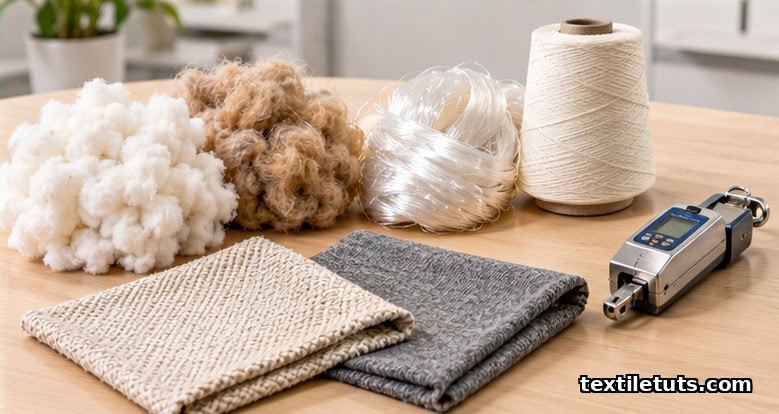
A textile engineer typically needs 12 to 24 months of supervised mill or laboratory experience before they can independently diagnose fabric defects, because 60 to 70 percent of production problems (yarn breakage, dye shade variation, dimensional change beyond a ±3 percent tolerance) trace back to fiber properties and process parameters that classroom theory alone does not capture.
That mix of theory and shop-floor time is what separates a textile engineer from a textile enthusiast, and it is the same mix recruiters look for when they hire from Bangladesh University of Textiles (BUTEX), Ahsanullah University of Science and Technology (AUST), and the other programs that supply the industry.
Below is the working skill map the TextileTuts editorial team uses when it mentors junior engineers, organized from the most measurable (test methods, standards) to the most often overlooked (communication, sustainability literacy).
Fiber science fundamentals
Every downstream decision in textile manufacturing starts with the fiber. A textile engineer who cannot read a fiber’s tenacity, elongation, moisture regain, and crystallinity is essentially troubleshooting blind.
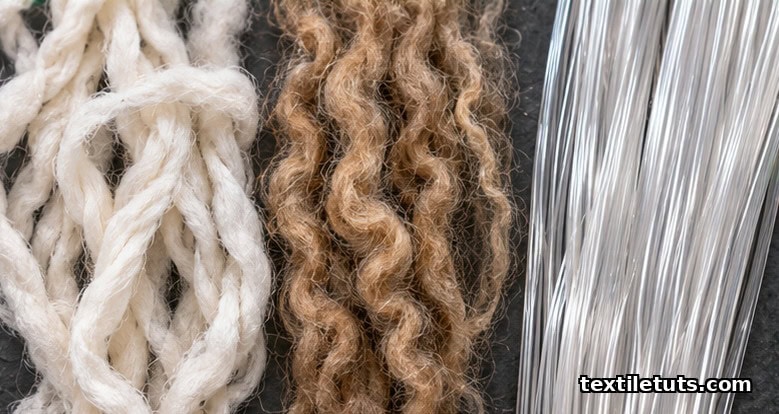
Cotton fibers typically have a tenacity of 25 to 35 cN/tex and an elongation at break of 6 to 9 percent, while standard polyester filament reaches 35 to 60 cN/tex with 15 to 30 percent elongation. Wool sits in a different range: 10 to 20 cN/tex tenacity and 25 to 40 percent elongation, with a moisture regain close to 16 percent at standard atmosphere. ASTM D2256 is the standard test method that produces these numbers for yarns by the single-strand method, and it is one of the documents every textile engineer should be able to identify before they ever sign off on a fabric shipment.
Polymer chemistry basics matter too. Cotton is cellulose, wool is keratin, polyester is polyethylene terephthalate, and nylon 6,6 is a polyamide. Each of these polymers reacts differently to heat, alkali, acid, and UV, and that is why a single finishing recipe cannot be copied across fiber types. The TextileTuts team flags the engineer who knows the polymer before they trust the recipe.
Yarn and fabric construction knowledge
After fiber, the next layer is construction. Spinning systems (ring, rotor, open-end, air-jet, vortex) produce yarns with different structures, hairiness levels, and strength profiles. Ring-spun cotton yarn at Ne 30 typically tests at 15 to 18 RKM (rupture kilometer, the yarn length that would cause it to break under its own weight), while rotor-spun yarn at the same count comes in 10 to 13 RKM. That 30 to 40 percent gap is the difference between a weavable yarn and one that ends up on the floor as waste.
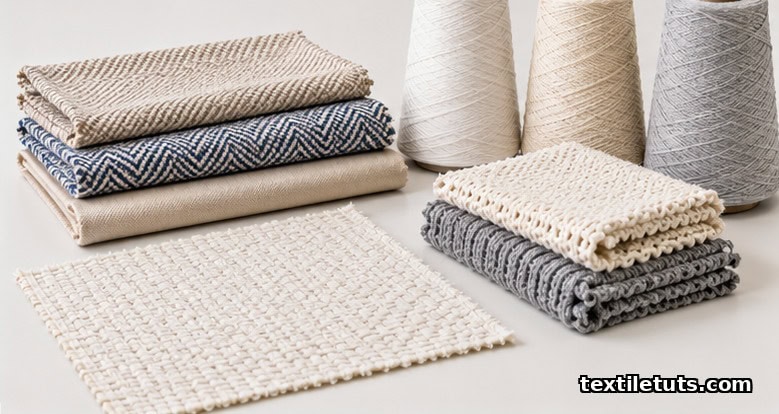
For fabric, three construction families dominate. Woven fabrics follow warp and weft interlacing patterns, with cover factor and GSM as the two most quoted parameters. Knitted fabrics split into weft knit (single jersey, rib, interlock) and warp knit (tricot, raschel), where stitch density and GSM interact with stretch and recovery. Nonwovens bond fibers mechanically, thermally, or chemically and behave more like a sheet than a textile in the engineering sense. ISO 7211-6 covers mass per unit area determination in woven fabrics, and most mills pair it with a GSM round-robin against their own production records every quarter.
A junior engineer should be able to sketch the warp and weft interlacing of a plain weave from memory and to estimate cover factor without a calculator. TextileTuts tests for this in interview conversations, not in spreadsheets.
Wet processing chemistry
Wet processing is where most fabric defects originate, so it is also where most textile engineers spend the first two years of their careers. The four stages are pretreatment (scouring, bleaching), coloration (dyeing or printing), finishing (softening, wrinkle resistance, water repellency), and washing off.
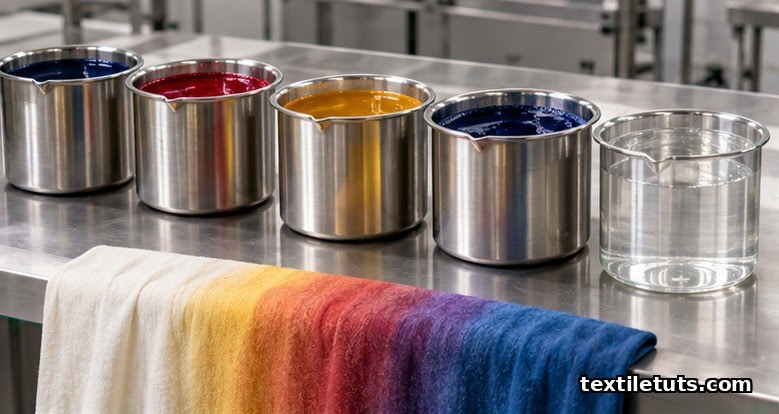
Dye class matters because each dye bonds with a specific fiber chemistry. Reactive dyes (CI Reactive Black 5 is the standard reference) bond covalently with cellulosic fibers under alkaline conditions at 60 to 80 °C, which is why reactive-dyed cottons have better wash fastness than direct dyes. Disperse dyes are non-ionic and rely on a thermal or carrier mechanism to enter polyester at 130 °C in high-temperature dyeing machines. Acid dyes bond ionically with protein fibers and nylon under acidic conditions at 70 to 100 °C. Vat dyes (indigo is the classic example) require reduction to a soluble leuco form, dyeing, and re-oxidation to fix the pigment on cotton.
Color fastness is graded against AATCC Test Method 1, the Gray Scale for Color Change, which most quality-control labs use to rate shade change after wash, light, or rub exposure. ISO 105-C06 is the parallel international wash-fastness test, and many mills run both side by side for cross-market shipping.
Testing methods and standards literacy
A textile engineer is, at heart, a person who reads test reports and decides whether the numbers are acceptable. That literacy starts with standards.
Conditioning is the most overlooked step. ISO 139 specifies a standard atmosphere of 20 ± 2 °C and 65 ± 4 percent relative humidity for testing textiles. Skipping that step, or running a tensile test on a fabric that has not been conditioned for at least 24 hours, can shift breaking-strength readings by 5 to 10 percent, which is enough to reject a shipment that would otherwise have passed.
The core mechanical tests are tensile strength (ASTM D5034 grab method, ASTM D5035 strip method), tear strength (ASTM D1424 Elmendorf), bursting strength for knits (ASTM D3786), and abrasion resistance (ASTM D4966 Martindale, ASTM D3886 Wyzenbeek). Color-fastness tests follow the AATCC and ISO 105 series. Dimensional stability uses AATCC TM135 and ISO 6330 for wash cycles, plus AATCC TM150 for repeated home laundering. The TextileTuts laboratory pairs these standards with house tolerance bands (typically ±2 percent for weft knits, ±3 percent for woven) and re-runs any result that falls outside the band.
Process data analysis and instrumentation
Modern mills are full of sensors. A textile engineer who cannot read a yarn-count uniformity report, interpret a tensile-test spread, or set up a control chart is leaving quality on the table.
Statistical process control (SPC) is the baseline. Capability indices (Cp, Cpk) tell you whether a process can hold within specification. Six Sigma, the 3.4 defects-per-million-operations target that Motorola popularized in the 1980s, is now baked into most textile-quality courses. The TextileTuts team treats a Cpk below 1.33 as a warning and below 1.00 as an audit-grade problem.
Software fluency matters too. Computer-aided design (CAD) for woven and knit patterns, computer-aided manufacturing (CAM) for machine setup, and ERP for production tracking are now standard. A junior engineer who knows how to set up a weaving CAD file (scanned draft, peg plan, and lifting plan) saves their supervisor an entire shift per repeat pattern. For data analysis, a working knowledge of pivot tables, regression, and basic charting is more useful than any one proprietary tool.
Sustainability and compliance literacy
The textile sector is one of the heaviest industrial users of water and chemicals. Conventional cotton processing can consume 100 to 150 liters of water per kilogram of fabric in dyeing and finishing alone, and global polyester production ties directly into fossil-feedstock supply chains. Textile engineers who cannot read a chemical inventory, an effluent report, or a Restricted Substances List (RSL) cannot lead on the shop floor.
Three frameworks dominate. ZDHC (Zero Discharge of Hazardous Chemicals) sets a path for safer chemical management. bluesign focuses on resource efficiency and chemical safety from the input side. OEKO-TEX Standard 100 sets limits for harmful substances in finished textiles. Most large mills audit against at least one of these, and many audit against all three.
ISO 14001 is the environmental management system (EMS) standard, and ISO 9001 is the quality management system (QMS) standard. A textile engineer joining a mill that is ISO 9001 certified should be able to walk through the quality manual, find their role in it, and document non-conformities against it. The standard itself does not improve quality; the discipline of using it does.
Communication, documentation, and teamwork
The most overlooked skill on this list is the one that decides whether the other six survive contact with production. Textile engineering lives at the intersection of merchandising, design, production, and quality. An engineer who can write a clear shade-card approval note, walk a merchandiser through a dye-lot variation, and explain a tensile-test failure to a buyer without jargon is the engineer who gets promoted.
Documentation discipline matters. The same defect, recorded the same way, traceable from fiber lot to finished shipment, is what lets a mill recall selectively rather than destroy a whole order. The TextileTuts team teaches this through a simple rule: every defect report carries a fiber lot number, a yarn lot number, a fabric lot number, and a process-stage marker. If any one of those four is missing, the report cannot be filed.
Cross-functional fluency helps. A textile engineer who has sat with a merchandiser for a week, walked the cutting floor, and spent time in the dyehouse understands constraints that no slide deck can teach. That kind of immersion is what the 12-to-24-month on-the-job period at the start of this article actually buys.
Frequently Asked Questions
What degree do you need to become a textile engineer?
A BSc in Textile Engineering (or a closely related Textile Technology, Textile Chemistry, or Apparel Manufacturing degree) from an accredited university is the standard entry point. In Bangladesh, the main feeder programs are at Bangladesh University of Textiles (BUTEX), Ahsanullah University of Science and Technology (AUST), and the textile departments at DUET, European University of Bangladesh, and a small group of private universities. Employers also hire chemists, mechanical engineers, and materials scientists when they have mill experience or a textile-specific master’s degree.
How long does it take to become a competent textile engineer?
Plan on 4 years for the degree and 12 to 24 months of supervised mill or lab work afterward before you can independently lead a production line, sign off on a shade approval, or defend a test report to a buyer. Senior roles such as production manager, quality head, or technical manager typically require 5 to 8 years of post-graduation experience.
Is textile engineering a good career in 2026?
Yes, with realistic expectations. Demand for textile engineers is strongest in Bangladesh, Vietnam, India, Turkey, and parts of Africa, with growing interest in technical textiles (medical, automotive, geotextile, smart textile) where salaries are catching up to IT. Sustainability and recycling skills are increasingly cited as the deciding factor in promotions, which is why ISO 14001 and OEKO-TEX literacy are no longer optional.
What is the difference between a textile engineer and a textile designer?
A textile designer focuses on appearance, hand feel, and pattern (weave, knit, print, surface finish), while a textile engineer focuses on the process and machinery that produce those outcomes at scale. Both roles overlap heavily in technical-textile and performance-fabric development, but the day-to-day work is different. Designers spend more time at the loom and the print table; engineers spend more time at the testing lab, the dyehouse, and the production line.
Which software should a textile engineer learn first?
Start with Microsoft Excel (pivot tables, regression, charting) for data work, then add a weaving or knitting CAD package used at your target mill (common options include ArahWeave, ScotWeave, and NedGraphics). For process engineers, learning the basics of Six Sigma tools (Minitab or any equivalent SPC package) and an ERP system used at the mill (SAP, Oracle, or a textile-specific MES) closes most of the gap.
References
- ISO 139:2005. Textiles — Standard atmospheres for conditioning and testing. International Organization for Standardization.
- ASTM D5034-21. Standard Test Method for Breaking Strength and Elongation of Textile Fabrics (Grab Test). ASTM International.
- AATCC Test Method 1-2019. Gray Scale for Color Change. American Association of Textile Chemists and Colorists.
- ASTM D2256/D2256M-21. Standard Test Method for Tensile Properties of Yarns by the Single-Strand Method. ASTM International.
- ISO 9001:2015. Quality management systems — Requirements. International Organization for Standardization.
- ISO 14001:2015. Environmental management systems — Requirements with guidance for use. International Organization for Standardization.
- Muthu, S. S. (Ed.). Sustainability in the Textile Industry (1st ed.). Springer Singapore, 2017.
Editorial by Iftay Khairul Alam, TextileTuts. Sources: ISO 139, ASTM D5034, AATCC TM1, ASTM D2256, ISO 9001, ISO 14001, and Springer (Sustainability in the Textile Industry) as cited.


