
Sizing in Weaving: Size Recipe and Process

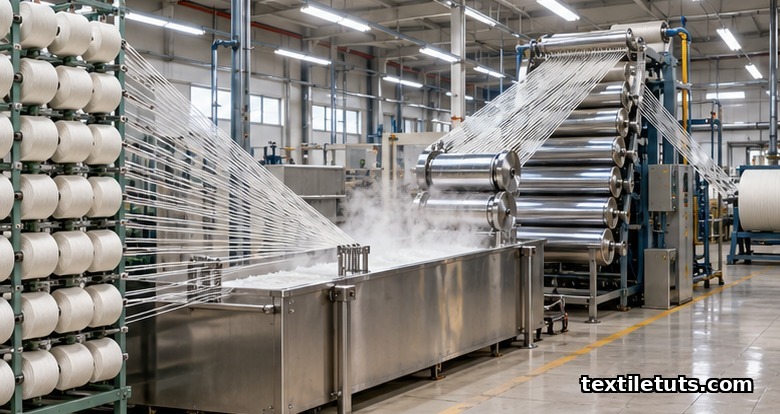
Sizing adds a 5 to 15 percent size add-on to warp yarn using a starch-PVA film that bonds 70 to 110 percent pick-up onto the fibers, reducing warp breakage by 40 to 70 percent and raising loom efficiency by 15 to 25 percent in cotton weaving. The protective film glues protruding surface fibers to the yarn body, which cuts hairiness-driven shedding and gives the warp the abrasion resistance it needs to survive 2,000 to 4,000 sheds per minute on a modern air-jet or rapier loom.
This article covers how size ingredients are formulated, the step-by-step wet process from creel to beam, the operating window for viscosity, temperature, and moisture, and the defects that show up when one of those parameters slips. The reference recipes below are the ones used for cotton, polyester-cotton, and filament warps in industrial sizing mills.
Why Warp Yarn Needs a Size Coating
Warp yarns carry the cyclic load of weaving: tension up to 15 cN/tex on a power loom, repeated abrasive contact with heddle eyes, drop wires, and reed dents at every pick, plus rapier or air-jet gripper friction. A sized yarn survives that gauntlet; an unsized cotton warp typically breaks every 50 to 200 m on a modern loom.
A size film works through three mechanisms. First, it bonds loose surface fibers into the yarn body, which lowers hairiness and the shedding that drops fly into the shed. Second, the polymeric film raises yarn tenacity by 10 to 20 percent at the cost of a 5 to 10 percent loss in elongation. Third, the film lubricates yarn-on-yarn and yarn-on-metal contact, lowering the coefficient of friction from roughly 0.35 for a dry cotton yarn toward 0.15 to 0.20 for a fully sized yarn.
Beyond breakage control, sizing drives woven fabric quality. Hairy warps leave loom-state fabric with visible reed marks and low cover factor; sizing holds the warp at the correct spread and width during weaving so the fabric leaves the loom at the design GSM and EPI.
Common Size Ingredients and What Each One Does
A size recipe is a blend, not a single polymer. Each additive plays a different role, and the ratios shift with the fiber in the warp, the loom type, and the desize plan at the finishing mill.
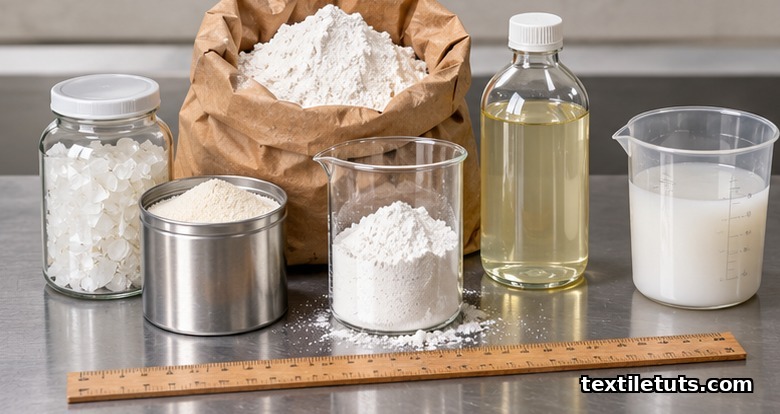
- Starch (native or modified): The backbone of most cotton warp sizes, used at 60 to 80 percent of the total recipe. Native maize, tapioca, or potato starch costs the least but retrogrades quickly; modified starches (oxidized, esterified, etherified) hold viscosity over the 4 to 8 hours a size box sits at 90 to 95 °C. Starch contributes film strength and abrasion resistance but lacks flexibility on its own.
- Polyvinyl alcohol (PVA): A fully or partially hydrolyzed synthetic that adds 10 to 25 percent of the recipe on polyester-cotton or filament warps. PVA gives a flexible, tough film with strong adhesion to hydrophobic fibers and good wash-out at finishing. Its environmental load is the trade-off; many mills now blend it with acrylic copolymers for the same performance.
- Carboxymethyl cellulose (CMC): A water-soluble cellulose ether used at 1 to 5 percent of the recipe. CMC smooths the size bath viscosity profile and improves film flexibility at low add-on, which helps with hairiness on rotor-spun warps.
- Acrylic copolymers: Often used as the main binder on filament polyester and viscose warps where PVA is being phased out. These acrylates give high adhesion to synthetic filaments at low film weight.
- Softeners and lubricants: Waxes, fatty-acid esters, or paraffin emulsions added at 2 to 6 percent of the recipe. They reduce film brittleness and lower the dynamic friction against heddles and reeds. Without a softener, a starch film cracks off as the warp threads flex on the loom.
- Antistatic agents: Quaternary ammonium salts or non-ionic surfactants at 0.1 to 0.5 percent, important on synthetic warps where static buildup stalls the loom.
- Biocides: Isothiazolinone-based products at 50 to 200 ppm to stop bacterial growth in the size box, which can otherwise drop viscosity over a shift.
Reference Size Recipes for Common Warps
The recipes below are starting points; every mill tunes to its own yarn count, loom type, and desize sequence.
| Recipe component | 100% cotton warp (40s to 60s Ne) | Polyester-cotton (65/35, 30s to 45s Ne) | Filament polyester (75D to 150D) |
|---|---|---|---|
| Modified starch | 8 to 10% bath solids | 5 to 7% bath solids | none |
| PVA (fully hydrolyzed) | 0 to 1% | 2 to 4% | 5 to 8% |
| Acrylic copolymer | none | 0.5 to 1.5% | 1 to 3% |
| CMC | 0.3 to 0.5% | 0.2 to 0.4% | none |
| Softener (fatty acid ester) | 0.5 to 1.0% | 0.5 to 0.8% | 0.3 to 0.6% |
| Antistatic agent | optional | 0.05 to 0.1% | 0.1 to 0.2% |
| Biocide | 100 ppm | 100 ppm | 100 ppm |
| Target add-on (dry film on yarn) | 10 to 15% | 8 to 12% | 5 to 8% |
The recipe numbers are typical, but the operating window of the size bath matters as much as the chemistry. A 10 percent starch bath sits at 88 to 95 °C and 8 to 15 seconds Stein-Hall cup viscosity at 100 °C, calibrated per ASTM D2196. Below 80 °C the starch retrogrades and the film breaks; above 100 °C the polymer degrades and viscosity drifts mid-shift.
The Sizing Process Step to Step
Step 1: Creeling
Yarn packages from the winding section are loaded on the creel. Sectional warpers handle 600 to 1,200 ends per creel head. Yarn tension at creel is set to 0.10 to 0.20 cN/tex.
Step 2: Size box immersion
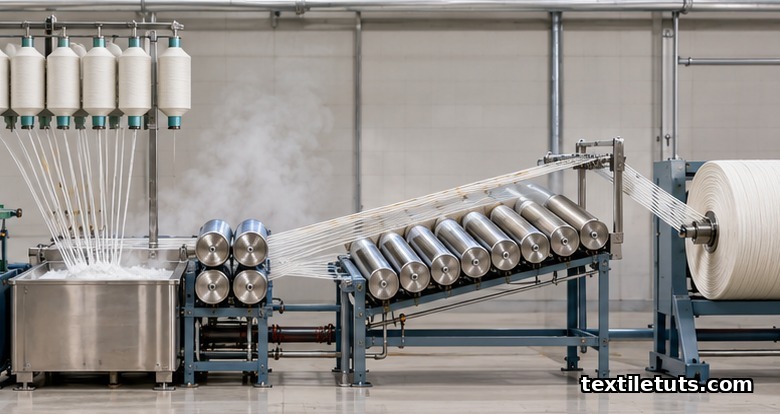
Yarns run through the size bath at 60 to 120 m/min. Submersion depth of 50 to 75 cm and a residence time of 0.3 to 0.8 seconds controls the size pickup. Two or three squeeze rollers press the wet pick-up toward the 70 to 110 percent wet-add-on target.
Step 3: Drying on cylinder dryers
Wet warp travels over a stack of steam-heated cylinders (usually 7 to 13) at 100 to 130 °C surface temperature. Total drying time of 30 to 60 seconds brings the yarn from 80 to 100 percent wet pick-up to 6 to 10 percent final moisture. The first cylinders run hot (130 °C) to set the film; the last cylinders run cooler (100 °C) to control final moisture.
Step 4: Splitting rod and beam winding
p>A splitting rod separates the hot, sticky ends into the correct sheet width before the warp is wound on the weaver’s beam. Beam winding tension runs 0.15 to 0.30 cN/tex, depending on yarn count, and uses a dancer or load-cell tension control to keep beam density uniform.
Step 5: Conditioning and storage
Before going to the loom, sized beams are conditioned at 65 to 75 percent RH for 12 to 24 hours so the size film equilibrates. A beam that ships hot and dry sheds a fine dust of unadhered size at the loom.
Key Process Parameters and Their Limits
Mills track size bath viscosity, temperature, pickup, and final moisture on every shift because each one of these will silently degrade the warp if it slips.
| Parameter | Typical operating window | Failure mode when out of spec |
|---|---|---|
| Size bath solids | 8 to 15% | Below 8%: weak film, high warp breakage. Above 15%: brittle film, sizing shedding. |
| Bath temperature | 88 to 95 °C (cotton) | Below 80 °C: starch retrogrades. Above 100 °C: bath thins, film coverage drops. |
| Bath viscosity | 8 to 15 sec (Stein-Hall at 100 °C) | Low: starved film. High: lumps, broken ends on the reed. |
| Wet pick-up | 70 to 110% of yarn weight | Low: insufficient add-on. High: dryer overload, sticky warp. |
| Dry add-on | 5 to 15% by yarn weight | Desize must remove 95 to 99% of the film; incomplete desize leaves a harsh handle. |
| Final moisture | 6 to 10% | Below 5%: brittle warp, high loom tension. Above 12%: mildew risk in storage. |
| Loom shed angle tension | 0.10 to 0.20 cN/tex | Outside this band: more end breaks regardless of size chemistry. |
The wet pick-up and dry add-on numbers tie back to fabric specifications. A 100% cotton poplin woven at 60 ends per cm and 30 picks per cm, using 40s Ne warp, calls for roughly 12% size add-on to keep loom efficiency above 90 percent.
Common Sizing Defects and Their Root Causes
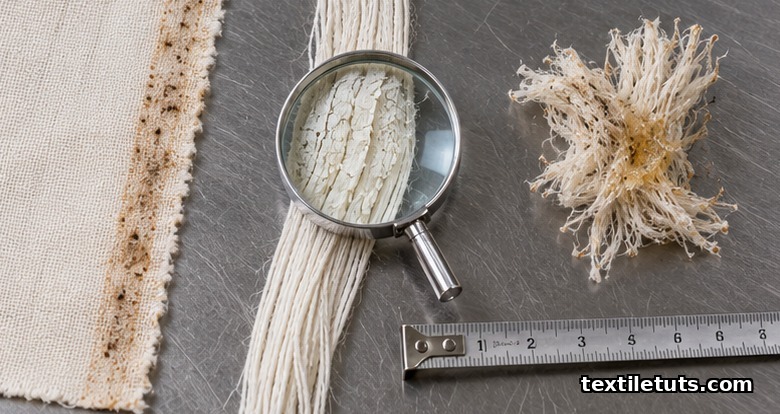
- Sizing shedding (loom fly): Brownish or off-white dust under the loom and streaks on the cloth. Most often caused by over-dried film (final moisture below 5%), excess add-on, or too little softener. Fix by rebalancing moisture, lowering add-on, or adding a fatty-acid softener at 0.5 to 1.0% of the recipe.
- Sticky warps (size not dried): Warp ends glue together on the beam or in the heddles. Caused by low cylinder temperature, low loom beam winding tension, or a final moisture above 12%. Fix by raising the last cylinder temperature 5 to 10 °C and pulling loom beam tension 10 to 15% higher.
- Hairiness after sizing: Loose surface fibers still visible. Caused by under-add-on or a size bath that retrograded before film formation. Fix by raising solids 1 to 2 percentage points or switching to a more stable modified starch.
- Uneven size film (thick-thin bands): Caused by misaligned squeeze rollers, low bath temperature (raising viscosity unevenly), or a worn Stein-Hall cup. Fix by re-calibrating roller pressure and verifying cup flow rate.
- Desize failure downstream: Caused by too-strong PVA or acrylic binder that resists wet processing, or by crosslinking agents added at the size box. PVA above 4% on a cotton warp is often the trigger; pre-checking the recipe against the finishing mill’s desize capacity prevents the dispute after the fabric leaves the loom.
Frequently Asked Questions
What is sizing in weaving, in one sentence?
Sizing is the application of a polymeric film, most often starch, PVA, or a blend, onto warp yarn before weaving, in order to raise yarn tenacity, lower hairiness, and cut breakage during shedding at the loom.
What is the standard size recipe for cotton warp?
A typical cotton warp size recipe runs 8 to 10 percent modified starch, 0 to 1 percent PVA, 0.3 to 0.5 percent CMC, and 0.5 to 1.0 percent fatty-acid softener in the size bath, with 100 ppm biocide and a 10 to 15 percent dry add-on target.
How much size add-on do cotton yarns need?
Cotton warps usually take 8 to 15 percent dry size add-on, depending on yarn count and loom type. Coarser yarns (20s Ne and below) sit at the lower end; finer yarns and air-jet looms sit at the higher end because both need extra film to survive the shedding cycle.
What size bath temperature and viscosity should the mill run?
For a starch-based bath, hold the size box at 88 to 95 °C and 8 to 15 seconds Stein-Hall cup viscosity at 100 °C. Filament polyester warps run cooler (60 to 80 °C) because PVA and acrylic binders do not need the starch gelatinization range.
Why is sizing called the most expensive step in weaving?
Sizing carries the cost of the chemicals, the drying energy, the desize water and chemistry at finishing, and the throughput loss when something drifts out of spec, while the size film itself leaves with the desize liquor and adds nothing to the fabric.
References
- Mishra, S. P. (Ed.). A Textbook of Fibre Science and Textile Processing. Springer. https://link.springer.com/chapter/10.1007/978-3-642-03916-0_3 . Peer-reviewed chapter on textile size chemistry and process parameters for warp sizing.
- ASTM International. ASTM D2196-20: Standard Test Methods for Rheological Properties of Non-Newtonian Materials by Rotational Viscometer. https://www.astm.org/d2196-20.html . Referenced for size-bath viscosity calibration.
- International Organization for Standardization. ISO 7211-5: Textiles, Methods for analysis of woven fabric construction, Part 5: Determination of linear density of yarns removed from fabric. https://www.iso.org/standard/39626.html . Method used to measure sized-yarn linear density and verify add-on.
- Tarafdar, N., and Choudhury, A. K. R. Role of Sizing in Weaving: An Overview. ResearchGate. https://www.researchgate.net/publication/295099840 . Overview paper on sizing additives, recipes, and their effect on weaving efficiency.
- IntechOpen. Warp Sizing Chemistry and Performance. https://www.intechopen.com/chapters/64819 . Open-access chapter covering starch modification, PVA substitution, and recipe design.
- AATCC. AATCC TM 99: Sizing and Desizing Test Methods (current edition). https://www.aatcc.org . Laboratory methods used to confirm add-on and desize removal.
- ScienceDirect. Review of Warp Sizing Materials and Their Effect on Weaving Performance. https://www.sciencedirect.com/science/article/pii/S2238785422000150 . Peer-reviewed review of size polymer chemistry and loom efficiency correlation.
This article is the working reference for sizing in weaving. Editorial by Mohammad Yousuf (Anik), TextileTuts. Reviewed by Sabbir Ahmed, TextileTuts. Sources: Springer, ASTM, ISO, IntechOpen, AATCC, ResearchGate, and ScienceDirect.


