
Beam Warping

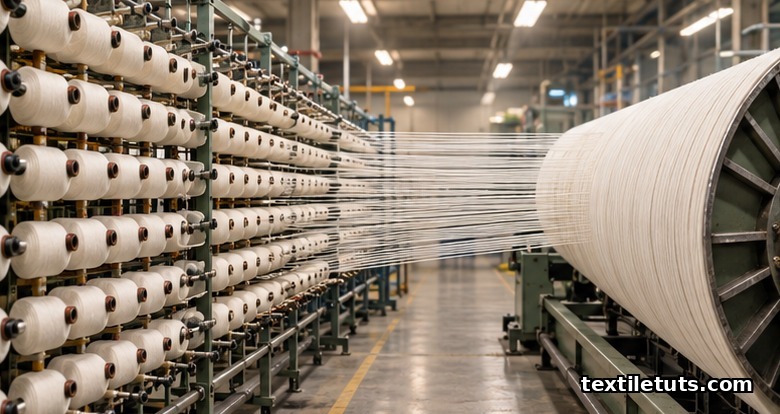
Beam warping winds 200 to 800 parallel warp ends from a creel onto a single conical warper’s beam at production speeds of 400 to 1,200 m/min, producing a uniform warp sheet that is later sized and transferred to a weaver’s beam for weaving.
It is the most widely used warp preparation method for short-to-medium production runs in cotton, wool, and synthetic weaving mills. Beam warping delivers lower yarn-to-yarn tension variation than sectional warping because every end is wound simultaneously from identical package positions.
What follows explains how the process works, how beam warping compares to sectional warping, the process parameters that decide fabric quality, the defects that disrupt weaving efficiency, and the ISO and ASTM standards that govern the warp sheet.
What Is Beam Warping?
Beam warping is a weaving preparatory process in which a fixed number of warp yarns, typically 200 to 800 ends per beam and sometimes up to 1,200 for staple-fibre weaving, is withdrawn in parallel from packages mounted on a creel and wound side-by-side onto a conical beam called a warper’s beam. The wound sheet is then taken to a sizing machine, where size is applied to the yarn surface to bind the protruding fibres, improve abrasion resistance during weaving, and reduce hairiness. After sizing, the warp is transferred to a weaver’s beam and mounted on a loom.
The defining feature of beam warping is simultaneity. Every warp end travels from the creel to the beam at the same time, under the same controlled tension, and across the same distance. This parallelism is what gives beam warping its reputation for low yarn-to-yarn tension CV (coefficient of variation), usually below 4 percent, compared with 8 to 12 percent for sectional warping on the same yarn lot.
How Beam Warping Works, Step by Step
A modern beam warping line consists of five functional zones: the creel, the tension zone, the leasing zone, the warper’s comb, and the headstock.
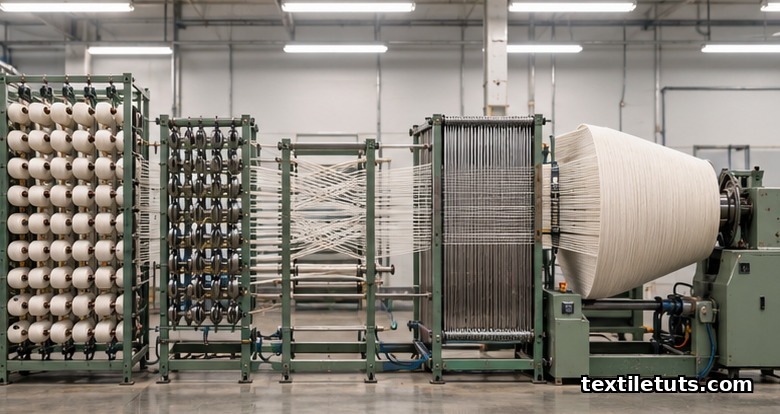
- Creel. Yarn packages (cones, cheeses, or cross-wound bobbins) are loaded onto a creel with capacity ranging from 200 to over 1,000 positions. Modern creels are fitted with broken-yarn sensors that stop the machine within 50 ms of an end failing.
- Tension zone. Each yarn passes through a gate, a balloon breaker, and a disc or gate tensioner. Yarn tension on cotton warps is normally set between 6 and 12 cN/tex; for filament polyester it can be as low as 3 to 5 cN/tex to avoid stretch-induced disorientation of the filaments.
- Leasing zone. Lease strings or lease yarns are inserted every 50 to 100 m to keep the warp sheet orderly and to give the weaver a reference for separating warp ends during drawing-in.
- Warper’s comb. A comb (also called a guide reed) with 6 to 30 dents per inch spaces the warp ends uniformly across the beam width. The comb density is usually chosen to match the loom reed plan, at 5 to 10 percent higher density than the loom reed to control end spacing.
- Headstock and beam. The headstock drives the warper’s beam at 400 to 1,200 m/min, winding each successive layer directly over the previous one to build a uniform beam profile. The beam is automatically stopped when the desired warp length is reached, normally 2,000 to 12,000 m per beam.
Beam Warping vs Sectional Warping
Two warp-preparation systems dominate industrial weaving: beam warping and sectional warping. The choice between them depends on run length, yarn type, and the colour pattern of the finished fabric.
| Property | Beam warping | Sectional warping |
|---|---|---|
| Run length | Short to medium (500 to 12,000 m per beam) | Long runs and short repeat patterns |
| Colour flexibility | Limited; coloured yarns mixed in the creel | High; each colour band placed section by section |
| Creel capacity | 200 to 1,000+ ends | 200 to 600 ends per section, with several bands |
| Yarn tension CV | Low, typically below 4 percent | Higher, 8 to 12 percent |
| Production speed | 400 to 1,200 m/min | 150 to 400 m/min per section |
| Typical application | Solid shade fabric, plain cotton, denim, suiting | Yarn-dyed checks, stripes, shirting |
Beam warping wins on throughput and tension uniformity, which is why mills producing plain-coloured cotton shirting and bottom-weight fabrics (denim, twill, drills) standardise on it. Sectional warping wins on colour-pattern flexibility and is the system of choice for yarn-dyed checks and stripes.
Key Process Parameters that Decide Warp Quality
Three parameters define warp quality more than any other: yarn tension, winding speed, and beam density.
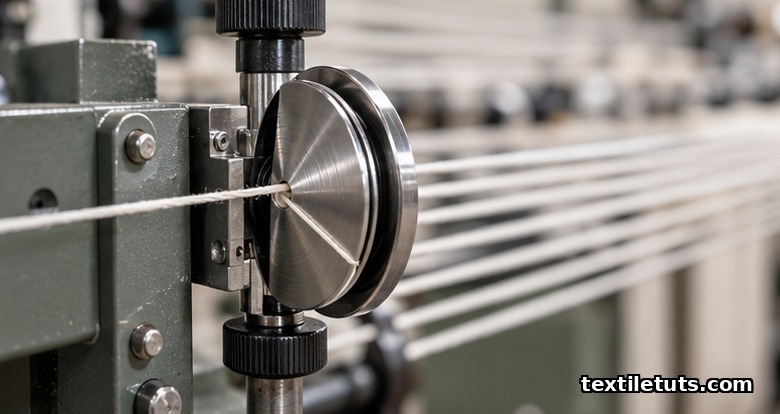
Yarn tension. Tension is the single largest controllable variable in warping. Excessive tension elongates the yarn and reduces crimp recovery, producing slack ends that snarl on the loom. Too little tension produces a soft beam that telescopes under its own weight. Most mills target 6 to 12 cN/tex for cotton and 3 to 5 cN/tex for filament polyester, with a CV across ends of less than 4 percent.
Winding speed. Modern Benninger, Karl Mayer, Hacoba, and Toyota warpers operate at 600 to 1,200 m/min for staple yarns and up to 1,500 m/min for filament yarns. Higher speeds raise productivity but also raise the rate of yarn breakages on weak spots. Best mills calibrate speed against yarn count and quality: 18 to 30 tex cotton is typically warped at 600 to 800 m/min, while 7 to 14 tex cotton runs at 800 to 1,000 m/min.
Beam density. The compactness of the wound warp sheet is set by the surface speed ratio between the beam and the measuring roller, also called the beaming ratio. A higher beaming ratio produces a denser, harder beam, which carries more yarn but unwinds with higher peak tension. Most mills operate at a beam density of 0.95 to 1.15 g/cm³, balancing capacity against unwinding tension.
Common Warping Defects and How to Prevent Them
Defects introduced in warping propagate into weaving, where they cause breaks, miss-picks, and seconds. Five defects account for the majority of warping-related weaving stoppages.
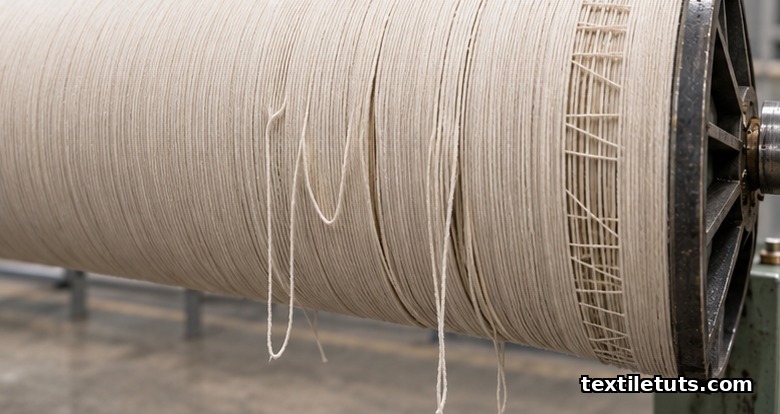
- Slack ends. Caused by uneven creel tension or by a single package with too low winding density. Detected by a slack detector in the tension zone; corrected by re-tying with the proper knot and by checking package hardness before creeling.
- Tight ends. Caused by excessive creel tension or by dragging yarns across broken lease strings. Detected by a tight-end detector; corrected by replacing tensioners and re-threading.
- Pattern falls-out. Caused by incorrect leasing sequence or skipped lease strings. Detected by visual inspection of the lease before beaming; corrected by re-leasing.
- Crooked weft direction (off-square beam). Caused by misalignment of the warper’s comb or by creel misalignment. Corrected by aligning the comb to the headstock within ±1 mm across the full width.
- Selvedge collapse. Caused by insufficient width at the warper’s comb or excessive weft shrinkage expectations on the loom. Corrected by adding 1.5 to 2.5 percent extra width at the comb.
ISO and ASTM Standards Governing Warping
Warping quality is anchored by international standards that define how warp sheets and yarns are measured, tested, and reported.
- ISO 1078:2009, Textiles — Determination of yarn number from packages. Specifies the method for measuring yarn linear density (in tex) from a package of known length, which is the first quality check before warping.
- ISO 2-1:1988, Textiles — Designation of yarn number. Defines the symbols used to express yarn count in tex, denier, Nm, and Ne.
- ISO 7211-5:1984, Textiles — Woven fabrics — Construction — Part 5: Determination of linear density of yarn removed from fabric. Used to verify that the warp sheet matches the design specifications after weaving.
- ASTM D 1059-17, Standard Test Methods for Yarn Number Based on Short-Length Specimens. Allows quick yarn-count verification on the shop floor, used during creeling to confirm that the right yarn is loaded.
- ASTM D 1909-13, Standard Tables of Commercial Moisture Regains for Textile Fibers. Defines the moisture regain values used to convert between conditioned and oven-dry yarn mass in warp calculations.
Together these standards give mills a common language for warp specifications. When a mill reports “warp yarn 30 tex, beam length 4,500 m, 480 ends,” ISO 1078 and ISO 2-1 make it possible for any downstream mill to interpret those numbers exactly the same way.
Frequently Asked Questions
How many warp ends can a beam warper handle at one time?
A modern industrial beam warper typically winds 200 to 800 ends on a single warper’s beam, with high-capacity creels reaching 1,000 to 1,200 ends. For wider fabrics that need more ends than a single creel can supply, the mill produces multiple identical beams and combines them on a sizing frame, a process called double beaming or twin beaming.
What is the typical production speed of a beam warping machine?
Most modern beam warpers operate at 600 to 1,200 m/min for staple yarns such as cotton, wool, and blends. Filament warping machines reach 1,200 to 1,500 m/min. These figures refer to the surface speed of the warper’s beam, which is the same as the speed at which any single end travels.
What is the difference between a warper’s beam and a weaver’s beam?
A warper’s beam is the conical beam on which the warp sheet is first wound in the warping machine. After sizing, the warp is transferred to a weaver’s beam, which is then mounted on the loom. The two beams are similar in geometry but may differ in flange diameter; weaver’s beams typically have larger flanges (up to 800 mm) to accommodate more yarn and to fit specific loom brackets.
How do you reduce yarn breakage during warping?
Yarn breakage is controlled by three actions: keeping yarn moisture regain close to standard conditions (8 to 8.5 percent for cotton, defined by ASTM D 1909), using ceramic or chrome tensioners with the proper setting (6 to 12 cN/tex for cotton), and replacing damaged yarns at the creel before starting the beam. Quality mills also conduct single-end strength tests on every yarn lot using ISO 1078 lot sampling before warping.
Is beam warping still used for denim?
Yes. The global denim industry standardises on beam warping combined with rope or slasher sizing because the yarn count, end density, and indigo dye chemistry of denim all favour a continuous, low-tension warp sheet. Sectional warping is rarely used for denim except for short runs with special colour effects.
This article is the working reference for beam warping. Editorial by Mohammad Yousuf (Anik), TextileTuts. Sources: ISO 1078:2009, ISO 2-1:1988, ISO 7211-5:1984, ASTM D 1059-17, ASTM D 1909-13, as cited.


