
Sinker and Cylinder in Circular Knitting

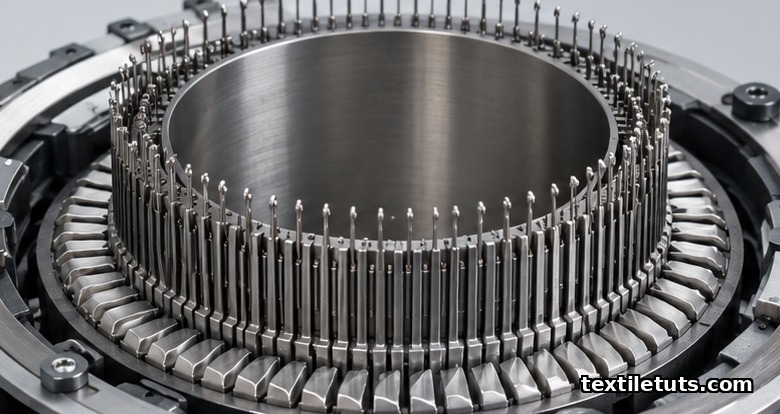
The sinker and cylinder form the two-piece needle bed at the heart of every circular knitting machine: the cylinder is a rotating vertical drum with one slot (a “trick”) per needle, while the sinker is a thin metal blade seated between each pair of needles whose curved belly holds down the old loop, clears the needle hook, and sets the new loop at a controlled stitch length of typically 2.5 to 5.0 mm.
Get the relative geometry between these two elements wrong and the machine either drops stitches, produces barre, or cannot knit at all. The rest of this article walks through how the cylinder holds and transports the needles, how the sinker performs its three loop-control functions, and why the cylinder-to-sinker clearance (commonly 0.3 to 0.6 mm) is the single most-watched dimension on a circular knitting floor.
What the Cylinder Does in a Circular Knitting Machine
The cylinder is the lower needle bed of a circular weft knitting machine. It is a hollow, precision-ground steel drum, vertically mounted on a central spindle, with vertical slots cut into its outer surface at evenly spaced intervals around the full circumference. Each slot is called a “trick,” and one knitting needle sits inside each trick. The cylinder rotates continuously (or index-by-index on a Jacquel-style machine) past a fixed ring of cam tracks mounted around its perimeter.
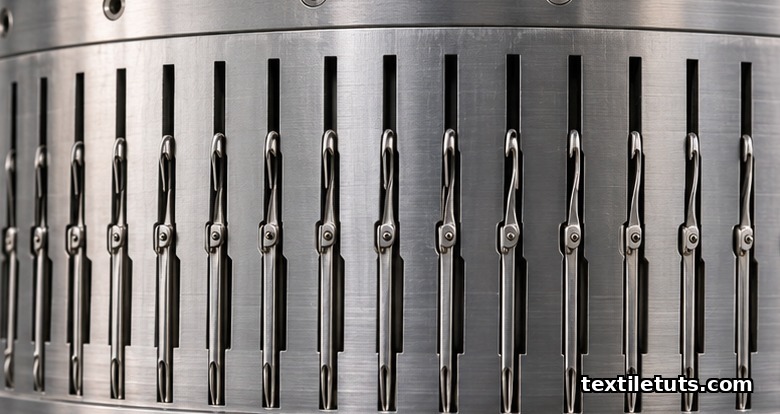
As each needle reaches a cam, the cam profile pushes the needle up or down inside its trick. This vertical reciprocation is what converts cylinder rotation into the three mechanical motions a needle must execute per cycle: rise to clearing position, descent to knock-over, and yarn-catching (latch closing) on the way back up. The cylinder does not form stitches itself; it is the transport and guidance mechanism that carries every needle through its individual cam sequence at exactly the same angular position around the circumference.
Cylinder diameters span a wide range, and the diameter you choose defines the fabric tube width and the maximum number of needles (and therefore the fabric gauge) the machine can knit. Common industrial diameters and their typical end uses are summarized below.
| Cylinder diameter | Typical end use | Approx. needle count (24 gauge) |
|---|---|---|
| 3 to 6 in (76 to 152 mm) | Socks, hosiery, narrow trim | 230 to 460 |
| 8 to 16 in (203 to 406 mm) | Underwear, body width knits, sleeve blanks | 610 to 1,220 |
| 17 to 30 in (432 to 762 mm) | Single jersey, rib, fleece for apparel | 1,300 to 2,290 |
| 30 to 60 in (762 to 1,524 mm) | Open-width jersey, technical textiles | 2,290 to 4,570 |
Gauge (E) is expressed as needles per inch measured along the needle line on the cylinder circumference. A 24-gauge machine on a 30-inch cylinder carries roughly 2,260 needles; the same gauge on a 16-inch cylinder carries about 1,200. Cylinder rotation speed is constrained by the peripheral velocity at the needle line: modern high-production single-jersey machines run at 1.0 to 1.4 m/s peripheral speed, which on a 30-inch diameter translates to roughly 24 to 34 revolutions per minute.
What the Sinker Does in a Circular Knitting Machine
Sinkers sit in a stationary ring outside the cylinder, one sinker positioned between each pair of needles. They are thin, flat blades machined from hardened tool steel, with three functional zones along their height: a curved upper edge called the belly (or throat), a vertical face called the nib or ledge, and a foot that locates them in a fixed ring called the sinker ring or trick ring.
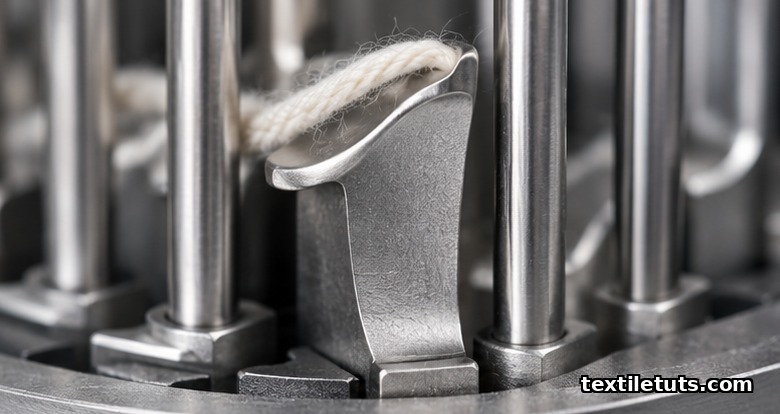
Unlike the cylinder, which rotates, the sinker ring does not move during steady-state knitting. Each sinker remains stationary relative to the cylinder rotation, so as needles pass each sinker, the sinker belly stays at a constant radius above the trick line. The radial gap between the cylinder’s needle line and the sinker belly is the critical geometry: it must be wide enough to let the needle hook and latch pass upward without contact, yet narrow enough that the old loop cannot balloon above the belly.
The sinker performs three named loop-control functions during each needle cycle:
- Loop holding. As the needle rises to clear the old loop, the old loop slides off the needle hook onto the sinker belly. The sinker holds the loop at a fixed take-down position, preventing it from being pulled up into the needle line and giving the fabric its course length.
- Loop clearing. As the needle continues to rise, the rising needle stem pushes the old loop further down the sinker belly until the loop clears the open hook. Without the sinker holding the loop down, the needle hook would simply lift the loop out of the fabric and knitting would stop.
- Loop setting. As the needle descends with newly caught yarn, the new loop pulls against the old loop held on the sinker belly. The sinker controls the loop length (and therefore the stitch length) by releasing the old loop only when the needle reaches a defined position. This is what makes every stitch the same size.
Sinkers also do a fourth job that is less often named: they protect the needle latches from being struck by external objects or by the take-down tensioner. On a high-speed machine, a broken needle can be thrown clear of the cylinder by the sinker ring, which is a safety feature as well as a knitting feature.
Cylinder and Sinker Materials, Tolerances, and Wear
Both cylinder and sinker ring are wear-critical components. Cylinders are typically case-hardened alloy steel (AISI 8620 or equivalent) with the tricks induction-hardened to roughly 60 to 62 HRC (Rockwell C) for needle-wear resistance. The trick walls must be straight to within 0.02 mm over their full depth to prevent needle tilting, and the cylinder circumference must run true within 0.05 mm total indicated reading at operating temperature.
Sinkers are usually through-hardened tool steel (AISI D2 or similar high-carbon, high-chromium grade) at 58 to 60 HRC, since the sinker belly sees repeated loop-on-belly contact at 30+ courses per minute. The belly radius is ground to a tight tolerance (typically +/- 0.02 mm) because that radius controls the contact point with the yarn. Worn sinker bellies produce uneven loop length, which shows up in the fabric as visible vertical lines called sinker marks or sinker lines, usually 1/24 inch (about 1.05 mm) apart at 24 gauge and running parallel to the wales.
The cylinder-to-sinker gap is set during machine assembly and is checked weekly on a production floor. Standard industrial practice (consistent with ISO 8388 knitting machine vocabulary and accepted mill tolerance conventions) holds this gap between 0.3 and 0.6 mm. Outside that range, the outcomes are predictable: too tight and needles jam against sinkers; too loose and loops slip above the belly, causing dropped stitches and float defects.
How Cylinder and Sinker Work Together in a Knitting Cycle
A complete needle cycle on a single-jersey machine takes one revolution past one feeder (one yarn feed point) and proceeds through five positions:
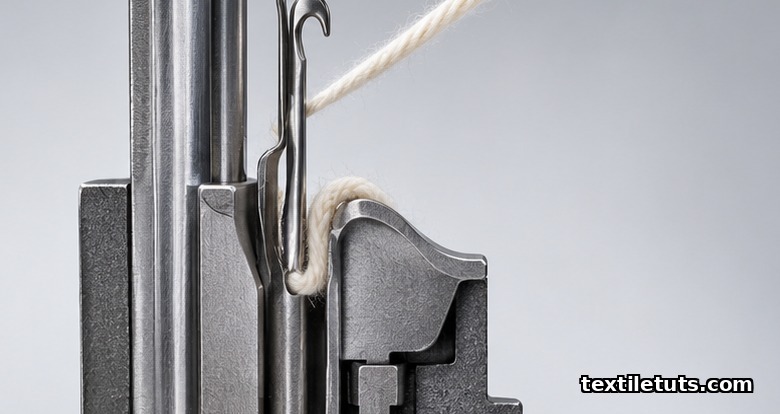
- Rest position. Needle is fully down inside its trick, old loop sits on the needle stem above the latch.
- Clearing. Cylinder rotates; rising cam pushes the needle up. The sinker belly holds the old loop down, so as the needle stem rises through the old loop, the loop slides up the stem until it clears the open hook.
- Yarn feeding and latch closing. At the feeder, new yarn is laid into the open hook. As the needle continues to rise, the latch swings closed on the new yarn, trapping it inside the hook.
- Knock-over. The descending cam pushes the needle back down. The old loop (held on the sinker belly) now slides over the closed hook and latch, knocking the newly caught yarn through itself and forming a new loop.
- Loop setting and take-down. The needle continues to descend to its lowest position. The new loop transfers off the hook and onto the needle stem, where it joins the fabric tube being pulled down by the take-down rollers. The sinker belly releases the old loop only at this moment, which sets the final stitch length.
Steps 2 through 5 repeat for every needle at every feeder, and on a modern 30-inch, 108-feeder, 24-gauge single-jersey machine running at 1.2 m/s, that is roughly 244,000 stitch-forming events per second across the machine as a whole.
Common Defects Linked to Cylinder and Sinker Condition
When knitting faults appear in a fabric tube, the cylinder and sinker are among the first things a textile engineer checks because their geometry directly controls every stitch.
- Dropped stitches (visible holes in the fabric) usually mean the cylinder-to-sinker gap has opened past specification, or a single sinker has chipped and cannot hold its loop.
- Sinker lines (regular vertical lines every needle space) point to worn or damaged sinker bellies.
- Barre (horizontal bands of uneven stitch density) can indicate cylinder ovality or a damaged needle trick letting one needle sit slightly higher than its neighbors.
- Needle lines (regular vertical lines that look like wales but run only part-way around the tube) usually indicate a bent or broken needle still sitting in its trick.
- Holes at a single radial position that repeat every revolution suggest one defective sinker that must be replaced before production can resume.
Most circular knitting mills keep a small stock of replacement cylinders (or send worn cylinders out for re-tricking) and replace sinkers individually as they fail, since sinkers are cheap relative to the downtime they cause.
Comparison Table: Cylinder vs. Sinker Functions
| Property | Cylinder | Sinker |
|---|---|---|
| Primary role | Transport and guide the needles through their cam sequence | Hold, clear, and set the loops at controlled stitch length |
| Motion during knitting | Rotates continuously (or indexes on Jacquel machines) | Stationary (on plain machines); rotates only on specialized sinker-wheel designs |
| Count on a 24-inch, 24-gauge machine | ~1,800 needles in ~1,800 tricks | ~1,800 sinkers, one between each needle |
| Material | Case-hardened alloy steel, 60 to 62 HRC at the trick walls | Through-hardened tool steel, 58 to 60 HRC |
| Critical dimension | Trick straightness to 0.02 mm; cylinder TIR to 0.05 mm | Sinker belly radius to +/- 0.02 mm; gap to cylinder 0.3 to 0.6 mm |
| Failure symptom | Barre, needle lines, oval fabric tube | Dropped stitches, sinker lines, holes at fixed position |
Frequently Asked Questions
How many sinkers are there in a circular knitting machine?
There is one sinker between every pair of adjacent needles around the cylinder. On a 30-inch cylinder at 24 gauge (24 needles per inch), that works out to about 2,260 needles and roughly 2,260 sinkers sitting in the sinker ring around the outside of the cylinder.
What is the gap between the sinker and the cylinder?
The radial gap between the cylinder’s needle line and the sinker belly is typically set between 0.3 and 0.6 mm in production. This gap is checked weekly because it directly controls whether the needle can move freely without dropping stitches or jamming against the sinker belly.
What is the function of the sinker in weft knitting?
The sinker performs three loop-control functions per cycle: it holds down the old loop as the needle rises (loop holding), it positions the old loop so the needle can clear it (loop clearing), and it controls the size of the new loop as the needle descends (loop setting). These three actions together set the stitch length of the fabric.
What is the cylinder in a knitting machine?
The cylinder is the rotating vertical needle bed of a circular knitting machine. It is a precision-ground steel drum with vertical slots called tricks cut into its outer surface, one trick per needle. As the cylinder rotates, every needle is carried past a fixed ring of cam tracks that lift and lower the needle through its knitting cycle.
Why do circular knitting machines have sinkers at all?
Without sinkers, the needle would have no way to hold the old loop down while it rises to catch new yarn. The result would be that the old loop simply lifts out of the fabric with the needle, breaking the knit. Sinkers make circular weft knitting mechanically possible at production speeds by holding, clearing, and setting each loop in a controlled sequence.
References
- International Organization for Standardization. ISO 8388:1998 Knitting machines — Vocabulary. iso.org — defines the standard terms for knitting machine components including cylinder, sinker, trick, cam, and needle cycle.
- Spencer, D. J. Knitting Technology: A Comprehensive Handbook and Practical Guide. Woodhead Publishing (now Elsevier). Peer-reviewed textile engineering textbook covering cylinder and sinker mechanics in weft knitting.
- Raz, S. Flat Knitting Technology. Universal Maschinenfabrik / Dr. Rudolf GmbH technical reference, widely used in weft and warp knitting training.
- ResearchGate (multiple authors). Effect of Cylinder and Sinker Wear on Single Jersey Fabric Quality. Peer-reviewed paper on the relationship between sinker belly wear and sinker-line formation in single jersey knitting.
- MDPI Textiles journal. Loop Formation and Yarn Tension in High-Speed Circular Knitting. Open-access peer-reviewed study on peripheral speed limits and loop geometry.
- ASTM International. ASTM D3888 Standard Terminology for Knit Fabrics. astm.org — standardizes knit fabric and machine terminology used in textile QC documentation.
- Textile Institute (Manchester). Knitting Technology Reference (Textile Institute publications). textileinstitute.org — professional body publications on knitting machinery and quality control.
Editorial by Iftay Khairul Alam, TextileTuts. Sources: ISO 8388:1998, Spencer’s Knitting Technology (Woodhead), Raz’s Flat Knitting Technology, and the cited MDPI and ASTM references as listed above.


