
Knit Fabric Bursting Strength Test

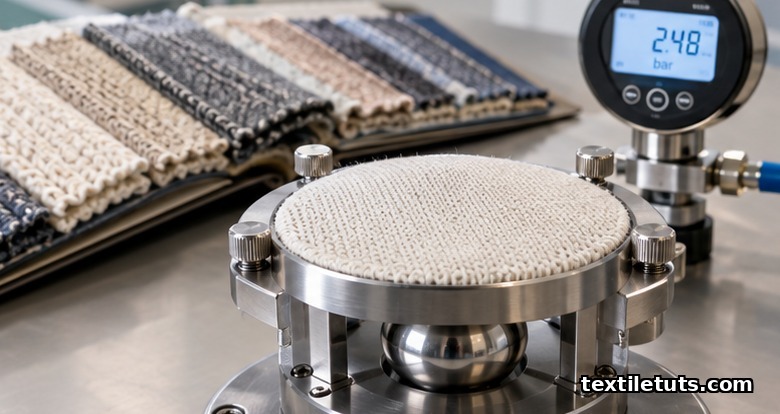
Knit fabric bursting strength is measured by applying uniform multidirectional pressure to a fabric specimen clamped over a circular aperture until it ruptures, with ISO 13938-1 (hydraulic), ISO 13938-2 (pneumatic), and ASTM D3786 reporting the result in kilopascals (kPa) or pounds per square inch (psi), while ASTM D3787 records the force in newtons (N) or pounds-force (lbf) from a 25.4 mm steel ball pushed through the specimen.
Single-jersey cotton knits typically burst between 200 and 600 kPa, and rib or interlock constructions commonly exceed 800 kPa, so the test is the standard way to compare knit constructions, finish lots, and supplier claims.
This article explains what bursting strength means for knit fabrics, how the three standard methods differ, how to read a result, and how to set a pass/fail limit that actually protects your end use.
Why Knits Are Tested by Bursting, Not by Tensile
Woven fabrics carry load along two perpendicular yarn systems (warp and weft), so a strip tensile test (ISO 13934, ASTM D5034) makes sense: pull the strip, the yarns align with the load, and the reading reflects the construction. Knit fabrics behave differently because they are a single system of interlooped yarns with no clear “warp” or “weft” direction; when you pull a knit strip, only the loops in line with the load resist, while the loops across the strip collapse and concentrate stress at the clamps.
Bursting strength solves this by pressurizing a circular area uniformly from below. Every loop in the test zone shares the load, the result is direction-independent, and it correlates much better with how a knit actually fails in a garment (a localized poke, elbow stress, or knee stress rather than a straight tear). That is why knit specifications on T-shirts, polo shirts, sweatshirts, sportswear, hosiery, and medical knits are almost always written as bursting strength, not as grab or strip tensile.
The Three Standard Methods You Will See on a Test Report
All three methods clamp the specimen over a circular test area and increase pressure or force until the fabric ruptures. They differ in how the pressure is generated and how the result is reported.
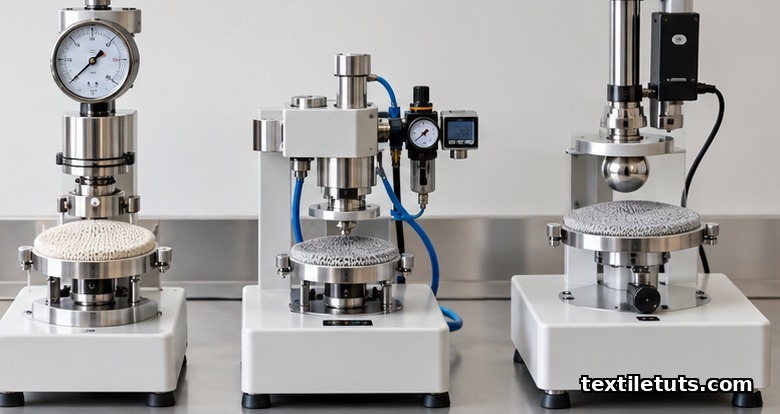
ISO 13938-1: Hydraulic (Steel Ball Variant)
The specimen is clamped over a 50 cm² test area (30.5 mm diameter opening) and pressure is applied from below using a hydraulic fluid that pushes a polished steel ball upward against the fabric. The pressure at rupture is recorded in kPa. This is the most common ISO method in the Bangladesh and European knit trade.
ISO 13938-2: Pneumatic Method
Compressed air (or inert gas) pressurizes the underside of the clamped specimen through a 50 cm² circular orifice. No steel ball is involved; pressure is purely pneumatic. The pneumatic head is mechanically simpler and easier to clean, which is why many production labs prefer it for high-throughput QC. Results between ISO 13938-1 and ISO 13938-2 on the same fabric can differ by 10 to 20 percent, so always quote the method number on your spec.
ASTM D3786: Hydraulic Bursting Strength (Mullen-Type)
The ASTM hydraulic method is functionally similar to ISO 13938-1 but uses a 30.5 mm test area and reports in psi or kPa. It is dominant in U.S. buyer specs. ASTM D3787 is a different method, a ball-burst test where a 25.4 mm steel ball is pushed through the specimen and the force is read in lbf or N, not as pressure. A D3787 number is not directly comparable to a D3786 kPa number; converting between them is approximate at best.
How a Bursting Test Is Actually Run
The procedure follows a tight sequence regardless of method. Conditioning matters first: specimens are pre-conditioned and tested at 20 ± 2 °C and 65 ± 4 percent relative humidity per ISO 13938 (or 21 ± 1 °C, 65 ± 2 percent RH per ASTM D3786), for at least 24 hours, because knit loops relax in humid air and a relaxed loop changes the reading.
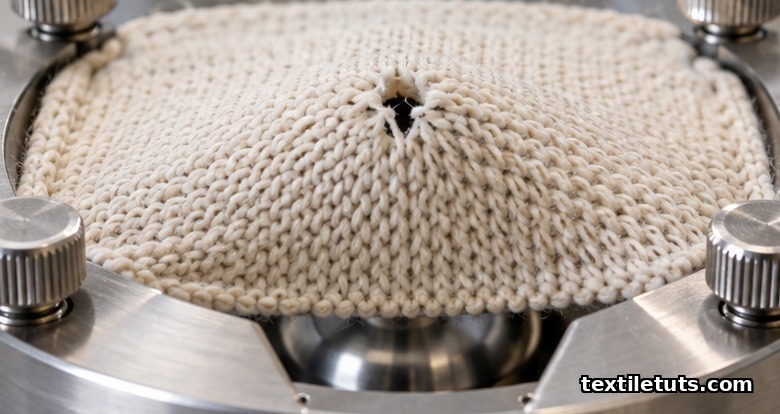
Five specimens, cut from different areas of the sample to be representative, are tested. The specimen is clamped over the test head at a defined torque (typically 10 to 50 N·m depending on the machine) so that the fabric sits flat without slippage but is not pre-crushed. Pressure or force is increased at a controlled rate (around 100 kPa/min for the hydraulic method, or 100 mm/min crosshead speed for the ball-burst) until rupture, defined as the peak force or pressure the fabric sustains.
For knits, the rupture almost always looks the same: a small, localized hole rather than a long tear, with loops on either side of the hole remaining intact. That is the visual signature of a clean burst.
Typical Bursting Strength Values by Knit Construction
The values below are typical ranges for finished, relaxed knit fabrics at standard atmosphere. Use them as a starting point for spec writing, not as acceptance limits.
| Fabric | Approx. GSM | Typical bursting strength (kPa) | Typical ball-burst (N, ASTM D3787) |
|---|---|---|---|
| Single jersey, combed cotton | 140-180 | 200-400 | 200-350 |
| Single jersey, cotton/elastane | 160-200 | 300-500 | 250-400 |
| Pique (lacoste), cotton | 180-220 | 350-550 | 300-450 |
| 1×1 rib, cotton | 180-240 | 450-700 | 350-550 |
| Interlock, cotton | 200-280 | 600-900 | 450-700 |
| French terry, cotton | 280-360 | 500-800 | 400-650 |
| Fleece, brushed, 80/20 cotton/poly | 320-420 | 500-900 | 450-750 |
| Three-thread fleece, poly/cotton | 300-400 | 700-1100 | 550-900 |
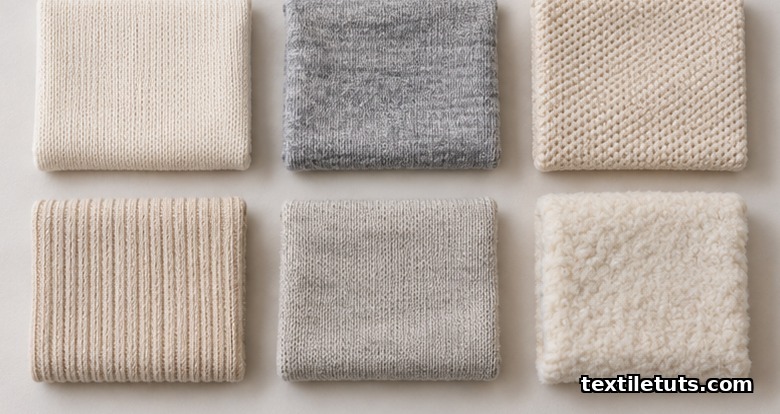
Construction matters more than fiber alone. An interlock at 220 GSM routinely bursts higher than a single jersey at 200 GSM, because two interlocked layers share the load and the loop density is higher. A 5 percent elastane addition typically raises bursting strength 10 to 30 percent on a single jersey by allowing loops to redistribute stress before rupture.
Factors That Move the Bursting Number Up or Down
Yarn count and loop length are the two biggest levers. A finer yarn at the same loop density gives more loops per unit area and more load-bearing elements, so bursting strength rises; a longer loop length (slack knit) drops it because each loop has more room to deform before its neighbors take over.
Yarn properties come next. Higher fiber strength (long-staple cotton, polyester filament, aramid) and higher yarn tenacity push the number up. Combed vs carded cotton typically shows a 15 to 25 percent improvement at the same construction. Twist level has an optimum: too low and loops distort easily; too high and the yarn is brittle and snaps under multidirectional load.
Finishing shifts the reading in both directions. Compacting and calendaring can temporarily raise surface strength but lower overall bursting by crushing loops. Heat setting on polyester knits stabilizes the structure and raises bursting by 10 to 30 percent. Softener application and resin finishing can lower bursting strength if applied heavily, which is why performance knits are often resin-finished and then mechanical-stabilized rather than the other way around.
Setting a Pass/Fail Spec That Matches the End Use
A spec copied from a buyer manual without checking the end use is the most common cause of bursting failures on the production floor. The right number depends on where the fabric goes.
For fashion single jersey T-shirts at 140 to 160 GSM, a minimum bursting strength of 200 kPa (or about 30 psi) on ISO 13938-2 is a typical working minimum, with most established brands setting 250 kPa as a comfortable cut-off. For mid-weight polo shirt pique, 350 kPa is a common minimum. For interlock used in dresses or premium knit shirting, 500 kPa is reasonable. For fleece and sweatshirt fleece, 450 kPa on the face fabric is a practical floor because the brushed inside does not contribute to bursting strength.
Always spec the method with the number. “Min. 400 kPa” without a method invites a dispute at the lab. “Min. 400 kPa, ISO 13938-2, 50 cm² test area, average of 5 specimens” is unambiguous.
Common Mistakes That Produce Misleading Results
Clamping torque is the single biggest controllable error. Under-clamping lets the specimen slip and artificially raises the reading; over-clamping cuts the yarns at the clamp edge and lowers it. Most lab manuals call for a specific torque value, and most production shortcuts ignore it.
Skipping relaxation before test inflates variability. Knit fabrics pulled straight off a knitting machine are under tension; the loops relax over 24 to 48 hours at standard atmosphere and the bursting value drops by 5 to 15 percent. If you test fabric as-knit and report it as a finished-fabric spec, you are setting up a customer complaint.
Mixing methods in a comparison is the next big trap. ISO 13938-1 kPa, ISO 13938-2 kPa, and ASTM D3786 psi are close but not identical, and ASTM D3787 N cannot be converted to kPa reliably because the stress field under a steel ball is different from the stress field under uniform hydraulic pressure.
How Bursting Strength Connects to Other QC Tests
Bursting strength is most often read alongside dimensional stability (shrinkage), GSM, spirality, and pilling resistance. A fabric can pass bursting at 450 kPa and still fail in the field if it shrinks 8 percent in the wash. A spec sheet that lists bursting alone, without GSM and shrinkage, hides the real risk.
For functional knits, bursting is also a useful proxy for snag resistance and seam security, because a knit that ruptures under multidirectional stress at low pressure will also pucker and tear at seam intersections under the same load.
Frequently Asked Questions
What is the difference between bursting strength and tensile strength for knit fabrics?
Tensile strength pulls the fabric in one direction at a time and is meaningful for wovens, where warp and weft yarns share the load predictably. Bursting strength pressurizes a circular area uniformly from below, so every loop in the test zone shares the load in all directions, which matches how knit garments actually fail in use. For knits, bursting is the preferred specification.
What is the minimum bursting strength for a T-shirt fabric?
For a 140 to 180 GSM single jersey cotton T-shirt, a minimum of 200 to 250 kPa on ISO 13938-2 is the usual working range for mainstream buyers, with many established brands setting 250 kPa as their cut-off. Heavier 200+ GSM T-shirts typically burst higher, in the 300 to 500 kPa range. Always quote the method with the number.
Can I convert ASTM D3787 ball-burst (N) to ASTM D3786 hydraulic (kPa)?
No, not reliably. The two methods apply load differently: ASTM D3787 pushes a 25.4 mm steel ball through the specimen and reports force, while ASTM D3786 applies uniform hydraulic pressure and reports pressure. The stress fields are different, so any conversion factor is fabric-specific and approximate. Always run both methods if you need both numbers.
Does GSM correlate with bursting strength?
Loosely. Within a single construction (say, single jersey combed cotton), higher GSM usually means more yarn per unit area and higher bursting strength, but the scatter is wide. A 200 GSM interlock routinely bursts higher than a 220 GSM single jersey because the construction is denser and more balanced. Spec by bursting strength, not by GSM.
How do elastane and polyester affect the bursting strength of knit fabric?
Adding 3 to 5 percent elastane to a single jersey typically raises bursting strength by 10 to 30 percent by allowing loops to redistribute stress before rupture. Polyester filament yarns in blends raise bursting strength relative to pure cotton at the same GSM, partly because polyester fibers are stronger and partly because filament loops resist deformation. Heat setting the polyester stabilizes the structure and adds another 10 to 30 percent.
References
- International Organization for Standardization. ISO 13938-1: Textiles — Bursting properties of fabrics — Part 1: Hydraulic method for determination of bursting strength and bursting distension. iso.org — the primary ISO hydraulic method for knit fabrics.
- International Organization for Standardization. ISO 13938-2: Textiles — Bursting properties of fabrics — Part 2: Pneumatic method for determination of bursting strength and bursting distension. iso.org — the pneumatic ISO method widely used in production QC labs.
- ASTM International. ASTM D3786 / D3786M-18: Standard Test Method for Bursting Strength of Textile Fabrics — Diaphragm Bursting Strength Tester Method. astm.org — the dominant U.S. hydraulic burst method.
- ASTM International. ASTM D3787-16: Standard Test Method for Bursting Strength of Textiles — Constant-Rate-of-Traverse (CRT) Ball Burst Test. astm.org — the ball-burst method; reports force, not pressure.
- Mokhtar, S. H., et al. “Bursting Strength of Knitted Fabrics: A Review.” Journal of Engineered Fibers and Fabrics, researchgate.net — peer-reviewed review of the variables that affect knit bursting results.
- Abdelfattah, M. Y. and El-Khatib, E. S. “Effect of Knit Structure on the Bursting Strength of Knitted Fabrics.” International Journal of Advanced Research in Engineering and Applied Sciences. intechopen.com — open-access study on how construction parameters move the bursting number.
- Senthilkumar, M. and Anbumani, N. Knitting Technology: Principle, Structure and Applications. ResearchGate publication — textile-engineering textbook chapter covering knit property testing including bursting.
This article is the working reference for knit fabric bursting strength testing. Editorial by Iftay Khairul Alam, TextileTuts. Sources: ISO 13938-1, ISO 13938-2, ASTM D3786, ASTM D3787, Journal of Engineered Fibers and Fabrics, IntechOpen, ResearchGate as cited.


