
Single Jersey vs Double Jersey: Construction, Properties, and End Uses

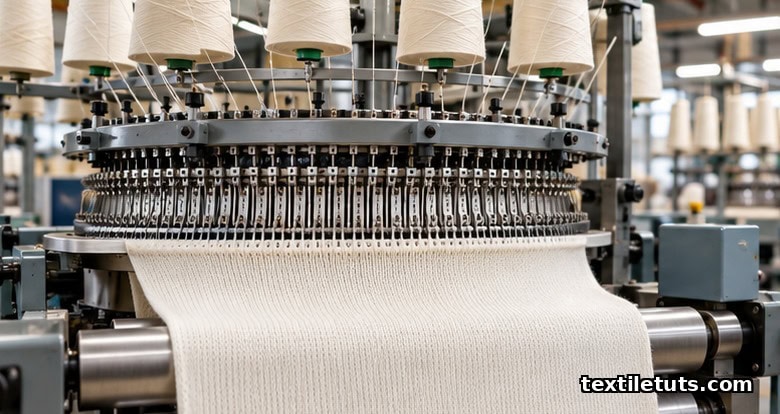
Single jersey fabric weighs 110 to 180 g/m² and stretches 30 to 60% in width and 10 to 30% in length, while double jersey (interlock and rib) weighs 180 to 340 g/m² and stretches only 20 to 40% in width with near-zero length stretch. The reason is structural: single jersey is knit on one needle bed at 7 to 12 courses per cm, while double jersey is knit on two needle beds at 12 to 20 courses per cm, doubling yarn consumption per unit area and locking loops against each other. This article covers the construction, measurable properties, and end-use mapping that separate the two fabric families.
Choosing between single and double jersey is one of the most common decisions in circular knitting, because the two structures share the same yarn (cotton, polyester, blends) but deliver entirely different drape, recovery, opacity, and cost. The selection drives dye-house settings, cut-and-sew behavior, and the final garment category.
Single Jersey Construction
Single jersey is produced on a single cylinder (or single needle bed) using one set of needles, so each yarn loop is formed and knitted in isolation from the loops immediately above and below it. The face shows vertical wales of V-shaped loops (the technical face), and the back shows horizontal arcs (the technical back), giving the fabric a different appearance on each side. Spencer’s Knitting Technology describes this as the simplest and most economical weft-knit structure, where the face shows needle loop shanks while the reverse exposes sinker loops.
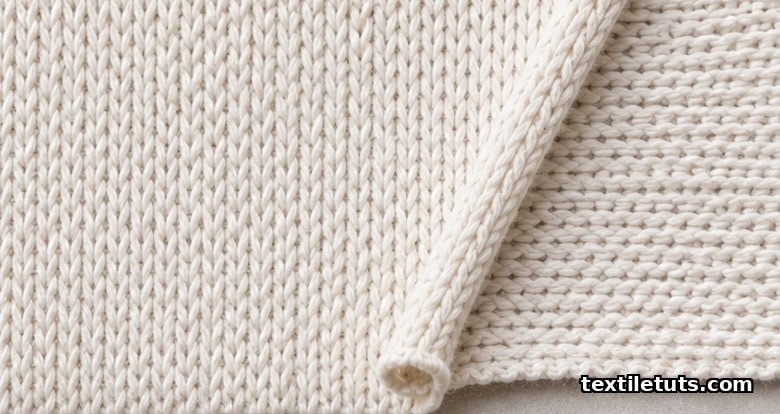
The structure is held together only by yarn loop interlocking at the stitch, which is why single jersey curls at cut edges, ladders when a yarn breaks, and tends to recover poorly after extension. A typical single jersey has a loop length of 2.5 to 4.0 mm, a stitch density of 7 to 12 courses per cm (cpc) and 8 to 14 wales per cm (wpc), and a thickness of 0.4 to 0.9 mm. Mass per unit area runs 110 to 180 g/m² for plain single jersey in 20 to 30 tex cotton or 18 to 26 tex polyester-cotton blends, climbing to 220 to 280 g/m² only when fleece-backed, terry-loop, or heavy Lycra-set constructions are used.
Single jersey is the default for T-shirts, lightweight innerwear, and jersey dresses because it drapes softly, has high breathability, and produces a clean printed surface on the face. Its two practical weaknesses are dimensional stability and edge curling, which the cutter has to manage with templates, overlock seams, or pre-shrinkage compaction on the finishing line.
Double Jersey Construction: Interlock and Rib
Double jersey is a family of structures produced on two needle beds, with the second bed (dial) feeding loops that interlock with loops from the first bed (cylinder). The two principal members of the family are rib and interlock, each with its own dial-and-cylinder timing.
Rib Jersey
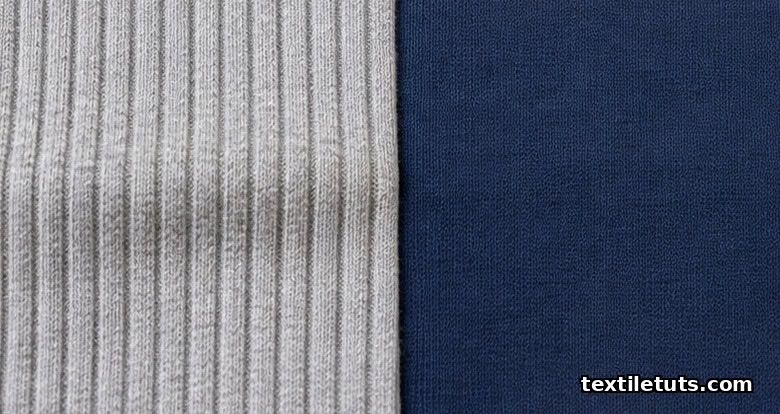
Rib is the simplest double jersey structure, formed when dial and cylinder needles knit on alternate courses. In 1×1 rib, every dial needle knits on every other course and every cylinder needle knits on the remaining courses, producing alternating wales of face and reverse loops. The fabric has a pronounced vertical rib cord on both surfaces, with a wales-to-courses ratio close to 1:1 in the relaxed state and a mass of 200 to 320 g/m² at typical gauges. Rib is highly extensible in width (often 60 to 100%) because dial loops pull toward the back and cylinder loops pull toward the front, but the stretch recovers when tension is released.
Interlock
Interlock is a variant of 1×1 rib in which both dial and cylinder knit on every course and the dial needles sit exactly behind the cylinder needles, so dial loops hide cylinder loops (and vice versa). Both surfaces look identical, smooth, and almost woven, with no visible rib cord. This is why interlock is often called “double jersey” in the trade: both faces show only face loops. Interlock runs 12 to 20 cpc and 14 to 18 wpc, with a loop length of 2.8 to 4.2 mm and a fabric weight of 180 to 280 g/m² for the standard 20 to 28 gauge machines. Tightness factor (tex divided by loop length, squared times a constant) is typically 1.3 to 1.5 for interlock versus 1.0 to 1.2 for plain single jersey at the same yarn count.
The interlocking of loops from two beds gives double jersey its key advantages: dimensional stability, near-zero edge curl, balanced stretch with strong recovery, and higher opacity because two layers of yarn overlap at every stitch. The trade-off is weight and yarn consumption (typically 30 to 60% more yarn per square metre than single jersey at the same cover factor).
Property Differences and Comparison Table
The four properties most often compared in a textile lab are thickness, dimensional stability, stretch and recovery, and opacity, with air permeability as a fifth indicator. Values below are typical ranges for cotton and cotton-blend knits on 18 to 28 gauge circular machines; finer gauges push weight and thickness down without changing the structural ranking.
Single jersey is thinner (0.4 to 0.9 mm versus 0.9 to 1.6 mm for interlock) and lighter (110 to 180 g/m² versus 180 to 280 g/m²), but it has lower dimensional stability, with spirality and shrinkage-after-wash values typically 2 to 5% in width and length. Double jersey shows 1 to 3% shrinkage and resists spirality because the two needle beds balance the wales. In stretch, single jersey is more elastic in width (30 to 60%) but recovers only 80 to 90% after five cycles, while interlock recovers 95 to 98% because the two opposing loop layers lock together when tension is released.
Opacity also differs measurably. Single jersey at 130 g/m² shows light transmission of 18 to 30% against a white background; interlock at the same yarn count drops that figure to 6 to 12%. Air permeability follows the same pattern: single jersey at 28 gauge runs 800 to 1,400 mm/s at 100 Pa pressure drop, while interlock drops to 300 to 700 mm/s because the second loop layer blocks the air path. These numbers come from ASTM D3887 and ISO 9237.
| Property | Single Jersey | Double Jersey (Interlock / Rib) |
|---|---|---|
| Needle beds used | 1 (cylinder only) | 2 (cylinder + dial) |
| Courses per cm | 7 to 12 | 12 to 20 |
| Wales per cm | 8 to 14 | 14 to 18 |
| Loop length (mm) | 2.5 to 4.0 | 2.8 to 4.2 |
| Mass per unit area (g/m²) | 110 to 180 | 180 to 340 |
| Thickness (mm) | 0.4 to 0.9 | 0.9 to 1.6 |
| Width stretch (%) | 30 to 60 | 20 to 40 (interlock), 60 to 100 (rib) |
| Length stretch (%) | 10 to 30 | 0 to 10 |
| Recovery after 5 cycles | 80 to 90% | 95 to 98% |
| Edge curl | Strong (curls both ways) | Negligible (interlock), slight (rib) |
| Opacity (light transmission %) | 18 to 30 | 6 to 12 |
| Air permeability (mm/s at 100 Pa) | 800 to 1,400 | 300 to 700 |
| Shrinkage after 5 wash cycles | 2 to 5% (length), 2 to 5% (width) | 1 to 3% (length), 0 to 2% (width) |
| Spirality | Noticeable | Minimal |
| Yarn consumption per m² | Lower (baseline) | 30 to 60% higher than single |
End Uses by Structure
Single jersey’s light weight and high air permeability make it the default for warm-weather and innerwear where drape and softness matter more than recovery. It is used for T-shirts, tank tops, lightweight dresses, sleepwear, and inner linings, and it is the fabric of choice for large-area rotary and digital prints because the smooth face holds ink without bleeding between loops. Single jersey is also the base for fleece and French terry when loop piles are knitted on the reverse during the same cycle.
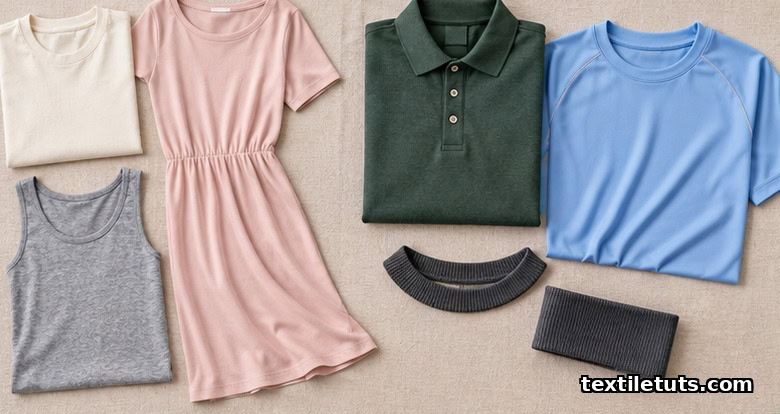
Double jersey splits into two end-use families. Interlock is used for polo shirts, sports jerseys, base layers, leggings, and dress shirts because both faces are smooth, the fabric is opaque enough to wear without lining, and recovery is high enough to keep shape after repeated wear. Rib jersey is used for cuffs, neck bands, waistbands, and form-fitting tops because its very high width stretch (60 to 100%) lets a small band grip the body without tight elastic. Raz’s Flat Knitting Technology highlights this split: rib for narrow trim, interlock for full-garment body.
Frequently Asked Questions
What is the main difference between single jersey and double jersey?
Single jersey is knitted on one needle bed and has a different face and back, while double jersey is knitted on two needle beds and has either two identical faces (interlock) or a ribbed surface (rib). This structural difference makes double jersey 30 to 60% heavier, more dimensionally stable, more opaque, and more recovery-elastic than single jersey at the same yarn count.
Which fabric is more comfortable for hot weather, single or double jersey?
Single jersey is more comfortable in hot weather because its air permeability (800 to 1,400 mm/s at 100 Pa) is two to three times higher than interlock (300 to 700 mm/s), so heat and moisture vapour escape the body faster. Double jersey traps more air inside the structure and reads as warmer.
Why does single jersey curl at the edges but double jersey does not?
Single jersey curls because every loop is anchored only on one side of the fabric, so the bent yarn tries to straighten itself and pulls the edges inward. Double jersey (interlock in particular) has loops anchored from two opposing needle beds, so the bending forces cancel and the fabric lays flat. This is also why single jersey must be cut with templates and sewn with overlock stitches to control curl in production.
Is single jersey cheaper to produce than double jersey?
Yes. Single jersey uses one needle bed, lower machine gauge, and 30 to 60% less yarn per square metre, so production cost at the same yarn count is roughly 20 to 35% lower than interlock. Rib is closer to single jersey in yarn cost because dial needles knit on alternate courses, but finishing cost is higher because of the high stretch.
References
- Spencer, D. J. Knitting Technology: A Comprehensive Handbook and Practical Guide. Woodhead Publishing. https://www.sciencedirect.com/book/9781855735751 — standard reference for weft-knit structure, loop geometry, and dimensional properties.
- International Organization for Standardization. ISO 8388:1998 Knitted fabrics — Types — Vocabulary. https://www.iso.org/standard/15814.html — defines single jersey, rib, and interlock nomenclature.
- ASTM International. ASTM D3887 Standard Specification for Tolerances for Knitted Fabrics. https://www.astm.org/d3887 — sets the dimensional tolerances cited in the property table.
- International Organization for Standardization. ISO 9237:1995 Textiles — Determination of the permeability of fabrics to air. https://www.iso.org/standard/13763.html — method behind the air permeability values.
- Raz, S. Flat Knitting Technology. ITB Verlag / Springer. https://link.springer.com — reference for rib, interlock, and flat-knit variants.
- Indian Journal of Fibre and Textile Research. “Dimensional properties of plain and interlock weft knitted fabrics.” https://nopr.niscair.res.in/handle/123456789/15777 — peer-reviewed measurements of courses, wales, and shrinkage.
Editorial by Iftay Khairul Alam, TextileTuts. Sources: Spencer Knitting Technology, ISO 8388:1998, ASTM D3887, ISO 9237:1995, Raz Flat Knitting Technology, and Indian Journal of Fibre and Textile Research, as cited.


