
Double Knit Fabric: Construction and Properties

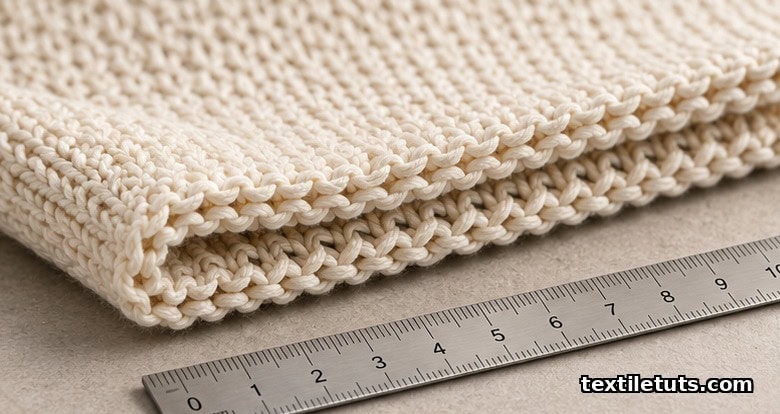
Double knit fabric weighs 180 to 340 g/m² and is knitted on two parallel needle beds at 12 to 20 courses per cm, because two interlocked layers of yarn loops deliver the thickness (0.9 to 1.6 mm), opacity (6 to 12% light transmission), and dimensional stability that single jersey cannot match. The structure is what makes double knit the default for jackets, suits, and structured dresses.
The two members of the family are interlock (both needle beds knit on every course, producing two identical smooth faces) and rib jersey (cylinder and dial knit on alternate courses, producing alternating face and reverse wales). Both rely on two opposing sets of needles that lock loops from both sides of the fabric.
What Is Double Knit Fabric?
Double knit is any weft-knit structure produced on two needle beds whose loops interlock across the full thickness of the fabric. According to Spencer’s Knitting Technology, the family includes interlock, rib (1×1, 2×2, and derivatives), punto di Roma (also called romano), milano rib, and double piqué. Each loop is anchored on both sides of the cloth by a loop from the opposing needle bed, which is why double knit lays flat at the cut edge, recovers shape after stretch, and reads as a heavier, more opaque fabric than single jersey.
ISO 8388:1998 classifies double knit as a weft-knit fabric in which “all or some of the loops of one course are intermeshed with loops of the next course and with loops of the opposite bed,” distinguishing it from single jersey, which has no dial loops.
Double Knit Construction: Two Needle Beds and Loop Interlock
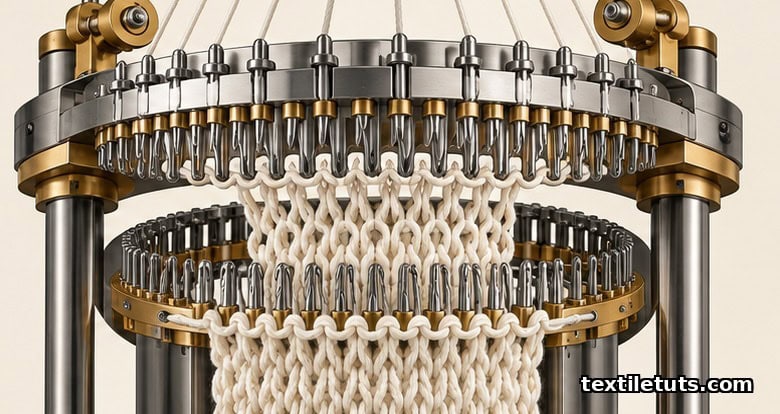
Double knit machines use a cylinder and a dial, both carrying latch needles arranged around the circumference. The cylinder needles knit loops on the technical back, the dial needles knit loops on the technical face, and the two sets of loops interlock at the loop feet. The machine gauge, dial-to-cylinder timing, and cam arrangement determine which member of the double knit family the machine produces.
Interlock
Interlock is the most common double knit. Both the dial and cylinder knit on every course, with the dial needles positioned directly opposite the cylinder needles, so each dial loop hides the cylinder loop beneath it. The fabric shows the same smooth face on both sides and reads as almost woven to the eye. Standard interlock runs 12 to 20 courses per cm (cpc) and 14 to 18 wales per cm (wpc), with a loop length of 2.8 to 4.2 mm and a mass per unit area of 180 to 280 g/m² on 20 to 28 gauge machines. Tightness factor is typically 1.3 to 1.5 for interlock versus 1.0 to 1.2 for single jersey at the same yarn count.
Rib Jersey
Rib jersey is the simpler double knit structure. In 1×1 rib, dial and cylinder needles knit on alternate courses, producing alternating face and reverse wales with a pronounced vertical cord on both surfaces. Rib runs 200 to 320 g/m² at typical gauges, with width stretch of 60 to 100% in the relaxed state and near-zero lengthwise stretch. 2×2 rib (two face wales followed by two reverse wales) is heavier and more stable than 1×1 rib, while punto di Roma and milano rib add tuck-and-miss patterns that trade elasticity for a more structured drape suitable for suiting.
Because loops are anchored from both sides of the fabric, the bending forces that make single jersey curl cancel out. Interlock lays flat at the cut edge; rib shows only slight curl because the alternating face and reverse loops are not symmetric across the dial and cylinder positions.
Key Properties of Double Knit Fabrics
The properties most often measured for double knit fabrics are thickness, weight, dimensional stability, stretch and recovery, opacity, and air permeability. Values below are typical ranges for cotton, polyester, and cotton-blend double knits on 18 to 28 gauge circular machines.
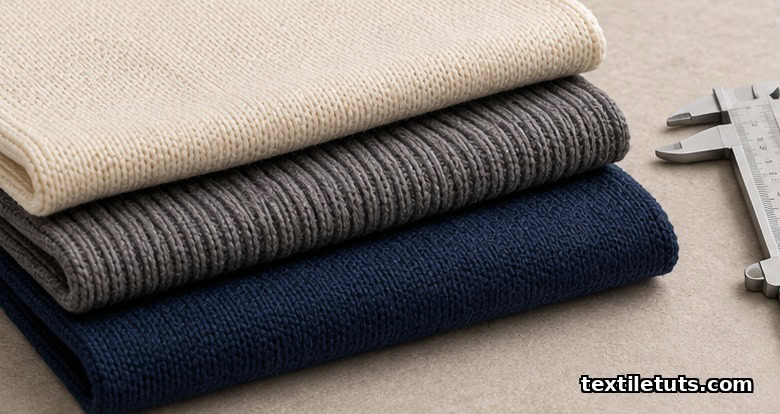
Thickness. Double knit runs 0.9 to 1.6 mm thick, versus 0.4 to 0.9 mm for single jersey, because the two loop layers stack rather than lie in a single plane. Heavier variants like punto di Roma and double piqué reach 1.4 to 2.0 mm at 240 to 340 g/m².
Weight. Double knit weighs 180 to 340 g/m² across the family, with 180 to 280 g/m² for plain interlock and 240 to 340 g/m² for rib and piqué variants. The higher yarn consumption per square metre (30 to 60% more than single jersey at the same cover factor) is the main reason double knit costs more per metre.
Dimensional stability. Double knit shrinks 1 to 3% in length and 0 to 2% in width after five wash cycles, against 2 to 5% in both directions for single jersey. Spirality is negligible in double knit because the two needle beds balance the wale direction.
Opacity. Double knit is more opaque because the second layer of loops blocks light transmission. Interlock at 200 g/m² shows 6 to 12% light transmission; single jersey at 130 g/m² shows 18 to 30% in the same test. This is why double knit can be used for unlined jackets and dresses without the sheerness that single jersey would show.
Breathability. Double knit is less breathable than single jersey, with air permeability of 300 to 700 mm/s at 100 Pa pressure drop (measured per ISO 9237) versus 800 to 1,400 mm/s for single jersey. The second loop layer blocks the air path, which is why double knit feels warmer to wear.
Single vs Double Knit: Comparison Table
| Property | Single Knit (Jersey) | Double Knit (Interlock / Rib / Piqué) |
|---|---|---|
| Needle beds used | 1 (cylinder only) | 2 (cylinder + dial) |
| Needle arrangement | Knit on every course | Knit every course (interlock) or alternate courses (rib) |
| Courses per cm (cpc) | 7 to 12 | 12 to 20 |
| Wales per cm (wpc) | 8 to 14 | 14 to 18 |
| Loop length (mm) | 2.5 to 4.0 | 2.8 to 4.2 |
| Mass per unit area (g/m²) | 110 to 180 | 180 to 340 |
| Thickness (mm) | 0.4 to 0.9 | 0.9 to 1.6 |
| Width stretch (%) | 30 to 60 | 20 to 40 (interlock), 60 to 100 (rib) |
| Length stretch (%) | 10 to 30 | 0 to 10 |
| Recovery after 5 cycles | 80 to 90% | 95 to 98% |
| Edge curl | Strong (curls both ways) | Negligible (interlock), slight (rib) |
| Opacity (light transmission %) | 18 to 30 | 6 to 12 |
| Air permeability (mm/s at 100 Pa) | 800 to 1,400 | 300 to 700 |
| Shrinkage after 5 wash cycles | 2 to 5% length, 2 to 5% width | 1 to 3% length, 0 to 2% width |
| Spirality | Noticeable | Minimal |
| Yarn consumption per m² | Baseline | 30 to 60% higher than single jersey |
End Uses: Jackets, Suits, and Structured Dresses
Double knit is the structural knit of the apparel industry. Its weight, opacity, recovery, and cut-edge stability make it the default for garments that need to hold a silhouette rather than drape softly.
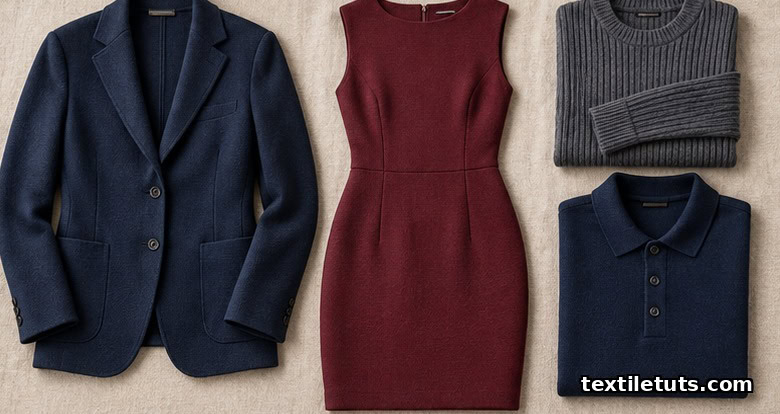
Interlock is used for polo shirts, knit blazers, structured dresses, base layers, and woven jacket linings because both faces are smooth and printable, the fabric is opaque enough to wear without lining, and the recovery is high enough to keep shape after repeated wear. Polyester interlock is also the standard for athletic jerseys and base layers because the same double-bed structure takes well to sublimation printing and brushed finishing for thermal layers.
Rib jersey is used for cuffs, neckbands, waistbands, beanie hats, and form-fitting tops because its very high width stretch (60 to 100%) lets a small band grip the body without tight elastic. 2×2 rib in heavier yarn counts (28 to 32 tex) is the classic choice for sweater cuffs and beanies; 1×1 rib with elastane is the standard for sock tops and undergarment bands.
Punto di Roma and double piqué are the heavier double knit variants used for suiting, knit blazers, and structured dresses. Punto di Roma uses knit and tuck stitches to create a fabric with two-way stretch and a smooth, almost woven face; double piqué uses tuck patterns to form a textured surface similar to Lacoste piqué but heavier and more stable. Both run 240 to 340 g/m² and are the standard fabrics for knit suits, office dresses, and unlined jackets.
Frequently Asked Questions
What is double knit fabric made of?
Double knit fabric is knitted, not woven, and is made on circular knitting machines that carry two sets of needles (a cylinder and a dial). The dial needles knit loops on the technical face and the cylinder needles knit loops on the technical back, and the two sets of loops interlock at the loop feet to form a single fabric with two yarn layers. The yarns used are the same cotton, polyester, viscose, wool, or blends used in single jersey, but the fabric consumes 30 to 60% more yarn per square metre.
Is double knit the same as interlock?
Interlock is the most common type of double knit, but the two terms are not exactly the same. Double knit is the broader family that includes interlock, rib, punto di Roma, milano rib, and double piqué. Interlock specifically describes the variant where both needle beds knit on every course, producing two identical smooth faces and the highest dimensional stability of the family.
Why is double knit better than single jersey for jackets and suits?
Double knit is better than single jersey for jackets and suits because it weighs 180 to 340 g/m² (versus 110 to 180 g/m²), is 0.9 to 1.6 mm thick (versus 0.4 to 0.9 mm), and shows 6 to 12% light transmission (versus 18 to 30%). These differences give double knit the opacity, body, and edge stability required to hold a tailored silhouette, while single jersey is too thin and prone to edge curl for unlined jacket or suit construction.
Does double knit fabric stretch?
Double knit stretches less than single jersey in width and almost not at all in length. Interlock stretches 20 to 40% in width and 0 to 10% in length; rib jersey stretches 60 to 100% in width. Recovery after stretch is 95 to 98% for both, which is why a double knit garment holds its shape after wear and washing better than a single jersey garment at the same yarn count.
References
- Spencer, D. J. Knitting Technology: A Comprehensive Handbook and Practical Guide. Woodhead Publishing. https://www.sciencedirect.com/book/9781855735751 (the standard reference for weft-knit structure, loop geometry, and the double-knit family).
- International Organization for Standardization. ISO 8388:1998 Knitted fabrics, Types, Vocabulary. https://www.iso.org/standard/15814.html (defines single jersey, rib, interlock, and double knit nomenclature).
- ASTM International. ASTM D3887 Standard Specification for Tolerances for Knitted Fabrics. https://www.astm.org/d3887 (sets the dimensional tolerances cited in the property table above).
- International Organization for Standardization. ISO 9237:1995 Textiles, Determination of the permeability of fabrics to air. https://www.iso.org/standard/13763.html (method behind the air permeability values).
- Raz, S. Flat Knitting Technology. Springer. https://link.springer.com (covers rib, interlock, and the flat-knit variants used for suiting and structured knitwear).
- Anbumani, N. Knitting Fundamentals, Machines, Structures and Developments. Woodhead Publishing India. https://www.sciencedirect.com/book/9781845693725 (comparative data on loop length, tightness factor, and bursting strength of double knit variants).
- Indian Journal of Fibre and Textile Research. “Dimensional properties of plain and interlock weft knitted fabrics.” https://nopr.niscair.res.in/handle/123456789/15777 (peer-reviewed measurements of courses, wales, and shrinkage for interlock versus single jersey).
Editorial by Iftay Khairul Alam, TextileTuts. Sources: Spencer Knitting Technology, ISO 8388:1998, ASTM D3887, ISO 9237:1995, Raz Flat Knitting Technology, Anbumani Knitting Fundamentals, and Indian Journal of Fibre and Textile Research, as cited.


