
Knitting Yarn Selection: Count, Twist, and Fiber

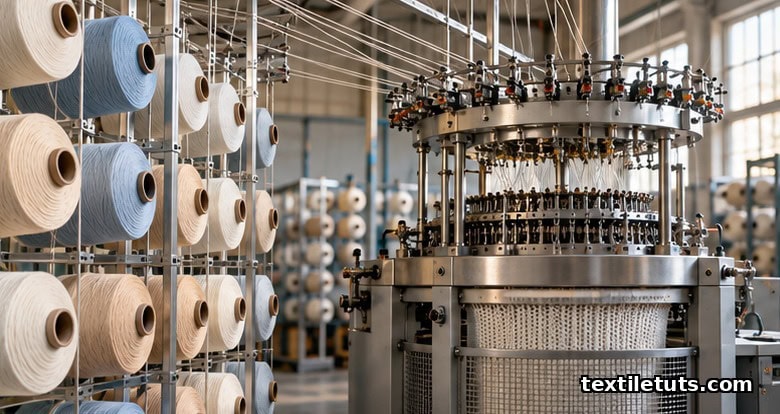
Knitting yarn is selected by three linked specs: yarn count (commonly Ne 14 to Ne 60, or 16.9 to 42.2 tex), twist direction (Z-twist for warp knitting, S-twist for most weft knitting), and twist multiplier (3.0 to 4.5 αtex for hosiery and jersey), because a 1 to 2 turn-per-inch deviation in twist direction or a one-count count jump shifts loop density by 8 to 15% and triggers snarling, barre, or needle damage during knitting.
In a circular knitting machine running at 1,200 to 1,800 rpm, the yarn passes through 12 to 18 metal guides before it loops at the needle hook, and every spec mismatch in count, twist, or fiber contributes to downtime, fabric defects, or garment failure. This article covers the three selection criteria mill technicians and knit merchandisers use, with the numerical thresholds defined under ISO 8388 and ASTM D1422.
You will learn the count systems used in knitting specifications, the physics of S-twist versus Z-twist in loop formation, fiber-specific performance windows for cotton, polyester, wool, and blends, plus a 4-step selection workflow for weft-knit and warp-knit fabrics.
Yarn Count Systems Used in Knitting
Knitting specifications use four yarn count systems, two of which dominate mill practice: the English cotton count (Ne) and the tex system. ISO 8388 defines yarn linear density in tex (grams per 1,000 m) and decitex (grams per 10,000 m), while ASTM D1907 and ASTM D2260 cover the other conventions.
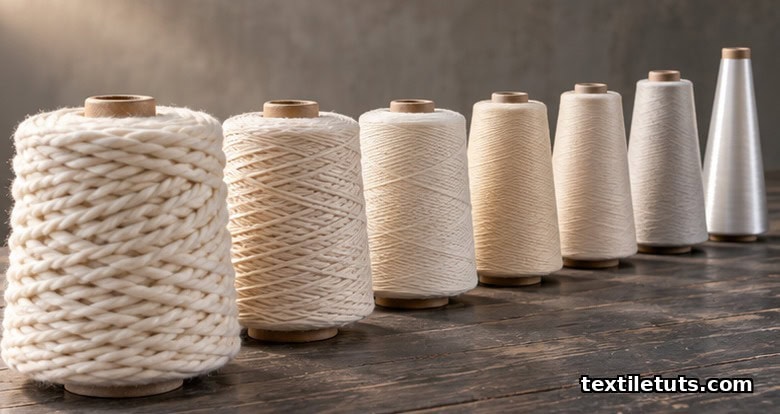
For a knitting mill running cotton-rich weft-knit fabric, yarn count is typically specified as Ne, where 1 Ne equals 0.59 tex (the constant 590.5 divided by Ne equals tex). For warp knitting and filament fabrics, the spec is denier (1 denier equals 0.111 tex, or 9,000 m per kilogram of yarn). Metric count (Nm, meters per gram) is common for wool hosiery and fine-gauge knitwear.
Practical knitting ranges in commercial mills:
- Single-jersey T-shirt fabric: Ne 24 to Ne 34 (24.5 to 14.7 tex) in combed cotton or cotton-polyester blend.
- Rib and interlock for cuffs, collars, and waistbands: Ne 26 to Ne 40 (22.7 to 14.8 tex).
- Hosiery and ladies’ knitwear: Ne 40 to Ne 80 (14.8 to 7.4 tex) for fine-gauge knitting.
- Warp-knit fabric (tricot, raschel, milano): 50 to 150 denier (5.6 to 16.7 tex) polyester or nylon filament.
- Circular knit fleece and terry: Ne 14 to Ne 20 (42.2 to 29.5 tex) coarse count for loop pile.
An 8 to 12% count variation (CV%) within a cone lot causes visible barre, the horizontal stripes that appear after dyeing single-jersey. The acceptable single-yarn CV% is 10 to 13% for knitting yarn, tighter than weaving because knitting tensions are lower and yarn faults are not hidden by interlacing.
Twist Direction: Why S Versus Z Matters in Knitting
Yarn twist direction is the second specification a knitter must match to needle geometry. Twist is described as S or Z according to ASTM D1422 and ASTM D2260: hold the yarn vertically and trace the spiral. If the spiral matches the diagonal of the Z letter, the yarn is Z-twist; if it matches the diagonal of the S letter, the yarn is S-twist. Most ring-spun yarns are Z-twist.
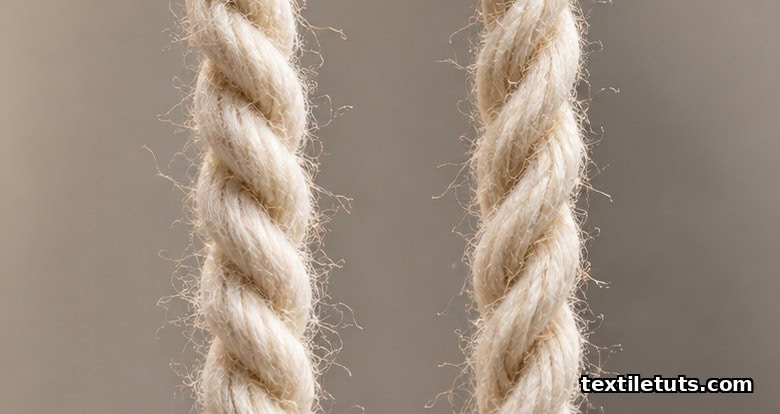
Twist direction interacts with loop formation in three measurable ways:
- Needle cutting. An S-twist yarn running through a needle hook oriented for Z-twist yarn creates a saw-tooth contact angle and increases needle failure by 30 to 40% in warp knitting.
- Snarling tendency. Untwisting torque in low-twist yarn causes the yarn to spiral when relaxed. S-twist yarn snarls counter-clockwise and Z-twist yarn snarls clockwise. Snarls break the loop, cause holes in fabric, and stop the machine.
- Barre and skew. Alternating S and Z twist cones in a circular knit cause alternating loop lean and produce visible diagonal streaks after finishing.
The general rule used in knitting:
- Warp knitting (tricot, raschel, and warp-knit): Z-twist yarn preferred.
- Weft knitting on circular and flat machines: S-twist yarn often preferred for single-jersey and rib because the yarn unwinds in the direction of loop formation, reducing liveliness.
- Hosiery: S-twist for single-cylinder machines, Z-twist for double-cylinder machines.
Twist level is expressed as twist per inch (TPI) or twist multiplier (αtex or TM). For knitting yarn, the αtex range is 3.0 to 4.5: a TM of 3.0 is soft and bulky for sweater yarn, a TM of 4.0 to 4.5 is the working range for cotton knit jersey (about 28 TPI at Ne 30), and a TM above 5.0 produces hard-feel yarn that is difficult to loop without needle damage.
Fiber Selection for Knitting: Cotton, Polyester, Wool, and Blends
Fiber choice is the third lever, and it interacts with count and twist to determine the final fabric hand, recovery, and shrinkage. Knitting requires fiber with adequate cohesion (loop stability) and elasticity (recovery after loop deformation).
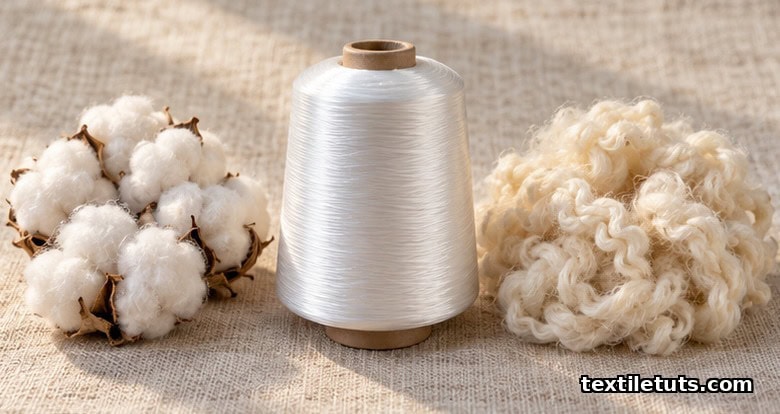
Cotton for knit. Combed cotton of 28 to 34 mm staple length and 3.8 to 4.5 micronaire is the standard for fine-gauge single-jersey. Combing reduces neps by 60 to 70% and gives the smooth yarn knitting needs. Ring-spun cotton at Ne 30 to Ne 40 dominates undergarments, T-shirts, and baby wear because of the soft hand and 4 to 6% moisture regain.
Polyester filament for knit. 50 to 150 denier (5.6 to 16.7 tex) partially oriented yarn (POY) and fully drawn yarn (FDY) feed warp knitting. Polyester gives dimensional stability (less than 2% shrinkage at warp-knit finishing) and high tenacity of 4.5 to 6.0 g/den. Draw-textured polyester (DTY) is used for weft-knit stretch fabric and circular-knit fleece.
Wool for knit. Machine-washable merino wool of 19 to 24 micron, worsted-spun at 60 to 80 Nm, is the standard for hosiery, sweater, and fine-gauge knitwear. Wool fiber has a moisture regain of 14 to 18% and a 30% recovery at 5% extension, the best of the common knit fibers.
Blends for knit. A 65/35 cotton-polyester blend or 50/50 PC blend is the workhorse for school uniforms, sportswear T-shirts, and sweatshirts because the polyester contributes strength and dimensional stability and the cotton contributes moisture absorbency. Spandex at 2 to 5% (Lycra or equivalent) is added in the feeder for stretch fabric and elastic waistband.
Recycled cotton and recycled polyester (rPET) blends are increasingly specified for circular knit fabric in sustainability commitments. rPET staple or filament produces fabric with 30 to 50% lower carbon footprint than virgin polyester at equivalent count and twist, and meets the Global Recycled Standard (GRS) certification that brand buyers now request.
Yarn Quality Requirements for Knitting
Knitting imposes tighter yarn-quality limits than weaving because each loop is exposed at the surface and a single fault produces a visible hole, thick place, or thin place. Uster Statistics 2018 and ASTM D1425 provide the benchmarks.
- CV% of single-yarn count (Uster CV%): 10 to 13% acceptable for knitting, under 12% preferred for dyed single-jersey. Higher CV% causes visible barre after dyeing.
- Imperfections per kilometer (IPI): thin places (-50%), thick places (+50%), neps at -40%/+200% sensitivity. Knitting yarn specification: IPI under 250/km for combed cotton Ne 30 and finer.
- Hairiness index (H): below 4.5 for combed cotton knitting yarn. Above this value the protruding fibers entangle at the needle hook and cause fly and needle damage.
- Single-end tenacity: knitting yarn must clear 12 cN/tex for cotton and 25 cN/tex for polyester filament, against the ASTM D2256 test method.
- Elongation: 6 to 8% for cotton ring-spun, 18 to 25% for textured polyester, 18 to 30% for wool. Low-elongation yarn snaps at the needle hook.
Yarn faults that are tolerable in weaving (slubs, mixed-count) become visible defects in knitting. Most knit fabric specifications set a Classimat fault cap of 30 faults per 100 km of yarn for cross-miss and long-period thick places, against the Uster Classimat instrument.
Comparison Table: Yarn Count Systems for Knitting
| Property | Ne (English cotton count) | Tex | Denier | Metric count (Nm) |
|---|---|---|---|---|
| Definition | Number of 840-yard lengths per pound | Grams per 1,000 m | Grams per 9,000 m | Number of meters per gram |
| Unit direction | Higher = finer | Lower = finer | Lower = finer | Higher = finer |
| Common knitting range | Ne 14 to Ne 60 | 16.9 to 42.2 tex | 50 to 150 denier | Nm 20 to Nm 80 |
| Dominant fabric type | Single-jersey, rib, fleece | Universal (ISO 8388) | Warp-knit, hosiery filament | Wool knitting |
| Formula conversion | tex = 590.5 divided by Ne | tex = 1,000 divided by Nm | denier = 9 divided by tex | Nm = 1,000 divided by tex |
Practical Selection Workflow: From Specification to Cone
Four steps move a knitting mill from customer specification to the cone in the creel.
- Read the fabric specification. Extract the GSM, course per cm, wales per cm, fiber blend, and finishing route. From GSM and loop length, derive the yarn count and twist multiplier using ISO 8388 conversion.
- Match the twist direction to the machine. Confirm the machine type (circular flat, warp, or hosiery) and select S or Z twist yarn accordingly. Check yarn liveliness by hanging a 1-meter loop; snarl-free yarn shows less than 5% axis deflection.
- Run a Uster Tester 5 or Premier aQura inspection on the cone lot. Record CV%, IPI, hairiness, and tenacity. Reject lots where CV% exceeds 13% or IPI exceeds 250/km.
- Run a 100-meter knitting trial on the production machine at production speed. Monitor needle cuts, holes, and fabric defects per 1,000 courses. Accept the lot when defects are under 5 per 1,000 courses.
Documenting the count, twist direction, twist multiplier, fiber blend, and yarn-quality results per lot is part of the ISO 9001 traceability requirement most mills operate under, and it is also the standard data point knit merchandisers share with brand customers during sample submission and bulk shipment.
Frequently Asked Questions
Q1: What is the best yarn count for a single-jersey T-shirt fabric of 150 to 180 GSM?
Single-jersey T-shirt fabric of 150 to 180 GSM uses Ne 26 to Ne 34 ring-spun cotton, which converts to 17.4 to 22.7 tex under ISO 8388. This count range gives 22 to 26 courses per cm and 16 to 20 wales per cm at standard loop length, and works on a 24-gauge circular knitting machine.
Q2: Which twist direction does a circular knitting machine need?
Most circular knitting machines run S-twist yarn for single-jersey and rib because the loop-forming direction matches the yarn untwist direction and reduces liveliness at the knitting feeders. Some mills specify Z-twist for combed cotton single-jersey and switch for the rib machine to keep yarn lot consistency.
Q3: Can I use recycled polyester filament for warp knitting?
Yes, recycled polyester (rPET) at 50 to 100 denier works in warp knitting as POY or FDY when tenacity stays above 4.0 g/den and the dye uptake matches the virgin polyester reference. Many brands accept rPET at 50 to 100% substitution for sustainability lines, with GRS certification.
Q4: Why does my dyed jersey show horizontal streaks (barre)?
Barre in dyed jersey traces back to count variation across cones, with single-yarn CV% over 13%, mixed-count cones, or alternating S/Z twist in the same fabric lot. Re-checking the Uster CV% and the twist direction of each cone resolves most barre incidents, and re-knitting the lot at uniform loop length removes the residual shading band.
References
- ISO. ISO 8388:2009, Textiles, Determination of yarn count by the skein method. iso.org, defines the tex and decitex systems used in knit yarn specifications.
- ASTM International. ASTM D1422 / D2260, Twist in Single Yarns / Yarn Number by Direct Count. astm.org, defines S-twist and Z-twist classification and yarn count conventions for knitting.
- Spencer, D.J. Knitting Technology: A Comprehensive Handbook and Practical Guide. ScienceDirect (Woodhead Publishing), the standard reference on yarn count, twist, and fiber selection for knit fabric construction.
- Ray, S.C. Textile Yarns: Technology, Structure, and Applications. Wiley, reference for yarn count systems, twist mechanics, and fiber effects in knitting and weaving.
- The Woolmark Company. Wool for Knitting: Fibre Properties and Processing. wool.com, fiber-specific guidance for wool hosiery, fine-gauge knitwear, and worsted-spun knit yarn.
- Uster Technologies. Uster Statistics 2018, Application Handbook for Yarn Quality. ResearchGate / Uster, peer-reviewed thresholds for CV%, IPI, and hairiness in knitting yarn.
Editorial by Iftay Khairul Alam, TextileTuts. Sources: ISO 8388, ASTM D1422 / D2260, ScienceDirect, Wiley, Woolmark Company, Uster Statistics 2018 as cited.


