
Knit Fabric for T-Shirts: GSM and Composition Guide

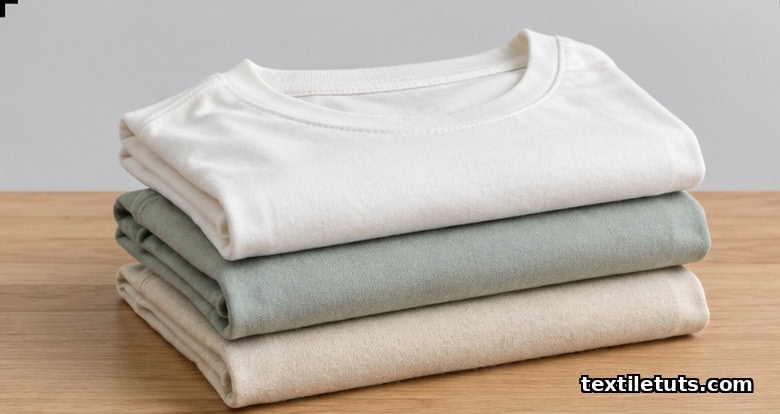
Knit fabric for t-shirts is a single jersey weft-knit structure weighing 140 to 220 g/m2 (GSM), produced from 100% cotton, cotton-polyester blends (commonly 65/35 or 80/20), cotton-modal (50/50), or tri-blends of cotton-polyester-rayon in ratios such as 50/25/25, with the GSM directly governing drape, opacity, durability, and seasonal use.
A 140 to 160 GSM single jersey works for lightweight summer layering, 160 to 180 GSM is the commercial sweet spot for everyday tees, and 180 to 220 GSM delivers premium weight with reduced transparency and a more stable print substrate for screen and digital decoration.
This guide covers the single jersey knit structure, the four most common fiber compositions and their tradeoffs, GSM ranges mapped to end use, the three yarn spinning systems that define hand and pilling resistance (ring, rotor/open-end, compact), and the finishing sequence (singeing, mercerizing, bio-polishing, compacting) that determines how a t-shirt feels, drapes, and survives repeated laundering.
Single Jersey Knit Structure: Why T-Shirts Use It
Single jersey is a weft-knit fabric produced on circular knitting machines using a single set of needles, forming a face side of knit stitches and a back side of purl (float) stitches. The structure is fed by one yarn per course and produces a fabric with distinct face and back appearances plus the characteristic mechanical profile of weft knits: high elongation in the width direction (typically 60 to 80% at break for cotton single jersey) and moderate elongation in the length direction (20 to 40%).
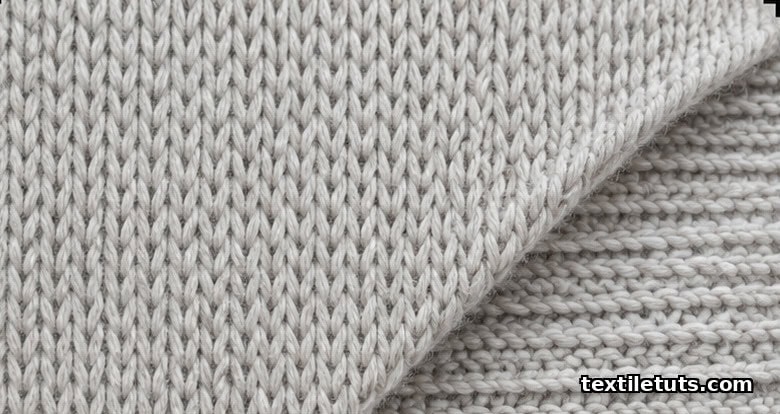
Cotton Incorporated technical bulletins describe single jersey as the dominant structure for t-shirts because it offers balanced hand, drape, and breathability while knitting efficiently at 18 to 28 gauge on circular machines ranging from 18 to 30 inches in diameter, producing open fabric widths from roughly 70 cm to 220 cm before finishing.
The interlocking loop geometry gives single jersey high tear strength relative to woven counterparts of comparable weight and makes it more comfortable against the skin than laminated or bonded structures, which is why it dominates the global t-shirt market across entry-level, mid-market, and premium segments.
Fiber Compositions: 100% Cotton, Poly Blends, Modal, and Tri-Blends
Fiber choice sets the ceiling for moisture management, hand, durability, and cost. The four compositions that cover essentially the commercial t-shirt market are:
- 100% cotton: Best moisture absorption (8 to 10% standard regain) and skin comfort, but higher residual shrinkage (5 to 8% after five home-laundry cycles) and lower wrinkle recovery. Common yarn counts range from Ne 20s to Ne 40s.
- Cotton-polyester blends (65/35, 80/20, 50/50): Polyester raises tensile strength, dimensional stability, and drying speed; a 65% cotton / 35% polyester blend balances comfort with durability, while 80/20 leans toward cotton hand and is the standard workwear ratio.
- Cotton-modal (50/50, 60/40): Modal, a regenerated cellulose fiber from beechwood pulp, adds softness and fluid drape; 50/50 modal-cotton is the default for premium basics.
- Tri-blends (cotton / polyester / rayon, often 50/25/25): Combine softness, drape, a heathered vintage look, and reduced weight per unit area; standard in fashion and streetwear tees where hand matters more than durability.
Peer-reviewed work in the textile engineering literature quantifies how blend ratio shifts performance. Increasing polyester content raises tensile strength, reduces residual shrinkage to 2 to 4%, and lowers moisture regain; increasing modal or rayon content improves drape and softness but reduces wet strength, which is why tri-blends are usually specified as fashion weight rather than uniform weight.
GSM Ranges and Their End Uses (140, 160, 180, 200, 220)
GSM, grams per square meter, is the single most quoted specification for t-shirt fabric. It is measured per ASTM D3776 using the cut-and-weigh method, which remains the most common QC technique for knit fabric, and it is the primary driver of perceived quality, opacity, and seasonal suitability.
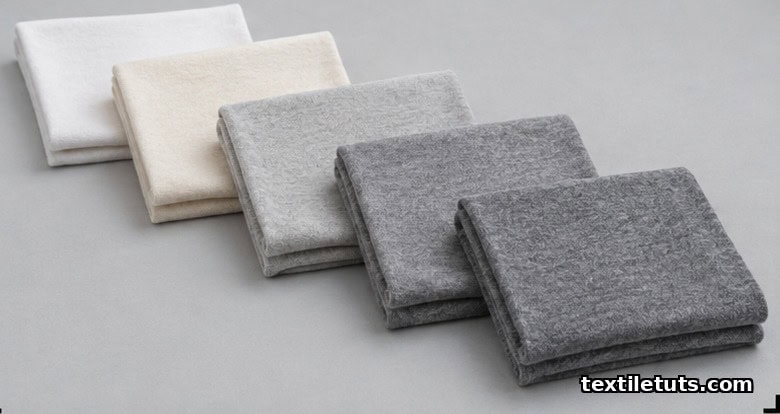
- 120 to 140 GSM: Lightweight, often sheer; used for fashion layering pieces and summer drape tees. Transparency risk at lighter colors.
- 140 to 160 GSM: Entry-level t-shirts, promotional tees, summer basics; the standard for fast-fashion and uniform basics.
- 160 to 180 GSM: The commercial sweet spot, used by most mid-market t-shirt brands; balances cost, opacity, and drape.
- 180 to 200 GSM: Premium weight; used by heritage and streetwear brands; a more stable substrate for high-density screen printing.
- 200 to 220 GSM: Heavyweight / structured; used for heavyweight streetwear, workwear-inspired tees, and high-density print bases where opacity and stiffness matter.
AATCC and ISO both specify standardized conditioning for GSM measurement. Specimens equilibrate at 20 degrees C and 65% RH per ISO 139 (or 21 degrees C and 65% RH per ASTM D1776) for at least four hours before cutting with a calibrated GSM cutter and weighing on an analytical balance. Without conditioning control, GSM readings drift by 2 to 4% across humid and dry climates.
Yarn Types: Ring, Open-End (Rotor), and Compact Spun
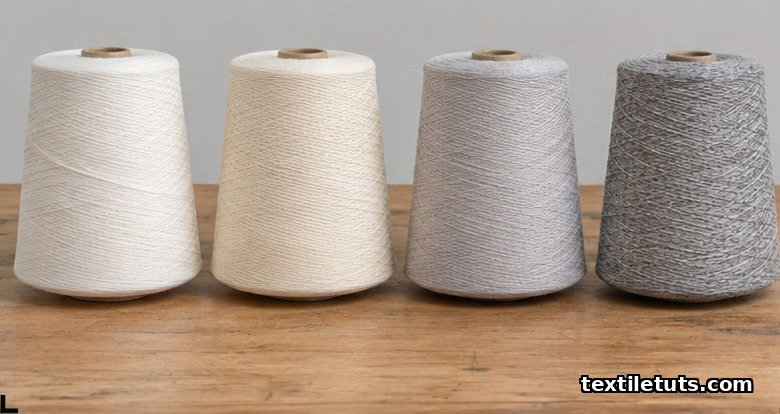
The spinning system used to make the yarn strongly affects hand, pilling, tensile strength, and price. The three systems most relevant to t-shirt fabric are:
- Ring-spun cotton: Yarn made by drafting roving through a moving spindle, twisting, and winding onto a cop. Ring-spun yarn has a tighter twist structure and a more uniform, softer surface, with single-yarn strength 10 to 15% higher than open-end at the same count. Used in mid to premium t-shirts.
- Open-end (rotor) spun: Yarn formed by feeding sliver into a high-speed rotating rotor, where fibers are assembled by centrifugal force and twisted. Open-end yarn is bulkier, less expensive, more regular in appearance, but slightly harsher and weaker than ring-spun. Standard for entry-level basics.
- Compact (condensed ring) spun: A modification of ring spinning that uses a condensing zone to align fibers before twisting, producing yarn with 5 to 10% higher strength, lower hairiness, and a noticeably softer hand. Standard for premium t-shirt fabric and combed cotton.
Peer-reviewed studies in Fibers and Polymers and similar journals document that compact-spun yarn reduces fabric pilling by 1 to 2 grade points on the ICI pilling box test (ISO 12945-1) compared with conventional ring-spun yarn at equivalent count, because protruding fiber ends are minimized at the yarn formation stage.
Finishing Treatments: Singeing, Mercerizing, Bio-Polishing, Compacting
Greige (loom-state) single jersey is too rough, hairy, and dimensionally unstable to wear directly. The finishing sequence determines the final hand, appearance, and stability of the fabric:
- Singeing: Passing fabric over a hot plate or gas flame at 600 to 900 degrees C for milliseconds to burn off protruding fiber ends. Produces a cleaner surface, better print definition, and reduced pilling in wear.
- Mercerizing: Treating cotton fabric with 20 to 25% sodium hydroxide (NaOH) under tension. Mercerization increases tensile strength by 15 to 25%, improves luster, and raises dye uptake by 30 to 50%, which is why it is standard for premium combed cotton tees.
- Bio-polishing (enzymatic treatment): Applying cellulase enzymes to hydrolyze loose cellulose fiber ends on the fabric surface, reducing pilling and giving a smoother hand without harsh chemical treatment. Standard for premium cotton tees and a key step in achieving a vintage soft feel.
- Calendaring and compacting: Mechanical finishing that sets fabric width, controls residual shrinkage, and stabilizes the structure. Compactors reduce residual shrinkage to under 5% in length and under 5% in width per AATCC TM135 home-laundering testing.
The sequence and intensity of these finishes define whether a t-shirt feels vintage soft (heavy bio-polishing, light mercerizing) or crisp premium (full mercerizing, light calendaring). Combed cotton adds an upstream yarn preparation step that removes short fibers before spinning, raising yarn strength and surface cleanliness before singeing.
T-Shirt Fabric Comparison by GSM and Composition
| Property | 140 GSM, 100% cotton OE | 160 GSM, 100% cotton ring | 180 GSM, 65/35 cotton-poly ring | 200 GSM, 50/50 cotton-modal compact | 220 GSM, 50/25/25 tri-blend ring |
|---|---|---|---|---|---|
| Typical end use | Promo / summer basic | Everyday tee | Workwear / uniform | Premium basic | Fashion / heavyweight |
| Hand feel | Crisp / light | Smooth / balanced | Smooth / slightly slick | Silky / fluid | Buttery / drapey |
| Opacity (white) | Low (sheer at light) | Moderate | High | High | Very high |
| Shrinkage after 5 home washes (AATCC TM135) | 5 to 8% | 3 to 5% | 2 to 4% | 3 to 5% | 2 to 4% |
| Pilling (ICI box, 5 hr, grade 1 to 5) | 3 | 3 to 4 | 4 | 4 | 4 to 5 |
| Drying time (relative) | Fast | Moderate | Moderate to fast | Moderate | Slow |
| Price index (relative) | 1.0x | 1.2x | 1.1x | 1.6x | 1.4x |
This table is a planning reference; actual mill output varies with yarn count (Ne 20s to Ne 40s), stitch density (courses and wales per cm), and the specific finishing sequence applied. Most commercial t-shirt fabric is specified at 160 to 180 GSM in either 100% cotton or 65/35 cotton-polyester.
Frequently Asked Questions
Q1: What GSM is best for a t-shirt?
For most everyday t-shirts, 160 to 180 GSM single jersey is the commercial sweet spot because it balances opacity, drape, and cost. Lightweight summer tees use 140 to 160 GSM; premium and heavyweight streetwear tees use 180 to 220 GSM. Below 140 GSM the fabric risks transparency at lighter colors; above 220 GSM it loses drape and feels structured rather than soft.
Q2: Is 100% cotton or cotton-polyester better for t-shirts?
100% cotton gives the highest moisture absorption (8 to 10% standard regain) and the softest hand against skin, but it shrinks 5 to 8% after five home washes without compaction. Cotton-polyester blends (commonly 65/35 or 80/20) give higher tensile strength, lower shrinkage (2 to 4%), faster drying, and lower cost. For uniform and workwear use, cotton-polyester is standard; for premium basics, 100% cotton or cotton-modal is preferred.
Q3: What does “combed cotton” mean, and is it worth the price?
Combed cotton is yarn made from cotton fiber that has been combed after carding to remove short fibers and impurities before spinning. Combed cotton yarn is 10 to 15% stronger, smoother, and more lustrous than carded cotton, and produces t-shirt fabric with fewer protruding fiber ends, lower pilling on the ICI box test, and a cleaner print surface. For premium basics it is worth the price premium; for promotional basics the upgrade is rarely necessary.
Q4: Will a 100% cotton t-shirt shrink in the wash?
Untreated 100% cotton single jersey typically shrinks 5 to 8% in length and 3 to 5% in width after the first five wash cycles per AATCC TM135. Compacting during finishing reduces this to under 5% in both directions, which is why most mill-direct 100% cotton t-shirt fabric is sold as “pre-shrunk” or “compacted.” Untreated greige fabric will visibly shrink on the first wash and should be avoided for fitted garment production.
References
- ASTM D3776 / D3776M-20. Standard Test Methods for Mass Per Unit Area (Weight) of Fabric. ASTM International. https://www.astm.org/d3776_d3776m-20.html . The cut-and-weigh GSM method standard used for knit fabric QC.
- ISO 139:2005. Textiles: Standard atmospheres for conditioning and testing. International Organization for Standardization. https://www.iso.org/standard/35179.html . The 20 degrees C / 65% RH standard atmosphere required before GSM and tensile testing.
- AATCC TM135. Dimensional Changes of Fabrics After Home Laundering. American Association of Textile Chemists and Colorists. https://www.aatcc.org/testing/test-methods/ . The home-wash shrinkage test referenced for knit fabric QC specifications.
- Cotton Incorporated. Knit Fabric Construction and Quality. Cotton Incorporated Technical Bulletin. https://www.cottoninc.com/ . Industry trade-association reference covering single jersey structure, gauge ranges, and cotton knit production.
- Spencer, D. J. Knitting Technology: A Comprehensive Handbook and Practical Guide. 3rd ed., Woodhead Publishing (Elsevier). https://www.sciencedirect.com/book/9780849313961 . Peer-reviewed reference covering weft-knit structure, circular knitting, and yarn systems.
- Sinclair, R. (Ed.). Textiles and Fashion: Materials, Design and Technology. Woodhead Publishing (Elsevier). https://www.sciencedirect.com/book/9781845699314 . Peer-reviewed textile reference covering knit structure, GSM, and finishing sequences.
This article is the working reference for knit fabric selection in t-shirt production. Editorial by Iftay Khairul Alam, TextileTuts. Sources: ASTM D3776, ISO 139, AATCC TM135, Cotton Incorporated, Spencer (Woodhead Publishing), and Sinclair (Woodhead Publishing) as cited.


