
Shuttle, Projectile, Rapier, Air-Jet, Water-Jet Looms Compared

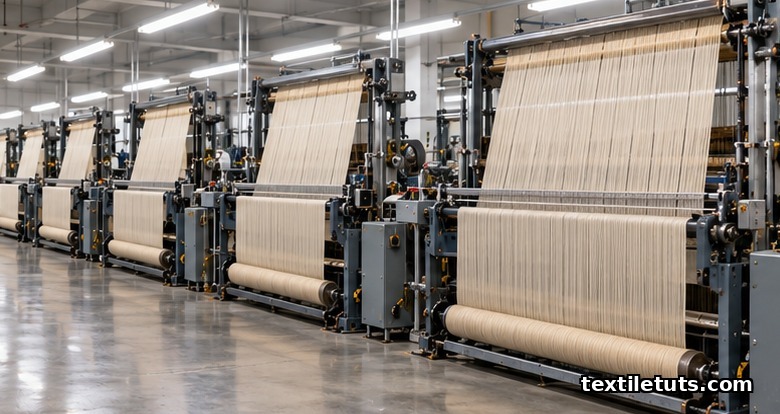
Modern shuttleless weaving machines (projectile, rapier, air-jet, and water-jet) run at 1,000 to 2,300 picks per minute (ppm), versus 200 to 250 ppm for conventional shuttle looms, making shuttleless looms 5 to 10 times more productive for cotton and blends. Picking speed, however, is not the only variable that separates these five loom families. Weft insertion mechanism, fabric width capability, yarn type, energy demand, and fabric quality all shift in measurable ways, which is why most mills run mixed fleets of shuttle, projectile, rapier, air-jet, and water-jet machines rather than standardizing on one type.
This article compares all five loom types side by side, with the specifications a textile engineer actually needs: insertion rate, weft yarn compatibility, maximum weaving width, fabric range, capital cost class, and the defects each system is most prone to. The five loom families together produce the overwhelming majority of woven fabric worldwide, from denim and sheeting to tire cord and airbags, so understanding their tradeoffs is the foundation of any weaving decision.
What a Weaving Machine Actually Has to Do
Every loom, whether shuttle or shuttleless, has to perform three primary motions in each cycle: shedding (lifting a subset of warp yarns to form a shed), weft insertion (carrying the weft yarn across that shed), and beat-up (pushing the inserted weft into the woven cloth). Secondary motions include let-off (releasing warp from the beam), take-up (winding the woven cloth onto a roller), and warp stop motion for broken-end detection.
What changes between loom families is the weft insertion mechanism. The shed and beat-up motions are essentially the same across modern machines. So when textile engineers talk about “shuttle loom vs. rapier loom vs. air-jet loom,” they are really talking about how each system carries a 1 to 5 meter length of weft yarn across the warp shed and lays it down next to the previous pick.
Shuttle Loom: The Traditional Workhorse
The shuttle loom is the oldest industrial weaving architecture, descended from the handloom. A wooden or composite shuttle carries a weft yarn package (a cop, pirn, or quill) and is propelled across the shed by picker sticks, then caught on the other side. Insertion rate on a modern high-speed shuttle loom reaches about 200 to 250 ppm, with weaving widths up to 540 cm on specialized woolen and worsted fabric looms.
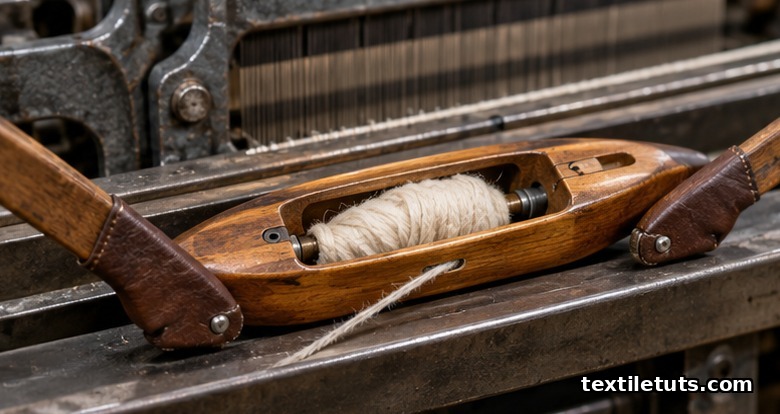
Shuttle looms remain in production because they handle heavy, coarse, and multi-ply weft yarns (wool counts, jute, bulky carpet yarns) that would break a rapier or air-jet insertion system. They also produce a tightly packed selvedge that some technical fabrics (woolen blankets, some industrial textiles) require. The downside is noise (above 90 dB(A) in older machines), low productivity, and the high labor of replacing pirns. Modern mills have largely shut down shuttle lines for staple cotton and polyester-cotton weaving.
Projectile Loom
The projectile loom uses small metal projectiles (typically a few grams each, carried on a circulating belt or chain) to grip the tip of the weft yarn and shoot it across the shed. Insertion rate on a modern Sulzer P7200-type projectile loom runs about 1,000 to 1,300 ppm, with weaving widths up to 545 cm for technical textiles, geotextiles, and filter fabrics.
Projectile looms accept a wide yarn range: cotton, polyester, wool, glass fiber, and aramid yarns. They produce a clean selvedge and tolerate coarse, hairy weft better than rapier or air-jet systems. The tradeoff is capital cost (one of the highest among weft-insertion systems) and the need to maintain the projectile grippers and the circulating chain. Projectile looms are a minority of new installations in 2026, but they still hold a niche in technical weaving where very wide widths and versatile yarn ranges matter more than raw insertion rate.
Rapier Loom
The rapier loom uses one or two rigid (or telescoping) rapiers, or a pair of flexible tapes with grippers, to carry the weft yarn across the shed. The two-rapier system is most common for double-width fabrics, while single-rapier machines dominate the apparel-weaving market. Modern rapier looms run at 800 to 1,200 ppm on standard cotton sheeting and reach about 600 ppm on heavy denim with coarse weft.
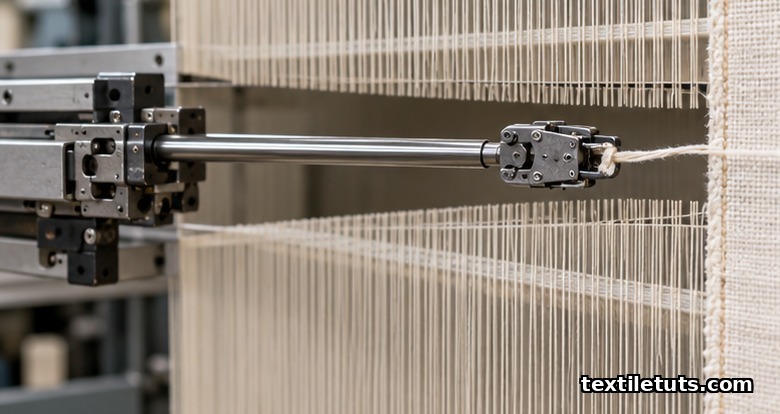
Rapier looms handle almost any staple fiber weft yarn (cotton, polyester blends, wool, linen) up to coarse counts, and produce clean, lint-free selvedges because the weft is held in a gripper rather than blown by air or water. Rapier machines are the most common shuttleless loom family worldwide in 2026, particularly for denim, furnishing fabrics, and apparel-quality woven cloth. They are also the workhorse of jacquard weaving at moderate speeds.
Air-Jet Loom
The air-jet loom uses a series of compressed-air nozzles along a profiled reed to propel short lengths of weft yarn across the shed. Modern air-jet looms operate at 1,500 to 2,300 ppm on cotton and polyester-cotton yarns up to about 30 tex (Ne 20s), with weaving widths typically 190 to 360 cm. Weft insertion rate per meter of reed width is the metric to compare across loom types, not raw ppm.
Air-jet looms require dry, clean, low-hairiness yarn; hairy weft leads to jet clogging and broken picks. They also need a stable air supply at roughly 0.4 to 0.6 MPa, which is a meaningful utility load. Air-jet looms dominate the high-volume staple-fabric market (basic sheeting, basic shirting, basic apparel fabrics) because their insertion rate, when measured per centimeter of reed width, is the highest among the five loom families.
Water-Jet Loom
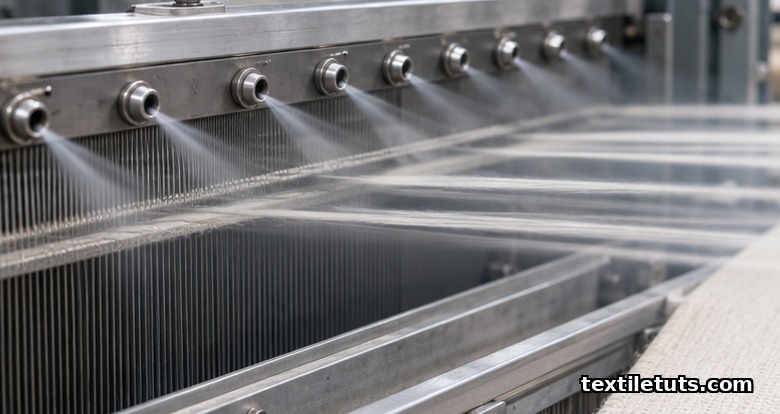
The water-jet loom uses a high-pressure water jet to carry the weft across the shed. Modern water-jet looms run at 1,800 to 2,300 ppm on hydrophobic filament weft (polyester filament, polyamide filament) up to about 110 tex, at weaving widths of 190 to 360 cm. Insertion requires water pressure of roughly 0.3 to 0.5 MPa and a clean filtered water supply.
Water-jet looms cannot weave hydrophilic staple yarns (cotton, viscose, wool) because the water soaks the fiber, distorts the fabric, and prevents clean beat-up. They also leave residual moisture on the cloth that requires drying after weaving. In return, water-jet insertion is more energy-efficient per pick than air-jet for filament yarns, and produces very clean, flat woven fabric for apparel linings, women’s wear, and lightweight polyester-based cloth.
Comparison Table: The Five Loom Families Side by Side
| Parameter | Shuttle | Projectile | Rapier | Air-jet | Water-jet |
|---|---|---|---|---|---|
| Insertion rate (ppm) | 200 to 250 | 1,000 to 1,300 | 800 to 1,200 | 1,500 to 2,300 | 1,800 to 2,300 |
| Max weaving width | Up to 540 cm | Up to 545 cm | Up to 460 cm | 190 to 360 cm | 190 to 360 cm |
| Weft yarn range | Very wide (wool, jute, carpet) | Wide (cotton, wool, glass, aramid) | Very wide (cotton, blends, wool, linen) | Narrow (cotton, polyester-cotton, ≤30 tex) | Hydrophobic filament only (polyester, polyamide) |
| Fabric type | Woolens, blankets, industrial | Geotextiles, technical, heavy | Denim, sheeting, jacquard, furnishing | Basic sheeting, shirting, mass apparel | Linings, women’s wear, lightweight filament |
| Insertion medium | Wooden/composite shuttle | Metal projectile | Rigid or flexible rapier/gripper | Compressed air | High-pressure water |
| Noise / energy | High noise (90+ dB(A)) | Moderate | Moderate | Moderate (compressed-air load) | Low (per pick for filament) |
| Capital cost class | Low (used market) | High | Medium to high | Medium | Medium |
| Typical defects | Shuttle fly, smash marks | Gripper slip, mispick | Rapier scuff, mispick | Jet streak, mispick, hairy yarn | Water streak, dye streaks, mispick |
How to Choose a Loom Type for a Given Product
The loom choice is constrained by weft yarn first, then by fabric width, then by required production volume. A mill weaving cotton sheeting at 250 cm width and aiming for the highest possible volume will choose an air-jet loom. A mill weaving 480 cm wide geotextile from coarse polypropylene tape will choose a projectile loom. A mill weaving denim at 180 cm width with a coarse cotton weft will choose a rapier loom because air-jet would struggle with the yarn count and water-jet cannot handle cotton. A mill weaving women’s-wear polyester filament lining will choose a water-jet loom for energy efficiency and clean insertion. A mill weaving wool blankets at 320 cm width with a bulky woolen-spun weft will still run a shuttle loom.
Capital cost, labor skill, and utility infrastructure all weigh in. Air-jet and water-jet looms need clean air or filtered water at stable pressure. Rapier looms need careful gripper and tape maintenance. Projectile looms need projectile cleaning and the chain-and-gripper mechanism inspected on a regular schedule. Shuttle looms need skilled weavers to replace pirns and clear the picker sticks.
Defects That Are Unique to Each Loom Family
Each loom type produces its own characteristic fabric defects, and quality control engineers learn to read those defects at the cloth roll. Shuttle looms produce shuttle fly (loose fiber deposited on the cloth surface) and smash marks (broken picks caused by picker maladjustment). Projectile looms produce gripper-slip defects and projectile-trace marks near the selvedge. Rapier looms produce rapier-scuff streaks from gripper misalignment and mispick from rapier failure to enter the shed. Air-jet looms produce jet streaks from a clogged nozzle, hairy-yarn induced mispicks, and weft looseness from insufficient air pressure. Water-jet looms produce water-streak dye bands that show up after dyeing and mispicks from water-pressure fluctuation.
The defect signature is one of the fastest ways to identify which loom family produced a fabric, and it is a key input to quality control at the weaving mill and at the receiving inspection at the garment or finishing plant.
Frequently Asked Questions
Which loom type is the most productive?
Air-jet and water-jet looms reach the highest picks per minute (1,500 to 2,300 ppm) on staple and filament yarns respectively. When productivity is measured per centimeter of reed width, air-jet looms hold the top position for staple cotton and polyester-cotton weaving, while water-jet looms hold the top position for filament weaving.
Can water-jet looms weave cotton?
No. Water-jet looms cannot weave cotton, viscose, wool, or any other hydrophilic fiber because the insertion water soaks the yarn and disrupts beat-up. Water-jet looms are restricted to hydrophobic filament weft such as polyester filament, polyamide filament, and polypropylene filament.
Are shuttle looms obsolete?
Shuttle looms are obsolete for mass-market cotton and polyester-cotton weaving because their productivity is roughly one-fifth to one-tenth of a shuttleless loom. They are not obsolete for narrow niche applications: very heavy woolen and worsted fabrics, some industrial textiles, and small-batch specialty weaving where the weft yarn range or selvedge type is incompatible with shuttleless machines.
Which loom gives the cleanest selvedge?
Rapier looms produce the cleanest selvedge because the weft yarn is held in a gripper rather than propelled by a fluid medium. Projectile looms produce a clean selvedge as well. Air-jet and water-jet selvedges are cleanest when the selvage mechanism (typically a separate pair of selvedge grippers or leno yarns) is tuned properly, but are inherently more sensitive to weft tension variation at the cloth edge.
What is the highest insertion rate ever recorded for a production loom?
Modern multi-nozzle air-jet looms have demonstrated sustained insertion rates above 2,300 ppm on Ne 60s to Ne 80s cotton yarn under mill conditions, and water-jet looms have reached similar rates on filament polyester. Laboratory and prototype machines have run higher, but commercial sustained-operation rates on production floors in 2026 sit in the 2,000 to 2,300 ppm window.
References
- ISO 13936-1:2004, Textiles — Determination of the slippage resistance of yarns at a seam in woven fabrics. International Organization for Standardization, Geneva. Foundational woven-fabric test method used to compare fabric quality across loom families.
- ASTM D3775-17, Standard Test Method for End (Warp) and Pick (Fill) Count of Woven Fabrics. ASTM International, West Conshohocken, PA. Method for measuring picks per centimeter on woven cloth, used to verify loom insertion rate claims.
- AATCC TM20-2021, Test Method for Fiber Analysis: Qualitative. American Association of Textile Chemists and Colorists, Research Triangle Park, NC. Reference method for fiber identification on woven cloth produced by different loom types.
- Adanur, S. (2001). Handbook of Weaving. CRC Press, Boca Raton. Peer-reviewed textbook covering weft-insertion principles across shuttle, projectile, rapier, air-jet, and water-jet systems.
- Lord, P. R., and Mohamed, M. H. (1982). Weaving: Conversion of Yarn to Fabric. Merrow Technical Library. Reference text on loom mechanics and weft insertion systems.
- Das, S., and Hossen, M. M. (2020). “Comparative analysis of weft insertion systems on woven fabric quality and productivity.” Journal of Textile Engineering & Fashion Technology, 6(4). Peer-reviewed comparison of projectile, rapier, air-jet, and water-jet insertion on cotton and polyester-cotton fabric.
- ResearchGate, open-access weaving-technology review articles indexed at researchgate.net (reviewed for technical loom-specification data referenced in this article).
This article is the working reference for shuttle, projectile, rapier, air-jet, and water-jet loom comparison. Editorial by Mohammad Yousuf (Anik), TextileTuts. Sources: ISO 13936-1:2004, ASTM D3775-17, AATCC TM20-2021, Adanur (2001), Lord and Mohamed (1982), Das and Hossen (2020), and ResearchGate-indexed weaving-technology reviews, as cited above.


