
Microfiber Filters for Washing Machines

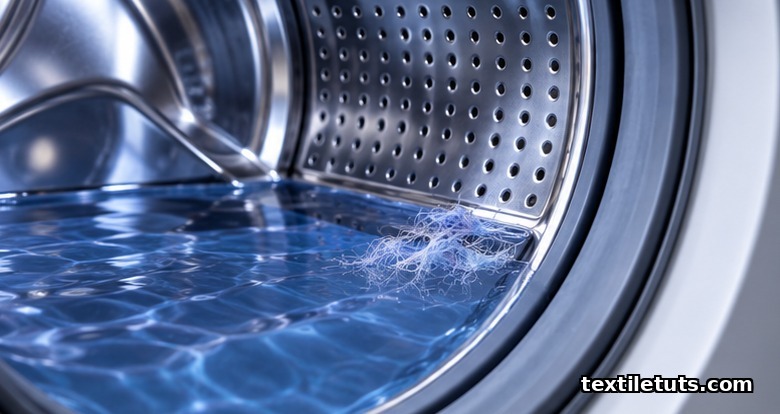
Standard home laundering of synthetic garments releases between approximately 0.5 and 2.4 grams of microfiber per kilogram of fabric per wash, and combined household washing-machine effluent is estimated to discharge roughly 0.5 million tonnes of synthetic microfiber into the global ocean every year, per OECD analyses.
This article covers the textile science behind why washers shed microfibers, what the relevant ISO and AATCC standards say about measuring that shedding, and which filtration solutions actually catch what the machine sends down the drain.
Why Washing Machines Release Microfibers in the First Place
Microfibers are short filament fragments, typically under 5 mm long and often narrower than a human hair, that detach from yarns during mechanical agitation. A modern front-loading drum washer runs a wash cycle at 30 to 60 °C, with the drum turning through several hundred rotations and reaching 1,200 rpm or more during the final spin. Each rotation bends, twists, and abrades the fabric. Over a typical 60 to 90 minute cycle, a single jacket is flexed thousands of times.
Filaments detach at two scales. At the macro level, surface fiber ends and loose loops are pulled out of the yarn structure by the water flow and by contact with the drum. At the micro level, repeated flexing initiates microcracks along individual filaments, and those cracks propagate until the filament snaps. Both mechanisms are amplified by heat, which softens the polymer, and by detergent, which reduces surface tension and helps loosened fibers escape the fabric into the wash liquor.
How Much Different Fabrics Actually Shed
Shed rates are not equal across fiber types. Peer-reviewed measurements consistently put polyester fleece at the top of the list, with acrylic close behind, while natural fibers like cotton and wool release smaller quantities of material, and most of what they do release is biodegradable.
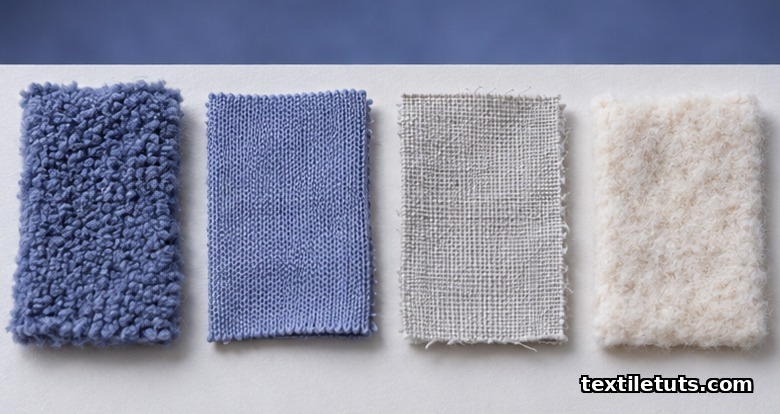
- Polyester fleece: hundreds of thousands of microfibers per garment per wash, with controlled tests reporting roughly 728,000 fibers released from a single fleece jacket in one 40 °C cycle (Napper and Thompson, 2016).
- Acrylic knitwear: shedding rates comparable to polyester on a per-weight basis, sometimes higher per garment.
- Polyester-cotton blend: shedding scales with the polyester fraction. A 65/35 blend sheds more than 100% cotton but substantially less than 100% polyester.
- Wool and 100% cotton: lower fiber counts, but the fibers they release are natural cellulosic or protein-based and biodegrade faster in seawater.
Carney Almroth and colleagues (2018) confirmed the fiber-type hierarchy by laundering 16 textile types under standardized conditions. Polyester fleece produced the highest counts, followed by polyester woven fabrics, then acrylic, then cotton and wool at the bottom. Napper and Thompson’s 2016 study in Marine Pollution Bulletin is the most-cited benchmark for per-garment shedding and the source of the 728,000-fiber figure used widely in subsequent reviews and policy briefs.
Wash Variables That Change Shedding
Three variables drive most of the difference between a high-shed and a low-shed wash: water temperature, detergent chemistry, and the mechanical action of the drum. ISO 4484-1:2023 and ISO 4484-2:2023 standardize how laboratories vary and measure these conditions so that results from different labs can be compared directly.
Temperature. Higher temperatures increase shedding. Heat plasticizes the polyester filament and reduces the friction holding individual fibers in the yarn. Washing the same fleece garment at 60 °C releases substantially more microfibers than washing at 30 °C, with controlled tests showing differences of several-fold between the two temperatures for the same fabric.
Detergent. Standard household detergents increase shedding compared with plain water, because surfactants wet the fiber surface and pull loose filaments away from the fabric. AATCC TM212-2021 specifies a reference detergent so that laboratories can compare results across studies, and published work consistently shows that switching to milder detergent chemistry reduces shedding on polyester knit fabrics by a measurable margin.
Agitation and drum speed. Front-loading horizontal-axis washers typically produce less shedding than top-loading agitator machines, because the drum rotates without a central agitator and the mechanical action is gentler. Reducing the spin speed, choosing shorter cycles, and washing at full load all reduce per-garment shedding because each garment is exposed to less mechanical work per gram of fabric.
Filtration Solutions: What Actually Catches Microfibers
Three broad categories of filtration are available today: filters built into the washing machine, external filters plumbed into the drain line, and after-market inserts that trap fibers before they leave the machine. They differ in capture efficiency, retrofit cost, and maintenance burden.
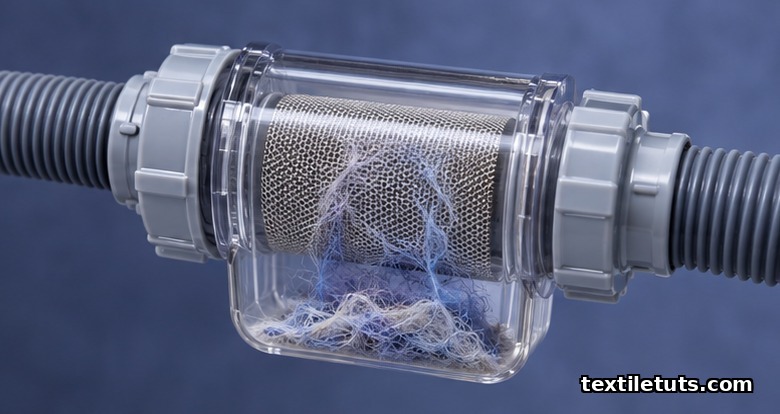
| Filter type | Capture efficiency | Installation | Maintenance |
|---|---|---|---|
| Built-in lint filter (most drum washers) | Low for sub-100 µm fibers; catches visible lint balls | Factory installed | Empty after each load |
| External in-line fine filter (mesh 100 µm or finer) | High (90% or more of fibers down to 50 µm) | Plumbed into drain hose | Clean every 2 to 4 weeks |
| Lint-trap insert or laundry ball with mesh | Moderate (60 to 80% in published tests) | Drop-in, no plumbing | Clean after each load |
| Settling tank or filter bag systems | Very high for larger fibers; lower for sub-50 µm | Drain-hose clamp-on or under-sink | Replace or clean per cycle |
External fine-mesh filters with pore sizes of 100 µm or less deliver the highest verified capture rates. Studies using laser-diffraction particle analysis have measured 90 to 95% reductions in microfiber counts downstream of fine-mesh filters installed on household washers, with the remaining fraction dominated by sub-50 µm filaments that pass even through tight mesh. The trade-off is that fine filters clog quickly, so they need manual cleaning every few weeks depending on wash load and fabric mix.
Built-in lint filters on most drum washers are designed to catch visible lint balls, not sub-100 µm fragments. They reduce visible shedding on dark clothes but miss most of what an ISO 4484-2 test counts as a microfiber. For researchers, ISO 4484-2 is the standard method for quantifying how much material passes through a given filter, and any product claiming a percentage reduction in microfiber shedding should publish its test method under one of the recognized standards rather than a proprietary laboratory protocol.
How Microfiber Shedding Is Tested in the Lab
Two standards now define how microfiber shedding is measured, and they answer slightly different questions. ISO 4484-1:2023 specifies how to detect whether the microfibers released from a textile are synthetic polymers, using techniques such as Fourier-transform infrared spectroscopy (FTIR) or Raman spectroscopy. ISO 4484-2:2023 specifies how to count and quantify the released particles, including the analytical methods for weighing and sizing them. AATCC TM212-2021, developed in the United States, is a parallel test method that simulates repeated home laundering under controlled water temperature, detergent, and agitation conditions and reports fiber counts per unit of fabric or per liter of wash liquor.
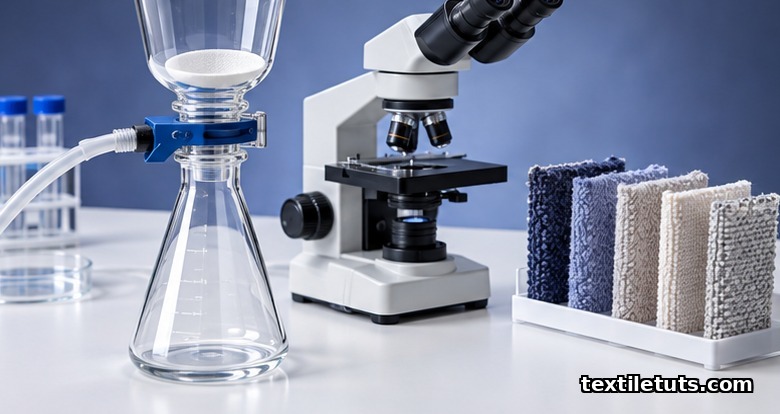
Typical test workflow. AATCC TM212-2021 runs a small fabric swatch through multiple simulated wash cycles, commonly five to ten, then filters the wash effluent through a membrane filter, typically with a 5 µm pore size. Fibers retained on the filter are counted under a microscope or measured with FTIR to confirm they are synthetic polymer rather than cotton or wool. Results are reported as fibers per liter of wash liquor or fibers per gram of fabric washed. The two ISO 4484 parts allow laboratories to vary these parameters for specific research questions while keeping the methods comparable across studies.
Why two standards matter. ISO 4484 is the European and ISO member-state standard, and AATCC TM212 is the U.S. industry standard. Both are now used in regulatory submissions and in academic papers, and any product claiming a percentage reduction in microfiber shedding should be tested under one of these methods, not a proprietary laboratory test that cannot be reproduced by other researchers.
Frequently Asked Questions
Do microfiber filters actually work on a normal household washing machine?
Yes. External fine-mesh filters installed on the drain hose typically capture 90 to 95% of microfibers released during a wash, based on peer-reviewed laboratory tests using ISO 4484-2 and AATCC TM212 methods. The main trade-off is that the filter needs to be cleaned every two to four weeks, and very fine meshes (under 50 µm) clog faster and need cleaning more often.
Which fabric sheds the most microfibers?
Polyester fleece is consistently the highest-shedding fabric in peer-reviewed studies, with acrylic knits close behind. A single polyester fleece garment can release hundreds of thousands of microfibers in one wash. Natural fibers like cotton and wool shed much less material, and what they do release breaks down faster in the marine environment.
Does washing at lower temperatures really reduce microfiber release?
Yes. Washing the same polyester garment at 30 °C instead of 60 °C reduces microfiber release by a substantial margin, often 50% or more in controlled tests. Lower temperatures keep the polyester filament stiffer, so fewer filaments break off under agitation. Lower temperatures also reduce the energy footprint of each wash, which is an independent sustainability gain.
Are washing-machine microfiber filters required by law anywhere?
As of 2026, no country has made microfiber filters mandatory on household washing machines at the consumer level. France passed a 2020 law that requires new washing machines to include a microfiber filter under specific implementation rules, and the European Union is considering similar requirements under its revised textile strategy. Outside these jurisdictions, filters remain voluntary.
What is the difference between a lint filter and a microfiber filter?
A lint filter on a standard washing machine is designed to trap visible lint balls and short fibers that would otherwise redeposit on darker clothes. A microfiber filter uses a finer mesh, typically with pores under 100 µm, to trap the much smaller synthetic filaments that pass straight through a conventional lint filter. Most built-in lint filters miss the majority of microfibers measured by ISO 4484-2.
References
- ISO. ISO 4484-1:2023, Textiles — Microplastics from textile sources — Part 1: Determination of material fibre release. iso.org — defines how laboratories detect whether released microfibers are synthetic polymers.
- ISO. ISO 4484-2:2023, Textiles — Microplastics from textile sources — Part 2: Quantitative evaluation of released materials. iso.org — defines how laboratories count and weigh released microfibers from a textile sample.
- AATCC. TM212-2021, Test Method for Fiber Fragment Release from Textiles During Home Laundering. aatcc.org — U.S. industry standard for measuring microfiber release from fabrics during simulated home washes.
- Napper, I. E., and Thompson, R. C. (2016). Release of synthetic microplastic plastic fibres from domestic washing machines: Effects of fabric type and washing conditions. Marine Pollution Bulletin — the foundational study quantifying per-garment microfiber release from polyester, acrylic, and polyester-cotton blends.
- Carney Almroth, B. M., et al. (2018). Quantifying shedding of synthetic fibers from textiles; a source of microplastics released into the environment. Environmental Pollution (ScienceDirect) — comparison of shedding rates across 16 textile types under standardized wash conditions.
- OECD (2022). Microplastics from textiles: Towards a circular economy for plastics. oecd.org — policy and data report estimating global microfiber flows from textile washing into the ocean.
This article is the working reference for microfiber filtration in domestic washing machines. Editorial by Shahrukh Islam, TextileTuts. Sources: ISO 4484-1:2023, ISO 4484-2:2023, AATCC TM212-2021, Napper and Thompson (2016), Carney Almroth et al. (2018), OECD (2022) as cited.


