
Shrinkage Verification

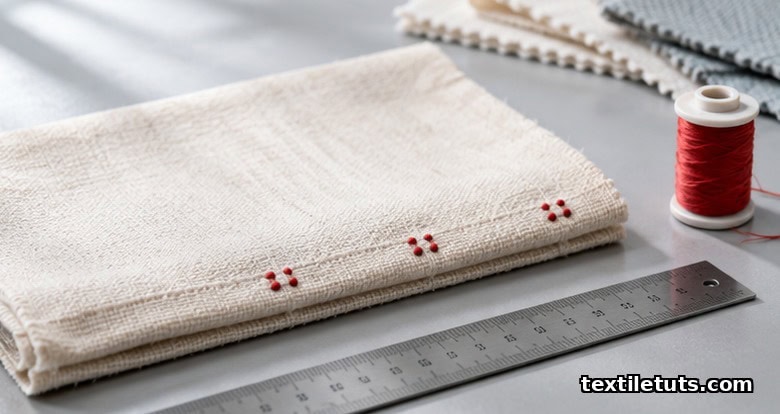
Shrinkage verification is the standardized measurement of dimensional change in fabrics and garments after exposure to specified washing, drying, or finishing procedures, governed primarily by ISO 5077, ISO 6330, AATCC Test Method 135, and AATCC TM 150, with typical industry acceptance limits set at 3% for woven cotton, 5% for knit fabrics, and 1% for wool.
Textile laboratories report the result as percentage change in length and width after specimens are conditioned at 20°C and 65% relative humidity per ISO 139, traced against bench marks sewn or printed on the fabric before any wet processing. A fabric that measures 100 cm in length before washing and 95 cm after is recorded as 5% warp-wise shrinkage, a single number that decides whether a mill shipment is accepted, sent for rework, or rejected at the buyer’s QC gate.
This guide explains the science behind fabric shrinkage, walks through the four standards every QC technician should know, breaks down the procedure from bench-mark placement to final calculation, and shows how mills and brands control dimensional change before the fabric ever reaches the cutting table.
Why Fabrics Shrink: The Three Driving Mechanisms
Shrinkage in a finished textile is not a single phenomenon. It is the combined effect of three distinct physical mechanisms that activate in sequence whenever a fabric meets agitation, heat, or moisture.
1. Relaxation shrinkage. Every fabric leaves the loom or knitting machine under tension. When that tension is released in finishing or in the first consumer wash, the yarns retract to their natural, stress-free state. For cotton woven fabrics, relaxation shrinkage accounts for roughly 1% to 2% of total dimensional change, concentrated in the warp direction where loom tension is highest. This is the easiest form to control, because it can be removed during finishing by pre-wetting the fabric on a tenter frame under tension-controlled drying.
2. Swelling shrinkage. Cotton, viscose, linen, and other hydrophilic fibers absorb water and swell laterally. As fiber diameter increases, yarn length decreases, producing dimensional change of 1% to 3% in tightly woven fabrics and up to 5% in loose knits. Swelling shrinkage is reversible; the fabric returns to its original dimensions when fully dried under low tension.
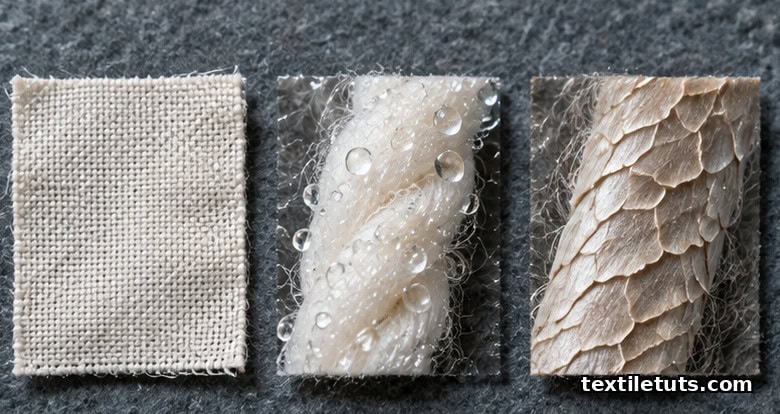
3. Felting shrinkage (wool only). Wool fibers carry microscopic scales on their surface. In combination with heat, moisture, and agitation, these scales interlock and migrate in one direction, an irreversible process that compresses the yarn by 40% to 60% in severe cases. This is why wool garments carry the strictest care label warnings and why mills treat wool with machine-washable finishes such as the Hercosett or chlorine-Hercosett processes documented in peer-reviewed wool-finishing research.
For most cotton and cotton-blend apparel, total shrinkage combines relaxation and swelling effects, falling in the 3% to 8% range if the fabric is not pre-shrunk. Knitted fabrics shrink more than wovens because the loop structure has greater elasticity and the yarn sits in a curved configuration that straightens on first wash.
The Four Standards Every QC Lab Uses
Shrinkage testing is one of the most standardized procedures in textile quality control. While the underlying physics is identical, the four most cited methods differ in washing machine, water temperature, drying procedure, and how the result is interpreted.
| Standard | Washing Apparatus | Temperatures Covered | Typical Use |
|---|---|---|---|
| ISO 6330:2021 | Horizontal-axis drum (Type A) or agitator (Type B) | 30°C, 40°C, 60°C, 92°C | Domestic washing reference cycles, paired with ISO 5077 |
| ISO 5077:2007 | Any per partner standard | Not applicable (procedure only) | Dimensional change measurement after ISO 6330 cycles |
| AATCC TM 135-2018 | Standard home laundering machine | (I) 27°C, (II) 41°C, (III) 49°C, (IV) 60°C | North American home-laundry shrinkage |
| AATCC TM 150-2018 | None (drying only) | Tumble, line, drip, flat, screen | Dimensional change after specified drying, often paired with TM 135 |
| ASTM D1905:13 | Reference to ISO or AATCC partner method | Per partner | Single-document reference for U.S. buyers consolidating shrinkage reporting |
The ISO 6330 standard defines 11 reference washing procedures, from a mild hand-wash simulation (procedure 1, 30°C) up to a vigorous boil wash (procedure 10, 92°C). AATCC TM 135 offers four normal-temperature cycles labelled (I) through (IV) that map to typical U.S. consumer habits from cold to hot wash. Labs usually report the cycle that matches the care label printed on the garment.
Procedure: From Bench Marks to Final Percentage
Whether the lab runs ISO 5077, AATCC TM 135, or an ASTM-anchored protocol, the procedure follows the same five-step logic. The variability between standards is in the washing machine, the temperature, and the drying method, not in how the result is calculated.
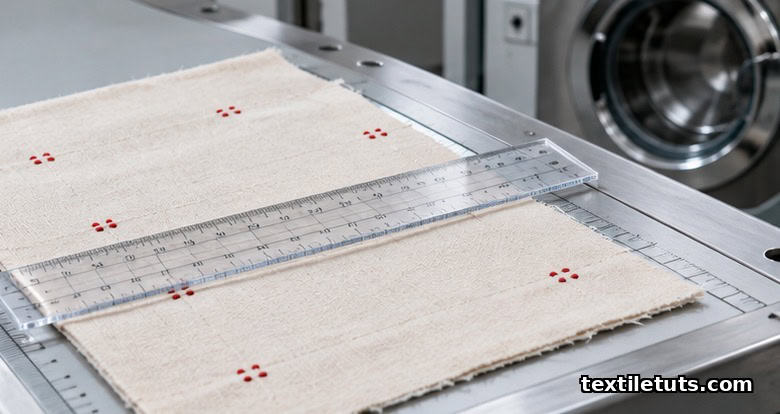
Step 1, Conditioning. Cut the test specimens (typically 30 cm × 30 cm or 50 cm × 50 cm) and condition them in a standard atmosphere of 20°C and 65% RH until equilibrium, usually 24 hours, as specified in ISO 139.
Step 2, Bench-mark placement. Mark three pairs of reference points, typically 25 cm apart in both warp and weft directions, using a waterproof textile marker, a heat-resistant stamp, or stitched threads. ISO 3759 specifies the distance between bench marks for different fabric constructions; AATCC TM 135 calls for marks at least 12 inches (305 mm) from any edge to avoid seam or selvage effects.
Step 3, Wash and dry cycle. Run the appropriate washing program per the chosen standard, then dry per the partner drying method (tumble, line, flat, or drip dry). For most QC submissions the cycle is run three times, since the third wash is where shrinkage stabilises for most fabrics.
Step 4, Re-condition. After drying, condition specimens back to 20°C and 65% RH for 4 to 24 hours before taking final measurements, so the result is not contaminated by transient moisture regain.
Step 5, Calculate. Measure the distance between each pair of bench marks to the nearest 1 mm. Apply the formula:
Dimensional change (%) = (Final length − Original length) / Original length × 100
A negative result indicates shrinkage; a positive result indicates growth. The reported value is usually the average of three readings per direction. For example, if a 25 cm warp-wise bench mark reads 24.0 cm after three wash cycles, the warp shrinkage is (24.0 − 25.0) / 25.0 × 100 = 4.0%.
Industry Acceptance Limits and Tolerance
Acceptable shrinkage is not a single number. It depends on fiber content, fabric construction, garment type, and the brand’s internal specification. The following ranges are typical for finished garments entering a QC gate at the garment factory level:
- Woven cotton shirting and trousers: warp ≤ 3%, weft ≤ 3%.
- Knit cotton T-shirts and polos: length ≤ 5%, width ≤ 5%.
- Denim (rigid, unsanforized): warp ≤ 8%, weft ≤ 5%, expected at first wash.
- Wool suiting: warp ≤ 1%, weft ≤ 1% (felting shrinkage is treated as a defect).
- Polyester and polyester-cotton blends: length ≤ 2%, width ≤ 2% (heat-set synthetic fibers shrink less).
Many retailers run a “3-3-3 rule” for woven cotton and a “5-5 rule” for knit cotton, meaning no more than 3% or 5% shrinkage in either direction after three home-laundering cycles per AATCC TM 135 or ISO 6330 procedure 4N. High-end shirting houses often tighten this to 2-2-2, accepting only 2% dimensional change after five wash cycles.
How Mills Control Shrinkage Before the Garment Is Cut
Verification is the QC step, but control happens earlier. The two most common industrial methods are pre-shrinking on a compressive shrinking machine (for cotton) and heat-setting on a tenter frame (for synthetic blends).
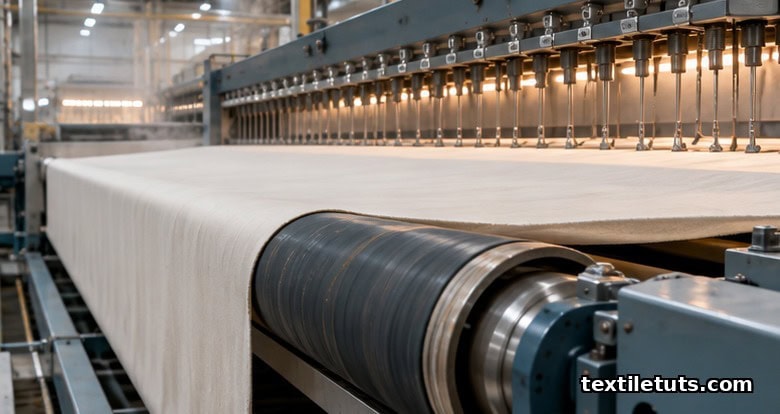
Compressive shrinking (sanforizing). A sanforizing machine mechanically compresses the fabric by forcing it against a heated, rubber-banded cylinder, packing the warp yarns closer together. Modern sanforizing lines hold residual shrinkage to ≤ 1% for woven cotton, verified by running the fabric through three AATCC TM 135 cycles before shipping. The denim industry uses a similar process on rope-form ranges to pre-shrink rigid denim to 8% to 10% expected shrinkage rather than the unshrunk 15% to 20% that comes off a non-sanforized loom.
Heat-setting. Polyester and polyester-blend fabrics are heat-set on a stenter at 180°C to 200°C for 30 to 60 seconds. The heat relaxes internal fiber stress and locks the yarn geometry in place, reducing thermal shrinkage to below 1% at normal laundering temperatures. Heat-setting verification is done by ironing the fabric at 150°C for 15 seconds and measuring the change, a simple check that complements the wet-wash test.
Compaction for knits. Knit fabrics are compacted on a separate machine that uses rubber belts and a heated cylinder to compress the loop length, reducing knit shrinkage from 7% to 12% as-knit down to 3% to 5% finished. This is verified by AATCC TM 135 or ISO 6330 procedure 4N before the fabric is approved for cutting.
Frequently Asked Questions
What is the difference between relaxation shrinkage and felting shrinkage?
Relaxation shrinkage is the reversible release of internal yarn tension built up during weaving or knitting, typically 1% to 2% in woven cotton and removed by pre-shrinking. Felting shrinkage is the irreversible, scale-driven compression of wool fibers under heat, moisture, and agitation, capable of reaching 40% to 60% in untreated wool. They are different physical processes and require different controls, which is why wool carries stricter care labels than cotton.
How many wash cycles are needed to verify shrinkage?
Most QC protocols call for three wash cycles before the final measurement, because cotton and cotton-blend fabrics typically reach a stable dimension by the third cycle. Some specifications, particularly for premium shirting and home textiles, require five cycles to confirm the fabric has stabilized. Running only one cycle risks accepting fabric that still has 1% to 2% residual relaxation shrinkage.
Why do knit fabrics shrink more than wovens?
Knitted fabrics shrink more because the loop structure stores more elastic energy than a woven structure. A knit yarn sits in a curved configuration in the fabric, and on first wash the loops straighten and pack closer together, lengthening the loop but reducing the fabric dimension. A plain-weave cotton shirting typically shrinks 3% to 5%, while a single-jersey cotton knit may shrink 5% to 8% before finishing, and a loose gauge knit can exceed 10%.
Can you test dimensional stability without a lab washing machine?
A rough home-wash check is possible by marking a 25 cm × 25 cm square on the fabric, washing in a domestic machine at the temperature closest to the care label, drying per the care label, re-conditioning, and re-measuring. The result is a directional indicator, not a contract-grade report, because home machines vary in agitation level and water ratio. ISO 6330 and AATCC TM 135 require calibrated laboratory machines for any result used to make accept/reject decisions.
What tolerance do most global retailers accept for woven cotton?
The widely cited industry benchmark is ≤ 3% shrinkage in both warp and weft after three wash cycles per AATCC TM 135 (or ISO 6330 procedure 4N). Premium shirting buyers often tighten this to ≤ 2% in either direction after five cycles. Exceeding the agreed tolerance is a standard reason for buyer rejection at the QC gate.
References
- International Organization for Standardization. ISO 5077:2007, Textiles — Determination of dimensional change. iso.org — defines the calculation procedure for dimensional change after washing.
- International Organization for Standardization. ISO 6330:2021, Domestic washing and drying procedures for textile testing. iso.org — the reference washing cycles used worldwide.
- International Organization for Standardization. ISO 3759:2011, Preparation, marking and measuring of fabric specimens. iso.org — specifies bench-mark placement and conditioning.
- AATCC. Test Method 135-2018, Dimensional Changes of Fabrics after Home Laundering. aatcc.org — the North American home-laundering reference.
- AATCC. Test Method 150-2018, Dimensional Changes of Fabrics after Home Laundering (Drying only). aatcc.org — paired with TM 135 for drying-procedure reporting.
- ASTM International. ASTM D1905-13, Standard Practice for Dimensional Change of Textile Fabrics (Withdrawn 2018, still cited in legacy specs). astm.org — historical U.S. reference for shrinkage reporting.
- Cook, J. G. Handbook of Textile Fibres: Natural Fibres. Woodhead Publishing (peer-reviewed textile reference cited on wool felting and cotton swelling mechanisms).
This article is the working reference for shrinkage verification in textile quality control. Editorial by Sabbir Ahmed, TextileTuts. Sources: ISO 5077, ISO 6330, ISO 3759, AATCC TM 135, AATCC TM 150, ASTM D1905, and Woodhead Publishing as cited.


