
Colorfastness Verification

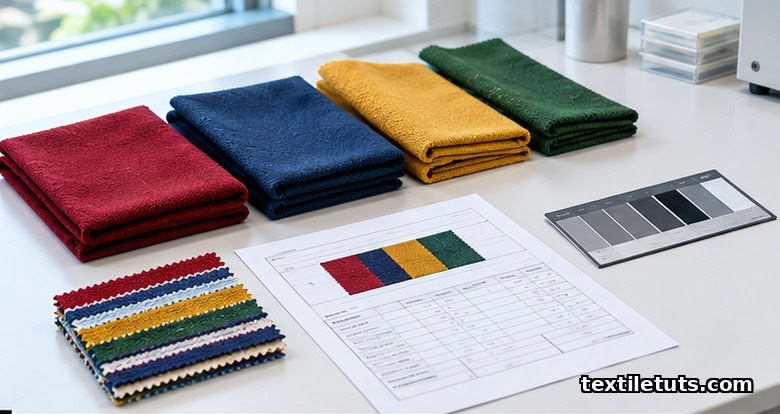
Colorfastness verification is the standardized laboratory assessment of a textile’s resistance to color change and staining under defined exposures (washing, light, rubbing, perspiration, water, sea water, chlorinated pool water, dry cleaning, and perspiration), graded on a 1–5 AATCC Gray Scale for shade change and stain transfer and on a 1–8 Blue Wool Scale for lightfastness under ISO 105-B02 and AATCC TM 16 protocols.
Every dye house, fabric mill, and apparel brand runs colorfastness tests because a single shipment that bleeds onto a white shirt in the wash can trigger a recall, a chargeback, or a destroyed buyer relationship. The tests behind those numbers look mundane on paper (a crockmeter rubbing a white cloth, a wash wheel spinning at 40 °C) but the rating system that turns the result into a pass/fail decision is one of the most precisely codified frameworks in textile science.
Below, you will find exactly how each test works, which ISO 105 part applies to which exposure, how the Gray Scale and Blue Wool Scale translate visual perception into numbers, and which AATCC or ASTM method your lab should run for a given end use.
What Colorfastness Verification Actually Measures
Colorfastness is not a single property. It is a family of properties, each tied to a specific exposure scenario a fabric is expected to survive. The four most commercially important are wash fastness (resistance to household laundering), lightfastness (resistance to UV in sunlight or xenon arc), rubbing or crocking fastness (resistance to dye transfer by friction), and perspiration fastness (resistance to dye migration in acidic or alkaline sweat). Less common but still required for specific end uses are water fastness, sea water fastness, chlorinated pool water fastness, dry cleaning fastness, and hot pressing fastness.
The output of every colorfastness test is a paired rating. The first number describes how much the original sample changed in shade; the second number describes how much dye transferred onto an adjacent multifiber strip or white crocking cloth. Together they answer the two questions any buying team asks: “Will the fabric look different after this exposure?” and “Will it stain anything that touches it?”?
The Two Rating Scales Every Lab Uses
Visual rating by a trained technician is the foundation of colorfastness reporting, because instrumental color measurement (CIELAB ΔE) does not reliably correlate with the way a customer perceives a stained garment. The two reference scales are codified in ISO 105-A02 (Gray Scale for change in color) and ISO 105-A03 (Gray Scale for staining).
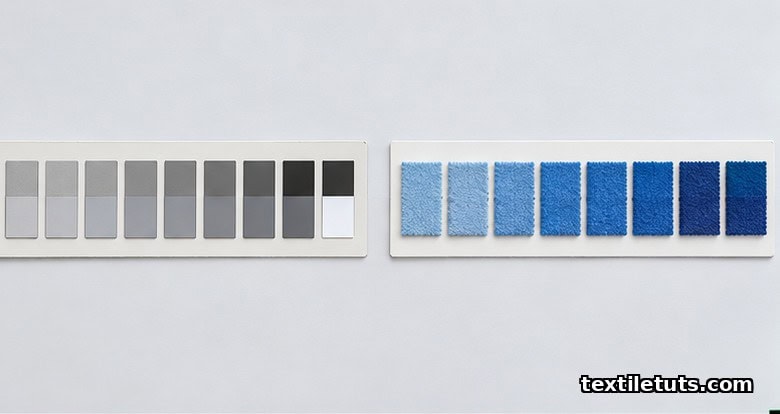
The Gray Scale is a set of nine pairs of matte gray chips, ranging from a perfect neutral gray pair (rating 5) to a high-contrast charcoal-on-white pair (rating 1). For shade change, the technician places the tested sample next to the original and matches it against the gray pairs; for staining, the technician places the stained adjacent fabric next to an unstained control. A rating of 5 means no perceptible difference; a rating of 1 means severe change or transfer.
The Blue Wool Scale, defined in ISO 105-B02, is a set of eight blue-dyed wool references with known lightfastness ratings from 1 (very low, fades within hours of summer sun) to 8 (extremely high, equivalent to a fade resistance of more than 3,800 hours of xenon arc exposure). A fabric rated 6 on the Blue Wool Scale is considered suitable for outdoor textile applications; a fabric rated 3 or below is appropriate only for short-life, indoor, or disposable garments.
ISO 105 Series: The Global Testing Suite
ISO 105 is the international colorfastness standard, organized into roughly 100 published parts each covering one specific exposure or property. The most cited parts in production laboratories:
- ISO 105-B02 — Light fastness (xenon arc). Sample is exposed alongside the Blue Wool references; rating is taken from the wool chip that fades at the same rate as the test fabric.
- ISO 105-C06 — Wash fastness at 40 °C or 60 °C using a standardized detergent (SDC ECE Type B without optical brightener), steel balls, and a 30-minute cycle. The “C06” condition is the workhorse test for cotton and cotton-blend apparel.
- ISO 105-X12 — Rubbing fastness (crocking). A dry and a wet white cotton crocking square are rubbed across the fabric under a 9 N load for 10 strokes in 10 seconds.
- ISO 105-E04 — Perspiration fastness. Samples are sandwiched against a multifiber adjacent fabric (containing acetate, cotton, nylon, polyester, acrylic, wool), wetted in an acidic and an alkaline artificial perspiration solution, and held under pressure at 37 °C for 4 hours.
- ISO 105-E01 — Water fastness (similar procedure, distilled water).
- ISO 105-E02 — Sea water fastness.
- ISO 105-N01 — Bleach fastness (sodium hypochlorite).
- ISO 105-D01 — Dry cleaning fastness using perchloroethylene.
Each ISO 105 part specifies exact machine parameters, water hardness, multifiber composition, specimen size, and conditioning time. A lab that runs “ISO 105 C06” without specifying the temperature (40 °C, 60 °C, or 95 °C), detergent dose (4 g/L standard), and number of steel balls is reporting a partial result that buyers cannot compare.
AATCC Test Methods for North American Production
The American Association of Textile Chemists and Colorists (AATCC) maintains the parallel set of standards used by most US brands and many Bangladesh exporters serving US and Canadian buyers. The mapping between ISO 105 and AATCC is not 1:1; some AATCC methods include conditions the ISO suite lacks, and vice versa.
- AATCC TM 8 — Colorfastness to crocking (rubbing). Directly comparable to ISO 105-X12, with a 9 N load and 10-stroke crockmeter.
- AATCC TM 16 — Colorfastness to light. Three options: xenon arc (option 1), carbon arc (option 2, largely obsolete), and behind-glass daylight (option 3). Blue Wool L1–L8 reference scale.
- AATCC TM 61 — Colorfastness to laundering. Six test conditions (1A through 6A) ranging from 30 °C hand wash to 95 °C severe machine wash; structurally similar to ISO 105-C06 but with different detergent (AATCC 1993 Standard Reference Detergent without brightener) and agitation parameters.
- AATCC TM 15 — Colorfastness to bleeding (non-wash).
- AATCC TM 23 — Colorfastness to burnt-gas fumes (atmospheric nitrogen oxides, mainly used for disperse dyes on polyester).
- AATCC TM 107 — Colorfastness to water (comparable to ISO 105-E01).
- AATCC TM 132 — Colorfastness to drycleaning (comparable to ISO 105-D01).
- AATCC TM 135 — Dimensional change after home laundering, often run in the same test cycle as TM 61.
ASTM also publishes a smaller colorfastness suite under ASTM D204 (older, less commonly specified) and per-test methods embedded in specific product standards (e.g., ASTM D4151 for blanketing flammability, which references ISO 105-B02 for lightfastness of cover fabrics).
Also Read:
How a Crockmeter Test Actually Works
The crockmeter (also called a crocking tester, AATCC Crockmeter Model CM-5 or SDL Atlas M238BB being the common bench models) is the most familiar instrument on a colorfastness bench because it runs in under a minute. The procedure is defined in ISO 105-X12 and AATCC TM 8 and works like this:
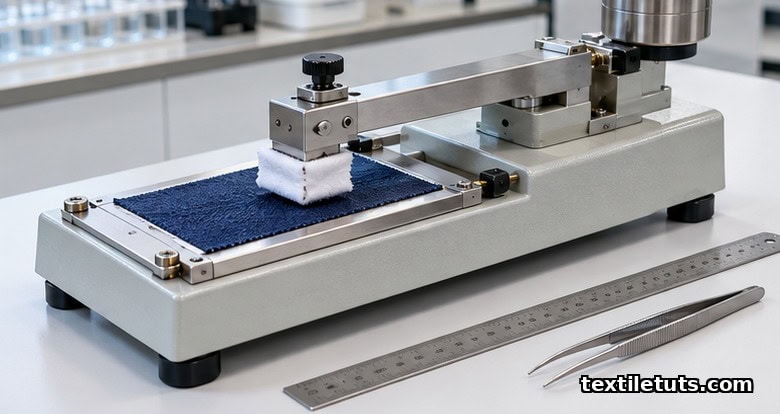
- A 5 cm × 5 cm conditioned fabric specimen is mounted flat on the tester platform.
- A 5 cm × 5 cm white cotton crocking square (SDC crocking cloth) is mounted on the 16 mm diameter rubbing finger.
- The finger is lowered onto the specimen under a 9 N load (about 920 g of mass plus weight carrier).
- The finger travels 100 mm in a straight line, forward and back, completing 10 cycles in 10 seconds.
- The crocking square is removed and rated for staining on the Gray Scale within 30 minutes, under controlled lighting (D65 or TL84).
Most buyer specifications demand a dry crocking rating of 4 or higher and a wet crocking rating of 3 or higher for apparel that contacts skin. Wet crocking is almost always 1 to 1.5 points lower than dry crocking because water mobilizes surface dye, so fabrics that pass dry crocking can still fail wet crocking if the dye is not fully fixed.
Wash, Light, and Perspiration Test Conditions
Wash fastness (ISO 105-C06) runs a 5 cm × 10 cm specimen sewn between two pieces of multifiber adjacent fabric (the standard SDC multifiber TV contains strips of acetate, cotton, nylon, polyester, acrylic, and wool in a single ribbon). The composite specimen is agitated at 40 °C for 30 minutes in a wash wheel containing ECE Type B detergent at 4 g/L, plus 10 steel balls per pot for mechanical action. After rinsing and drying, both the original shade change and the staining on each fiber strip of the adjacent fabric are rated.
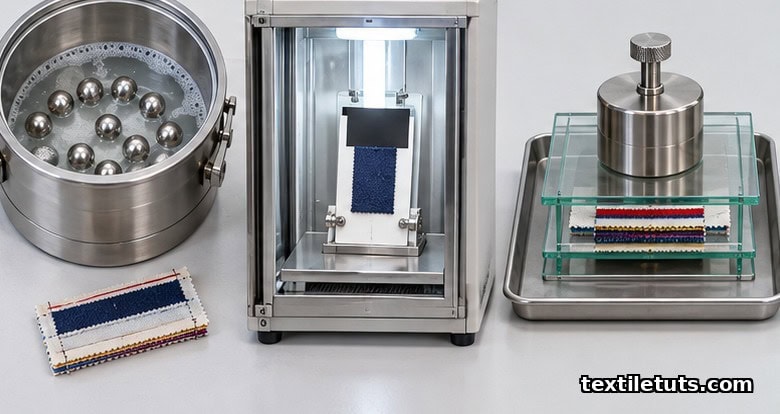
Lightfastness (ISO 105-B02) exposes one-third of the test specimen, with the other two-thirds masked. After a set interval (commonly 20 hours of xenon arc), the mask is advanced and the specimen is inspected. The cycle continues until a perceptible fade is visible, then the exposed strips are compared to the Blue Wool references exposed in parallel. A fabric rated 6 will tolerate more than 900 hours of accelerated xenon exposure before reaching Gray Scale 3 fade; a fabric rated 4 will reach Gray Scale 3 in roughly 200 hours.
Perspiration fastness (ISO 105-E04) uses an acidic solution (pH 5.5) containing sodium chloride, disodium hydrogen phosphate, and histidine, plus an alkaline version (pH 8.0) with the same salts. Sandwiches of fabric and multifiber are immersed, pressed between glass plates under a 12.5 kPa load, and held at 37 °C for 4 hours in an oven, then dried and rated. The two solutions simulate human perspiration; the alkaline version is usually more aggressive on reactive dyes, the acidic version is usually more aggressive on disperse dyes.
Choosing the Right Test for Your Fabric
The selection of colorfastness tests should follow the end use of the fabric, not the available lab equipment. A buyer specification for children’s cotton sleepwear typically requires ISO 105-C06 at 60 °C, ISO 105-X12 dry and wet, ISO 105-B02 light, and ISO 105-E04 both solutions; a specification for polyester workwear adds ISO 105-N01 (bleach) and often ISO 105-E02 (sea water); a specification for upholstery adds ISO 105-B02 at a higher lightfastness threshold (usually 5 or higher) plus a crocking test.
If a buyer specification does not name a specific ISO part or AATCC test method, the lab’s default should be the ISO 105 series, which is the framework most international retailers reference. Many Bangladesh mills run both ISO 105 and AATCC in the same lot, because the same lot may ship to a European buyer (ISO 105) and a US buyer (AATCC) in different purchase orders.
ISO 105, AATCC, and ASTM Colorfastness Methods Compared
| Property | ISO 105 part | AATCC test method | ASTM equivalent |
|---|---|---|---|
| Wash fastness | ISO 105-C06 (40 °C / 60 °C / 95 °C) | AATCC TM 61 (conditions 1A–6A) | No direct equivalent; ASTM AATCC M06 partner test |
| Light fastness (xenon) | ISO 105-B02 | AATCC TM 16 option 1 / 3 | ASTM G155 + ISO 105-B02 reference |
| Rubbing / crocking | ISO 105-X12 | AATCC TM 8 | ASTM F1319 (limited) |
| Perspiration | ISO 105-E04 | AATCC TM 15 (bleeding), TM 168 (perspiration) | None direct |
| Water | ISO 105-E01 | AATCC TM 107 | None direct |
| Sea water | ISO 105-E02 | None direct (use ISO method) | None direct |
| Dry cleaning | ISO 105-D01 | AATCC TM 132 | None direct |
| Chlorinated water | ISO 105-N01 (bleach) | AATCC TM 188 (pool water) | None direct |
| Gray Scale rating | ISO 105-A02 (change), A03 (staining) | AATCC Evaluation Procedure 1 (Gray Scale) | ASTM D2616 (Gray Scale) |
Frequently Asked Questions
What is a passing colorfastness rating?
A rating of 4 or 5 on the Gray Scale is typically required for shade change in commercial apparel; a rating of 3 to 4 is acceptable for staining onto adjacent multifiber fabric. Lightfastness requirements vary by end use: 4 is the minimum for general apparel, 5 for home furnishings, and 6 or higher for outdoor and automotive textiles. Most buyer specifications list the minimum rating per test in the technical sheet that accompanies the purchase order.
How long does a full colorfastness test suite take?
A single crockmeter test takes about 5 minutes of hands-on time plus 30 minutes for rating. A wash fastness test (ISO 105-C06) takes about 90 minutes including conditioning and drying. A lightfastness test takes the longest, anywhere from 20 hours to more than 200 hours depending on the target rating, because the fabric must be exposed long enough to show perceptible fade. A complete colorfastness suite for a single dye lot typically runs 3 to 5 working days end to end.
Can one sample be tested for colorfastness more than once?
No. Each colorfastness test consumes the specimen. Wash fastness, light fastness, perspiration, and crocking all require fresh fabric because the exposure is destructive. Labs cut multiple specimens from each lot submission to allow retests when a result is borderline or the buyer requests a confirmation.
Why does wet crocking always rate lower than dry crocking?
Water swells the surface dye layer and acts as a transport medium, so a wet white cotton crocking square picks up more dye than a dry one. Reactive dyes on cotton, acid dyes on nylon, and disperse dyes on polyester all show this effect, usually a 1 to 1.5 point drop on the Gray Scale for staining. A buyer specification that allows a wet crocking rating of 3 is acknowledging that almost no dye class reaches 4 or 5 when wet without a thorough after-soaping wash.
What is the most common reason a fabric fails colorfastness?
Incomplete dye fixation is the single most common cause. Reactive dyes on cotton, for example, form a covalent bond with the cellulose only under alkaline conditions at temperatures above 60 °C, and any unfixed dye remains on the fiber surface, available to wash off or rub off in the first consumer cycle. The standard mill remedy is a hot soap-off rinse at 95 °C after dyeing; the standard lab test that catches this is wash fastness (ISO 105-C06) or wet crocking (ISO 105-X12 wet).
References
- International Organization for Standardization. ISO 105-B02:2014, Textiles — Tests for colour fastness — Part B02: Colour fastness to artificial light (xenon arc fading lamp test). iso.org — defines the Blue Wool Scale 1–8 reference system.
- International Organization for Standardization. ISO 105-C06:2010, Textiles — Tests for colour fastness — Part C06: Colour fastness to domestic and commercial laundering. iso.org — the workhorse 40 °C / 60 °C wash test with ECE Type B detergent and steel balls.
- International Organization for Standardization. ISO 105-X12:2016, Textiles — Tests for colour fastness — Part X12: Colour fastness to rubbing. iso.org — 9 N crockmeter test, dry and wet, against white cotton crocking cloth.
- International Organization for Standardization. ISO 105-E04:2013, Textiles — Tests for colour fastness — Part E04: Colour fastness to perspiration. iso.org — acidic and alkaline artificial perspiration at 37 °C for 4 hours.
- International Organization for Standardization. ISO 105-A02:1993 and ISO 105-A03:1993, Textiles — Tests for colour fastness — Part A02/A03: Gray Scale for evaluating change in colour / staining. iso.org — the 1–5 visual rating scales.
- AATCC. TM 8-2016, Colorfastness to Crocking: AATCC Crockmeter Method. aatcc.org — North American parallel to ISO 105-X12.
- AATCC. TM 16.3-2020, Colorfastness to Light: Xenon-Arc. aatcc.org — option 3 daylight, behind glass, the most commonly specified lightfastness option in US apparel.
- AATCC. TM 61-2013, Colorfastness to Laundering: Accelerated. aatcc.org — six test conditions covering hand wash through severe machine wash.
- ResearchGate / Springer Open. Color Fastness of Textile Dyes: A Review of Test Methods and Rating Systems (peer-reviewed overview). researchgate.net — academic summary of ISO 105 and AATCC mapping for production labs.
This article is the working reference for colorfastness verification protocols used in textile quality control laboratories. Editorial by Iftay Khairul Alam, TextileTuts. Sources: ISO 105 series (B02, C06, X12, E04, A02, A03), AATCC TM 8 / TM 16 / TM 61, and the Springer Open color-fastness review as cited.


