
Hand Feel Evaluation

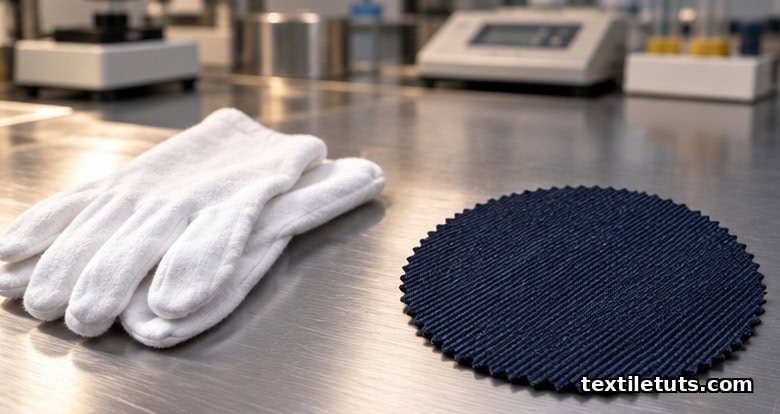
Hand feel evaluation is the measurement of a fabric’s tactile and mechanical response, typically expressed as a Primary Hand Value (PHV) on a 0 to 10 scale by the Kawabata Evaluation System (KES), which quantifies 16 fabric properties across tensile, shearing, bending, compression, and surface friction blocks. Trained panel assessment under AATCC TM 202 conditions remains the dominant production-line method, with inter-rater agreement of 70 to 80 percent among assessors who have completed at least 60 hours of calibration on a reference fabric set.
This guide covers the science, instruments, and standard methods behind hand feel, the difference between subjective panel testing and objective KES/FAST measurement, and how quality-control labs use both to resolve disputes between mills and buyers.
Hand feel sits at the intersection of fiber science, yarn structure, and finishing chemistry. A 2 percent change in fabric softener add-on can shift the KES surface friction coefficient (MIU) by 0.04, which is enough to move a suiting fabric from “smooth” to “slippery” on a 9 point scale. The next sections show how that shift is detected, recorded, and used to make accept or reject decisions on a shipment of 5,000 meters.
What Hand Feel Actually Measures
Hand feel is not a single property. It is a composite sensory impression built from at least 14 mechanical inputs that the human hand picks up through skin receptors in roughly 2 seconds of contact. The Kawabata Evaluation System, developed by Sueo Kawabata at Kyoto University and published by the Textile Machinery Society of Japan in 1980, decomposes that impression into four primary hand values:
- KOSHI (stiffness / springy resilience) is dominated by fabric bending rigidity and recovery.
- NUMERI (smoothness) reflects surface friction and surface roughness.
- FUKURAMI (fullness and softness) is governed by compressional linearity, compressional energy, and fabric thickness.
- SOPHIA (anti-drape stiffness) combines bending and shearing behavior for thicker fabrics such as woolens and overcoating.
These four Primary Hand Values combine via regression equations (the KN-201 equations) into a Total Hand Value (THV) ranging from 0 (poor) to 5 (excellent). For each fabric category, suiting, dress, knit, etc., a different set of weighting constants is used. THV above 3.5 is typically what a buyer means when they say the cloth has “good hand”.
The Four Standard Methods Used in Production
Textile labs use four principal families of methods, and each answers a slightly different question.
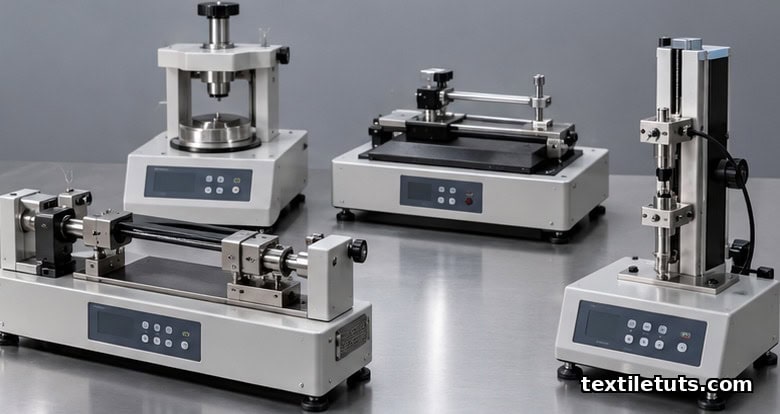
1. AATCC TM 202 (subjective, trained panel): A panel of at least 5 trained assessors ranks fabrics in paired comparison or rank order under controlled temperature (21 ± 1 °C) and relative humidity (65 ± 2 percent). The method replaced AATCC TM 5 in 2013 and is the most widely used line method because it requires no capital equipment, only trained hands.
2. Kawabata Evaluation System (objective, instrumented): Four instruments (KES-F1 tensile and shearing, KES-F2 bending, KES-F3 compression, KES-F4 surface friction and roughness) measure 16 parameters. One full KES test takes 20 to 30 minutes per sample and produces a printout of PHVs and THV. The system is the reference standard for objective hand measurement.
3. FAST (Fabric Assurance by Simple Testing, CSIRO): Three instruments (FAST-1 compression meter, FAST-2 bending meter, FAST-3 extension meter) plus a separate dimensional-stability test produce a hand signature plotted as a shaded fingerprint chart. A test cycle takes about 8 minutes per sample.
4. PhabrOmeter (ASTM D6828): A single instrument pulls a fabric disk through a ring nozzle and records force and displacement. From the curve, the system extracts a relative hand value, a softness index, and a stiffness index. One sample reads in under 60 seconds, which is why it is growing in acceptance testing.
How the 16 KES Parameters Map to Sensory Perception
The following table shows how each KES block contributes to the primary hand values and what a typical 100 percent worsted wool suiting at 240 g/m² reads.
| Block | Parameter | Symbol | Typical value (worsted wool 240 g/m²) | Sensory meaning |
|---|---|---|---|---|
| Tensile | Linearity | LT | 0.60 to 0.70 | Stretch softness |
| Tensile | Tensile energy | WT (gf·cm/cm²) | 8 to 12 | Formability |
| Tensile | Resilience | RT (%) | 55 to 65 | Spring-back |
| Tensile | EM at 500 gf/cm | EM (%) | 3 to 5 | Stretch under load |
| Shearing | Shear stiffness | G (gf/cm·deg) | 0.5 to 0.8 | Drape fluidity |
| Shearing | Hysteresis at 0.5° | 2HG (gf/cm) | 0.3 to 0.6 | Recovery from small shear |
| Shearing | Hysteresis at 5° | 2HG5 (gf/cm) | 1.0 to 1.8 | Recovery from large shear |
| Bending | Bending rigidity | B (gf·cm²/cm) | 0.08 to 0.12 | Stiffness to bend |
| Bending | Hysteresis | 2HB (gf·cm/cm) | 0.04 to 0.07 | Energy lost per bend cycle |
| Compression | Linearity | LC | 0.30 to 0.45 | Compress softness |
| Compression | Compressional energy | WC (gf·cm/cm²) | 0.20 to 0.35 | Loft / fullness |
| Compression | Resilience | RC (%) | 55 to 65 | Recovery from compression |
| Compression | Thickness | T (mm) at 0.5 gf/cm² | 0.55 to 0.75 | Loft |
| Surface | Coefficient of friction | MIU | 0.18 to 0.25 | Slickness |
| Surface | Roughness amplitude | SMD (μm) | 3.0 to 6.0 | Surface unevenness |
| Surface | Geometrical roughness | Roughness | 1.5 to 3.0 | Waviness |
Two fabrics can share the same bending rigidity but feel completely different because their MIU values diverge by 0.05. This is why single-property measurements (cantilever bending under ASTM D1388) are not enough to settle a hand dispute.
Subjective vs Objective: When to Use Which
The choice depends on the question being asked.
Use subjective panel testing (AATCC TM 202) when:
- The buyer specifies “hand acceptable to the brand” with no numeric target.
- Throughput is high (more than 50 lots per day) and capital cost must stay near zero.
- The dispute is about small differences that instruments cannot resolve reliably (within-lab repeatability below 5 percent CV).
Use KES or FAST when:
- Mill and buyer cannot agree after subjective testing, and a third-party number is needed.
- R&D is reformulating finish chemistry and needs to isolate which mechanical property changed.
- The fabric is a new category (technical textile, smart textile) for which no trained panel exists yet.
Use PhabrOmeter (ASTM D6828) when:
- The lab runs more than 200 acceptance tests per week and needs single-instrument speed.
- The goal is a relative ranking, not an absolute hand value.
- Sample size is small (the PhabrOmeter uses a 100 cm² disc).
The most rigorous labs run both: KES on the master lot to set a fingerprint, then PhabrOmeter or panel testing on every subsequent lot against that fingerprint. A deviation larger than 5 percent on any single KES parameter triggers a panel re-test.
Calibration, Conditioning, and Common Errors
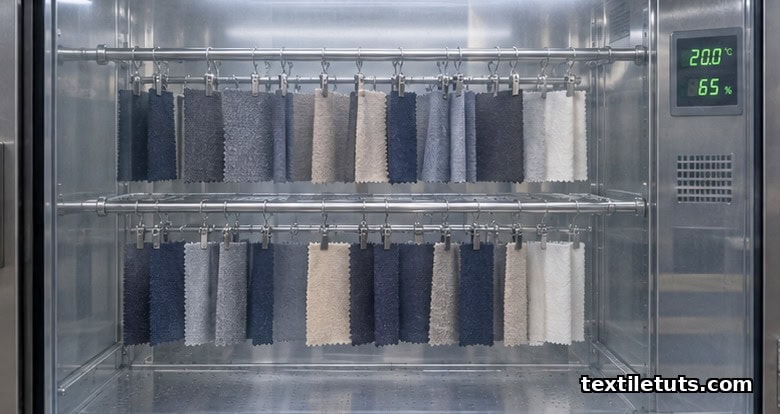
Hand feel is notoriously sensitive to moisture and temperature. Cotton at 20 percent regain feels stiffer than the same cotton at 8 percent regain because the cotton fiber’s microfibril angle relaxes and bending rigidity drops by 8 to 15 percent. ISO 139 requires 20 ± 2 °C and 65 ± 2 percent RH for all textile testing, and hand evaluation is the test most punished by a bad environment.
Common errors that produce misleading hand data:
- Skipping the 24-hour conditioning cycle. A sample pulled straight from a 40 °C finishing range and tested within an hour will read 10 to 20 percent stiffer than its true relaxed state.
- Cutting the wrong direction. Warp and weft bending rigidities can differ by a factor of 2 in a twill. Always report the value tested and the direction.
- Touching the test face with bare fingers. Skin oils raise the surface friction reading (MIU) by 0.02 to 0.05 within seconds.
- Using a panel without a reference fabric set. AATCC TM 202 recommends a minimum of 3 reference fabrics in the same category as the test fabric, anchored to a known KES fingerprint.
- Reporting only THV. Two fabrics with THV 4.0 can have very different profiles; one stiff and smooth, one soft and rough. Always attach the parameter-level printout.
Hand Feel as a Quality-Control Trigger
In a typical mill-to-buyer workflow, hand feel enters at three checkpoints:
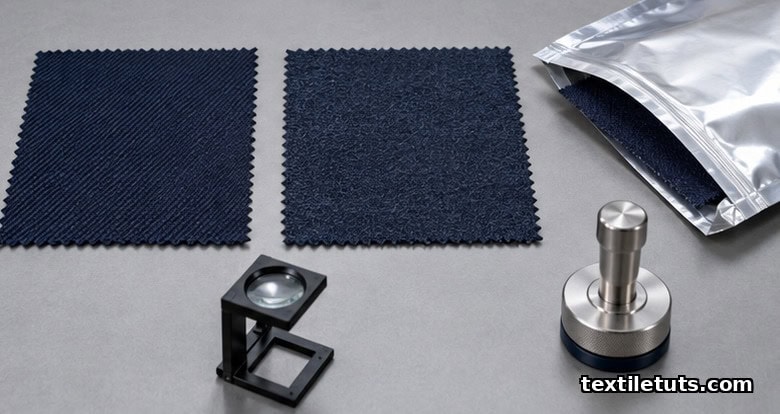
- Pre-production: The lab tests a strike-off sample against the bulk reference (THV within ±0.3 of the standard is the usual pass band).
- Bulk production: AATCC TM 202 panel testing on 1 in 10 lots, with PhAbrOmeter spot-checks for outliers.
- Final inspection: Trained QC auditors hand-feel 5 percent of pieces in the shipment, comparing to a sealed reference swatch sealed in a moisture-barrier bag.
A reject rate of 4 to 6 percent for hand is normal in worsted wool; above 8 percent points to a finishing bath drift (temperature, pH, or softener dosage) that needs root-cause analysis.
Frequently Asked Questions
Q1: What is the difference between KES and FAST?
The Kawabata Evaluation System (KES) uses four separate instruments to measure 16 mechanical properties with very high resolution, suitable for R&D and dispute resolution. FAST uses three simpler instruments that finish in about a quarter of the time, producing a fingerprint chart rather than full PHV regression output, which makes it well suited to production-floor quality control.
Q2: Can hand feel be measured reliably without instruments?
Yes, using AATCC TM 202 with a trained panel of at least 5 assessors conditioned in a 21 °C, 65 percent RH room for at least 30 minutes before evaluation. Inter-rater agreement reaches 70 to 80 percent when assessors have completed at least 60 hours of calibration on reference fabrics.
Q3: Why does the same fabric feel different in summer and winter?
Skin temperature changes the perceived warmth of a fabric by up to 20 percent. In winter, hands are colder and the same wool reads as stiffer and less smooth. Laboratory conditioning at 20 °C and 65 percent RH controls the fabric side, but the assessor’s hand still shifts the result. AATCC TM 202 now recommends pre-warming the assessor’s hands in a 30 °C water bath for 2 minutes before each session.
Q4: What does a Total Hand Value (THV) of 4 actually mean?
A THV of 4 on the 0 to 5 Kawabata scale indicates a fabric that a trained panel would rate “good” to “very good” for its category (suiting, dress shirting, knit). THV 5 is essentially unobtainable in commercial fabrics because at least one mechanical property always compromises slightly. THV below 3 typically triggers an accept/reject discussion.
Q5: Is hand feel testing standardized globally?
No single ISO standard governs subjective panel hand evaluation, although ISO 3071 covers related pH testing and ISO 14704 touches flexural properties. The de facto reference is AATCC TM 202 (subjective) and the Kawabata system documentation from the Textile Machinery Society of Japan (objective). ASTM D6828 covers the PhabrOmeter. Most mills accept any of the three when the method is named on the test report.
References
- Kawabata, S. (1980). The Standardization and Analysis of Hand Evaluation. Textile Machinery Society of Japan. Original source for the 16-parameter KES framework and the KN-201 Primary Hand Value equations.
- AATCC. Test Method 202: Relative Hand Value of Textiles. American Association of Textile Chemists and Colorists. Subjective panel evaluation standard with conditioning requirements of 21 °C and 65 percent RH.
- ASTM. D6828-02: Standard Test Method for Determination of the Relative Hand Feel (Smoothness) of Fabrics by the PhabrOmeter. ASTM International. Single-instrument objective hand ranking method.
- ASTM. D1388: Standard Test Method for Stiffness of Fabrics by the Cantilever Test. ASTM International. Used for bending rigidity, one component of hand but not sufficient on its own.
- ISO. ISO 139: Textiles – Standard atmospheres for conditioning and testing. International Organization for Standardization. Conditioning protocol (20 °C, 65 percent RH) that all hand evaluations depend on.
- ISO. ISO 14704: Fibre-reinforced plastic composites – Determination of flexural properties. International Organization for Standardization. Referenced for flexural methodology cross-applied in textile bending work.
- Hu, J. (Ed.). (2008). Fabric Testing. Woodhead Publishing / Elsevier. Chapter 7 covers KES, FAST, and PhabrOmeter methods with comparative data on cotton, wool, and polyester fabrics.
- Mahar, T. J., & Postle, R. (1986). Fabric mechanical and physical properties relevant to clothing manufacture. CSIRO Division of Wool Technology. Source for the FAST fingerprint chart methodology.
This article is the working reference for hand feel evaluation. Editorial by Iftay Khairul Alam, TextileTuts. Sources: Kawabata (1980), AATCC TM 202, ASTM D6828, ASTM D1388, ISO 139, ISO 14704, Hu (2008), Mahar & Postle (1986) as cited.


