
Colorfastness to Perspiration: ISO 105 E04

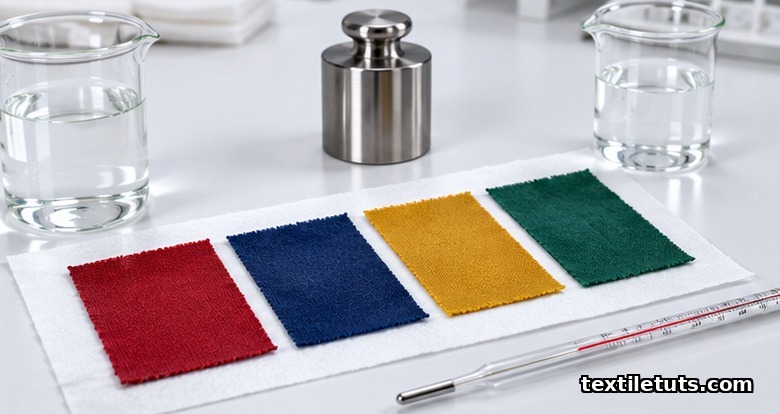
ISO 105-E04:2013 specifies a test method that exposes textile specimens to two artificial perspiration solutions (pH 8.0 alkaline and pH 5.5 acid) at 37 °C ± 2 °C for 30 minutes in a perspirometer under 12.5 kPa pressure, then evaluates colour change against the ISO grey scale per ISO 105-A02 and staining of a multifibre adjacent fabric against ISO 105-A03.
The test simulates the combined chemical, thermal, and mechanical action of human sweat on dye-fibre systems, and it is the standard method cited in buyer specifications for apparel that contacts the skin, including T-shirts, dress shirts, sportswear, denim, socks, and lining fabrics. It belongs to the ISO 105-E series alongside E01 (water), E02 (sea water), and E03 (chlorinated water).
This guide covers the chemistry of the two perspiration solutions, the step-by-step procedure, the perspirometer apparatus, how to read grey-scale ratings, common dye-fibre failure modes, and how E04 differs from its sibling tests.
What ISO 105-E04 Tests, and Why the Method Exists
Human perspiration is not just water. Sweat is a saline, mildly acidic to slightly alkaline fluid containing sodium chloride, lactic acid, urea, ammonia, and trace amino acids, and its pH on healthy skin varies between roughly 4.5 and 8.0 depending on body site, diet, microbial activity, and individual physiology. When sweat migrates from skin into a coloured textile, the salts and acids interact with the dye and the fibre surface, and the combination of body heat (around 37 °C) plus mechanical pressure from skin contact can produce visible dye transfer or stain migration onto adjacent fabrics.
ISO 105-E04:2013 standardises the conditions so that laboratories anywhere in the world can produce repeatable comparisons of how a dyed fabric performs under simulated perspiration. The standard was first published in 1978, revised in 1994, 2008, and most recently in 2013, and it remains the harmonised reference cited in OEKO-TEX, major retailer quality assurance manuals, and buyer technical specifications for colourfastness to perspiration [1].
The Two Artificial Perspiration Solutions
The standard defines two solutions. Each is prepared from analytical-grade reagents and adjusted to a defined pH, and each represents one extreme of the human sweat range.
| Parameter | Alkaline solution | Acid solution |
|---|---|---|
| Sodium chloride (NaCl) | 5.0 g/L | 5.0 g/L |
| Disodium hydrogen phosphate (Na₂HPO₄·2H₂O) | 5.0 g/L | — |
| Sodium dihydrogen phosphate (NaH₂PO₄·H₂O) | — | 2.5 g/L |
| L-histidine monohydrochloride monohydrate | 0.5 g/L | 0.5 g/L |
| Adjusted pH (with NaOH) | 8.0 ± 0.2 | 5.5 ± 0.2 |
Both solutions use L-histidine as a buffering amino acid because it represents the nitrogen-containing organic fraction of real perspiration. The phosphate buffer at pH 8.0 simulates the alkaline shifts that occur when sweat mixes with cosmetics, deodorant residue, or bacterial breakdown products on the axilla and back, and the pH 5.5 buffer simulates the mildly acidic conditions on the forehead, palms, and feet [1][2]. Without L-histidine the test would essentially duplicate ISO 105-E01 (water), so the amino acid is the chemical signature that defines a perspiration test.
ISO 105-E04 Test Procedure Step-by-Step
Specimens are cut 10 cm × 4 cm and placed face-to-face with a multifibre adjacent fabric strip of identical dimensions. The composite is wetted thoroughly in the test solution, and the excess is squeezed off to a defined wet pickup of around 100 to 105% of fabric mass. The composite is loaded into a perspirometer under defined pressure and held at body temperature.
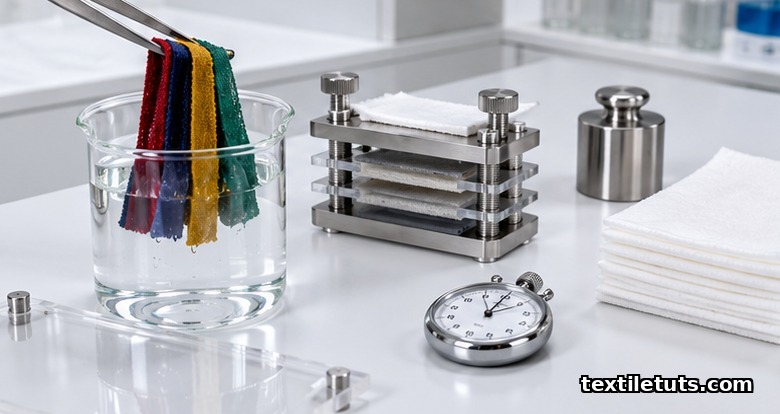
- Pre-condition the specimens for 4 hours at 20 °C ± 2 °C and 65% ± 2% relative humidity (per ISO 105-A01).
- Wet the composite in either the acid or the alkaline solution, ensuring full saturation.
- Place the composite under a 5 kg weight in the perspirometer, producing a pressure of approximately 12.5 kPa on the test area.
- Hold the loaded perspirometer at 37 °C ± 2 °C for 30 minutes.
- Remove the composite, separate the specimen from the adjacent fabric, and dry both at room temperature (or at a temperature not exceeding 60 °C).
- Evaluate colour change of the specimen against the ISO grey scale for colour change (ISO 105-A02) and staining onto each fibre band of the adjacent fabric against the grey scale for staining (ISO 105-A03).
The 37 °C temperature matches human skin temperature, so the test reproduces worst-case skin-contact thermal conditions for a wearer in a hot environment or during exercise. The 30-minute exposure is a standard window chosen to align with E01 (water) and to fit typical QA lab throughput.
Perspirometer Apparatus and Multifibre Adjacent Fabric
The perspirometer is a stainless-steel or acrylic frame that holds up to 21 specimen-adjacent-fabric sandwiches between acrylic plates separated by spacer rods. Each sandwich sits under a defined pressure, and the entire assembly is immersed in a thermostatically controlled water bath at 37 °C. The mechanical pressure from the plates mimics the compressive load that skin exerts on a garment during wear, and the controlled wet-heat cycle ensures every specimen sees identical conditions during the same run.
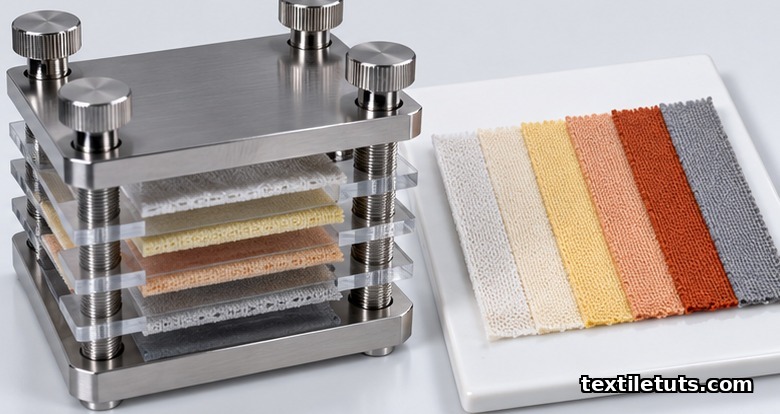
The multifibre adjacent fabric, designated TV under ISO 105-F, is a woven strip containing six bands: secondary cellulose acetate, bleached cotton, polyamide 6.6, polyester, acrylic, and wool. Each band has a different dye affinity, so a single composite test produces six simultaneous staining ratings, one per fibre type. This is more efficient than running six separate mono-fibre staining tests, and it gives the lab a quick fingerprint of how the dye bleeds into each common garment-fibre class [3].
Reading the Results: Grey Scale Ratings
Two separate ratings are reported, each scored on the 1 to 5 ISO grey scale in half-step increments.
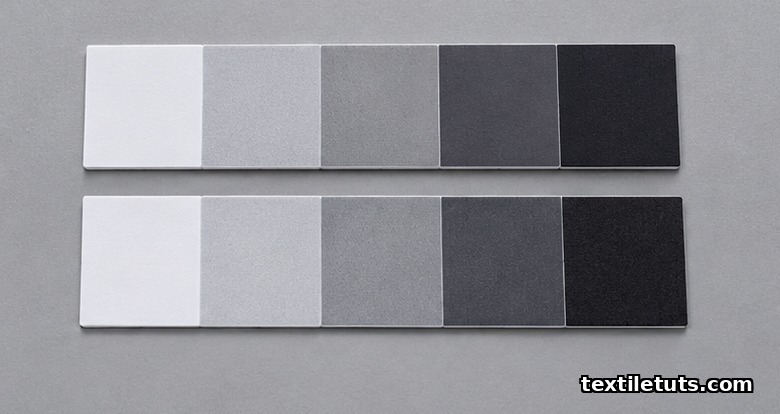
- Colour change of the specimen (CC): 5 = no change, 4 = slight, 3 = moderate, 2 = considerable, 1 = severe.
- Staining of each adjacent-fibre band (CS): same 1 to 5 scale, scored per band and reported for both acid and alkaline solutions.
Most apparel buyers require a colour-change rating of 4 or higher and a staining rating of 3 to 4 or higher under both acid and alkaline conditions. Sportswear and underwear buyers often require 4 to 5 for both ratings. Denim buyers typically accept 3 for staining on indigo-dyed cotton because indigo is notorious for crock-migration, but demand higher numbers on solid black reactive dyes.
Results are reported separately for acid perspiration and alkaline perspiration, because a reactive dye may pass one solution and fail the other. Reactive dyes on cellulosic fibres typically perform better in the acid solution, where the protonated amino groups on the dye form ionic bonds with cellulosate anions, while disperse dyes on polyester can show weaker alkaline-perspiration ratings because alkaline hydrolysis can slowly cleave dye ester linkages over time [1][2].
Common Failure Modes by Dye-Fibre System
| Dye class | Fibre | Typical E04 issue |
|---|---|---|
| Reactive (vinyl sulphone, monochlorotriazine) | Cotton, viscose | Covalent bond is strong; failures usually trace to hydrolysed dye not fully removed in soaping-off. |
| Direct | Cotton, viscose | Moderate staining under alkaline sweat because ionic fixation is pH-sensitive. |
| Vat (indigo, leuco) | Denim, workwear cotton | Indigo crock-migration under both acid and alkaline; physical rubbing resistance is the bigger gate. |
| Disperse | Polyester, secondary acetate | Alkaline hydrolysis over time can break dye-fibre bonds; thermomigration during finishing adds risk. |
| Acid (1:1 and 1:2 metal-complex) | Wool, polyamide | Strong in acid sweat; can fail alkaline if the metal-complex sits outside its pH stability window. |
| Reactive on wool (after-fixation) | Wool | Critical to test both solutions; pH shift can hydrolyse any unreacted dye groups on the fibre surface. |
For dark shades, the rate-limiting step is rarely the dye-fibre bond itself. It is incomplete washing-off after dyeing. Hydrolysed dye that remains on the fibre surface leaches under sweat and lowers the rating, which is why post-dyeing soaping-off at 95 °C with a non-ionic detergent is a core part of reactive dyeing recipes, not an optional finishing step [4][5].
ISO 105-E04 vs the Other ISO 105-E Tests
The E series tests simulate four different wet-exposure scenarios. E01 is plain water, E02 is sodium chloride at 30 g/L to mimic sea water, E03 is chlorinated pool water (typically 20 to 100 mg/L active chlorine at pH 7.0), and E04 is the perspiration model with phosphate buffer and histidine.
| ISO part | Test fluid | pH | Temperature | Time |
|---|---|---|---|---|
| ISO 105-E01 | Deionised water | Neutral | 37 °C | 30 min |
| ISO 105-E02 | NaCl 30 g/L | Neutral | 37 °C | 30 min |
| ISO 105-E03 | NaClO + NaCl | 7.0 | 27 °C | 30 min |
| ISO 105-E04 | Histidine + phosphate buffer + NaCl | 5.5 and 8.0 | 37 °C | 30 min |
The key chemical difference is histidine and the phosphate buffer, which is what makes E04 a perspiration test rather than a generic wet test. The amino acid simulates the nitrogen chemistry of sweat and is the reason some dyes that pass E01 and E02 fail E04 even though the salt concentration and pH look similar. For example, a reactive black dyed on cotton may rate 4 to 5 under ISO 105-E01 but drop to 3 under the alkaline half of E04 if there is any residual hydrolysed dye present.
Where the Standard Fits in Buyer Specifications
Most major apparel buyers in Europe, North America, and Asia require ISO 105-E04 results in their quality assurance manuals, either alone or paired with ISO 105-X12 (rubbing and crocking) and ISO 105-C06 (laundering). The corresponding American Association of Textile Chemists and Colorists test method is AATCC TM15 (Colorfastness to Perspiration), which uses a similar perspirometer but with different solution composition, exposure parameters, and grey-scale evaluation [6].
The two methods are not interchangeable. ISO 105-E04 uses 30 minutes at 37 °C with histidine-buffered solutions at pH 5.5 and 8.0, while AATCC TM15 specifies a different buffer system and exposure sequence against AATCC grey scales. Certification bodies and commercial labs such as Testex, SGS, Intertek, and TÜV typically run whichever method the buyer’s specification cites, and they report precision data independently for each method [6][7].
OEKO-TEX Standard 100 cites E04 minimum ratings of 3 to 4 for colour change and staining on Class II and Class III products, and stricter thresholds for baby textiles in Class I. Brands producing for European and Japanese markets usually reference ISO 105-E04; brands producing for North American cut-and-sew operations more often reference AATCC TM15 alongside ISO 105-X12.
Frequently Asked Questions
What does ISO 105-E04 actually measure?
ISO 105-E04 measures the resistance of a dyed textile to the combined chemical, thermal, and mechanical action of human sweat. After exposure to defined acid and alkaline perspiration solutions, the specimen is rated for colour change and the adjacent multifibre fabric is rated for staining, each on the 1 to 5 ISO grey scale.
What is the difference between ISO 105-E04 and AATCC TM15?
Both expose fabrics to artificial perspiration and grade the result on a grey scale, but they differ in solution composition, exposure time, apparatus, and the grey-scale reference document. ISO 105-E04 uses histidine-buffered solutions at pH 5.5 and 8.0 for 30 minutes at 37 °C, while AATCC TM15 uses a different buffer system and exposure sequence against the AATCC grey scales. Buyers specify one or the other depending on their QA manual.
What is a passing score for colorfastness to perspiration?
Most apparel buyers require 4 or higher for colour change and 3 to 4 or higher for staining under both acid and alkaline conditions. Sportswear and underwear specifications usually demand 4 to 5 across all ratings. Anything at 3 or lower usually triggers a shipment hold and a mill-side investigation that starts with a soaping-off and wash-fastness review, since residual surface dye is the most common root cause.
Which dye classes fail ISO 105-E04 most often?
Direct dyes on cotton, certain disperse dyes on polyester (especially under alkaline sweat where dye ester bonds hydrolyse), and metal-complex acid dyes tested outside their optimal pH window are the most frequent failures. Reactive dyes and vat dyes that have been thoroughly soaped-off after dyeing generally pass without issue.
Can ISO 105-E04 results predict real-wear staining?
The standard is a screening tool for the perspiration-staining risk family, not a guarantee of real-wear performance. Perspirometer tests measure dye chemistry under controlled wet-heat pressure, while actual wear adds abrasion, multiple wash cycles, body-chemistry variation, and detergent residue. A fabric that scores 4 to 5 in E04 can still show visible staining on collars and cuffs after six months of wear, and a fabric that scores 3 can sometimes hold up better than expected in the field.
References
- International Organization for Standardization. ISO 105-E04:2013, Textiles — Tests for colorfastness — Part E04: Colorfastness to perspiration. https://www.iso.org/standard/58014.html — official standard text, solution recipes, apparatus, and procedure.
- International Organization for Standardization. ISO 105-A02:1993, Textiles — Tests for colorfastness — Part A02: Grey scale for assessing change in colour. https://www.iso.org/standard/3784.html — evaluation scale for specimen colour change.
- International Organization for Standardization. ISO 105-A03:2019, Textiles — Tests for colorfastness — Part A03: Grey scale for assessing staining. https://www.iso.org/standard/72560.html — evaluation scale for adjacent-fibre staining.
- International Organization for Standardization. ISO 105-F:2008, Textiles — Tests for colorfastness — Part F: Standard adjacent fabrics. https://www.iso.org/standard/40252.html — multifibre TV strip specification used in E04.
- American Association of Textile Chemists and Colorists. AATCC TM15, Colorfastness to Perspiration. https://www.aatcc.org/ — North American equivalent test method and grey-scale evaluation procedure.
- International Organization for Standardization. ISO 105-E01:2013, Textiles — Tests for colorfastness — Part E01: Colorfastness to water. https://www.iso.org/standard/58011.html — sibling water test in the E series.
- OEKO-TEX Association. Standard 100 by OEKO-TEX, Annex 4, Limit Values and Fastness Requirements. https://www.oeko-tex.com/ — cited minimum ratings for E04 colour change and staining on Class I, II, and III products.
This article is the working reference for ISO 105-E04 colorfastness to perspiration. Editorial by Iftay Khairul Alam, TextileTuts. Sources: ISO 105-E04:2013, ISO 105-A02, ISO 105-A03, ISO 105-F, ISO 105-E01:2013, AATCC TM15, and OEKO-TEX Standard 100 as cited.


