
Shoulder Pad Construction

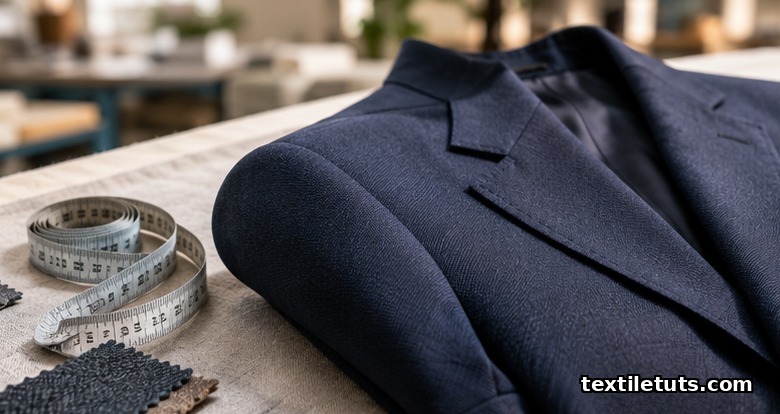
A standard canvas shoulder pad adds 8 to 12 mm of vertical lift at the shoulder seam and is built as three bonded layers: a woven shell of 120 to 180 g/m² wool or wool-polyester fabric, a nonwoven or foam core 4 to 8 mm thick with a density of 60 to 100 kg/m³, and a brushed interlining laminated with ethylene-vinyl acetate (EVA) adhesive at 130 to 150 °C. This layered construction is what allows a tailored jacket to keep its silhouette through 50 or more wear cycles without collapse.
This guide walks through the materials, the construction sequence, the ISO and AATCC test methods that govern pad quality, and the construction differences between men’s, women’s, and raglan shoulder pads.
What a Shoulder Pad Actually Does
A shoulder pad is a shaped insert sewn between the outer fabric and the shoulder lining of a tailored garment. It serves three functions: silhouette shaping, structural support for the shoulder seam, and protection of the inner construction from body heat, skin oils, and abrasion.
Tailors measure shoulder-pad performance by three numbers: the lift in millimeters at the shoulder tip, the compression set after a load cycle, and the dimensional change of the cover fabric after dry cleaning. ISO-style flex tests and AATCC TM135 dimensional-change tests apply because a pad that loses more than 3% in either dimension after five dry-clean cycles is rejected by most outerwear buyers.
The Three-Layer Construction
Almost every machine-made shoulder pad is a laminate of three layers, each chosen for a different mechanical property.
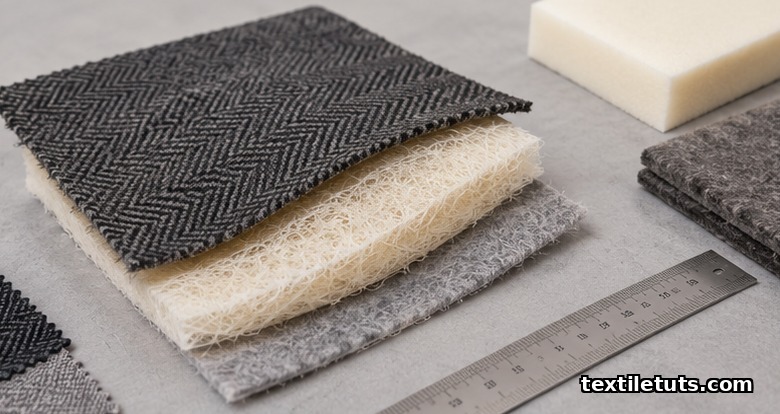
The cover fabric is the visible side of the pad. It is typically a 120 to 180 g/m² plain-weave or twill wool or wool-polyester blend, sometimes pre-shrunk under ISO 6330 procedure 4N (40 °C wash, flat dry). The cover protects the core, distributes the stitch load, and slides against the garment lining without grabbing.
The core supplies the lift. Four core families dominate commercial production:
- Needle-punched nonwoven. Polyester or viscose fibers tangled by barbed needles, density 60 to 100 kg/m³, thickness 4 to 8 mm. The most common core in mid-market jackets.
- Polyurethane foam. Open-cell PU, density 30 to 80 kg/m³, thickness 5 to 12 mm. Light, but compresses faster than nonwoven.
- Wool felt. Pressed wool fibers, density 90 to 150 kg/m³, thickness 3 to 6 mm. Used in premium tailoring because it recovers shape after compression.
- Polyester fiberfill batting. Loose fiber web, density 20 to 40 kg/m³, used in budget pads and in shoulder pieces that need to be molded at low temperature.
The interlining is the back layer that sits against the garment lining. It is almost always a brushed polyester or polyamide tricot, 60 to 90 g/m², treated with a low-melt EVA or polyamide adhesive. The brushed surface prevents the pad from sliding inside the jacket during wear.
Step-by-Step Construction Sequence
Industrial pad production follows a consistent eight-step sequence. Each step has a measurable output that the line QC samples against AATCC spot-check criteria.
1. Pattern cutting. The pad shape is cut from a graded marker. Men’s sizes follow the ISO 3635 size designation system; women’s pad patterns run narrower at the neck point (typically 35 to 45 mm narrower than men’s at the same chest size) and slightly wider at the armhole to follow the shoulder slope.
2. Cover fabric pre-shrinking. Wool covers are decated or steamed at 110 to 120 °C for 30 to 60 seconds to drive relaxation shrinkage below 1%. Per ISO 6330, a 4N cycle is the standard pre-shrink benchmark.
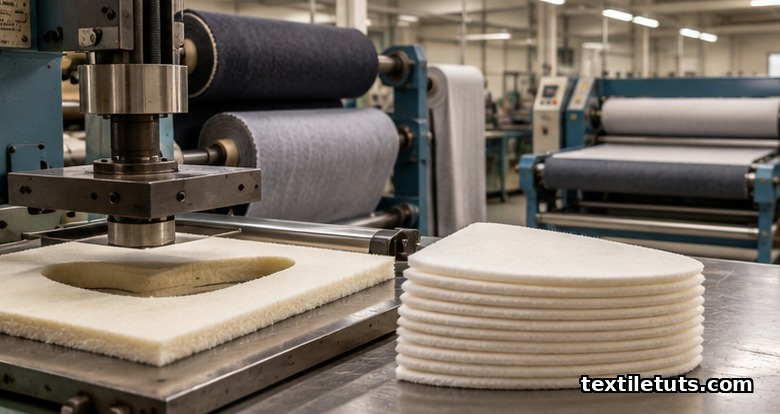
3. Core die-cutting. Foam and felt cores are cut with a clicker press or, in higher-end lines, a water-jet cutter to keep edges clean. Edge compression must stay above 90% of bulk density; below that, the shoulder tip looks visibly flat.
4. Adhesive lamination. The three layers are stacked and fed through a continuous-belt laminator. EVA hot-melt adhesive is applied at 130 to 150 °C with a dwell time of 8 to 15 seconds and a line pressure of 0.3 to 0.5 MPa. Lower temperatures give poor bond strength; higher temperatures scorch the wool cover.
5. Shaping. The flat laminate is pressed in a contoured mold at 100 to 130 °C for 20 to 40 seconds. The mold imparts the shoulder slope (typically 18 to 22° from horizontal for men’s jackets, 16 to 20° for women’s) and the rounded armhole curve.
6. Edge stitching or binding. The cut edge is either surge-stitched with polyester thread (Tex 27 to 35) or wrapped with a polyester binding tape 12 to 15 mm wide. Bound edges last longer in wear but add 1 to 2 g per pad.
7. Quality inspection. Each pad is checked for bond strength, dimensional accuracy (plus or minus 2 mm of pattern), and visual defects. Bond strength is tested by peeling a 25 mm strip at 100 mm/min; an acceptable bond exceeds 8 N per 25 mm.
8. Packaging. Pads are stacked and wrapped in pairs to keep pairs matched. Most factories ship 50 to 100 pairs per carton.
Standards That Govern Shoulder Pad Quality
Several published standards apply directly or by extension to shoulder pads, even though no single ISO standard is dedicated to the pad itself.
- ISO 3635 — Size designation of clothes. Defines the body dimensions used to grade men’s, women’s, and children’s pad patterns.
- ISO 6330 — Domestic washing and drying procedures for textile testing. The 4N procedure (40 °C wash, flat dry) is the universal pre-shrink and care-cycle reference.
- ISO 14704 — Flexural behavior of laminate films. Borrowed as a reference for cover-fabric flex life.
- AATCC TM135 — Dimensional changes of fabrics after home laundering. Used to verify that the cover fabric will not pull the pad out of shape after the consumer’s first wash.
- ASTM D5034 — Breaking strength and elongation of textile fabrics (grab method). Applied to the seam between pad and jacket lining.
- ASTM D1776 — Conditioning and testing textiles. Specifies the 20 °C and 65% RH lab environment required for reproducible pad measurements.
- AATCC TM20 — Fiber analysis. Used to confirm the fiber content of the cover fabric, which is required on the care label in most markets.
A pad that passes all seven tests above is what the industry calls compliant for tailored outerwear.
Comparison Table: Core Material Trade-offs
| Property | Needle-punched nonwoven | PU foam | Wool felt | Polyester batting |
|---|---|---|---|---|
| Density (kg/m³) | 60 to 100 | 30 to 80 | 90 to 150 | 20 to 40 |
| Compression recovery after 24 h at 50% load | 88 to 92% | 75 to 85% | 94 to 98% | 70 to 80% |
| Typical thickness (mm) | 4 to 8 | 5 to 12 | 3 to 6 | 6 to 15 |
| Dry-clean resistance | Good | Risk of hydrolysis | Excellent | Good |
| Cost per pad (USD) | 0.15 to 0.35 | 0.10 to 0.25 | 0.45 to 1.10 | 0.08 to 0.20 |
| Common use | Mid-market jackets | Budget and fashion jackets | Premium tailoring | Casual and lightweight outerwear |
Construction Differences by Garment Type
Set-in sleeve jackets use a symmetrical pad that is sewn into the armhole seam and the shoulder seam, with a tab at the neck point to keep the pad from shifting.
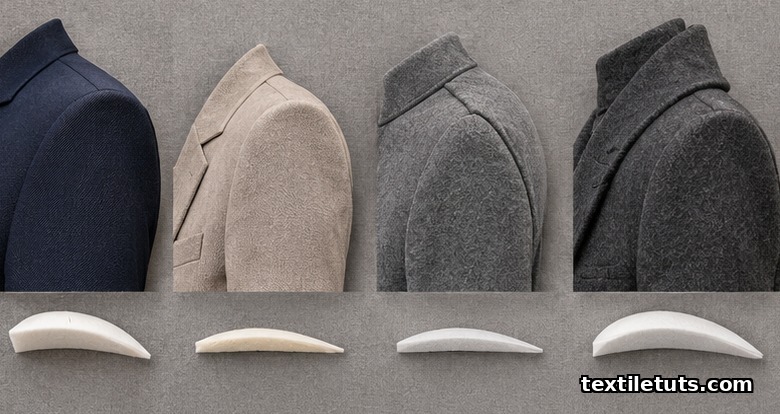
Raglan sleeve garments need a different construction: the pad wraps from the neck point down the shoulder slope to the underarm, with no shoulder seam to anchor a tab. The pad is usually tacked at three points, not sewn into a seam.
Women’s jackets use narrower neck and wider armhole dimensions to follow the typical 16 to 20° shoulder slope. The pad is also thinner (typically 4 to 6 mm versus 6 to 10 mm in men’s) to avoid a square silhouette.
Coats and outerwear use thicker pads (8 to 14 mm) with a denser core, because the garment is heavier and the shoulder needs more lift to balance the bulk of the body fabric.
Frequently Asked Questions
What is the most common shoulder pad filling?
Needle-punched nonwoven polyester is the most common shoulder pad filling in mass-market tailored jackets. It combines a competitive price (USD 0.15 to 0.35 per pad), good dry-clean resistance, and a compression recovery of 88 to 92% after a 50% load cycle, which keeps the shoulder line from collapsing during normal wear.
How thick should a shoulder pad be?
For a men’s tailored jacket, the standard thickness is 6 to 10 mm at the shoulder tip, tapering to 2 to 3 mm at the neck point. Women’s jackets use 4 to 6 mm tapering to 2 mm. Coats and outerwear often run 8 to 14 mm. Going thicker than 14 mm starts to look like a 1980s power-shoulder rather than a modern structured shoulder.
Can you wash a jacket with sewn-in shoulder pads?
It depends on the core. PU foam cores are vulnerable to hydrolysis in a standard machine wash and will collapse within 5 to 10 cycles. Needle-punched nonwoven and wool felt pads tolerate dry cleaning well but should not go in a domestic washing machine, because agitation permanently deforms the shaped contour. The safe rule is dry clean only for any jacket with a shaped pad, with a pressing cloth if the cover is wool.
How long does a shoulder pad last?
A wool-felt or high-density nonwoven pad in a regularly dry-cleaned jacket lasts 4 to 6 years or roughly 80 to 120 wear cycles before the shoulder tip visibly flattens. PU foam pads lose shape in 1 to 2 years. The cover fabric usually outlasts the core, which is why high-end tailors replace the core but keep the original cover when re-padding.
Can the shoulder pad be removed without damaging the jacket lining?
In a properly constructed jacket, the pad is tacked at 4 to 6 points along the armhole and shoulder seam with chain stitch, which is designed to be unpicked. Removing the tacks leaves small holes in the lining that are visible only when the lining is pulled away from the outer fabric, so a tailor can replace the pad invisibly. Cheap fused pads, by contrast, are glued to the lining, and removing them usually tears the lining.
References
- International Organization for Standardization. ISO 3635:1981, Size designation of clothes: definitions and body measurement procedure. iso.org, body-measurement definitions used to grade pad patterns.
- International Organization for Standardization. ISO 6330:2021, Domestic washing and drying procedures for textile testing. iso.org, the 4N wash procedure cited for pre-shrink benchmarking.
- American Association of Textile Chemists and Colorists. AATCC TM135, Dimensional Changes of Fabrics After Home Laundering. aatcc.org, dimensional-change test for cover fabrics.
- ASTM International. ASTM D5034, Standard Test Method for Breaking Strength and Elongation of Textile Fabrics (Grab Test). astm.org, seam-strength reference for pad-to-jacket attachment.
- ASTM International. ASTM D1776, Standard Practice for Conditioning and Testing Textiles. astm.org, 20 °C and 65% RH conditioning environment for pad measurements.
- American Association of Textile Chemists and Colorists. AATCC TM20, Fiber Analysis: Qualitative. aatcc.org, fiber identification method required for care-label compliance.
- International Organization for Standardization. ISO 14704:2008, Plastics: determination of flexural properties of laminate films. iso.org, flex-life reference borrowed for cover-fabric durability.
This article is the working reference for shoulder pad construction. Editorial by Kazi Sifat Muntasir, TextileTuts. Sources: ISO 3635, ISO 6330, ISO 14704, AATCC TM135, AATCC TM20, ASTM D5034, ASTM D1776 as cited.


