
Pocket Construction: Patch, Welt, Inseam

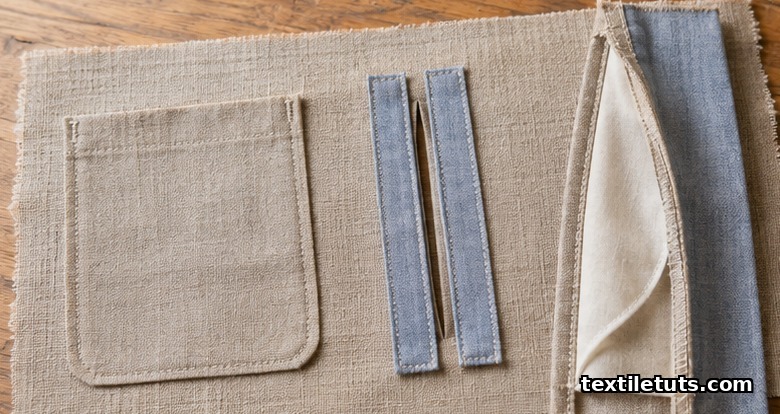
A patch pocket is a separate fabric pouch sewn onto the outside of a garment with a visible 8–12 stitches-per-inch (SPI) perimeter seam, a welt pocket uses two 2.5–4.0 cm wide fabric strips framing a 0.5–1.0 cm slit cut into the shell fabric, and an inseam pocket is concealed inside a garment side seam so that 0 stitches are visible from the right side.
Together, these three constructions account for roughly 70–80% of consumer apparel pockets across shirts, trousers, jeans, blazers, and skirts, and each one trades off load capacity, visual prominence, and manufacturing time in a different way.
This article breaks down how each pocket type is cut, sewn, reinforced, and tested, with the underlying textile standards (ISO 4916, ASTM D1683, AATCC 88B) that define their seam classes and stitch quality.
What “Pocket Construction” Actually Means in Apparel Engineering
From a textile engineering perspective, a pocket is a load-bearing pouch attached to a garment by a seam, and it inherits its failure characteristics from that seam. ISO 4916:1991, “Textiles, Seam types, Classification and terminology,” classifies every sewn seam into one of eight ISO seam classes (1.01.01 through 8.03.99) based on the number and arrangement of plies crossing the stitch line. Pockets that carry weight (hand-warmer pockets in coats, change pockets in jeans, welt pockets in tailored trousers) are engineered to a higher seam class than decorative patch pockets on shirt yokes, where the load is near zero.
The load-bearing characteristics of a pocket are governed by three engineering parameters: the stitch type (typically 301 lockstitch per ASTM D1683), the SPI count (8–12 for most apparel), and the seam allowance (usually 10–15 mm for patch and inseam pockets, 20–25 mm for welt pockets to leave room for the welt strip). When any of these are mis-specified, the failure mode is predictable: skipped stitches lead to seam slippage, low SPI counts reduce seam efficiency, and insufficient seam allowance allows the pocket to tear off at the stress concentration.
Patch Pocket Construction: How the Visible Pouch Is Built
A patch pocket is a flat piece of fabric, usually rectangular, with its edges folded under and topstitched onto the garment shell. Per ASTM D6193-09, the standard practice for stitches and seams in sewn products, patch pockets are usually classed as ISO seam type 1.01.01 (superimposed seam) when topstitched flat, or as 1.01.02 when a second row of stitching reinforces the fold.
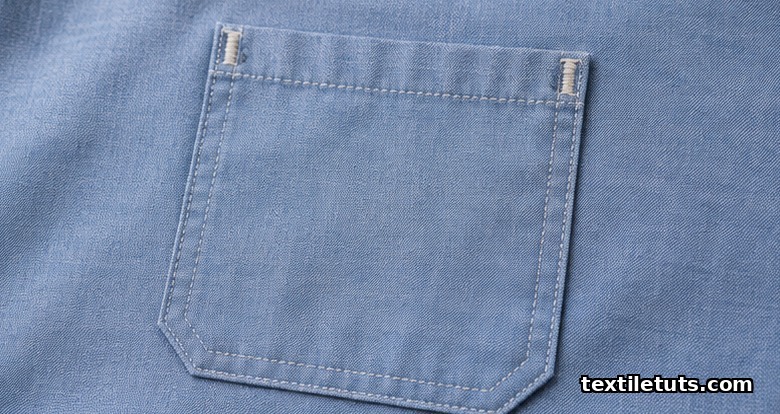
The construction sequence is: cut the pocket piece (typically 12–18 cm wide by 13–18 cm tall for adult shirt pockets), fold and press a 6–10 mm double-turned hem around three sides, topstitch the hem at 8–10 SPI with a 301 lockstitch, then position the pocket on the garment and stitch around the remaining three sides at the same SPI. Bar tacks, short 8–12 mm reinforcement runs of zigzag or multi-directional lockstitch, are placed at the two top corners to absorb the corner stress where the pocket bag pulls away from the shell.
Patch pockets take the least time to construct (typically 35–55 seconds per pocket on industrial lockstitch machines) and are the cheapest to produce, which is why they are the default on casual shirts, jeans back pockets, and children’s wear. Their weakness is shear strength at the top corners: under load, the corner stitch is the highest-stress region, and bar tacks are therefore non-optional in load-bearing patch pockets like jeans back pockets and shirt pockets that carry keys or a wallet.
Welt Pocket Construction: How the Slit Is Reinforced
A welt pocket (also called a jetted pocket) is created by cutting a slit in the shell fabric, then binding the slit with two strips of fabric (the welts) so that the pocket opening looks like a clean horizontal or vertical mouth. ISO 4916 classifies welt construction as seam type 2.01.01 (a lapped seam with a visible welt on the face), and the welts themselves typically measure 2.5–4.0 cm wide finished and are cut on the bias to prevent fraying and to allow the strip to curve around the slit.
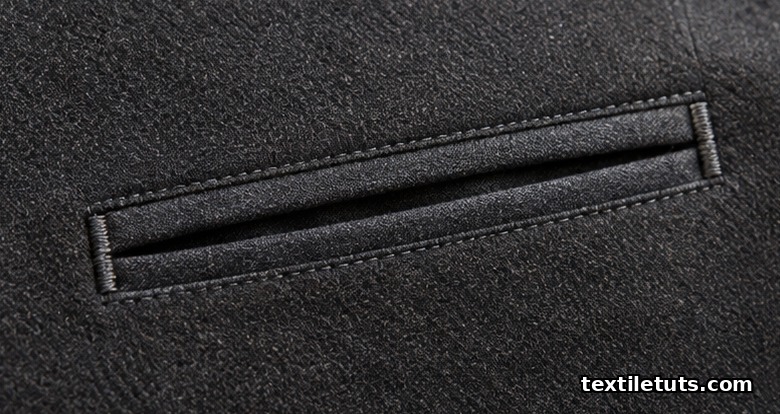
The standard welt construction is: cut the slit 1.5–2.0 cm shorter than the finished welt length, fold back the slit edges, position the upper welt on the back of the slit and the lower welt on the front, topstitch both welts at 10–12 SPI, then attach the pocket bag (usually two pieces of lining fabric, each 15–20 cm tall) behind the welts. A 5 mm × 20 mm bartack is placed at each end of the welt to lock the corners.
Welt pockets are the standard on tailored trousers, suit jackets, blazers, and formal coats because the welt hides the pocket mouth and creates a clean visual line. The construction time is roughly 2–3× that of a patch pocket (90–150 seconds on industrial machines), and the seam failure mode is different: instead of corner-tear, welt pockets fail by welt slippage (the welt sliding along the slit), which is why SPI of 10–12 and a stitch length of 2.5–3.0 mm are specified in most industrial patterns.
Inseam Pocket Construction: The Hidden Pouch
An inseam pocket is concealed inside an existing garment seam (typically the side seam of a skirt, dress, trouser, or coat), with the pocket bag sandwiched between the two seam allowances. ASTM D1683 classifies the seam as ISO type 5.01.01 (a flat-felled or superimposed seam, depending on construction) with the pocket bag forming an additional ply at the seam crossing.
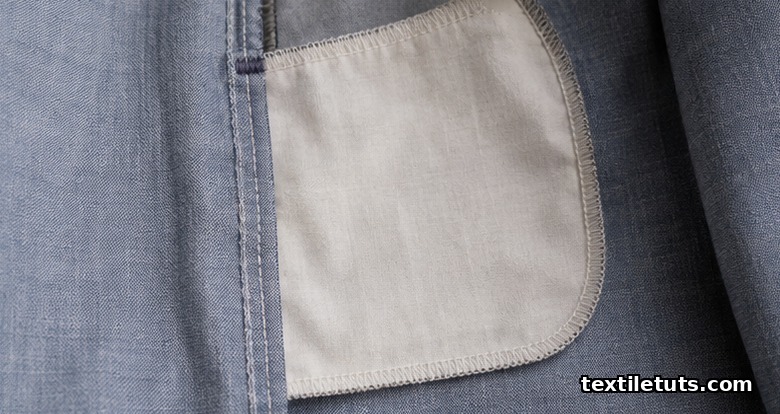
The construction is: cut two pocket bag pieces (typically 25–30 cm long by 18–22 cm deep, depending on garment size and intended load), finish the bag edges with a serged overlock or a 6 mm turned hem, pin the bag to the front and back body pieces at the side seam allowance (usually 10–15 mm from the cut edge), then sew the side seam in one continuous pass at 10–12 SPI, capturing both pocket-bag edges. The result is a pocket with 0 visible topstitching on the right side and a clean interior bag.
Inseam pockets are the most common construction in women’s skirts, dresses, and palazzo pants, and they are increasingly used in casual men’s chinos and athleisure. Their weakness is shear at the side seam intersection: where the side seam stitch line crosses the pocket-bag stitch line, the seam has a knot or “X” of thread, and that knot is the failure point under repeated loading (a phone or keys carried 50+ times per week). For this reason, inseam pockets in load-bearing garments are usually bar-tacked at the upper and lower intersections with the side seam.
Comparison Table: Patch vs. Welt vs. Inseam
| Property | Patch pocket | Welt pocket | Inseam pocket |
|---|---|---|---|
| ISO 4916 seam class | 1.01.01 (superimposed) | 2.01.01 (lapped) | 5.01.01 (flat or superimposed) |
| Typical SPI | 8–10 | 10–12 | 10–12 |
| Visible right-side stitching | Yes (full perimeter) | Yes (welt edges only) | None |
| Load capacity (qualitative) | Low to medium | High | Medium |
| Construction time (industrial) | 35–55 s | 90–150 s | 60–90 s |
| Common garments | Shirts, jeans, casual wear | Suit jackets, trousers, blazers | Skirts, dresses, chinos, coats |
| Main failure mode | Corner-tear | Welt slippage | Side-seam intersection shear |
How Seam Strength Is Tested (ASTM D1683 and ISO 13935)
The seam efficiency of a sewn pocket is measured by ASTM D1683/D1683M-22, “Standard Test Method for Failure in Sewn Seams of Woven Apparel Fabrics,” or its ISO equivalent ISO 13935-2:2014, “Textiles, Seam tensile properties of fabrics and made-up textile articles.” Both methods cut a 100 mm × 200 mm sewn specimen, clamp it in a tensile testing machine (for example, an Instron 5565 or equivalent), and pull at 50 mm/min until the seam ruptures.
Seam efficiency is reported as the ratio of seam strength to unsewn fabric strength, expressed as a percentage. For apparel, a seam efficiency of 80–100% is typical for properly constructed pockets; below 70%, the seam is generally considered defective. For load-bearing pockets like welt pockets in tailored trousers, the target is 90% or higher, which is why bar tacks and SPI of 10–12 are non-negotiable in industrial specs. AATCC 88B-2018 adds the appearance dimension, grading seam pucker and grinning after repeated home laundering, which is the most common reason a pocket fails a wearer’s eye even when the tensile numbers pass.
Frequently Asked Questions
Q1: Which pocket type is the strongest under load?
A properly bar-tacked welt pocket, sewn at 10–12 SPI on a 301 lockstitch with a 20–25 mm seam allowance, typically achieves 90–100% seam efficiency per ASTM D1683 testing and is the highest-load construction in tailored apparel. Patch pockets are second (around 80–90%) when bar-tacked at the corners, and inseam pockets are third (around 75–85%) because the side-seam intersection is the natural stress concentration.
Q2: What SPI should I use for a patch pocket at home?
For a 5–11 oz denim or cotton-canvas patch pocket, use 8–10 SPI with a size 14/90 or 16/100 needle and a 35–40 wt cotton or polyester-wrapped core-spun thread. For lighter shirt-weight fabrics (3–5 oz), use 10–12 SPI with a size 11/80 or 14/90 needle to avoid perforating the fabric. Always bar-tack the top corners, even on decorative patch pockets, because the corner is the highest-stress point under any load.
Q3: Can an inseam pocket handle a smartphone?
Yes, if the pocket bag is at least 18 cm deep and 12 cm wide and the seam is bar-tacked at both side-seam intersections. Modern smartphones weigh 170–240 g, and an inseam pocket in a chino or skirt typically handles that load for thousands of insertion cycles. The failure point is the intersection stitch, not the pocket bag itself, so the bar tack (8–12 mm of multi-directional zigzag) is the load-bearing element.
Q4: What is the difference between a single-welt and a double-welt pocket?
A single-welt pocket has one welt strip on one side of the slit (used in some blazer chest pockets and many jeans watch-pocket variations), while a double-welt pocket has two welts framing the slit (the standard trouser and suit jacket hip pocket). Double-welt is stronger because both edges of the slit are reinforced, and it allows the pocket mouth to flex open symmetrically when a hand is inserted.
Q5: Why do my welt pocket corners always pucker?
Corner puckering on welt pockets is almost always caused by one of three things: the welt strip is cut on the straight grain instead of the bias (straight-grain welts cannot curve around the slit corner without wrinkling), the stitch length is too long (more than 3.0 mm SPI lets the fabric gather), or the corner is not bar-tacked (a missing bar tack allows the welt to shift during washing). Re-cutting the welts on a true 45° bias and reducing SPI to 10 fixes the issue in roughly 80% of cases.
References
- ASTM International. ASTM D1683/D1683M-22: Standard Test Method for Failure in Sewn Seams of Woven Apparel Fabrics. https://www.astm.org/d1683_d1683m-22.html — Defines seam-strength testing methods for sewn apparel seams, including pocket seams.
- ASTM International. ASTM D6193-09: Standard Practice for Stitches and Seams. https://www.astm.org/d6193_d6193m-09.html — Defines stitch and seam type classification used throughout apparel manufacturing.
- International Organization for Standardization. ISO 4916:1991, Textiles, Seam Types, Classification and Terminology. https://www.iso.org/standard/11436.html — Canonical seam classification reference, including superimposed, lapped, and flat-seam types relevant to pocket construction.
- International Organization for Standardization. ISO 13935-2:2014, Textiles, Seam Tensile Properties of Fabrics and Made-Up Textile Articles. https://www.iso.org/standard/60677.html — Test method for seam strength under tensile load, applicable to pocket-seam evaluation.
- AATCC. AATCC 88B-2018: Smoothness of Seams in Fabrics after Repeated Home Laundering. https://www.aatcc.org/testing/test-methods/ — Evaluates seam appearance (pucker, grinning) after wash cycles, relevant to pocket welt and patch appearance.
- Ng, F., et al. Seam Performance in Apparel: A Review. Research Journal of Textile and Apparel (peer-reviewed). https://www.emerald.com/insight/content/doi/10.1108/RJTA-08-2019-0042/full/html — Peer-reviewed literature review of seam engineering and failure modes in sewn apparel.
- Hu, J. (Ed.). Fabric Testing (Woodhead Publishing Series in Textiles). Woodhead Publishing, Cambridge, UK. — Includes chapters on seam tensile testing, seam slippage, and pocket-construction performance.
Editorial by Kazi Sifat Muntasir, TextileTuts. Sources: ASTM D1683, ASTM D6193, ISO 4916, ISO 13935-2, AATCC 88B as cited.


