
Lingerie Fabric Selection: Comfort and Aesthetics

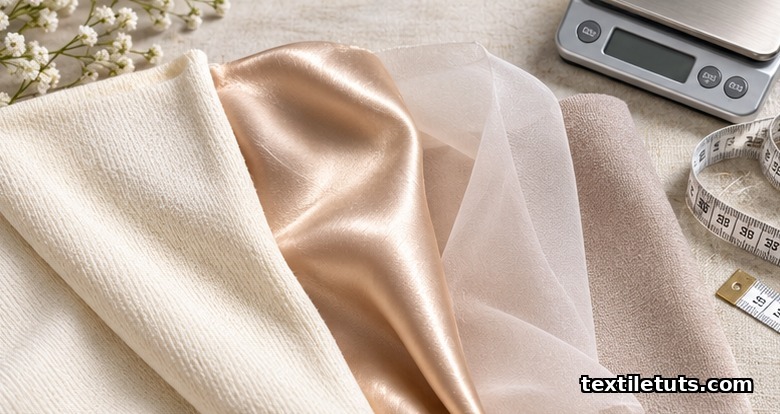
Lingerie fabric selection requires balancing three measurable properties: water vapor permeability above 1,000 g/m²/24h per ISO 15496, elastic recovery of at least 80% after 5% elongation per ASTM D4964, and a skin-contact pH between 4.0 and 7.5 per ISO 3071. Meeting these three thresholds separates fabrics that the body actually tolerates from fabrics that look attractive on the rack but fail in daily wear. A fourth aesthetic dimension, including drape, sheen, color fastness to laundering, and tactile hand, decides whether a customer reaches for the garment again six months later.
This article walks through the fiber chemistry, the testing standards, and the design trade-offs that lingerie designers, pattern makers, and informed buyers use to pick the right fabric for each category of intimate apparel, with measurable numbers rather than vague claims.
The Three Performance Pillars: Breathability, Stretch, and Skin-Safe pH
Textile engineers evaluate lingerie fabrics against three load-bearing properties that map directly to comfort and durability. Each is governed by an international standard so that laboratories in different countries can compare results on the same scale.
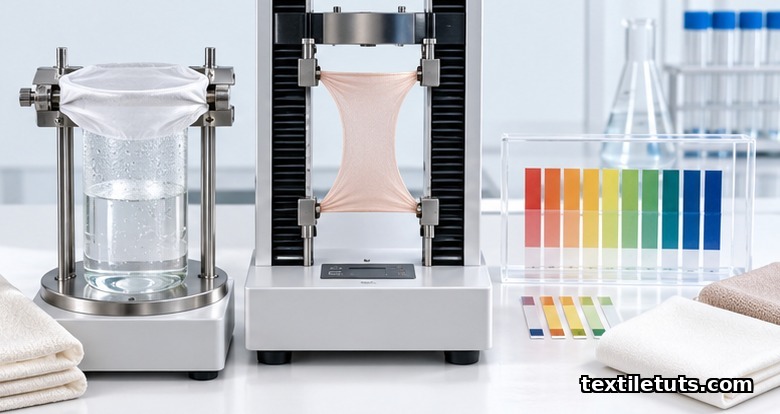
The first pillar is moisture vapor transmission. ISO 15496 describes the cup method for measuring how many grams of water vapor pass through a square meter of fabric in 24 hours under controlled temperature and humidity (typically 23 °C and 50% RH). Cotton woven at 110 g/m² typically reaches 1,300–1,800 g/m²/24h; microfiber nylon lands between 800 and 1,200; standard polyester sits around 600 to 900. For a basic bra or panty worn against the skin, a fabric below roughly 800 g/m²/24h feels clammy during light activity. That is why the lining layer is almost always a higher-permeability material than the decorative shell.
The second pillar is elastic recovery. ASTM D4964 subjects a fabric strip to a defined elongation, holds it for a set interval, releases it, and measures how much of the original length returns. Plain woven cotton recovers 60–70%; cotton/spandex blends with 5–8% elastane recover 90–95%. A bra band or panty waistband that does not recover at least 80% after wear will bag out and ride down within a single season of normal use.
The third pillar is pH. ISO 3071 measures the pH of an aqueous extract from the finished textile. Skin surface pH sits in the 4.5–6.0 range, and the textile next to it should fall between 4.0 and 7.5 to avoid disrupting the acid mantle. Residues from scouring, dyeing, and finishing can push fabrics outside that range, which is why OEKO-TEX Standard 100 and most brand specifications require pH testing on the finished good before shipment. OEKO-TEX additionally screens for extractable heavy metals, formaldehyde, banned azo dyes, and phthalates.
Natural Fibers: Cotton, Silk, and Modal in Intimate Apparel
Cotton dominates the comfort-first segment of the lingerie market because it combines high moisture regain (8.5% at standard atmosphere per ISO 139) with a soft hand and broad dye affinity. Long-staple cotton such as Egyptian, Supima, or Sea Island produces finer yarns that knit into denser, smoother fabrics suitable for everyday panties, sleepwear, and bralette cups. Combed cotton ringspun to 40 Ne or finer yields the typical 110–140 g/m² jersey used in body liners.
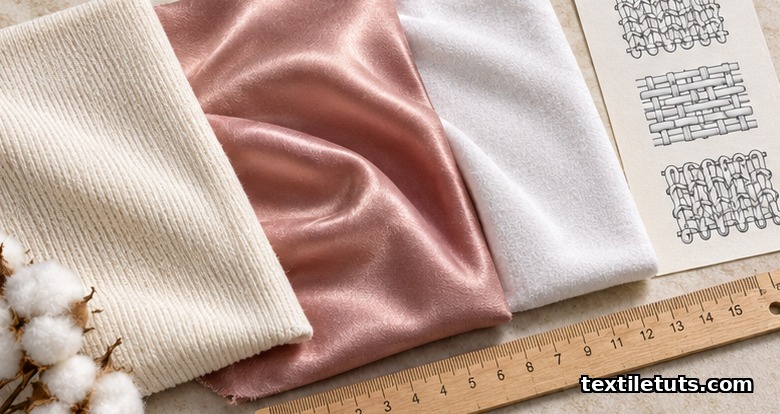
Silk brings a unique combination of thermal regulation and sensory appeal. Its protein structure, fibroin, is hygroscopic, yet the fabric surface feels cool to the touch because the fiber conducts heat away from skin faster than cellulosic fibers. Silk charmeuse at 80–95 g/m² is a common choice for high-end slips and camisoles where drape matters more than support. The drawback is poor wet strength: abrasion during machine washing degrades silk fibers, which is why silk intimate apparel is almost always labeled dry-clean-only.
Modal, a regenerated cellulosic fiber spun from beechwood pulp via a modified viscose process, has gained share in the bralette and boy-short segments. Modal fabrics recover better than pure cotton after repeated laundering because the fiber’s highly oriented molecular structure resists swelling. A 92/8 modal/elastane jersey at 170–190 g/m² is a common spec for everyday wear, combining the moisture benefits of cellulosics with the shape retention of synthetic stretch. Tencel (lyocell), a related fiber made in a closed-loop solvent process, behaves similarly and brings documented sustainability credentials to the same fabric space.
Synthetic Fibers: Nylon Microfiber, Polyester, and Elastane Blends
Synthetic fibers cover the performance-aesthetic gap that natural fibers cannot reach alone. Nylon 6 and nylon 6,6 microfiber yarns, typically 0.5–1.0 denier per filament, produce the smooth, second-skin surface used in warp-knit bras, shapewear, and high-end hosiery adjacent products. The fine filament count multiplies the number of fibers per cross-section, raising capillary action and pulling moisture outward; this explains the engineered cooling hand of quality microfiber compared with a coarse 3-denier nylon.
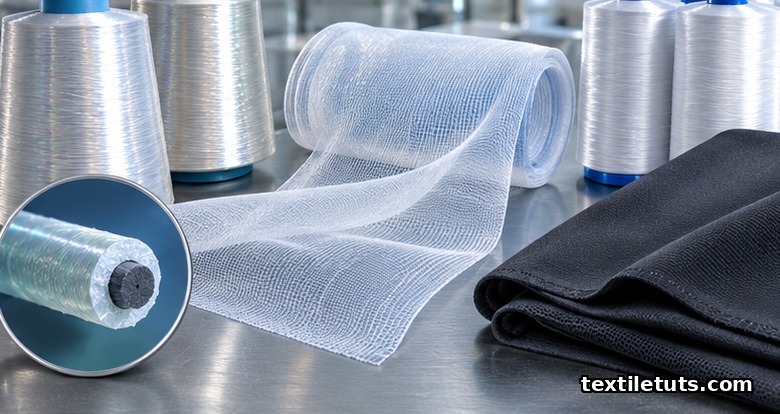
Polyester appears most often in molded cup bras, lace bases, and printed panels where color fastness and dimensional stability matter more than peak moisture transport. Disperse dyes form robust bonds with polyester’s polymer chains, so the color holds through home laundering at 60 °C, well above the 40 °C typical for cotton-rich intimates. AATCC 61 accelerated laundering predicts this performance by exposing samples to elevated temperature with steel balls for a defined cycle. AATCC 61 (test 2A, 49 °C, 45 minutes) correlates with roughly five home launderings at 40 °C and is the workhorse accelerated test for intimate apparel.
Elastane, also called spandex or Lycra depending on the manufacturer, is the stretch backbone of most modern lingerie. Standard elastane fibers stretch 500–700% before breaking and recover more than 90% from modest elongations, which is why a fabric with only 3–5% elastane behaves like a much higher-stretch textile to the wearer. Most intimate apparel relies on elastane wrapped with nylon or polyester in a covered yarn, which protects the rubber-like core from body oils, chlorine, and UV while presenting a smooth surface for dyeing and finishing.
Aesthetic Properties: Sheen, Drape, and Color Fastness
Comfort wins the first impression, but aesthetics determine whether a customer buys. Three measurable aesthetic properties map directly to fabric chemistry and construction, and each is rated under a published test method.
Sheen depends on fiber cross-section and surface smoothness. Trilobal nylon filaments reflect light at multiple angles, producing the characteristic shimmer of satin-style intimate apparel. Round-cross-section polyester yields a more matte look. Mercerized cotton, treated with concentrated sodium hydroxide to swell the fiber, gains a permanent silk-like luster and stronger dye uptake; it is a common spec for premium cotton nightwear where a soft sheen signals quality.
Drape is the way a fabric falls under its own weight. The simplest lab measure is ISO 9073-9, which records how a fabric strip bends at a defined angle. For lingerie, drape is more often evaluated subjectively because the target silhouette (slinky slip, structured bra, snug boxer) varies by garment. A 30–40 g/m² nylon tricot produces a fluid drape. A 220–280 g/m² powernet produces firm structure. A 170–190 g/m² modal jersey sits between.
Color fastness is governed by ISO 105, a multipart standard whose individual sections cover perspiration (ISO 105-E04), washing (ISO 105-C06), light (ISO 105-B02), and rubbing (ISO 105-X12). Lingerie sits against sweat-prone skin, so perspiration fastness is rated at both pH 5.5 (acid) and pH 8.0 (alkaline) to simulate different body chemistries. Quality control programs typically require grade 3–4 or higher on the gray scale for color change and staining across these tests before a fabric clears production.
Choosing Fabric by Garment Type
| Garment | Typical spec | Why this spec |
|---|---|---|
| Everyday panty | 92–95% cotton or modal, 5–8% elastane, 140–180 g/m² | High breathability plus shape retention across washes |
| Bralette (wireless) | 85–90% nylon microfiber, 10–15% elastane, 150–200 g/m² | Soft stretch with smooth second-skin surface |
| Molded-cup bra | 80–90% polyester, 10–20% elastane, 180–220 g/m² | Dimensional stability needed for thermal molding at 180–200 °C |
| Shapewear | 70–80% nylon, 20–30% elastane, 240–280 g/m² powernet | Engineered compression with controlled-return stretch |
| Slip / camisole | 100% silk charmeuse or 92% nylon, 8% elastane, 80–110 g/m² | Drape and sheen prioritized over support |
| Lace trim | Leavers or Raschel knitted nylon, sometimes with metallic or viscose accents | Decorative surface, low skin contact, soft scalloped edge |
These specs are not absolute. Designers routinely blend fibers to balance two opposing targets. A common compromise is a cotton/spandex body panel lined with a nylon/elastane mesh in the cup, which puts a breathable cellulosic against the skin and a stable synthetic where the structural demands sit. The art of lingerie fabric selection lies less in picking one perfect fiber and more in matching the right blend to each panel of the garment.
Frequently Asked Questions
What is the most breathable fabric for lingerie?
Cotton and modal, both cellulosic, deliver the highest moisture vapor transmission in lingerie weights, typically 1,300–1,800 g/m²/24h per ISO 15496. Microfiber nylon comes close (800–1,200 g/m²/24h) while adding stretch and a smoother hand, which is why most warp-knit bra shells use nylon rather than cotton.
Is polyester safe for underwear?
Polyester is safe for skin contact when the finished fabric passes ISO 3071 pH testing (4.0–7.5) and shows no disperse-dye transfer under ISO 105-E04 perspiration fastness. Unlined polyester can feel clammy in hot conditions because its moisture regain is only 0.4%, but its dimensional stability and color fastness to washing make it the workhorse of molded-cup bras.
How much spandex do you need for a supportive bra?
For everyday bras without underwire, 12–18% elastane in the band typically produces a firm-but-comfortable stretch with the 80%+ elastic recovery required by ASTM D4964. Shapewear climbs higher (20–30%) because engineered compression needs more aggressive return force than comfort bras.
What does OEKO-TEX Standard 100 actually test?
OEKO-TEX Standard 100 evaluates the finished textile against a list of substances considered harmful to health, including extractable heavy metals, formaldehyde, banned azo dyes, phthalates, and pH outside the 4.0–7.5 range. It is the most widely cited third-party safety certification in intimate apparel, though it is voluntary and brand-neutral rather than a regulatory requirement.
Why does some lingerie feel sticky on humid days?
A sticky or clammy sensation comes from sweat that does not evaporate off the skin side of the fabric quickly. Liners made from fibers with low moisture regain (polyester at 0.4%) or tightly woven microfiber create a partial vapor barrier. Switching to a cotton liner, a modal jersey, or an engineered multi-channel polyester that wicks moisture to an outer surface reduces the sensation.
References
- ASTM International. ASTM D4964: Standard Test Method for Tension and Elongation of Elastic Fabrics (Constant-Rate-of-Extension Type). ASTM International, West Conshohocken, PA.
- International Organization for Standardization. ISO 15496:2018 — Textiles — Measurement of water vapour permeability of textiles for the purpose of quality control. ISO, Geneva.
- International Organization for Standardization. ISO 3071:2020 — Textiles — Determination of pH of aqueous extract. ISO, Geneva.
- International Organization for Standardization. ISO 139:2005 — Textiles — Standard atmospheres for conditioning and testing. ISO, Geneva.
- International Organization for Standardization. ISO 105-C06 / ISO 105-E04 / ISO 105-X12 — Textiles — Tests for colour fastness. ISO, Geneva.
- American Association of Textile Chemists and Colorists. AATCC TM 61: Colorfastness to Laundering, Accelerated. AATCC, Research Triangle Park, NC.
- ScienceDirect (peer-reviewed). Moisture management of textile materials: a review. Review of water vapor permeability and skin comfort research in apparel fabrics.
- MDPI (peer-reviewed). Mechanical and Surface Properties of Regenerated Cellulosic Fibers in Intimate Apparel. Peer-reviewed study of modal and lyocell performance in underwear-class fabrics.
Editorial by Kazi Sifat Muntasir, TextileTuts. Sources cited: ASTM D4964, ISO 15496, ISO 3071, ISO 139, ISO 105 (Parts C06, E04, X12), AATCC TM 61, and the peer-reviewed moisture-management references listed above.


