
Shape Memory Textiles

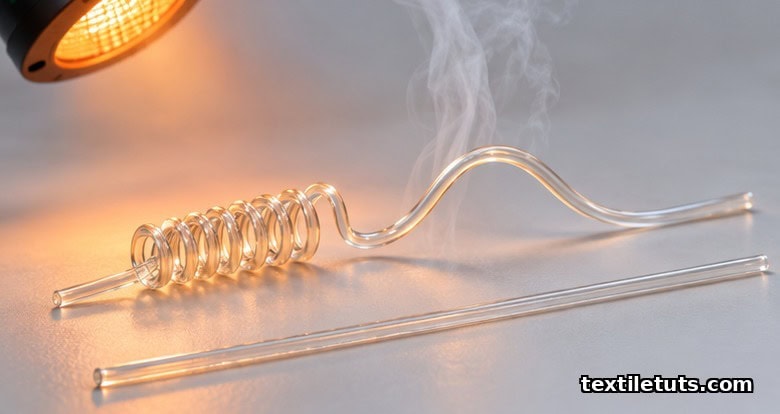
A shape memory textile is a fabric constructed from shape memory polymers (SMPs) or shape memory alloys (SMAs) that can be deformed into a temporary shape, fixed in that configuration, and then returned to a pre-programmed original shape on exposure to a single external stimulus, most commonly heat at a switching temperature between 30 and 90 °C. Polyurethane-based SMP fibers, the dominant commercial class, routinely achieve shape fixity above 98% and shape recovery above 95% across repeated thermo-mechanical cycles, while nickel-titanium Nitinol alloy fibers produce recovery stresses of 200–800 MPa. This guide explains the underlying shape memory effect (SME), the polymer and alloy chemistries used in textile form, the activation triggers beyond heat, manufacturing routes, application areas, and the testing standards that verify shape recovery performance.
How the Shape Memory Effect Works in Textiles
The shape memory effect is a property of certain materials that lets the material “remember” a permanent shape, be deformed and fixed in a different temporary shape, and then revert to the original shape when a stimulus is applied. In textile fibers, this effect is engineered at the polymer chain level (for SMPs) or the crystal structure level (for SMAs).
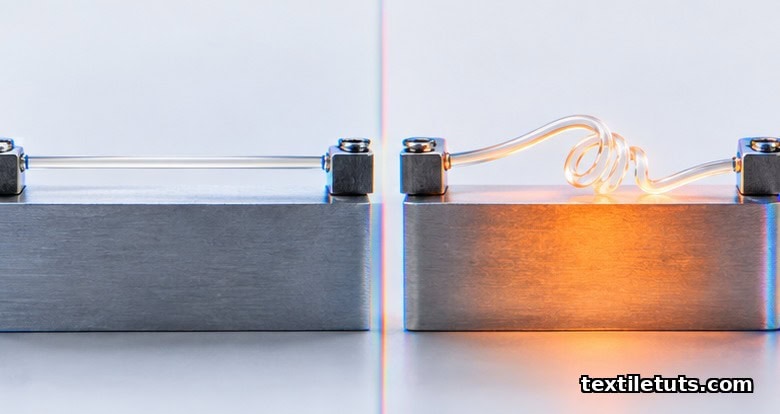
Two quantities describe how well a shape memory fiber performs. Shape fixity (Rf) is the fraction of the imposed mechanical strain that the fiber holds in its temporary shape after the stimulus is removed. Shape recovery (Rr) is the fraction of that strain that the fiber releases when the activation stimulus is reapplied. For a high-performance SMP fiber, Rf is typically 95–99% and Rr is 90–98% across the first 20–50 thermo-mechanical cycles before any noticeable fatigue, according to the foundational SMP review by Lendlein and Kelch (2002).
In a polymer fiber, the mechanism relies on two structural components: a permanent network that stores the original shape (chemical cross-links, hard-segment domains, or crystalline regions with a high melting point) and a switching segment that softens or stiffens in response to the stimulus. When the polymer is heated above its switching transition temperature (Ttrans, set by the melting point of the soft segment for a typical polyurethane SMP), the switching segments become flexible, allowing the fiber to be stretched into a new shape. Cooling below Ttrans locks the temporary shape by re-solidifying those segments, and reheating above Ttrans triggers the elastic pull of the permanent network that drives recovery.
Common Materials Used in Shape Memory Textiles
Textile-grade shape memory materials fall into two families: polymers and alloys. Each has a different performance profile.
Shape memory polymers (SMPs)
Polyurethane SMPs dominate the commercial fiber market. They are block copolymers built from hard segments (typically diisocyanates with short-chain diol extenders) and soft segments (polyether or polyester diols with a controlled molecular weight). The soft-segment melting point defines Ttrans, so chemists can dial the switching temperature anywhere from roughly 0 °C to 100 °C by choosing the soft-segment chemistry and length. Polyester-soft-segment SMPs typically switch between 50 and 80 °C, which is convenient for body-heat activation.
Polyethylene and cross-linked polyolefin SMPs are used in nonwoven and film-based smart textiles where the switching temperature is set by the degree of cross-linking rather than block architecture. These offer lower cost but lower recoverable strain (typically 50–80% versus 100–300% for polyurethanes).
Cyclic and bio-based SMPs, including polynorbornene, polycaprolactone (PCL) segments, and chemically modified chitosan, have been developed for biomedical textiles where biocompatibility and resorption rate matter as much as the mechanical effect.
Shape memory alloys (SMAs)
Nitinol (nickel-titanium, with optional copper, niobium, or chromium additions) is the only SMA used in commercial textiles today. Its switching is driven by a martensite-to-austenite phase transition, which is sharp (a few °C wide) and produces a recovery stress high enough to actuate mechanical work. Nitinol is expensive, difficult to spin into fine fibers (most textile Nitinol is 25–100 µm wire), and reserved for high-value medical and aerospace uses rather than apparel.
Activation Triggers Beyond Heat
Although heating above Ttrans is the most common activation route, modern shape memory textiles respond to other stimuli. The same permanent-and-switching network that drives thermal recovery can be re-engineered to respond to each trigger listed below.
- Light: photoresponsive SMPs contain chromophores (often cinnamate or azobenzene units) that change chain conformation when exposed to UV or visible light. Direct sunlight (around 30 mW/cm² in the UV-A range) is sufficient to trigger recovery in thin films.
- Moisture or water: hydro-responsive SMPs swell when wet, and the swelling-driven plasticization triggers recovery. Moisture-activated recovery works at room temperature and is useful for biomedical scaffolds that release tension when implanted in a wet surgical site.
- Electricity: conductive fillers (carbon nanotubes, silver nanowires, short carbon fibers, graphene flakes) are compounded into the SMP matrix at 2–8 wt%. Applying 1–5 V/mm across the composite Joule-heats the network above Ttrans and triggers recovery without an external oven.
- Magnetic field: magnetic nanoparticles (iron oxide, 5–15 wt%) embedded in the SMP are heated by hysteresis losses in an alternating magnetic field (typically 30–100 kHz, 10–30 kA/m), triggering recovery in implants or actuators where direct heating is impossible.
- pH or chemical: pH-sensitive SMPs contain pendant carboxylic acid or amine groups that protonate or deprotonate, changing the polymer’s effective Ttrans. Targeted drug-release textiles use this effect.
Manufacturing Shape Memory Textiles
Three manufacturing routes dominate the field.
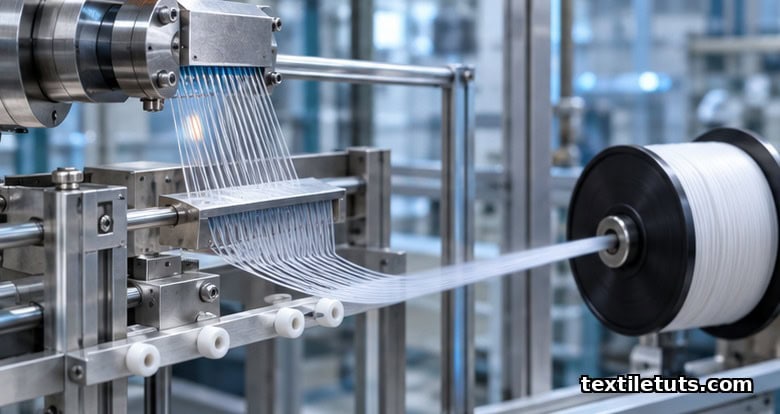
Melt spinning is the standard route for SMP fibers. SMP pellets are melted through a single-screw extruder, metered through a spinneret (typical hole diameter 100–400 µm), drawn at 50–200 m/min, and wound. The drawing ratio sets the orientation of the soft segments and therefore the recoverable strain capacity. Specialty fiber producers (Mitsubishi DiAPLEX, Asahi KASEI, several Chinese producers) supply SMP polyurethane multifilament yarns in 30–150 denier for weaving and knitting.
Solution spinning (wet or dry) is used for polymers that degrade at the melt temperature. The polymer is dissolved, extruded into a coagulation bath or hot-air column, and wound. This is the standard route for cellulose-based and bio-based SMPs.
Coating and finishing apply SMPs as a thin layer on conventional textiles. An SMP solution or dispersion is padded, knife-coated, or screen-printed onto a base fabric (cotton, polyester, nylon). This is the lowest-cost route but the recovered actuation force is limited because the SMP layer is thin (10–80 µm).
Woven, knitted, and nonwoven construction converts the SMP filaments or coated fabrics into final textile structures. Knitted constructions recover more readily because the looped geometry allows large strains, while woven constructions carry higher loads but recover less.
Applications of Shape Memory Textiles
Shape memory textiles sit at the high-value end of the technical textile market. The main application areas are summarized below.
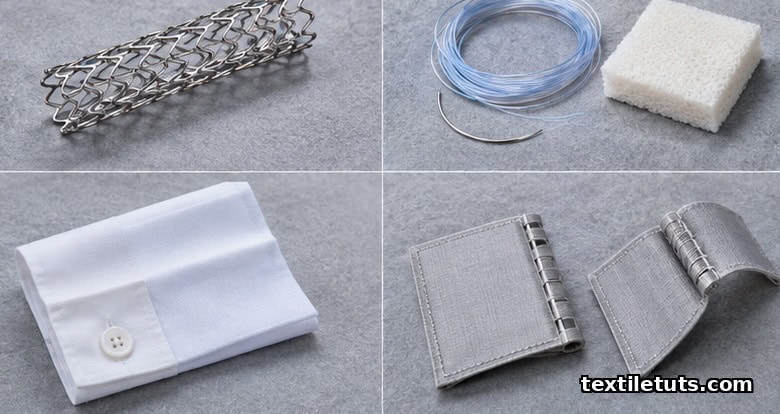
- Medical and hygiene: self-tightening surgical sutures, deployable vascular and ureteral stents braided from Nitinol wire, hemostatic sponges that expand to fill a wound cavity when warmed to body temperature, and smart wound dressings that apply graded compression on warming.
- Protective and workwear: astronaut glove inner liners and spacesuit layers that contract on re-entry heating to restore thermal seal, firefighter jacket inner liners that thicken the air gap under heat, and self-fitting compression garments used in recovery wear.
- Smart apparel and fashion: wrinkle-free shirt cuffs and collars that recover a pressed crease with body heat, deployable fashion pleats that open on warming, and 3D-printed textile sculptures that change shape with temperature.
- Industrial and deployable structures: shape memory composite hinges used in satellite solar array deployment (triggered by sunlight warming) and in space-rigidizable inflatable structures.
- Filtration and technical textiles: SMP filter mats that change pore size with temperature to alter flow rate or capture efficiency in industrial gas streams.
Performance and Recovery Benchmarks
The table below summarizes how a representative SMP polyurethane fiber compares with a Nitinol wire across the metrics textile engineers use to size a shape memory textile.
| Property | SMP polyurethane fiber (DiAPLEX-class) | Nitinol wire (medical grade) |
|---|---|---|
| Switching temperature (Ttrans) | 30–90 °C (tunable via soft-segment chemistry) | 40–110 °C (set by alloy Ni:Ti ratio) |
| Recoverable strain | 100–300% | 6–10% |
| Recovery stress | 1–10 MPa | 200–800 MPa |
| Shape fixity (Rf) | 95–99% | 98–99% |
| Shape recovery (Rr) | 90–98% | 99%+ |
| Density | ~1.1–1.2 g/cm³ | ~6.4–6.5 g/cm³ |
| Typical fiber diameter | 10–50 µm multifilament | 25–200 µm wire |
| Cycles to fatigue | 20–500 (depends on strain) | 10⁴–10⁶ (low-strain) |
| Typical cost | $30–200/kg | $200–800/kg |
Two design lessons follow from this comparison. SMPs carry far higher recoverable strain and at far lower cost than Nitinol, but their recovery stress is roughly two orders of magnitude lower, so they suit low-load applications like garment shaping or smart filters rather than load-bearing actuators. Nitinol wins when both actuation force and cycle count matter, which is why the surgical stent market remains Nitinol-dominated more than two decades after the first commercial Nitinol stent was approved.
Testing Standards for Shape Memory Behavior
Shape memory textile performance is characterized by the combined mechanical and thermal load cycle, so no single textile standard captures the effect in isolation. Practitioners rely on a small cluster of ASTM and ISO methods.
- ASTM D638: tensile properties of plastics, used as the base method for SMP filament tensile testing at temperatures both below and above Ttrans.
- ASTM D3822: tensile properties of single textile fibers, used to compare SMP filaments against conventional fibers.
- ISO 527-1: tensile testing of plastics, the European counterpart of ASTM D638 and routinely cited alongside ASTM methods for SMP composite work.
- ASTM F1639: standard test methods for tissue-engineered medical products (TEMPs), applied to medical-grade SMP scaffolds and Nitinol fiber constructs.
- ISO 10993 series: biocompatibility evaluation, mandatory for any SMP or Nitinol textile that contacts human tissue (implants, sutures, wound dressings).
A typical Rf and Rr measurement loads an SMP filament under tension above Ttrans, cools it under load to fix the temporary shape, removes the load, measures the residual strain, then reheats above Ttrans and measures the residual strain after recovery. The two ratios are calculated from those strain values using the formulas in Lendlein and Kelch’s 2002 review, which remains the reference protocol two decades on.
Frequently Asked Questions
What is a shape memory textile?
A shape memory textile is a fabric made from fibers that can be deformed, fixed in a temporary shape, and then returned to a programmed original shape on exposure to a stimulus such as heat, light, moisture, electricity, or a magnetic field. The shape memory effect is engineered into the fiber polymer structure (for SMPs) or alloy crystal structure (for Nitinol) and survives weaving or knitting into a textile.
How are shape memory textiles activated?
The most common activation route is heating above the switching temperature Ttrans, which for apparel and biomedical uses is typically set between 30 and 60 °C so that body heat alone is sufficient. Other activation routes include UV light (for photoresponsive SMPs), water uptake (for hydro-responsive SMPs), an applied voltage of 1–5 V/mm across a conductive SMP composite, and an alternating magnetic field for SMPs loaded with iron oxide nanoparticles.
What is the difference between shape memory polymers and shape memory alloys in textiles?
SMPs have lower density (1.1–1.2 g/cm³ versus 6.4–6.5 g/cm³ for Nitinol), much higher recoverable strain (100–300% versus 6–10%), and much lower actuation force. Nitinol produces recovery stresses of 200–800 MPa, roughly 30 to 80 times higher than SMP polyurethane fibers. SMPs are the practical choice for garments and filters; Nitinol is reserved for medical implants and aerospace actuators.
How long do shape memory textiles last?
Cycle life depends on the material and the strain per cycle. SMP polyurethane fibers tolerate 20 to 500 cycles before Rr drops noticeably if operated at high (over 100%) strain; they last thousands of cycles if operated at low (under 20%) strain. Nitinol tolerates 10,000 to 1,000,000 cycles at low strain and remains the most fatigue-tolerant shape memory material in commercial use.
Are shape memory textiles safe for medical use?
Both Nitinol and biocompatible SMPs (polyurethane and polycaprolactone grades) have a multi-decade clinical record when processed under ISO 13485 quality systems and tested to the ISO 10993 biocompatibility series. Nitinol vascular stents are an established treatment for peripheral artery disease. The risk is not the material chemistry itself but the absence of proper biocompatibility testing on poorly characterized grades, which is why medical shape memory textiles must come with a documented ISO 10993 compliance file.
References
- Lendlein, A., & Kelch, S. (2002). Shape-memory polymers. Angewandte Chemie International Edition, 41(12), 2034–2057. The foundational SMP review, widely cited as the reference protocol for Rf and Rr measurements.
- Leng, J., Lan, X., Liu, Y., & Du, S. (2011). Shape-memory polymers and their composites: Stimulus methods and applications. Progress in Materials Science, 56(7), 1077–1135. Comprehensive review of SMP composites, activation routes, and applications.
- Hu, J., Meng, H., Li, G., & Leng, J. S. (2012). Review on actively moving functional textiles. Textile Research Journal, 82(15), 1581–1591. The Journal of the Textile Institute’s primary review of shape memory and active textile systems.
- Behl, M., & Lendlein, A. (2007). Actively moving polymers. Soft Matter, 3(1), 58–67. Authoritative survey of multi-stimuli SMP systems.
- ASTM D638-22: Standard Test Method for Tensile Properties of Plastics. ASTM International, West Conshohocken, PA, 2022. Base tensile method used for SMP filament characterization below and above Ttrans.
- ISO 10993-1:2018: Biological evaluation of medical devices, Part 1. International Organization for Standardization, Geneva. Biocompatibility framework applied to medical shape memory textile implants and wound dressings.
This article is the working reference for shape memory textiles. Editorial by Md. Asad Ullah (Meem), TextileTuts. Sources: Lendlein and Kelch (2002), Leng et al. (2011), Hu et al. (2012), Behl and Lendlein (2007), ASTM D638-22, ISO 10993-1:2018 as cited.


