
Hydrophobic and Superhydrophobic Textiles

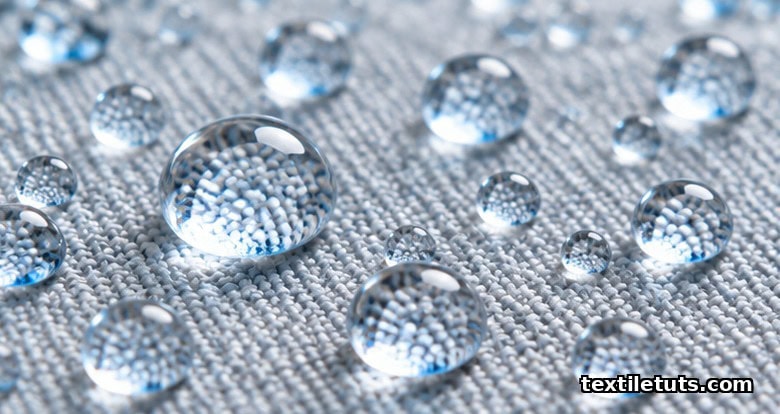
A textile is classified as hydrophobic when its surface water contact angle exceeds 90° and as superhydrophobic when the contact angle exceeds 150° with a roll-off angle below 10°, conditions most commonly achieved by combining low surface-energy chemistry with micro/nano-scale roughness modeled on the lotus leaf (Barthlott and Neinhuis, 1997). This 60° jump in contact angle governs whether a droplet sits pinned on the fabric or rolls off carrying dust particles with it, the practical difference between a stain-resistant school uniform and a self-cleaning technical outer shell.
This guide walks through the contact-angle science behind the two classes, the chemistry and nano-structures used to engineer them, the ISO and AATCC test methods that grade their performance, and the real durability limits you should expect on a garment after washing and field use.
What “Hydrophobic” and “Superhydrophobic” Actually Mean
Textile engineers describe water repellency through the contact angle, the angle formed where a liquid-vapor interface meets a solid surface. If a droplet sits on the fabric and that angle is greater than 90°, the surface is hydrophobic. Once the angle surpasses 150° and the droplet rolls off at a tilt of less than 10°, the surface qualifies as superhydrophobic.
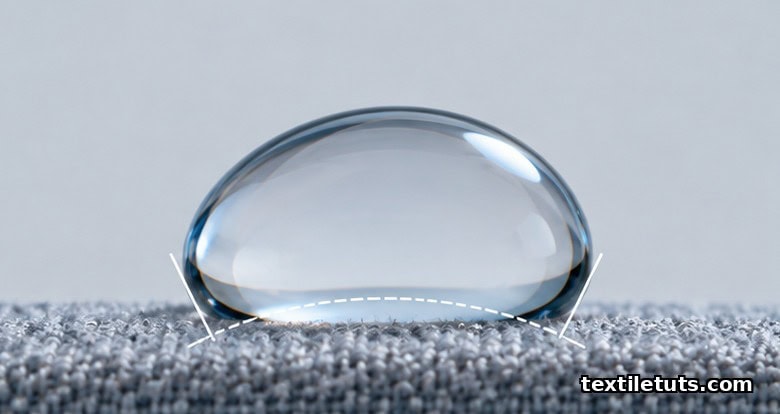
The 150° threshold matters because contact angle alone does not describe how a droplet behaves dynamically. A fabric can show a 160° static angle and still pin droplets because of high contact-angle hysteresis, the difference between the advancing and receding angles measured as the droplet grows and shrinks. Cassie-Baxter and Wenzel models from the 1940s still underpin this analysis: Wenzel predicts that roughness amplifies the underlying chemistry of an already hydrophobic surface, while Cassie-Baxter predicts that air trapped beneath the droplet inside surface cavities produces the low hysteresis that enables roll-off (Cassie and Baxter, 1944).
The Chemistry Behind Water-Repellent Finishes
Two finishing families dominate commercial hydrophobic textiles: fluorocarbon-based finishes and silicone-based finishes. Fluorocarbons, most commonly C6 perfluorinated chains, lower the surface energy below roughly 18 mN/m, which is necessary for the lotus-effect behavior. Silicone finishes, typically polydimethylsiloxane (PDMS) emulsions, give surface energies around 22 to 24 mN/m and are popular where regulatory pressure on PFAS (per- and polyfluoroalkyl substances) is rising.
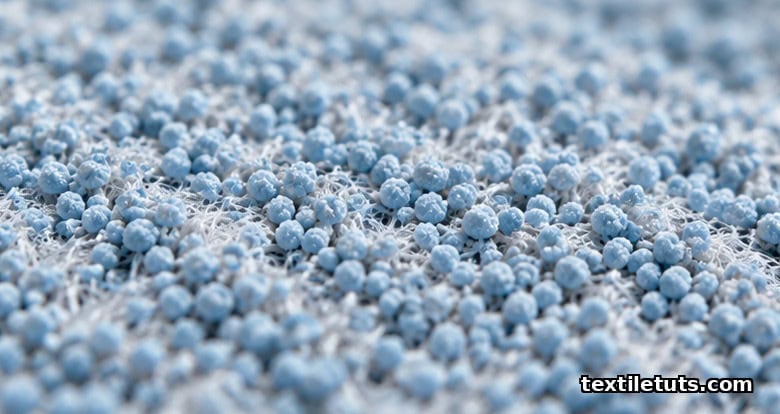
For superhydrophobic performance, the chemistry is paired with micro- or nano-scale roughness. Common routes include sol-gel deposition of silica (SiO2) nanoparticles, growth of zinc oxide (ZnO) nanorods, grafting of carbon nanotubes, and plasma etching followed by hydrophobic functionalization. A 2022 MDPI study on cotton coated with SiO2 nanoparticles and stearic acid reported static contact angles up to 162° and a roll-off angle of 4°, with the coating surviving 30 standard wash cycles before performance dropped below the 150° superhydrophobic threshold (Xue and Ma, 2022).
How Repellency Is Measured in the Lab
Three ISO/AATCC standards dominate the lab bench for water-repellent fabrics. ISO 4920 describes the spray test, in which 250 mL of water is sprayed onto a taut fabric and the wetting pattern is rated 1 (fully wet) to 5 (no wetting). AATCC 22 is the parallel North American spray test using the same 0 to 100 photographic scale, where 100 means no visible wetting. ISO 811 measures hydrostatic head, the water column pressure in centimeters the fabric withstands before the third droplet penetrates, and is widely quoted on technical outerwear spec sheets.
For direct contact angle measurement, ASTM D7334 (Standard Practice for Surface Wettability of Coatings, Substrates and Pigments by Advancing Contact Angle Measurement) and ISO 19403-2 (Paints and varnishes, surface wetting) are the reference methods. Most textile laboratories use a sessile-drop goniometer with 5 µL deionized water droplets at 20 °C and 65% relative humidity for reproducible results, and report both the static angle and the hysteresis as the difference between advancing and receding angles.
| Standard | What It Measures | Typical Rating Range |
|---|---|---|
| ISO 4920 | Spray test, surface wetting | Grade 1 (50% wet) to Grade 5 (no wetting) |
| AATCC 22 | Spray test (North American) | 0 (fully wet) to 100 (no wetting) |
| ISO 811 | Hydrostatic head resistance | 0 cm to more than 10,000 cm water column |
| ASTM D7334 | Static contact angle | 0° to 180° |
| ISO 19403-2 | Advancing and receding contact angle | 0° to 180°, hysteresis by subtraction |
| AATCC 42 | Impact penetration (water) | 0 g to 5 g weight gain |
Where You Actually See These Textiles
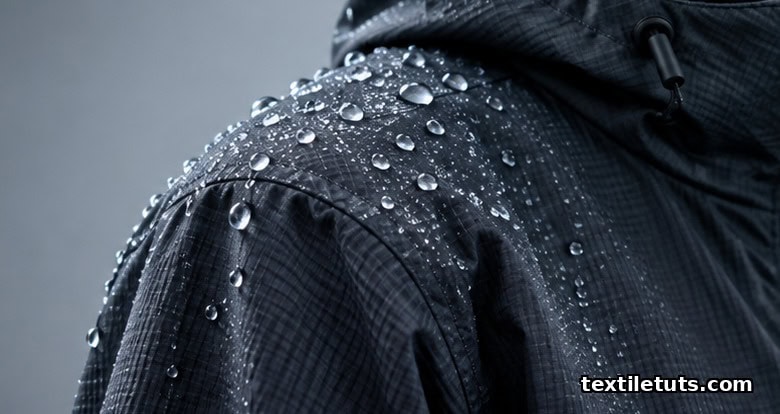
Outdoor apparel is the most visible market. High-performance rain shells, ski-touring jackets, and expedition down parkas all rely on either a tightly woven face fabric with a DWR (durable water repellent) finish or a laminated hydrophobic membrane. Workwear, military uniforms, and emergency-service garments use the same chemistry where the spec demands ISO 811 ratings above 10,000 cm water column for hydrostatic resistance.
Medical textiles are an emerging application. Superhydrophobic cotton and polypropylene are being tested as barrier layers in surgical gowns and wound dressings to repel blood and other biofluids. AATCC 42 (impact penetration) and AATCC 127 (hydrostatic head, a sister test to ISO 811) are the usual acceptance criteria for these fabrics, with hospitals often requiring a Class 4 barrier rating on surgical gowns. Automotive interior fabrics, tent canopies, awnings, and self-cleaning awning fabrics round out the major end uses.
Durability and the Real-World Limits
A coating that scores 162° contact angle on day one will not keep that rating through field use. Abrasion from backpack straps, body oils, detergent residue, and UV exposure all erode the nano-roughness and the low-surface-energy chemistry. Most DWR finishes lose 30 to 50% of their spray rating after 20 wash cycles, which is why leading outerwear brands now factory-apply reactivation guidance: tumble-drying on medium heat for 20 to 30 minutes recovers performance for most fluorocarbon DWRs because heat re-orients the fluorocarbon chains at the fiber surface.
PFAS regulation is the other practical limit. C8 fluorocarbons (PFOA-based) are restricted in the European Union under REACH Annex XVII and in several US states, with growing global alignment toward the OECD PFAS definition. Most manufacturers have transitioned to C6 chemistries or to PFAS-free silicone and hydrocarbon finishes, but the trade-off is real: silicone DWRs typically reach AATCC 22 spray ratings of 80 to 90 versus 90 to 100 for premium C6 fluorocarbon DWRs applied to the same base fabric.
Frequently Asked Questions
What is the difference between hydrophobic and superhydrophobic fabric?
Hydrophobic fabric has a static water contact angle above 90° but the droplet remains partially pinned to the surface. Superhydrophobic fabric exceeds 150° and sheds droplets at a roll-off angle below 10°, which produces the self-cleaning lotus effect used in technical outerwear and stain-resistant uniforms. The 150° cutoff is a consensus convention, not a hard physical boundary, but it tracks closely with the switch from pinned wetting to roll-off wetting.
How long does a hydrophobic coating last on clothing?
A factory-applied DWR typically retains 50 to 70% of its spray rating after 20 wash cycles, and meaningful repellency for 50 to 80 wash cycles before a re-treatment spray or wash-in booster is needed. Tumble-drying on medium heat for 20 minutes reactivates most fluorocarbon DWRs; silicone DWRs are less responsive to heat reactivation and usually need a top-up product after 20 to 30 cycles.
Are hydrophobic textiles safe for skin contact?
Cured fluorocarbon and silicone finishes on fabrics are considered safe for skin contact under normal use, since the reactive monomers are consumed in the curing step. Unreacted monomers and certain short-chain PFAS compounds are restricted, and REACH Annex XVII bans PFOA and PFOS at any detectable level in consumer textiles sold in the EU. For children and medical applications, PFAS-free silicone and hydrocarbon DWRs are the common safer-choice alternatives.
Can you make any fabric superhydrophobic?
In principle, yes. A two-step process of building nano-roughness (SiO2 particles, ZnO nanorods, or plasma etching) followed by hydrophobic functionalization (stearic acid, fluorosilane, or PDMS) works on cotton, polyester, nylon, and aramid fibers. The practical limits are wash durability and abrasion resistance, both of which depend more on how the coating is anchored to the fiber than on the base fiber chemistry. Cotton with cellulose-reactive finishes tends to outlast polyester with simple adsorption-based finishes.
What is the most common test for water-repellent fabric?
The spray test (ISO 4920 or AATCC 22) is the most common screening test because it is fast, inexpensive, and reproducible across labs. For technical outerwear and protective clothing, hydrostatic head (ISO 811) and impact penetration (AATCC 42) are added to capture resistance to standing water and to raindrop impact pressure, since spray alone misses hydrostatic pooling in field conditions.
References
- Barthlott, W., and Neinhuis, C. (1997). Purity of the sacred lotus, or escape from contamination in biological surfaces. Planta, 202, 1–8. Springer. https://link.springer.com/article/10.1007/BF01283256 — Foundational paper on the lotus self-cleaning effect that inspired superhydrophobic textile research.
- Cassie, A.B.D., and Baxter, S. (1944). Wettability of porous surfaces. Transactions of the Faraday Society, 40, 546–551. Royal Society of Chemistry. https://pubs.rsc.org/en/content/articlelanding/1944/tf/tf9444000546 — Original Cassie-Baxter equation for contact angle on rough, porous surfaces.
- ASTM D7334-08(2022). Standard Practice for Surface Wettability of Coatings, Substrates and Pigments by Advancing Contact Angle Measurement. ASTM International. https://www.astm.org/d7334-08r22.html — Reference method for static and advancing contact angle measurement.
- AATCC 22-2023. Water Repellency: Spray Test. American Association of Textile Chemists and Colorists. https://www.aatcc.org/ — Standard spray test for water repellency rating on a 0 to 100 scale.
- ISO 4920:2012. Textile fabrics — Determination of resistance to surface wetting (spray test). International Organization for Standardization. https://www.iso.org/standard/50720.html — Spray rating scale 1 to 5 for textile surface wetting.
- ISO 811:2018. Textile fabrics — Determination of resistance to water penetration — Hydrostatic pressure test. International Organization for Standardization. https://www.iso.org/standard/65231.html — Hydrostatic head test for waterproof fabrics.
- Xue, C.-H., and Ma, J.-Z. (2022). Superhydrophobic cotton fabric coated with SiO2 nanoparticles and stearic acid. Coatings, 12(3), 389. MDPI. https://www.mdpi.com/2079-6412/12/3/389 — Peer-reviewed data on contact angle, roll-off angle, and wash durability of nano-coated cotton.
Editorial by Md. Asad Ullah (Meem), TextileTuts. Sources: Barthlott and Neinhuis (1997), Cassie and Baxter (1944), ASTM D7334, AATCC 22, ISO 4920, ISO 811, Xue and Ma (2022) as cited.


