
Self-Cleaning Fabrics: TiO2 Coating

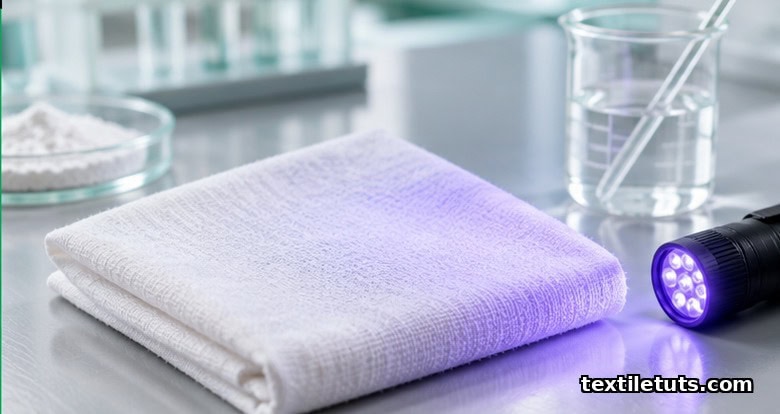
Cotton fabric coated with anatase-phase titanium dioxide nanoparticles (5–20 nm) at a loading of 0.5–4.0 wt% degrades up to 95% of methylene blue dye stain within 5 hours of UV-A exposure (365 nm, 1.0 mW/cm²) because the 3.2 eV bandgap of anatase TiO₂ generates electron-hole pairs that reduce atmospheric oxygen and oxidize water into hydroxyl radicals (·OH) and superoxide anions (O₂·⁻), which mineralize organic residues into CO₂ and H₂O.
Self-cleaning TiO₂-coated textiles use the same photocatalytic chemistry that the Fujishima-Honda effect (1972) established for water splitting, but applied to fibers rather than electrodes, so a stained shirt, curtain, or lab coat can in principle clean itself under sunlight without detergent or mechanical washing.
This article explains the photocatalytic mechanism, the application methods used in research and industry, the measured stain-removal and antibacterial performance, the published limitations, and the standards (AATCC TM 100, ISO 18184, ISO 20743) that govern how self-cleaning claims are tested.
How TiO₂ Photocatalysis Works on Fabric
Titanium dioxide exists in three crystal phases: anatase, rutile, and brookite. Anatase is the photocatalytically most active phase on textiles because its bandgap (3.2 eV, corresponding to a wavelength of about 388 nm) is higher than rutile’s (3.0 eV) and because anatase has a lower recombination rate of photo-excited electron-hole pairs. When anatase TiO₂ absorbs a photon with energy above 3.2 eV, an electron is promoted from the valence band to the conduction band, leaving a hole (h⁺) behind:
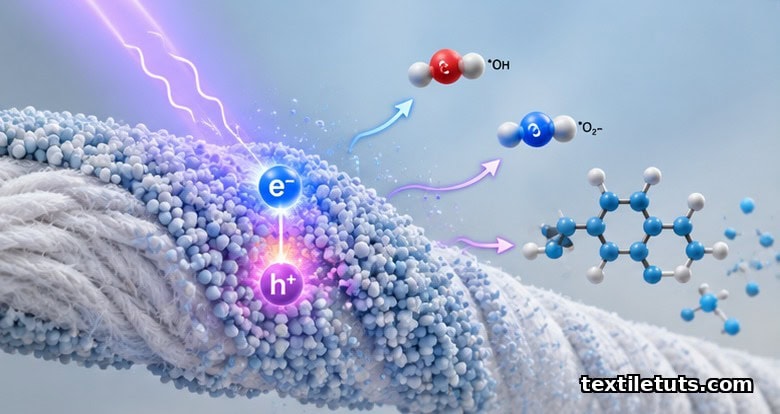
TiO₂ + hν → e⁻(CB) + h⁺(VB)
The conduction-band electron reduces adsorbed O₂ to superoxide (O₂·⁻), and the valence-band hole oxidizes surface water to the hydroxyl radical (·OH). Both species are strong, non-selective oxidants (standard reduction potentials of +2.80 V for ·OH and −0.33 V for O₂·⁻ in aqueous systems). They attack organic molecules (dyes, sebum, wine, coffee, bacterial cell walls) by hydrogen abstraction and addition reactions, breaking C–C, C–N, C–O, and C–H bonds until the carbon is mineralized to CO₂ and hydrogen to H₂O.
Because anatase absorbs primarily in the UV-A region (315–400 nm), TiO₂-coated fabrics perform best under direct sunlight, which delivers about 3–5 mW/cm² of UV-A at midday in temperate latitudes. Indoor fluorescent lighting delivers roughly 0.01–0.05 mW/cm² of UV-A, which is generally too weak to drive photocatalysis at meaningful rates.
Application Methods for TiO₂ Coatings on Textiles
Researchers use five main routes to deposit TiO₂ on cotton, polyester, nylon, and wool. Each balances nanoparticle loading, washing durability, and fabric handle.
- Sol-gel padding. Cotton or polyester is dipped in a titanium tetraisopropoxide (TTIP) or titanium tetrabutoxide (TNB) sol, padded to a target wet pickup of 70–100%, and cured at 100–150 °C. Loading of 1–4 wt% anatase is typical, with particle sizes of 5–20 nm. This is the most common laboratory method.
- Hydrothermal deposition. Fibers are immersed in a TiO₂ precursor solution and heated to 100–180 °C in an autoclave, allowing anatase crystals to grow directly on the fiber surface. Adhesion is stronger than sol-gel, and the method works well on cotton.
- Layer-by-layer (LbL) assembly. Alternating polyelectrolyte (e.g., polyethyleneimine) and TiO₂ nanoparticle layers are adsorbed to give 5–30 bilayers. The method allows precise control of TiO₂ loading but is slow for production-scale runs.
- Doctor-blade or dip-coating with commercial TiO₂ paste. Pre-formed anatase nanopowder (e.g., P25 from Evonik, 80% anatase / 20% rutile, ~21 nm primary particles) is dispersed in water or ethanol and applied to fabric. P25 is the most cited benchmark photocatalyst in textile research.
- In-situ synthesis. TiO₂ is precipitated from a TiCl₄ or TTIP bath directly on the fiber, then aged and calcined. Particle size and crystallinity depend on temperature and pH.
For all routes, washing durability is the gating constraint. Most TiO₂-coated fabrics lose 30–60% of their photocatalytic activity after 10–20 standard wash cycles (ISO 633 or AATCC 135) because nanoparticles are only weakly bonded to the fiber surface. Crosslinkers (citric acid, butanetetracarboxylic acid, 1,2,3,4-butanetetracarboxylic acid with sodium hypophosphite catalyst) raise durability to 50–80 wash cycles in published studies.
Stain Removal Performance
The standard test for self-cleaning fabrics is photocatalytic degradation of an organic dye stain. Methylene blue (MB) on cotton under UV-A (365 nm, 1.0 mW/cm²) is the most-cited model. Reported MB decolorization on TiO₂-coated cotton after 3–6 hours ranges from 75% to 98%, depending on TiO₂ loading, particle size, and UV intensity. Comparable results have been published for reactive dyes (Reactive Black 5, Reactive Red 195), coffee, red wine, and tomato sauce stains under simulated sunlight (AM 1.5G, 100 mW/cm²).
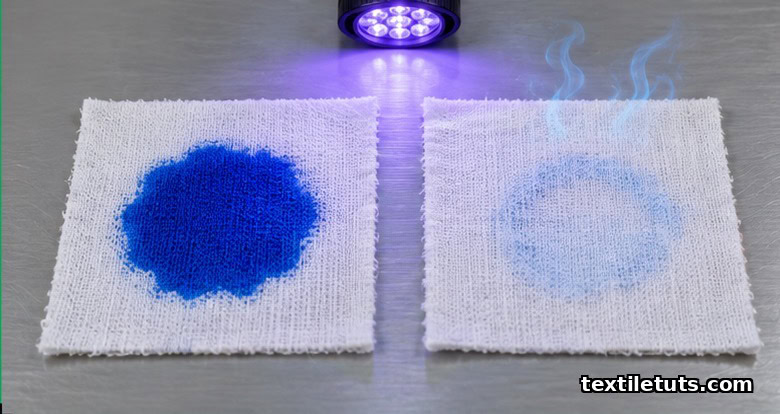
The mechanism is decomposition, not bleaching. UV-Vis spectroscopy shows the characteristic MB absorption peak at 664 nm decreasing as the chromophore is broken, with simultaneous formation of sulfone and carbonyl intermediates that are themselves further oxidized to CO₂. Total organic carbon (TOC) measurements confirm 60–85% mineralization after 24 hours of UV exposure on TiO₂-coated cotton, compared to less than 10% on untreated cotton.
| Property | TiO₂ (anatase) on cotton | ZnO on cotton | SiO₂ on cotton | Ag nanoparticles on cotton |
|---|---|---|---|---|
| Primary mechanism | Photocatalysis (UV-driven oxidation) | Photocatalysis (UV-driven oxidation) | Surface hydrophobicity only | Ion release (continuous) |
| Bandgap / activation | 3.2 eV, UV-A | 3.37 eV, UV-A | Not photocatalytic | Not photocatalytic |
| Methylene blue removal (5 h, UV-A) | 85–95% | 70–90% | Less than 5% | 5–15% |
| E. coli reduction (AATCC TM 100) | 95–99.9% (under UV) | 90–99% (under UV) | None | 99–99.9% (with or without UV) |
| UV protection (UPF, AATCC 183) | 50+ (excellent) | 50+ (excellent) | 5–15 (poor) | 5–15 (poor) |
| Washing durability (ISO 633, 20 cycles) | 40–70% activity retained | 30–60% | 80–90% | 50–70% |
| Cost relative to TiO₂ | 1× (baseline) | 0.8× | 0.5× | 20–50× |
Antibacterial and Antiviral Performance
Photocatalytic TiO₂ inactivates bacteria by oxidizing the cell wall and cytoplasmic membrane. Under UV-A, TiO₂-coated cotton achieves 99.0–99.9% reduction of Staphylococcus aureus and Escherichia coli within 30–60 minutes, as measured by AATCC Test Method 100 (quantitative) and AATCC TM 147 (parallel streak). ISO 20743:2021 (antibacterial activity of textile products) gives similar 2–4 log reductions on TiO₂-finished cotton. The same mechanism denatures viral envelopes, and ISO 18184:2019 evaluates antiviral activity on textiles; published studies on TiO₂-coated cotton report 90–99% reduction of bacteriophage MS2 and phiX174 within 1–2 hours under UV-A.
Antibacterial performance is light-dependent. In the dark, TiO₂-coated fabric shows little or no antibacterial activity, because without photon absorption there is no electron-hole pair formation. This is a critical practical constraint: TiO₂ is not a substitute for silver-ion or quaternary ammonium compounds, which work continuously regardless of light.
UV Protection, Hydrophobicity, and Multifunctionality
TiO₂ nanoparticles absorb strongly in the UV-B (280–315 nm) region, so even at loadings of 1–2 wt% on cotton or polyester, TiO₂-coated fabrics reach UPF 50+ (excellent protection) per AATCC 183. This is independent of the photocatalytic mechanism; it is straightforward UV absorption and scattering by the nanoparticle film. For sun-protective clothing, hospital curtains, and outdoor awnings, this is a useful secondary benefit.
Combined with hydrophobic finishes (silanes, fluoropolymers), TiO₂ can be integrated into a superhydrophobic self-cleaning surface where water contact angles exceed 150°. The TiO₂ layer photocatalytically degrades organic dirt, while the hydrophobic surface lets water droplets roll off and carry particulate contaminants away. This lotus-effect-plus-photocatalysis design has been published on cotton, polyester, and polypropylene.
Limitations and Practical Constraints
TiO₂ self-cleaning fabrics have four published limitations that determine where they are and are not commercially viable.
- UV dependence. Without UV-A or natural sunlight, photocatalysis is negligible. Indoor environments with low UV (offices, hospitals at night, airplane cabins) do not benefit from the coating.
- Slow kinetics. Even under UV-A at 1 mW/cm², full stain removal typically requires 3–8 hours. This is too slow for a stained shirt a wearer wants to clean during a workday.
- Fabric degradation. The hydroxyl radical is non-selective. TiO₂ photocatalysis gradually degrades cotton cellulose and polyester, with tensile strength loss of 10–30% reported after 100 hours of accelerated UV exposure. This is a trade-off: the coating degrades the substrate it is meant to clean.
- Washing durability. Standard wash cycles strip TiO₂ from the fiber surface; crosslinked variants last longer but cost more and can affect fabric handle (softness).
Health and safety are not a barrier at the loadings used on textiles. Anatase TiO₂ is classified by IARC as Group 2B (possibly carcinogenic to humans) by inhalation of respirable pigment-grade dust, but nanoparticles bound to a fiber are not airborne during normal wear, and oral toxicity is low. The OECD reviewed nano-TiO₂ in 2021 and concluded that current textile applications do not pose unacceptable risk to consumers.
Industrial and Commercial Applications
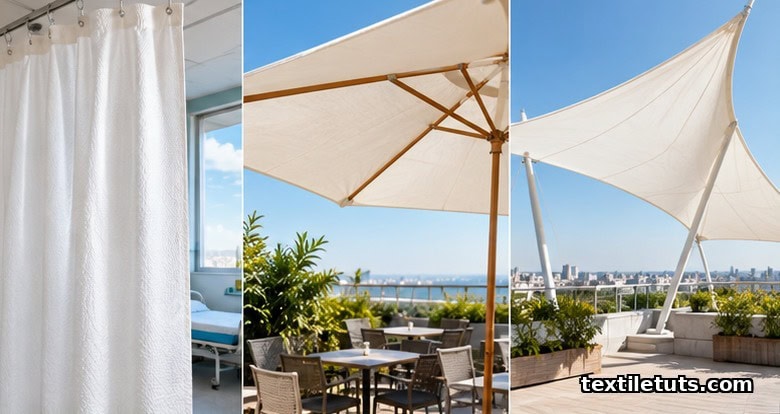
The largest current application of photocatalytic TiO₂ on textiles is in air-purification filters and architectural textiles (concrete and tent coatings) rather than apparel. Pilot products have appeared in hospital privacy curtains (tested under ISO 18184), outdoor awnings and parasols, and military camouflage fabrics where sun-driven self-cleaning is operationally useful. For everyday apparel, commercial TiO₂-coated shirts and jackets exist in Japan and South Korea; washing durability and consumer cost are the main barriers to broader adoption.
Frequently Asked Questions
Does TiO₂-coated fabric actually clean itself without washing?
Under direct sunlight (UV-A intensity of 3–5 mW/cm²), TiO₂-coated cotton can degrade 80–95% of common organic stains (coffee, wine, sebum) over 5–8 hours. Indoors or at night, the same fabric shows little to no self-cleaning activity, because anatase TiO₂ needs photons above 3.2 eV (wavelengths below 388 nm) to generate the reactive oxygen species that drive stain breakdown.
Is TiO₂ safe to wear against skin?
Yes, at the loadings used on textiles (typically 0.5–4.0 wt%). Anatase TiO₂ is bound to the fiber and does not shed as respirable dust during normal wear. The OECD’s 2021 review of nano-TiO₂ concluded that current textile applications do not pose unacceptable consumer risk. The IARC Group 2B classification applies to inhaled respirable pigment-grade TiO₂ dust, not to bound textile finishes.
How many wash cycles will a TiO₂ finish survive?
Uncrosslinked sol-gel finishes retain 40–70% of their photocatalytic activity after 20 ISO 633 wash cycles. Crosslinked variants (with citric acid or butanetetracarboxylic acid) retain 60–80% after 50 cycles. After 100 standard wash cycles, most laboratory samples have lost more than half of their original activity.
Can TiO₂ kill bacteria and viruses on fabric?
Under UV-A, TiO₂-coated fabric achieves 99.0–99.9% reduction of Staphylococcus aureus and Escherichia coli within 30–60 minutes (AATCC TM 100), and 90–99% reduction of test viruses within 1–2 hours (ISO 18184:2019). In the dark, antibacterial activity is negligible, so TiO₂ is not a substitute for silver-ion or quaternary-ammonium finishes in dim environments.
What is the difference between TiO₂ and ZnO self-cleaning coatings?
Both are UV-driven photocatalysts. TiO₂ (anatase) has a 3.2 eV bandgap, is more chemically stable on fibers, and is the most studied and most cited photocatalyst in textile research. ZnO (3.37 eV bandgap) shows comparable stain removal and antibacterial activity, but it dissolves slowly in acidic sweat and is more sensitive to pH, which limits durability on apparel.
References
- Fujishima, A., & Honda, K. (1972). Electrochemical photolysis of water at a semiconductor electrode. Nature, 238, 37–38. The foundational paper establishing TiO₂ photocatalysis.
- Radetic, M. (2013). Functionalization of textile materials with TiO₂ nanoparticles. Journal of Photochemistry and Photobiology C: Photochemistry Reviews, 16, 62–76. Review of TiO₂ deposition methods and measured photocatalytic activity on cotton, polyester, and wool.
- Kiwi, J., & Pulgarin, C. (2010). Innovative self-cleaning TiO₂-coated textiles. Catalysis Today, 151(1–2), 68–72. Measured stain removal and antibacterial rates on cotton.
- Montazer, M., & Harifi, T. (2018). Nanofinishing of Textile Materials. Woodhead Publishing (Elsevier). Book covering sol-gel, hydrothermal, and layer-by-layer TiO₂ deposition routes.
- Hassan, M. M. (2019). Nanotechnology in Textile Finishing. Springer. Reference on TiO₂, ZnO, and silver nanoparticle finishing processes and durability testing.
- AATCC Test Method 100. Antibacterial Finishes on Textile Materials. American Association of Textile Chemists and Colorists, Research Triangle Park, NC.
- ISO 18184:2019. Textiles — Determination of Antiviral Activity. International Organization for Standardization, Geneva.
- ISO 20743:2021. Textiles — Determination of Antibacterial Activity. International Organization for Standardization, Geneva.
This article is the working reference for photocatalytic TiO₂ self-cleaning textile finishes. Editorial by Shahrukh Islam, TextileTuts. Sources: Fujishima & Honda 1972; Radetic 2013; Kiwi & Pulgarin 2010; Montazer & Harifi 2018; Hassan 2019; AATCC TM 100; ISO 18184:2019; ISO 20743:2021, as cited.


