
Sewing Thread Spinning Process

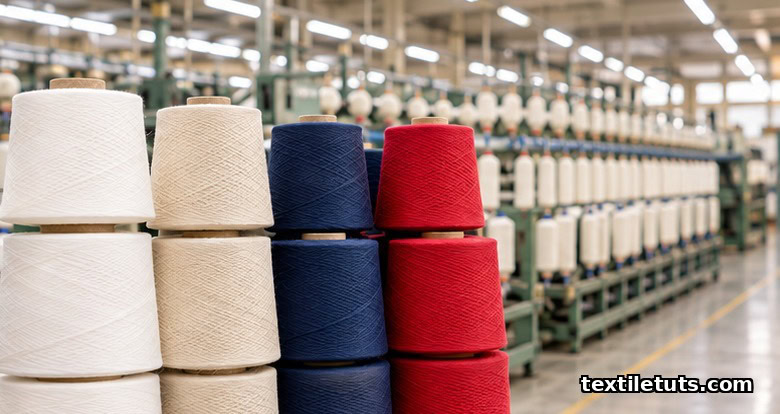
Sewing thread is manufactured by twisting staple fibers (38-50 mm polyester or combed cotton) or continuous polyester filaments, often around a filament core, at a twist multiplier of 3.0-4.5, producing yarns of 12-200 tex with tensile strengths between 20-60 cN/tex depending on construction.
This article walks through the engineering behind every spool: how fiber selection, drafting, twist geometry, and post-spinning finishing combine to give sewing thread its characteristic seam strength, low friction, and abrasion resistance. You will see why a 40s core-spun poly-cotton thread behaves nothing like a 40s ring-spun cotton thread, even though they share a yarn count.
What Sewing Thread Is, and Why It Is Spun Differently
Sewing thread is a special-purpose yarn engineered to survive the high stress, friction, and heat of the sewing needle without breaking or shedding fiber debris. ISO 8239 and ASTM D204 both define sewing thread as a yarn intended for stitching, and they require a minimum breaking tenacity roughly 30-50% higher than a comparable apparel weft yarn of the same linear density. To meet that requirement, manufacturers do three things ordinary yarn spinning does not: (1) they increase twist to lock fibers more tightly, (2) they often wrap a high-tenacity filament core with a spun fiber sheath, and (3) they lubricate and sometimes singe the surface to reduce needle friction.
The standard tex range for apparel sewing thread sits between 12 and 60 tex, with heavier thread (up to 200 tex) reserved for denim, leather, and industrial seams. Twist direction matters too: virtually all commercial sewing thread is Z-twist, because sewing machine feed dogs and bobbin cases are designed to release Z-twist yarn without unravelling the surface fibers.
Fiber Selection: What Goes Into a Sewing Thread
Three fiber families dominate global sewing thread production: combed cotton, polyester staple (typically 1.2-1.5 denier, 38 mm), and polyester filament (50-150 denier). Cotton gives the best needle heat tolerance and a natural fiber feel against skin, making it the standard for shirts, babywear, and embroidery. Polyester filament offers the highest tenacity per unit linear density (typically 55-65 cN/tex), low shrinkage under hot-pressing, and excellent color fastness, which is why most all-purpose and upholstery thread is filament polyester. Polyester staple thread sits between the two, with the look and sewability of cotton but the strength and mildew resistance of polyester.
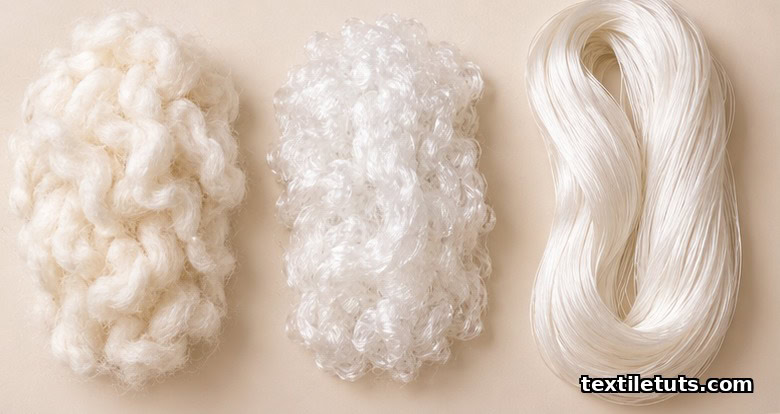
For core-spun constructions, the core is almost always a continuous polyester filament (50-100 denier), while the sheath can be cotton, polyester staple, or a blend. Cotton-wrapped cores deliver the classic “polished cotton” look favored in shirt manufacturing, while polyester-wrapped cores dominate industrial and outdoor applications. Core-spun threads can reach breaking tenacities of 35-45 cN/tex even at relatively coarse counts, which is the main reason they have largely replaced 100% cotton thread in commercial apparel production.
The Spinning Process: From Blowroom to Package
For staple-fiber sewing thread, the route through the spinning mill follows the conventional short-staple sequence, but with tighter process parameters at every stage.
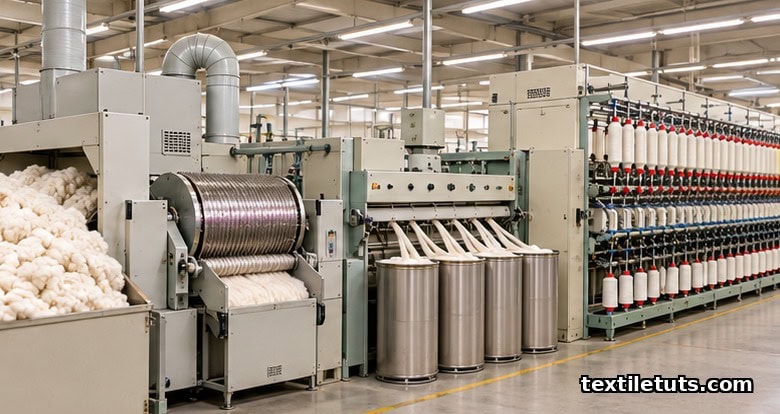
Blowroom and carding. Fibers are opened, blended, and cleaned in the blowroom, then passed through a card to remove short fibers (below ~12 mm) and neps. For high-quality sewing thread, the carded sliver typically has a Trash and Dust Content (TDC) below 0.3% by weight, and the noil extraction at the comber can reach 18-22% (well above a normal apparel yarn) to leave only the longest, most uniform fibers in the sliver.
Drawing. Two or three passages of draw frame bring the sliver to a uniform linear density of about 4-5 ktex, with a CV% below 3.5. Auto-levelers on modern draw frames hold mass variation low, which is critical because yarn evenness directly controls seam appearance: a 1% increase in yarn CV% roughly correlates with a 0.5-0.8 increase in seam pucker (the visible waviness along a stitched seam).
Roving and ring spinning. For ring-spun sewing thread, a roving frame reduces the drawn sliver to about 0.5-1.0 ktex, and ring spinning inserts the final twist. Spindle speeds for sewing thread are typically 12,000-15,000 rpm, lower than apparel yarn spinning because the higher twist and heavier count produce more end-breaks at high speed. Twist is set using the twist multiplier formula TM = TPI × square root of cotton count, and sewing thread mills operate at TM = 3.5-4.2 for ring-spun cotton, noticeably higher than the 3.0-3.5 used for ordinary weft yarn.
Winding and clearing. Cone winding clears thick places (typically +50% above mean linear density) and thin places (-30%), then packages the yarn on cross-wound cones of 1-5 kg, ready for twisting or finishing.
Core-Spun Sewing Thread: How It Is Made
Core-spun sewing thread is produced on a modified ring-spinning frame that feeds a filament core through the front drafting rollers at the same time staple roving is drafted. The two streams combine at the nip of the front rollers, and the staple fibers wrap the filament under the action of the spindle twist. Core-spun spinning frames must hold the filament under constant tension (usually 8-15 cN) and synchronize filament feed rate with roving draft, because any mismatch produces bare spots or core exposure.
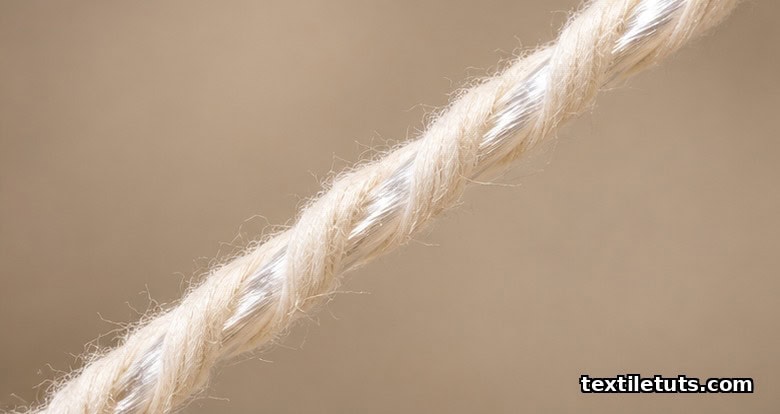
The resulting yarn has a distinct two-component structure: the polyester filament carries most of the load, while the staple sheath provides surface fiber for needle grip and dye uptake. After core-spun spinning, the yarn is typically plied (two or three single yarns twisted together) to balance the torque and improve evenness. Plying inserts twist in the opposite direction to the singles (S-on-Z or Z-on-S), giving a balanced, kink-free thread.
Post-Spinning Treatments
Raw spun sewing thread is rarely sold without finishing. The four most common post-spinning treatments are singeing, mercerizing, dyeing, and lubrication.
Singeing passes the yarn quickly through a flame or heated plate to burn off protruding surface fibers, reducing hairiness and giving the characteristic smooth “polished” appearance. ISO 20684 reports that a properly singed thread can reduce needle friction coefficient by 30-40% compared to unsung yarn, which directly translates to fewer skipped stitches and lower needle heat.
Mercerizing (for cotton threads) treats the yarn with cold concentrated sodium hydroxide (typically 20-24% NaOH at 20-25 °C) to swell the fiber, increase luster, and raise strength by 10-20%. Mercerized cotton thread is the standard for high-quality shirts, buttonholes, and embroidery.
Dyeing uses high-temperature pressure dyeing for polyester (130 °C, 30-60 minutes) and atmospheric dyeing for cotton, with reactive or vat dyes selected for wash and light fastness. Color fastness is graded against ISO 105-C06 (wash) and ISO 105-B02 (light), and most commercial sewing thread is rated Grade 4 or higher on both.
Lubrication applies a thin film of silicone emulsion, wax, or paraffin (typically 2-5% by weight of dry thread) to the surface. The lubricant film lowers needle friction, reduces heat buildup during high-speed stitching, and helps the thread slide smoothly through fabric.
Quality Testing and Standards
Sewing thread is governed by a stack of ISO and ASTM standards covering tensile properties, friction, evenness, and color fastness. Tensile strength and elongation are tested on CRE-type tensile testers per ASTM D204 and ISO 20645, with ten typical test conditions of 500 mm/min gauge length and 250 mm sample. Friction is measured per ISO 20684, which reports the dynamic coefficient of friction against a stainless steel rod; for a good sewing thread, this coefficient should sit between 0.15 and 0.30. Evenness (CV%) and imperfection counts are evaluated on Uster evenness testers per ASTM D1425 or ISO 16549, with Grade A sewing thread requiring CV% below 12% at 50 tex and imperfection counts (thick + thin + neps) below 30 per kilometer.
Seam performance itself is tested per ISO 13935-2 (seam tensile strength) and ISO 13936 (seam slippage). A well-constructed lockstitch seam in a medium-weight woven fabric typically retains 70-85% of the unsewn fabric tensile strength, and this number is the practical benchmark that mills use to qualify a thread for a given end-use.
Comparison: Sewing Thread Types and Their Properties
| Property | Ring-spun Cotton | Core-spun Poly-cotton | Polyester Filament |
|---|---|---|---|
| Typical tex range | 20-80 | 20-60 | 12-50 |
| Breaking tenacity (cN/tex) | 20-30 | 35-45 | 50-65 |
| Elongation at break (%) | 6-9 | 12-18 | 15-25 |
| Twist direction | Z | Z | Z |
| Surface finish | Mercerized / polished | Singeed / lubricated | Bonded / lubricated |
| Best end-use | Shirts, embroidery | General apparel | Upholstery, outdoor |
Frequently Asked Questions
What is the difference between ring-spun and filament sewing thread?
Ring-spun thread is made from short staple fibers twisted together, which gives a softer hand and better needle grip but lower breaking tenacity (20-30 cN/tex). Filament sewing thread is made from continuous polyester filaments extruded from the melt, giving much higher tenacity (50-65 cN/tex) and a smoother surface, but less fiber grip inside the stitch.
Why are sewing threads twisted instead of braided or bonded?
Twisting locks fibers together by friction, giving the yarn cohesion without adding any external binding agent. This keeps the thread flexible enough to pass through a needle eye and withstand repeated bending, while still resisting breakage under seam tension. Bonded filament thread exists (for aramid and nylon), but twisted construction remains the standard because it is cheaper, easier to dye, and behaves more predictably in the seam.
What twist direction do sewing threads use?
Virtually all commercial sewing thread uses Z-twist (twist direction that mirrors the diagonal of the letter Z) on the singles, with plied constructions using S-twist on the ply. This matches the geometry of lockstitch sewing machines, which are built to release Z-twist thread from the bobbin without un-twisting the surface fibers.
How do you determine sewing thread count?
Sewing thread count is expressed in tex (grams per 1,000 meters), denier (grams per 9,000 meters), or the legacy cotton count system (Ne, the number of 840-yard lengths per pound). To convert: tex = 590.5/Ne, and denier = 9,000/(Ne × 0.59). A 40s cotton count thread, for example, equals roughly 14.8 tex.
Will polyester sewing thread melt during high-speed stitching?
At normal sewing speeds (3,000-5,000 stitches per minute) with a sharp, correctly threaded needle, polyester sewing thread will not melt. Needle heat can reach 250-300 °C at the eye during extended runs on dense fabric, which is well below polyester’s melting point of about 260 °C but high enough to scorch cotton or damage elastic. To stay safe, mills lubricate thread heavily and recommend needle changes every 8-12 hours of continuous stitching on synthetic fabrics.
References
- ASTM International. ASTM D204-02(2016), Standard Test Methods for Sewing Threads. ASTM International, West Conshohocken, PA. The primary US standard for tensile, elongation, and stitch testing of sewing threads.
- International Organization for Standardization. ISO 20645:2004, Textiles – Determination of Seam Strength by the Grab Method. ISO, Geneva. Method for measuring the breaking force of sewn seams.
- International Organization for Standardization. ISO 20684:2021, Textiles – Determination of Yarn Friction. ISO, Geneva. Standard for measuring dynamic and static friction coefficients of sewing thread against metal.
- International Organization for Standardization. ISO 13935-2:2014, Textiles – Seam Tensile Properties of Fabrics and Made-up Textile Articles. ISO, Geneva. Test method for the seam strength used to qualify sewing thread end-uses.
- Behera, B. K., and Mishra, R. (2020). “Textile Engineering: Spinning and Yarn Manufacturing.” Woodhead Publishing, Cambridge. Engineering textbook covering the staple-to-yarn route, including sewing thread specific drafting and twist calculations.
- Lawrence, K. D. (2021). “Advances in Yarn Manufacturing: Spinning, Twisting, and Texturing.” Elsevier, Cambridge. Peer-reviewed compilation covering core-spun, friction-spun, and air-jet sewing thread constructions.
This article is the working reference for sewing thread spinning. Editorial by Iftay Khairul Alam, TextileTuts. Sources: ASTM D204, ISO 20645, ISO 20684, ISO 13935-2, Behera and Mishra (Woodhead, 2020), Lawrence (Elsevier, 2021) as cited.


