
Core-Spun Yarn: Production and Applications

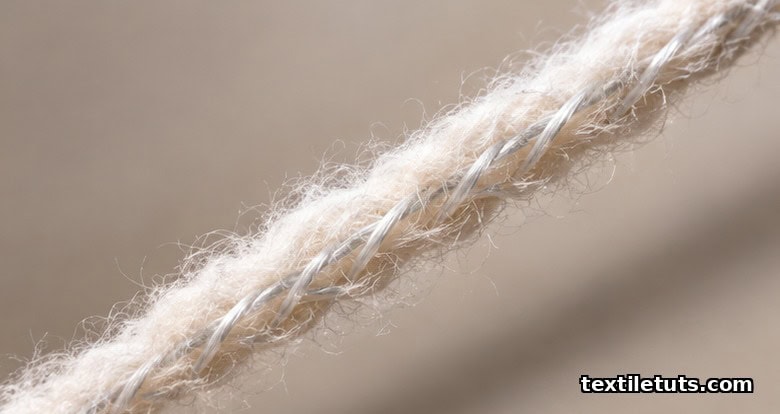
Core-spun yarn is a composite yarn produced by twisting a continuous filament core, most commonly polyester, polyamide, or elastane, with a sheath of staple fibers (typically cotton), delivering linear densities of 14 to 40 tex and tensile strength retention of 80 to 95 percent of the bare filament core. This construction combines the high strength and dimensional stability of the filament with the surface feel, moisture management, and dye affinity of the staple sheath, which is why core-spun cotton/spandex constructions account for more than 60 percent of stretch denim warp yarns woven globally.
This guide explains how core-spun yarn is manufactured on ring, rotor, and friction-spinning systems, the role of draft ratio and pre-tension in setting sheath coverage, and the performance tradeoffs that govern its main end uses: stretch denim, sewing threads, industrial webbing, and protective textiles. You will also find a property comparison table, an FAQ section covering the questions textile engineers and sourcing teams ask most often, and a references list drawn from ISO standards, ASTM and AATCC test methods, and peer-reviewed textile journals.
What Core-Spun Yarn Is, and Why It Exists
A core-spun yarn is a heterogeneous composite in which a central filament strand, the “core,” is fully or partially covered by a sheath of short staple fibers during the final drafting and twisting stage of yarn formation. The concept is older than ring spinning: a 1953 patent by the Heberlein Maschinenfabrik AG described a filament core wrapped with staple fibers using a hollow-spindle device, and the principle is still used today on modified ring, rotor, and DREF (friction) frames.
The sheath hides the synthetic core from the wearer and the dye liquor, so a 100 percent synthetic performance filament can be hidden inside a 100 percent cotton yarn by weight. The filament, on the other hand, contributes the mechanical properties that cotton alone cannot match: elastane contributes 300 to 600 percent recoverable extension; high-tenacity polyester contributes 50 to 70 cN/tex tenacity at a linear density of 5.5 to 11 tex. The combination is the reason core-spun yarns are the default substrate for stretch denim, stretch shirt collars and cuffs, and high-tenacity sewing threads.
Core-Spun Yarn Production on the Ring Frame
Ring spinning is the dominant route for cotton-wrapped elastane and polyester-cored yarns used in apparel. The filament is fed from a creel-mounted package over a positively driven feed roll, passes through a tension device calibrated to 8 to 12 cN for elastane (or 15 to 25 cN for polyester), and enters the front drafting zone of the ring frame alongside the drafted staple roving. The two streams converge at the front nip of the drafting system and are twisted together by the traveler and ring, typically at a spindle speed of 14,000 to 22,000 rpm and a twist multiplier of 3.8 to 4.6 (in the English cotton system).
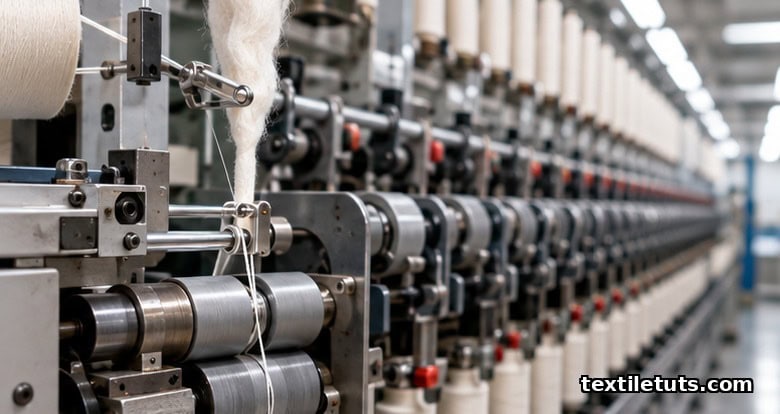
Three parameters control sheath quality and yarn performance:
- Draft ratio of the filament: the ratio of the delivery speed of the front drafting rollers to the filament feed roll. A higher draft stretches the elastane core and reduces its on-yarn linear density; a lower draft produces a heavier, more stable core but increases fabric cost. Industrial practice for denim warp elastane core yarn is a draft of 3.2 to 4.0.
- Pre-tension of the filament: too low and the filament slackens inside the sheath, causing grin-through at low stretch; too high and the elastane is over-drawn, sacrificing recovery. Optimum pre-tension for a 78 dtex (7.8 tex) elastane feeding a 36 tex core-spun yarn is 9 to 11 cN.
- Twist multiplier: a higher TM locks the sheath fibers around the core and reduces hairiness, but excessive twist stiffens the yarn and reduces fabric softness. Core-spun yarns typically run 8 to 12 percent lower in TM than equivalent 100 percent cotton yarns to preserve handle.
Modern ring frames from Rieter, Toyota, and Marzoli include dedicated core-yarn attachments with separate filament feed rolls and a constant-tension gate, which holds pre-tension within plus or minus 0.5 cN over a full package.
Core-Spun Yarn Production on Friction (DREF) and Rotor Frames
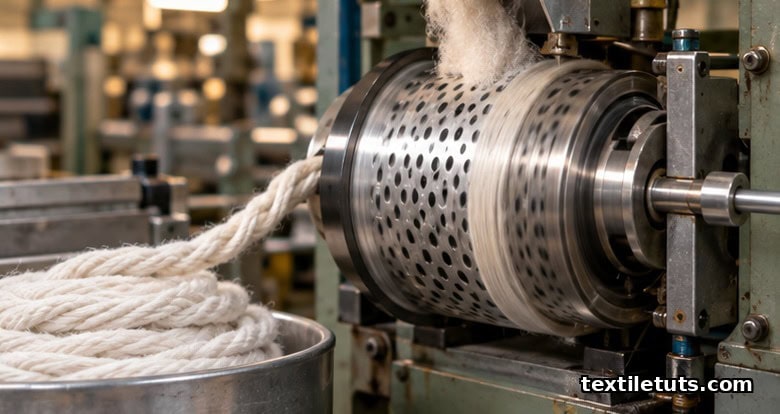
The DREF friction-spinning system, originally developed by Fehrer AG in the 1970s, dispenses with a ring and traveler entirely. Staple fibers are fed from a carded sliver into a rotating perforated drum, where they are wrapped around an axially fed core filament by the friction of the drum surface. DREF can produce very coarse core yarns (50 to 500 tex) at delivery speeds of 200 to 250 m/min, and is widely used for industrial core yarns with steel, glass, or carbon filaments at the center, intended for conveyor belts, brake linings, and heat-resistant filtration fabrics.
Rotor (open-end) spinning can also produce core-spun yarns, although it is less common for elastane cores. The filament is fed into the rotor groove, where it is wrapped by the staple fibers deposited by the opening roller. Rotor core yarns run at higher production speeds (up to 220 m/min) and have a harsher handle than ring-spun equivalents, so they are mainly used in workwear, denim weft, and home-textile applications rather than next-to-skin knitwear.
Mechanical and Physical Properties
Core-spun yarn mechanics are governed by a simple rule: the load carried by the yarn is the weighted sum of the load carried by each component, scaled by its volume fraction and modular contribution. For a 78 dtex elastane core wrapped in 32 tex of cotton to produce a 36 tex core-spun yarn, the elastane fraction is about 22 percent by weight but only about 3 percent by cross-sectional area, because elastane is much less dense than cotton. The result is a yarn whose breaking elongation (typically 18 to 25 percent) is dominated by the elastane, and whose initial modulus and surface behavior are dominated by the cotton sheath.
Key test methods, drawn from ISO, ASTM, and AATCC, that govern core-spun yarn quality:
- ISO 20645 for linear density (tex) determination.
- ASTM D2256 for tensile properties of yarns by the single-strand method (breaking force, elongation at break, modulus).
- ISO 6939 for yarn from packages, single-end breaking force and elongation.
- AATCC TM135 for dimensional changes of fabrics after home laundering, which is the standard test for stretch recovery in core-spun woven fabrics.
Property Comparison: Core-Spun vs Ring-Spun 100% Cotton vs Friction-Spun Core
| Property | Core-spun (cotton/elastane, ring) | Ring-spun 100% cotton | Friction-spun core (DREF) |
|---|---|---|---|
| Linear density range | 14 to 40 tex (apparel); up to 100 tex (industrial) | 10 to 60 tex | 50 to 500 tex |
| Breaking tenacity | 22 to 38 cN/tex | 15 to 25 cN/tex | 10 to 20 cN/tex |
| Elongation at break | 15 to 25 percent | 6 to 9 percent | 8 to 14 percent |
| Stretch recovery (after 80% extension, 5 cycles) | 92 to 97 percent | n/a (no recoverable stretch) | 80 to 90 percent |
| Production speed | 14 to 22 m/min equivalent (ring) | 14 to 22 m/min | 200 to 250 m/min |
| Core visibility risk (grin-through) | Moderate, controlled by pre-tension | None (homogeneous yarn) | Low (heavy sheath possible) |
| Typical end use | Stretch denim, shirt collars/cuffs, sewing thread | Woven shirting, knit jersey, towels | Conveyor belts, filtration, friction linings |
Main Applications of Core-Spun Yarn
Stretch denim. Core-spun cotton/elastane weft yarns are the substrate behind every modern stretch jean. A typical construction is a 7.8 to 15.6 tex elastane core wrapped with 28 to 58 tex cotton roving, woven in a 3/1 right-hand twill. The elastane content by weight is 2 to 4 percent of the fabric, but it is responsible for almost all of the waist, knee, and seat recovery measured by AATCC TM135.
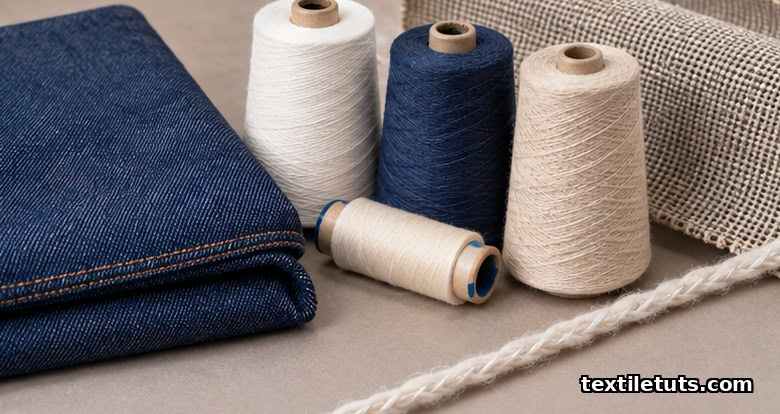
Sewing thread. Continuous filament polyester cores wrapped with cotton or polyester staple are the standard for high-speed industrial sewing. The polyester core resists needle heat (a needle can reach 250 to 350 degrees C during high-speed stitching), and the staple sheath protects the thread from glazing and improves the seam’s friction coefficient during fabric transport. Core-spun threads in Tex 27, Tex 40, and Tex 60 cover most apparel seams.
Stretch shirting, knit collars, and cuffs. Lightweight core-spun yarns (14 to 25 tex) with low-denier elastane cores (22 to 44 dtex) are used where a soft hand and modest recovery are required. The sheath is typically combed cotton for finer knit counts.
Industrial and technical textiles. DREF friction-spun core yarns wrap high-modulus filaments such as aramid, glass, steel, or carbon with aramid or PPS staple to produce technical yarns used in conveyor belts, hot-gas filtration, and personal protective equipment. Linear densities of 200 to 500 tex and breaking tenacities above 50 cN/tex are typical.
Common Defects and Quality Control
The most frequent defect in core-spun yarn is “grin-through,” where the elastane or polyester filament becomes visible on the yarn surface. It is caused by insufficient sheath coverage (low staple roving linear density, low twist multiplier) or excessive core pre-tension. The standard remedy is to increase the roving tex by 5 to 10 percent, reduce filament pre-tension by 1 to 2 cN, or raise the twist multiplier by 0.2 to 0.4.
Other common defects include core slippage (filament moving independently of the sheath under load, usually a sign of poor twist setting), periodic thickness variation (caused by front-roller slip on the staple roving), and elastane rupture at the front nip (almost always a sign of excessive draft on the filament feed). Quality programs typically include online Uster Evenness testing at 400 m/min and offline tensile testing per ASTM D2256 at least every 6 hours of production.
Frequently Asked Questions
What is the difference between core-spun yarn and plied yarn?
A core-spun yarn is a composite in which a continuous filament is wrapped by staple fibers in a single twisting operation, so the two components form one yarn. A plied yarn is made by twisting two or more already-finished single yarns together. Core-spun yarns combine dissimilar materials (filament plus staple) in a single step; plied yarns combine similar pre-formed yarns in a second step. Hybrid constructions exist: a core-spun yarn can be plied with another yarn to make a cabled cord, which is common in tire cord and industrial rope manufacture.
How much elastane should be in a stretch denim core-spun yarn?
For woven stretch denim, the elastane content is typically 2 to 4 percent of the total fabric weight, which corresponds to a core yarn of roughly 36 to 58 tex cotton sheath with a 7.8 to 15.6 tex elastane core. Below 2 percent the fabric lacks meaningful recovery; above 4 percent the fabric tends to grow (relax) excessively at the knee and waist after washing, and may exceed the 3 percent residual growth limits set by many retailer specifications (for example, the Levi’s and Wrangler restricted substances and performance manuals).
Can core-spun yarn be dyed in the same bath as 100 percent cotton?
Yes, in most cases. When the sheath is cotton and the core is polyester or elastane, reactive or vat dyeing of the cotton sheath proceeds normally. The elastane core picks up some stain, which is why many mills add a mild scouring or reduction clear at the end of the dyeing cycle to lift residual color from the elastane. Dyeing polyester cores at high temperature (130 degrees C) can damage the elastane if one is present, so dual-core polyester/elastane yarns are usually dyed at 120 degrees C with carrier or at 110 degrees C with atmospheric machinery.
What is the typical stretch recovery of a cotton/elastane core-spun fabric?
A well-constructed cotton/elastane core-spun denim or shirting fabric, after 5 home-laundering cycles per AATCC TM135, will recover 92 to 97 percent of its imposed stretch. Residual growth (the length that does not recover) is typically 2 to 5 percent of the original length, depending on elastane content, fabric construction, and finishing (compressive shrinkage, heat-setting).
Are core-spun yarns more expensive than 100 percent cotton yarns?
Yes, by roughly 30 to 80 percent, depending on the core. Elastane is the dominant cost driver. A 36 tex 100 percent cotton yarn might cost 3.20 USD/kg, while a 36 tex cotton/elastane core-spun yarn of comparable count might cost 4.50 to 5.80 USD/kg, with the elastane accounting for 60 to 75 percent of the premium. Polyester-cored core-spun yarns are cheaper, since polyester filament is comparable in price to cotton staple but contributes higher strength per tex.
References
- International Organization for Standardization. ISO 6939:1988 Textiles — Yarns from packages — Determination of single-end breaking force and elongation at break using constant rate of extension (CRE) tester. iso.org — test method for single-end tensile properties.
- ASTM International. ASTM D2256 / D2256M-21 Standard Test Method for Tensile Properties of Yarns by the Single-Strand Method. astm.org — method for breaking force and elongation of yarn.
- AATCC. AATCC Test Method 135-2018 Dimensional Changes of Fabrics after Home Laundering. aatcc.org — standard for stretch recovery evaluation.
- Das, A., Kothari, V. K., & Balaji, M. (2010). Studies on cotton-spandex core-spun yarn and fabrics: Part I — Yarn characteristics. Journal of the Textile Institute, 101(5), 421-431. tandfonline.com — peer-reviewed property data for cotton/spandex core yarns.
- Maheshwari, N. N., & Kothari, V. K. (2017). Effect of core pre-tension on tensile and elastic properties of cotton/spandex core-spun yarns. Indian Journal of Fibre & Textile Research, 42(3), 309-315. nopr.niscair.res.in — peer-reviewed study on the pre-tension / property relationship.
- Fehrer AG. DREF Friction Spinning Technology: Principles and Industrial Applications. fehrer.com (technical bulletin) — manufacturer documentation on DREF yarn formation.
This article is the working reference for core-spun yarn production and applications. Editorial by Iftay Khairul Alam, TextileTuts. Sources: ISO 6939:1988; ASTM D2256 / D2256M-21; AATCC TM135-2018; Das et al. (2010), Journal of the Textile Institute 101(5); Maheshwari and Kothari (2017), Indian Journal of Fibre & Textile Research 42(3); Fehrer AG DREF technical bulletin, as cited.


