
Embroidery Thread Spinning

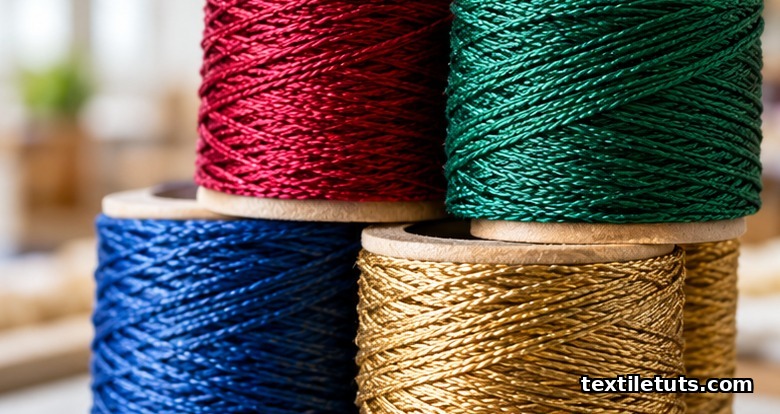
Embroidery thread is produced as a 2-ply or 3-ply construction at 12 to 30 tex (Ne 35/2 to Ne 75/2), with single-ply twist levels of 80 to 200 turns per meter balanced by opposite-direction ply twist, because matching twist magnitude and reversing direction across plies cancels residual torsional stress and prevents loop distortion, knotting, and stitch spiraling at machine speeds of 400 to 1,000 stitches per minute.
Modern industrial embroidery threads must also satisfy minimum tenacity of 35 cN/tex for polyester filament, 18 to 22 cN/tex for rayon filament, and colorfastness of Grade 4 or better on the AATCC gray scale under light, perspiration, and crocking tests, or they will fail QC at the brand’s incoming-inspection line.
What follows covers the raw materials, twist mechanics, spinning systems, ply geometry, quality standards, and the defects that most often reject a thread lot before it reaches a needle.
What Embroidery Thread Spinning Actually Produces
Embroidery thread spinning is the conversion of staple fibers or filament yarns into a twisted, plied product engineered specifically for stitched surface decoration rather than for seam strength. A standard sewing thread is balanced between strength and softness, but an embroidery thread must add three more properties: high surface sheen for visual coverage, exact color matching across dye lots (typically within ΔE 1.0 under CIELAB), and resistance to the needle friction heat that builds at sustained high stitch rates.
Industrial embroidery thread manufacturing grew steadily after 1863, when the Schiffli embroidery machine (German for “shuttle”) entered the market. The Schiffli principle, still used today for mass embroidery of lace, curtains, badges, and labels, established the first strict tolerance on thread uniformity because any yarn break on a 1,000-stitch-per-minute machine halts the entire frame, damages the fabric underneath, and costs the operator minutes of recovery time.
Today’s embroidery thread industry is dominated by a handful of integrated producers that extrude or spin, dye, lubricate, and wind the thread in a continuous flow. The two largest by volume are Madara (Japan) and Coats (UK), with regional players like A&E (US), Sdlesha (China), and Hamelex supplying specialty and effect threads.
Raw Materials Used in Embroidery Thread
Embroidery thread fibers divide into three groups by construction: spun staple, continuous filament, and effect or laminated.
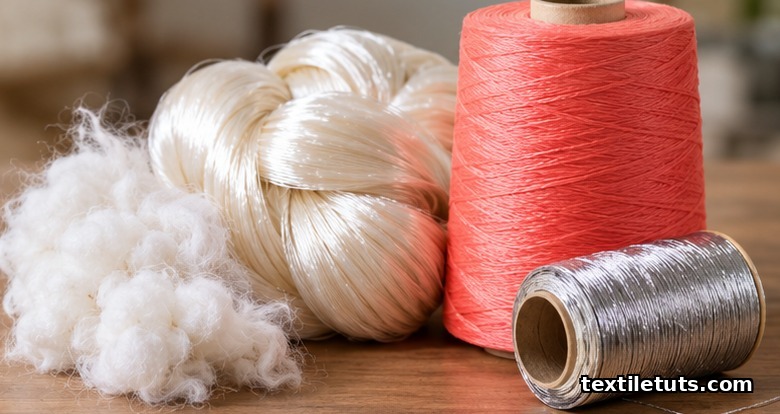
- Spun staple cotton and wool: Used primarily for hand embroidery (crewel, cross-stitch, sashiko, redwork). Cotton embroidery threads are combed and mercerized to increase luster, with surface reflectance typically 60 to 70% on a 60° glossmeter.
- Continuous filament rayon (viscose) and polyester: Make up the bulk of machine embroidery thread. Filament construction skips the spinning-to-yarn step and goes directly into twisting and plying from the extrusion stage.
- Effect threads: Metallic and holographic threads are produced by laminating a polyester film (12 to 25 µm thick) with aluminum or pigment layers, then slitting the laminate into 0.2 to 0.4 mm strips and winding them onto a core yarn.
Rayon remains the visual benchmark for sheen because its smooth, round cross-section reflects light predictably and holds bright, saturated dye. Polyester filament has gained ground since the 1990s because its tenacity (35 to 50 cN/tex as filament) and colorfastness to chlorine bleach outperform rayon in commercial laundering. Cotton holds a niche for traditional embroidery and monogramming because its matte finish and slightly higher coefficient of friction keep stitches in place on loosely woven ground fabrics without distortion.
Twist Mechanics: Single-Ply TPM and Ply Direction
Twist is the single most controlled variable in embroidery thread manufacturing. Too low a twist and the thread untwists under the needle’s friction; too high a twist and the thread snarls on itself and produces spiraled stitches. Every thread spec sheet records the turns per meter (TPM), which is the number of full rotations inserted into a 1-meter length of yarn.
For embroidery thread, the typical single-ply TPM ranges are:
- Cotton (combed, mercerized): 80 to 120 TPM in Z direction.
- Rayon filament: 140 to 180 TPM in Z direction.
- Polyester filament: 120 to 160 TPM in Z direction.
- Wool (crewel): 60 to 90 TPM in Z direction.
The ply is then twisted in the opposite direction (S when the single is Z) at a similar TPM so that the residual torsional stress cancels. This is the “balanced ply” construction noted on every commercial embroidery thread spec sheet. A common rule of thumb is that ply TPM should equal single-ply TPM plus a 10 to 15% reduction, because the inner plies already carry the tension from single-ply twist, and excessive ply twist re-introduces liveliness into the finished thread.
Direction matters as much as magnitude. Two Z-plied singles make a snarly thread that loops on the needle; an S-plied Z single lays flat. Most embroidery threads are Z singles with S ply, but hand-embroidery cotton threads sometimes reverse this to S singles with Z ply, matching the traditional hand-twisting direction and producing a slightly higher hand friction that grips the fabric better.
Spinning and Twisting Systems
Embroidery thread manufacturing uses two distinct processes, one for staple fibers and one for filaments.
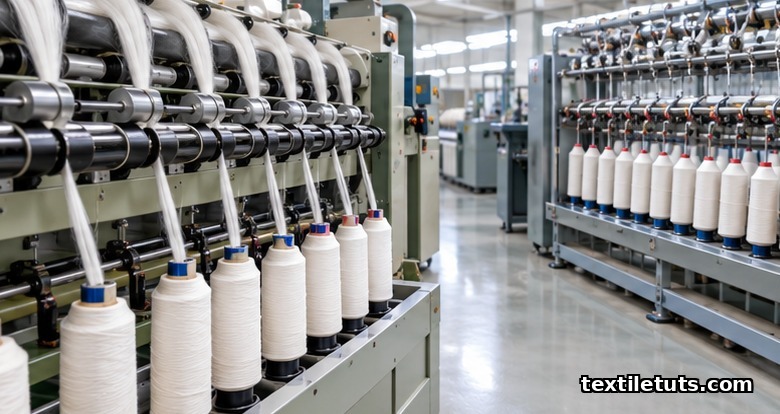
For spun staple threads (cotton, wool): Ring spinning is dominant because it produces yarn with the highest tensile strength and the smoothest surface. A typical embroidery-grade combed cotton ring frame runs at 18,000 to 25,000 rpm spindle speed, drafts the sliver to 20 to 30 tex, and inserts 80 to 120 TPM of Z twist. Compact spinning, a ring-frame modification that uses a suction zone to control fiber migration, raises tenacity by 8 to 12% over conventional ring spinning and is now the default for premium cotton embroidery threads.
For filament threads (rayon, polyester): The polymer is extruded, drawn, and wound as a flat multifilament. The actual “spinning” step is replaced by a two-for-one (TFO) twister or a direct cabling machine from makers like Volkmann, Hamelex, or Toshin. These machines insert S ply twist at 4,000 to 6,000 rpm and wind the finished ply onto a package ready for dyeing. Throughput on a modern TFO line is 60 to 100 m/min per spindle, with frames carrying 96 to 240 spindles in parallel.
Open-end (rotor) spinning is rarely used for embroidery thread because the wrapper-fiber structure produces a hairier surface that scatters light and reduces sheen. The few products on the market that use air-jet or rotor spinning for embroidery, typically heavy-weight wool or rustic decorative threads, explicitly market the textured look as a feature rather than a defect.
Ply Geometry and Thread Count Systems
Embroidery threads are sold by nominal weight (wt), tex, or denier depending on the market, and the conversion between them is straightforward once you know the convention. A “40 wt” embroidery thread has a linear density of approximately 14.8 tex (about Ne 40/1 single equivalent, plied to 29.5 tex for a 40 wt 2-ply). A “12 wt” thread used for bolder hand embroidery runs around 49 tex (about Ne 12/2 equivalent). The “wt” system originates with cotton sewing thread and is inversely proportional to thread thickness: a higher wt number means a finer thread.
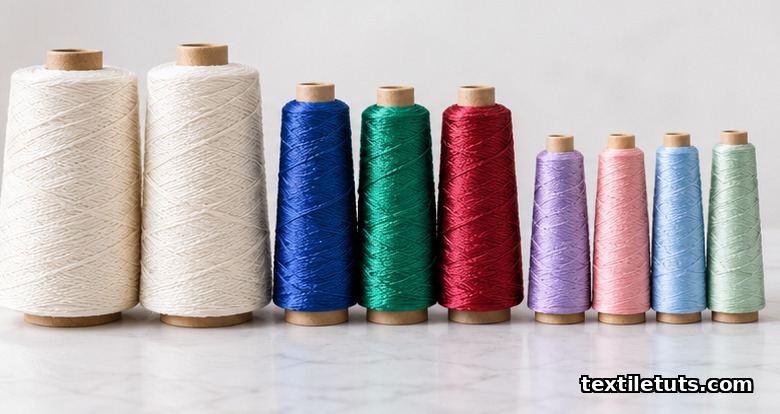
Most machine embroidery threads are 2-ply. A 3-ply construction adds roundness and a slight increase in cover on dark fabrics, but it also adds 50% more twist liveliness to manage, which is why 3-ply threads are specialty items rather than the default. Cable constructions (4-ply and above) are reserved for very heavy hand-embroidery threads like Persian yarn and for some cotton crochet threads, where stitch definition is less important than tactile presence.
The single-ply linear density must stay in tolerance across the bobbin, otherwise the take-up tension on the embroidery machine changes mid-design and produces uneven stitch length. The standard tolerance is plus or minus 5% on tex across any single cone, and plus or minus 3% lot-to-lot, which is the reason embroidery thread makers run gravimetric checks at the start, middle, and end of every package.
Quality Standards for Embroidery Thread
Commercial embroidery thread is tested against textile test standards at three stages: greige yarn (before dyeing), dyed yarn (before lubrication), and the finished package. The main ISO and AATCC methods that govern embroidery thread acceptance are:
- ISO 20647:2020: Yarns from packages, determination of single-end breaking force and elongation at break using a constant-rate-of-extension (CRE) tester. This is the principal tensile test.
- ISO 20645:2005: Yarns from packages, determination of linear density (gravimetric method), used to confirm a 40 wt thread stays within the 14.4 to 15.2 tex band.
- AATCC TM-8: Colorfastness to Crocking (AATCC Crockmeter Method), the standard test for dry and wet rubbing dye transfer onto adjacent fabric.
- AATCC TM-15: Colorfastness to Perspiration, simulating acidic and alkaline perspiration to predict dyed-thread behavior in a worn garment.
- AATCC TM-16.3: Colorfastness to Light, using a xenon arc fading lamp to predict long-term UV exposure.
- ASTM D2256/D2256M-21: Standard Test Method for Tensile Properties of Yarns by the Single-Strand Method, the US companion tensile method for quality control.
A first-pass rejection on any one of these tests halts shipment. Embroidery thread makers run statistical process control (SPC) on these tests in real time, and lot-to-lot color drift above ΔE 1.0 remains the most common cause of customer complaints in the industrial market, ahead of tensile variation and abrasion loss.
Common Defects and Their Spinning-Related Causes
Most embroidery thread defects traceable to the spinning stage fall into four families: unbalance, undertwist, surface hair, and dyestuff variance.
- Unbalance (liveliness): Visible as loops forming off the cone surface or as snarling at the needle eye. Cause: ply TPM too close to single-ply TPM, or ply direction matching rather than opposing the single. Correction: re-balance at the twister to single minus 12%.
- Undertwist: Visible as plying separation during stitching. Cause: ply TPM below the lower bound (typically below 100 TPM on a 2-ply 40 wt polyester). Correction: increase ply TPM by 8 to 10%.
- Surface hair (filament rayon): Visible as a fuzzy look on the stitched design. Cause: filament tow of too high a denier-per-filament (above 2.5 dpf). Correction: switch to finer filament count (1.7 to 2.0 dpf) at the extrusion stage.
- Shade drift: Visible as visible color step between two thread lots in the same garment. Cause: dye bath exhaustion curves shifting across lots. Correction: spectrophotometric lot-matching against a master standard at ΔE < 0.7.
Brands that reject on the first fault rather than the second save roughly 0.5 to 0.8 cents per finished garment, an amount that adds up quickly across millions of pieces. That is why the spinning standards are rigid rather than aspirational.
Embroidery Thread Type Comparison
| Property | Rayon (Viscose) Filament | Polyester Filament | Mercerized Cotton |
|---|---|---|---|
| Tenacity (cN/tex) | 18 to 22 | 35 to 50 | 25 to 35 |
| Elongation at break | 15 to 22% | 18 to 30% | 6 to 9% |
| Single-ply twist (TPM, Z) | 140 to 180 | 120 to 160 | 80 to 120 |
| Heat resistance (°C) | 150 (shrinks) | 200 to 220 (melts at 260) | 180 (chars at 200) |
| Colorfastness to bleach | Poor | Excellent | Moderate |
| Best use | Decorative, sheen-critical designs | Uniforms, workwear, bleach-cleanable | Traditional embroidery, matte finishes |
Frequently Asked Questions
How many twists per meter should embroidery thread have?
For machine embroidery, 120 to 180 TPM is typical for filament threads. Spun cotton usually runs 80 to 120 TPM. Below 60 TPM the thread untwists under the needle; above 200 TPM the thread snarls and skews the stitch direction.
Why does my embroidery thread unply while stitching?
Unpiling, the separation of the two plies, almost always points to ply TPM being too low relative to single-ply TPM, or to the upper thread tension being set higher than the bobbin tension. Increase the bobbin tension first; if that does not stop the unplying, the thread itself has under-twisted ply.
Rayon vs. polyester embroidery thread: which should I use?
Use rayon when the design relies on sheen and the finished item will be dry-cleaned or hand-washed. Use polyester when the garment will see commercial laundering, chlorine bleach, or significant UV exposure, because polyester resists both far better than rayon and runs about 60% higher in colorfastness grade after 40 wash cycles.
Can I use regular sewing thread in an embroidery machine?
Technically yes, but the result is poor. Sewing thread is built for seam strength, not for sheen or stitch definition. It will produce a dull, sometimes fuzzy stitch and may break more often at speeds above 700 stitches per minute, especially on densely packed designs.
What is the most common embroidery thread defect at incoming inspection?
Color drift between dye lots. Most production lines tolerate a 3 to 5% tensile variation between thread lots, but a ΔE above 1.0 across adjacent stitches in a multi-color design is visible to the eye and triggers immediate lot rejection at incoming QC.
References
- ISO. ISO 20647:2020, Textiles: Yarns from packages, Determination of single-end breaking force and elongation at break using constant rate of extension (CRE) tester. iso.org. Method for the tensile test that confirms embroidery thread tenacity.
- ISO. ISO 20645:2005, Textiles: Yarns from packages, Determination of linear density (gravimetric method). iso.org. Gravimetric tex test that anchors embroidery thread count tolerance.
- AATCC. Test Method 8, Colorfastness to Crocking: AATCC Crockmeter Method. aatcc.org. Standard test for dye transfer under dry and wet rubbing.
- AATCC. Test Method 15, Colorfastness to Perspiration. aatcc.org. Predicts dye behavior in acidic and alkaline perspiration.
- ASTM. ASTM D2256/D2256M-21, Standard Test Method for Tensile Properties of Yarns by the Single-Strand Method. astm.org. US companion tensile method widely used in embroidery thread QC.
- Encyclopaedia Britannica. Embroidery (decorative arts). britannica.com. Reference entry for the historical and technical scope of embroidery threads.
- Cotton Incorporated. Cotton for embroidery: characteristics and care. cottoninc.com. Industry trade reference on cotton embroidery thread properties and mercerization.
Editorial by Iftay Khairul Alam, TextileTuts. Sources: ISO 20647:2020, ISO 20645:2005, AATCC TM-8, AATCC TM-15, AATCC TM-16.3, ASTM D2256, Encyclopaedia Britannica, Cotton Incorporated as cited.


