
Sewing Machines: Complete Guide to Types and Selection

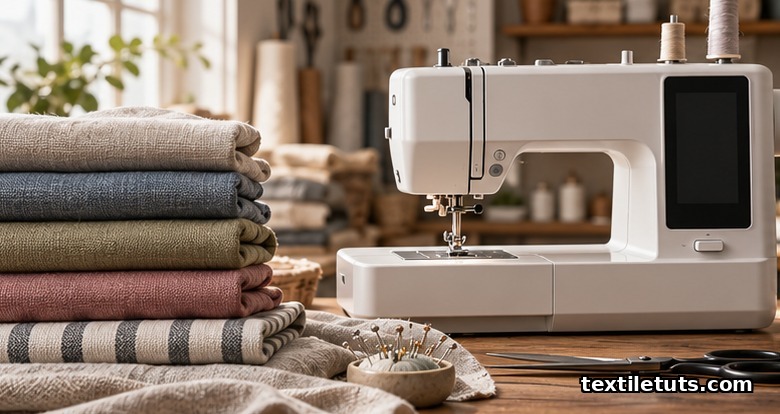
A lockstitch sewing machine produces 1,000 to 5,000 stitches per minute with a standard stitch length of 2.5 to 3.5 mm, the operating window that defines most domestic and industrial units covered by ISO 8230 safety requirements. For buyers comparing home use, small studios, and factory floor options, the meaningful differences come down to feed mechanism, motor torque, stitch type per ISO 4916, and seam strength measured under ASTM D1683.
This guide breaks down the engineering categories behind every sewing machine on the market, then walks through the selection criteria textile engineers and home sewists actually use.
Mechanical Action: Lockstitch, Chainstitch, and Overlock
The first specification to compare is the stitch-forming action. ISO 4916:1991 classifies stitches into six families (chain stitch, lockstitch, overlock, cover stitch, flatlock, and zigzag variants), each producing a different seam structure and stretch behavior.
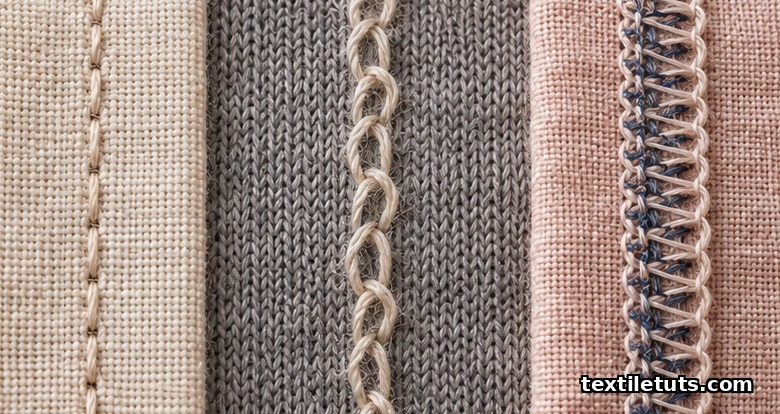
A lockstitch sewing machine uses a top thread and a bobbin thread that meet inside the fabric, producing a balanced stitch that does not unravel when a single thread breaks. Lockstitch machines account for the majority of domestic units and most general purpose industrial sewing, and a typical 301 lockstitch seam in medium weight woven cotton fails at 200 to 350 N per 25 mm width under ASTM D1683.
A chainstitch sewing machine forms a series of loops on the underside that pull through each other like a chain. Chainstitch seams stretch more than lockstitch seams, which makes them standard for knit garment assembly and elastic applications. The trade off is unraveling risk when the looper thread is broken at the end of a seam, so chainstitch seams are usually backtacked or secured.
Overlock machines, commonly called sergers, use multiple looper threads and a cutting blade to trim and encase the seam edge in one pass. A 4 thread overlock produces a 401 stitch per ISO 4916 and creates a stretch seam commonly used on T shirts, activewear, and underwear hems. Industrial overlock machines commonly reach 7,000 to 8,500 stitches per minute.
Feed Mechanism: Drop, Needle, Walking Foot, and Differential
The feed system controls how the fabric advances under the presser foot, and this is the single biggest determinant of seam quality on slippery, layered, or stretchy materials.
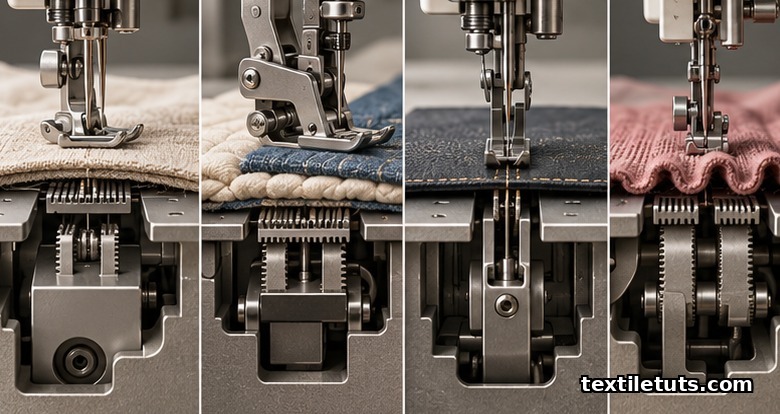
Drop feed machines move fabric only from below, using a feed dog that rises through the needle plate. Drop feed is the standard configuration on most home sewing machines and works well on wovens with two or three layers.
Walking foot machines add a top feed dog that moves in sync with the bottom feed, gripping the upper layer so quilted, leather, or multi layer assemblies advance without shifting. Walking foot machines are the workhorses for upholstery, denim, and bag construction.
Needle feed machines drive the fabric from the needle itself, which eliminates the slip that occurs on vinyl, coated fabrics, and technical textiles. Needle feed machines are common in technical textile and shoe upper assembly.
Differential feed appears on overlock machines. Two feed dogs sit in front and behind the needle, and their relative speed is adjustable from roughly 0.7 to 2.0. A differential ratio above 1.0 stretches the fabric before cutting; below 1.0 gathers it. This setting is what gives a serger the ability to produce lettuce hems on knits.
Motor, Torque, and Stitch Rate
Industrial sewing machines are typically rated by maximum stitches per minute (SPM) and by motor torque at low speed. A typical industrial lockstitch machine runs at 4,500 to 5,000 SPM with a 400 to 750 W servo motor. Direct drive servo motors have largely replaced clutch motors because they stop the needle instantly when the operator releases the pedal, reducing injury risk and saving 30 to 50 percent energy.
Domestic sewing machines usually operate at 600 to 1,100 SPM. The reduced rate is a safety feature, since home users cannot maintain the hand speed demanded by a 5,000 SPM machine. Computer controlled home machines lower the SPM further when sewing through thick seams and raise it again on long straight runs.
ISO 8230 covers safety requirements for industrial sewing machines, including needle guards, belt covers, and clutch brake response time. A conforming machine must stop within 70 milliseconds after the operator releases the pedal.
Industrial versus Domestic Construction
The structural difference between industrial and home machines is not the brand, it is the frame. Industrial sewing machines use a cast iron or aluminum die cast head bolted to a table, with a separate servo motor mounted beneath. The bed plate is flat, allowing pieces to be fed in any direction, which is essential for production work on shirts, trousers, and bag components.
Domestic machines integrate the motor inside the head and use a free arm or flatbed convertible bed. The integrated design saves space and reduces cost, but limits continuous run time. Most domestic machines are rated for 30 to 60 minutes of continuous sewing before a cooling pause is recommended.
Industrial machines are typically single function, dedicated to one operation such as lockstitch, buttonhole, bartack, or blind hem. Domestic machines are multi function, with cam driven or computer controlled mechanisms that switch between stitch patterns using a single needle bar.
Stitch Classification and Seam Strength
ISO 4916 and ASTM D6193 cover stitch classification. ISO 4916 uses a three or four digit code where the first digit indicates the stitch family (1 for chainstitch, 2 for lockstitch, 3 for overlock, 4 for cover, 5 for flatlock, 6 for zigzag) and subsequent digits identify subclasses.
ASTM D1683 measures sewn seam strength by pulling a sewn sample in a tensile testing machine until failure. Seam efficiency, defined as seam strength divided by fabric strength, typically ranges from 60 to 85 percent for woven garments. Above 85 percent the fabric usually fails before the seam, which is the typical target for woven apparel.
AATCC 135 and AATCC 150 cover dimensional changes after home laundry, which is critical for evaluating seam puckering. Lockstitch seams with low thread tension show measurable puckering after 5 wash cycles, while chainstitch and overlock seams resist pucker because of their built in stretch.
Thread, Needle, and Material Compatibility
Sewing thread is sized by tex (grams per 1,000 m) or by ticket number. A 40 tex polyester core spun thread is the standard for shirt weight wovens, while 60 to 80 tex is used for denim and upholstery. Polyester core spun thread is typically rated at 50 to 60 cN/tex tenacity and 15 to 22 percent elongation under ASTM D2256.
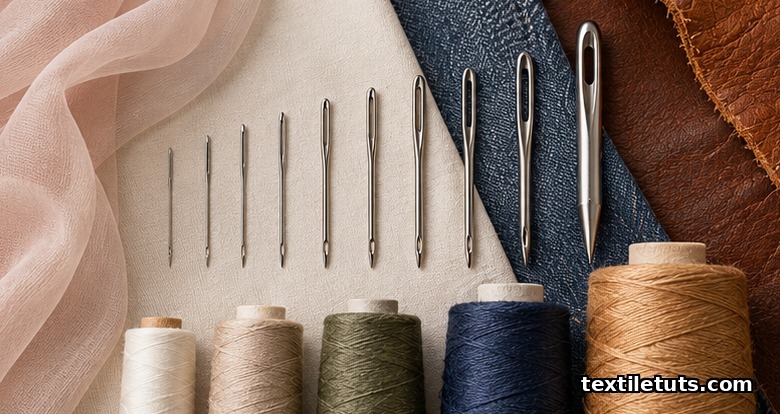
Needle selection is governed by the needle system (for example DBx1 for most domestic lockstitch machines, DPx5 for industrial lockstitch) and the needle point style. Ball point needles are used for knits to push between yarn loops; sharp set points are used for woven fabrics; leather needles have a cutting wedge tip.
Fabric weight drives the needle size: 60/8 to 70/10 for lightweight silk and chiffon, 80/12 to 90/14 for cotton shirting, 100/16 to 110/18 for denim and canvas, and 120/19 to 160/23 for heavy leather and sailcloth. Mismatched needle size is the most common cause of skipped stitches and thread breakage.
How to Select a Sewing Machine
Selection is an application matched decision. For a home sewist making garments and home decor, a 100 to 200 W computer controlled lockstitch machine with 60 to 100 stitch patterns and a free arm handles roughly 90 percent of typical projects.
For a small production studio sewing knits, an overlock machine with 4 thread capacity and adjustable differential feed is the priority, paired with a basic lockstitch for construction steps that require it.
For industrial production, the choice is task specific: a 5,000 SPM lockstitch with servo motor for shirt side seams; a bartack machine for pocket reinforcement; a buttonhole machine for plackets; an overlock with cover stitch capability for knitwear. Most factories run a fleet of dedicated machines rather than one multi task unit.
Budget guidance: home sewing machines start near USD 150 for mechanical units and reach USD 600 to 1,500 for computer controlled embroidery models. Industrial lockstitch heads cost USD 500 to 2,500, with a complete table and motor setup adding USD 400 to 800. Overlock machines range from USD 300 for home sergers to USD 3,000 to 8,000 for industrial units.
Verify that any industrial machine carries a current CE marking and compliance with ISO 8230 before purchase. Check the stitch length range, presser foot lift, and maximum fabric clearance under the foot, which determines the number of layers that can be sewn at once.
Frequently Asked Questions
What SPM is best for a home sewing machine?
For home use, a machine rated at 800 to 1,100 SPM is the practical maximum. Going higher than this with a typical home user foot pedal cadence produces uneven stitch length and increases the risk of needle breakage on thicker seams. Most home users sew effectively in the 500 to 700 SPM range.
Do I need a serger if I already own a lockstitch machine?
If you sew knit garments regularly, yes. A 4 thread overlock produces a stretch seam and clean edge finish in one operation that a lockstitch cannot replicate. For woven only projects, a quality lockstitch with a zigzag option covers most seam types without the extra machine.
What is seam efficiency and why does it matter?
Seam efficiency is the sewn seam strength divided by the unsewn fabric tensile strength, expressed as a percentage. A seam efficiency of 70 percent means the seam retains 70 percent of the parent fabric strength. Below 60 percent the seam becomes the weak point of the garment; above 85 percent the fabric usually fails before the seam, which is the typical target for woven apparel.
Can I use industrial needles on a domestic machine?
No. Industrial and domestic lockstitch machines use different needle systems with different shank diameters and scarf positions. Using an industrial needle in a domestic machine risks needle bar damage and skipped stitches. Buy needles matched to your machine system (for example DBx1 for domestic lockstitch, DPx5 for industrial lockstitch).
How do I reduce seam puckering on lightweight fabric?
Reduce top thread tension by 10 to 20 percent, switch to a 70/10 ball point or microtex needle, and use a fine 60/2 or 80/2 polyester thread. Sewing a test seam on a scrap before cutting your project pieces lets you confirm stitch balance before committing to the final fabric.
References
- ISO 4916:1991, Textiles, Seam types, Classification and terminology, International Organization for Standardization.
- ISO 8230, Safety requirements for industrial sewing machines, International Organization for Standardization.
- ASTM D1683, Standard Test Method for Failure in Sewn Seams of Woven Fabrics, ASTM International.
- ASTM D6193, Standard Practice for Stitches and Seams, ASTM International.
- ASTM D2256, Standard Test Method for Tensile Properties of Yarns by the Single Strand Method, ASTM International.
- AATCC 135, Dimensional Changes of Fabrics after Home Laundering, American Association of Textile Chemists and Colorists.
- AATCC 150, Dimensional Changes of Fabrics after Home Laundering (commercial alternative), American Association of Textile Chemists and Colorists.
This article is a working reference for sewing machine selection. Editorial by Mohammad Yousuf (Anik), TextileTuts. Sources: ISO 4916:1991, ISO 8230, ASTM D1683, ASTM D6193, ASTM D2256, AATCC 135, AATCC 150 as cited.


