
Industrial vs Home Sewing Machines

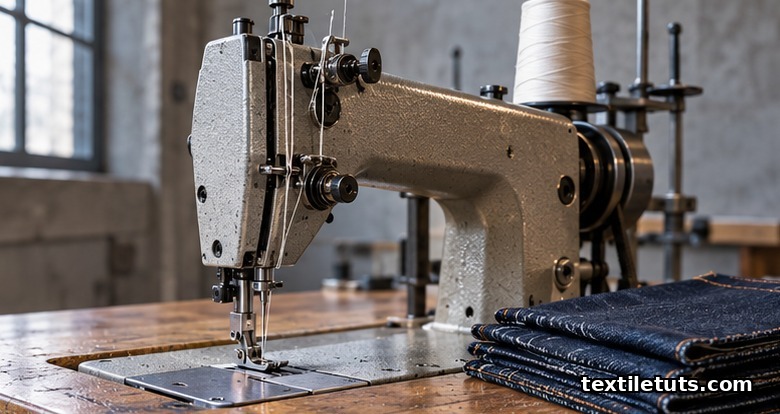
Industrial sewing machines operate at 1,000 to 5,000 stitches per minute (SPM) with servo motors rated 0.55 to 1.5 kW, while home sewing machines run at 400 to 1,000 SPM with built-in motors of 70 to 100 watts, making industrial machines 3 to 12 times faster and engineered for 8+ hours of continuous daily operation rather than the 1 to 3 hours of intermittent use that domestic machines are rated for.
This speed and power gap is the defining physical difference between the two machine classes, and it cascades into almost every other specification on the comparison sheet: stitch length range, presser foot pressure, throat plate geometry, thread size tolerance, frame rigidity, and lubrication system.
Below is a textile-engineer breakdown of the seven properties that separate the two machine categories, the ISO, ASTM, and AATCC test standards that quantify each difference, and a clear decision framework for choosing the right class for your workload.
What Separates an Industrial Sewing Machine from a Domestic One
The term “industrial sewing machine” is not a marketing label. ISO 8239:1987 (Textiles, Sewing Machines, Vocabulary) defines a sewing machine as a mechanism that forms stitches in textile material, and reserves the “industrial” classification for machines built for production environments where stitch-per-minute, seam-strength consistency, and mean-time-between-failures (MTBF) are controlled variables. A domestic machine falls under a different usage category where the priorities are operator safety, decorative stitch variety, and quiet operation.
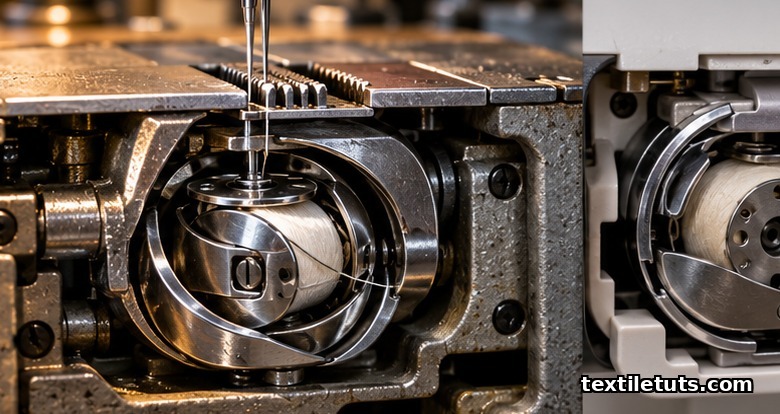
The physical result of those different design priorities shows up in three places: the bedplate, the drive system, and the bobbin case.
An industrial lockstitch head typically uses a horizontal-axis rotary hook and a semi-automatic lubrication system that recirculates sewing oil at the needle bar and hook race. A domestic lockstitch uses a vertical-axis oscillating hook with a self-lubricating sintered bushing that the user oils by hand every 8 to 10 hours of use. The hook geometry determines the maximum stitch length, the bobbin capacity, and the thread size the machine can run without skipped stitches.
Operating Speed: Why Industrial Machines Run 3 to 12 Times Faster
Industrial straight-stitch heads such as the Juki DDL-8700 and the Brother BAS-311H are rated at 4,000 to 5,000 SPM. Coverstitch and chainstitch industrial heads run slower, usually 3,000 to 3,500 SPM, because multi-needle threading adds tension complexity at high speeds. Industrial walking-foot machines for leather and upholstery run slowest at 1,000 to 1,800 SPM, which is still faster than most home machines.
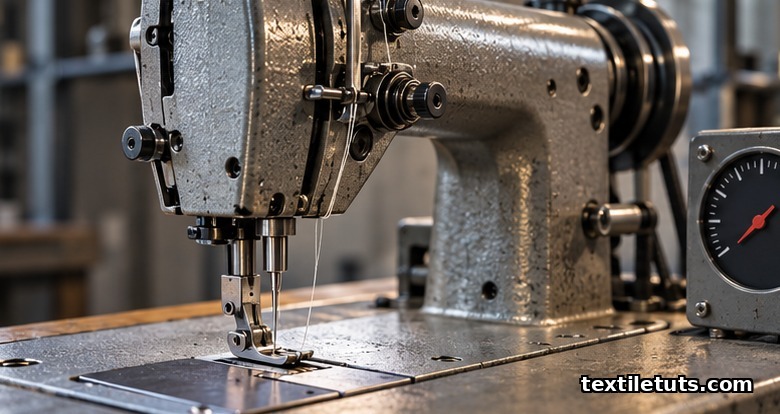
Home machines are deliberately capped between 400 and 1,000 SPM. The cap exists because above 1,000 SPM, vibration and needle heat become user-experience problems in a plastic-bodied consumer chassis. A domestic needle bar can reach 60 to 80 °C after 20 minutes of continuous high-speed sewing because the heat generated at the needle-fabric interface has nowhere to dissipate. Industrial shafts are mounted in heavier cast iron and dissipate heat faster, but they also run cooler simply because the needle enters the fabric for less time per stitch.
For a small apparel workshop producing 50 to 200 finished garments per day, the speed difference is decisive. Sewing a 12-stitch-per-inch straight seam on a 1-meter panel at 4,000 SPM takes about 7.5 seconds; at 800 SPM it takes 37.5 seconds. Across 200 garments with 6 seams each, that is the difference between a 2.5-hour day and a 12-hour day.
Motor Power and Continuous-Duty Cycle
Industrial sewing machines use either a clutch motor (older designs, 0.75 to 1.5 kW, high starting torque, noisier) or a modern servo motor (0.55 to 0.75 kW for most straight-stitch heads, up to 1.5 kW for heavy-duty walking-foot machines). Servo motors use a position sensor to drive the needle bar only through the angles where torque is actually needed, which cuts power consumption 50 to 70 percent relative to a clutch motor running at the same SPM.
Home machines integrate a small DC or AC motor inside the head itself, typically rated 70 to 100 watts, and use a belt or direct-drive coupling to the main shaft. The motor is sized to deliver the rated SPM for short bursts under load and is not designed for thermal soak above 30 minutes.
ASTM D1683/D1683M-22 (Standard Test Method for Failure in Sewn Seams of Woven Fabrics) requires test specimens to be sewn under controlled, repeatable conditions, which is why industrial sewing stations in QA labs are required to log motor temperature and stitch length on every seam. A domestic machine cannot pass that audit under continuous duty because the motor temperature drifts upward during a long test sequence, changing the stitch geometry.
Stitch Types and Stitch Length Range
ISO 4915:1991 (Textiles, Stitch Types, Classification and Terminology) classifies stitches into six families numbered 100 through 600. The families most relevant for industrial work are:
- Stitch type 301 (lockstitch): produced by a single needle and a bobbin hook, used on roughly 80 percent of garment seams.
- Stitch type 304 (zigzag lockstitch): used for stretch knits, decorative topstitching, and label attachment.
- Stitch type 401 (chainstitch): produced by a single needle and a looper, used for bagging operations on denim jeans and for basting in industrial production.
- Stitch type 504 (four-thread overlock): used on knit trims and serged seams.
- Stitch type 605 (coverstitch): used on hemming knit garments where both stretch and a clean topstitch are required.
An industrial straight-stitch machine is dedicated to type 301. It does one stitch type, but it does it across a stitch-length range of 1 to 9 mm and a stitch-width range that depends on the needle plate. A domestic machine offers 5 to 20 built-in stitch patterns (utility, stretch, decorative, buttonhole) but the mechanical stitch-length range is typically 1 to 5 mm, and the zigzag width is mechanically limited to 5 to 7 mm.
This trade-off is the core design choice: industrial machines maximize seam quality and throughput on a narrow set of stitches; domestic machines maximize versatility on a small set of fabric weights.
Frame, Throat Plate, and Presser Foot Pressure
Industrial sewing machine heads weigh between 25 and 40 kg. The mass is functional: a heavier cast-iron head dampens vibration at 4,000+ SPM, which keeps the needle penetration force stable. The bed (the horizontal arm) is typically 30 to 50 cm from the needle to the operator, shorter than most domestic machines because industrial sewing is done with a “trim and guide” hand position rather than the “fabric-glide” position used in hobby sewing.
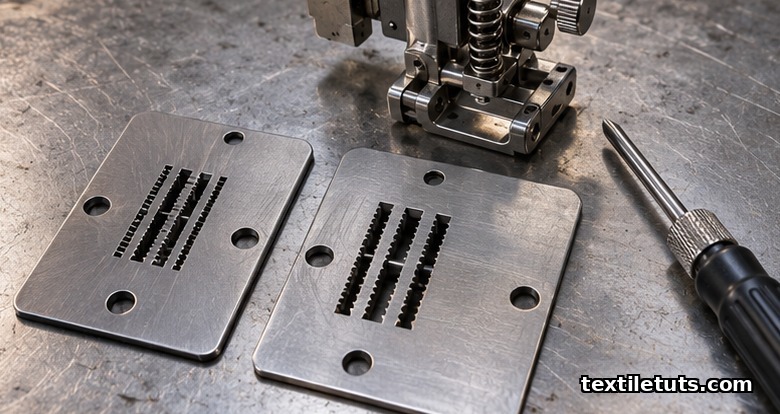
The throat plate (the metal plate around the needle with the feed dog opening) is a quick-change component on industrial machines. A factory running 200 shirts per day can swap from a fine-pitch plate (10 stitches per inch) to a coarse-pitch plate (6 stitches per inch) in 30 seconds by unscrewing the plate. On most domestic machines, the throat plate is captive and changing it requires partial disassembly of the bobbin area.
Presser foot pressure on industrial machines is spring-loaded and adjustable from 1 to 10 kg. On domestic machines it is typically spring-loaded at 2 to 4 kg with limited adjustment. Heavier pressure is required to feed multiple fabric layers (such as 6-layer denim waistbands or canvas strap assemblies) without the foot skating.
Thread and Needle Compatibility
Industrial machines are built to run Tex 30 to Tex 180 thread, which corresponds to ticket numbers T30 to T180 (denim, canvas, upholstery). Domestic machines are limited to Tex 10 to Tex 50 because the bobbin case, tension discs, and needle bar geometry are sized for fine thread.
ISO 10781:1994 (Textiles, Determination of Seam Slippage) requires test seams to be sewn with thread whose linear density is matched to the fabric mass per unit area (GSM). A 400 GSM denim seam must be sewn with Tex 60 or higher to pass the slippage test, which puts the seam out of range for most domestic machines. This is why denim mills (and the denim washing houses that test them) all run industrial lockstitch heads even for development samples.
Comparison Table: Industrial vs Home Sewing Machine Specifications
| Property | Industrial Sewing Machine | Home Sewing Machine | Reference Standard |
|---|---|---|---|
| Maximum speed (SPM) | 1,000 to 5,000 | 400 to 1,000 | Manufacturer rating; ISO 8239 |
| Motor power | 0.55 to 1.5 kW (servo) | 0.07 to 0.10 kW (built-in) | ASTM D1683 test conditions |
| Daily duty cycle | 8+ hours continuous | 1 to 3 hours intermittent | Manufacturer specification |
| Head weight | 25 to 40 kg | 5 to 12 kg | Manufacturer specification |
| Stitch type range | 1 to 3 types (301, 304, 401) | 5 to 20 utility and decorative | ISO 4915:1991 |
| Stitch length range | 1 to 9 mm | 1 to 5 mm | Manufacturer specification |
| Thread range (Tex) | Tex 30 to 180 | Tex 10 to 50 | ISO 10781 (seam slippage) |
| Presser foot pressure | 1 to 10 kg adjustable | 2 to 4 kg fixed or limited | Manufacturer specification |
| Lubrication | Semi-automatic recirculating | Manual sintered-bushing | Manufacturer maintenance schedule |
| Head price (new) | USD 600 to 3,500 (head only) | USD 150 to 2,500 (full machine) | Market reference |
| Typical operator skill required | Garment technician or industrial training | Self-taught to intermediate | Operator qualification |
Which Class Should You Buy?
Choose an industrial machine if you are producing more than 4 to 6 hours of sewn output per day, if you are sewing Tex 50+ thread, if you are sewing 3 or more fabric layers (denim, canvas, technical textiles, leather), or if you need a single-stitch head to deliver the same seam at 4,000 SPM over a year of two-shift operation. A Juki DDL-8700 single-needle lockstitch or a Brother BAS-311H is the standard entry point for new apparel workshops.
Choose a home sewing machine if your workload is under 3 hours per day, your fabric weights stay under 300 GSM, your thread stays under Tex 40, and you need utility stitches, buttonholes, and a small selection of stretch stitches for crafts and home decor. A home machine rewards you with versatility; an industrial machine rewards you with throughput.
For textile students, the practical recommendation is to train on a home machine for the first 6 to 12 months to learn stitch geometry, tension balance, and seam behavior, then transition to a used industrial straight-stitch head (in the USD 300 to 700 range on the secondary market) for production training.
Frequently Asked Questions
Can a home sewing machine be used for commercial production?
Technically yes, legally yes in most jurisdictions, but the machine will fail under continuous duty. The motor will thermally limit after 30 to 90 minutes of continuous sewing, the hook race will wear prematurely because the bushing lubrication depends on user-applied oil, and the seam-quality consistency will drift stitch to stitch. A standard home sewing machine is rated for 1 to 3 hours of intermittent use per day, not the 8-hour shifts a production line runs.
Are industrial sewing machine heads interchangeable between brands?
Industrial heads are largely interchangeable at the mounting-bolt pattern level. A Juki DDL-8700, a Brother BAS-311H, and a typical Chinese-made single-needle lockstitch head all use the same table cutout (a 470 mm by 178 mm rectangular cutout) and the same oil-pan mounting pattern. Aftermarket parts (bobbins, needles, presser feet, feed dogs) are also largely interchangeable across the Juki-compatible platform, which is why Juki-pattern parts dominate the global aftermarket.
What is the loudest operational difference between the two classes?
At rated SPM, an industrial straight-stitch head produces 75 to 85 dB(A) at the operator position; a home machine produces 60 to 70 dB(A). OSHA’s 29 CFR 1910.95 occupational noise limit is 90 dB(A) over an 8-hour time-weighted average, which puts industrial machines at the edge of hearing-protection territory after 2 to 3 hours of exposure. Workshops that run industrial machines for full shifts usually add anti-vibration table mounts and acoustic panels.
Do industrial machines need a different needle system?
Yes. Industrial machines use the DBx1 needle system (also marked 16×257 or 287 WH); home machines use the 15×1 system (also marked HAx1). The DBx1 shank is thicker, which makes it incompatible with home machine needle bars. The DBx1 is also offered in heavier needle weights (up to size 230 / NM 230) for stitching leather and technical textiles, while the HAx1 is typically limited to size 110 / NM 110. Buying industrial needles means stocking a DBx1 inventory.
Why do industrial sewing tables have a specific shape?
Industrial sewing tables are cut with a 470 by 178 mm rectangular hole in the tabletop, which is the same on every Juki-pattern straight-stitch head. The cutout lets the head’s hook race sit below the table surface, where the bobbin and the feed mechanism live. Home machines are self-contained because the bobbin and hook are inside the machine’s own chassis. The industrial cutout also allows the head to tilt back on a hinge for cleaning and oil change, which home machines do not need.
References
- International Organization for Standardization. ISO 4915:1991 Textiles, Stitch Types, Classification and Terminology. ISO, 1991. Classification and definitions of the six stitch families used in seam construction.
- International Organization for Standardization. ISO 8239:1987 Textiles, Sewing Machines, Vocabulary. ISO, 1987. Terminology for sewing machine components, classes, and operation.
- International Organization for Standardization. ISO 10781:1994 Textiles, Determination of Seam Slippage. ISO, 1994. Method for measuring yarn slippage at sewn seams under tensile load.
- ASTM International. ASTM D1683/D1683M-22 Standard Test Method for Failure in Sewn Seams of Woven Fabrics. ASTM, 2022. Reference for testing seam strength under controlled machine and stitch conditions.
- ASTM International. ASTM D3940-22 Standard Test Method for Determining the Breaking Strength of Sewn Seams. ASTM, 2022. Test method for seam tensile strength of sewn fabric assemblies.
- AATCC. AATCC TM 88B-2018 Smoothness Appearance of Fabrics After Repeated Home Laundering. AATCC, 2018. Standard reference for evaluating seam appearance after repeated wash cycles.
- Adanur, S. Wellington Sears Handbook of Industrial Textiles. Lancaster, PA: Technomic Publishing, 1995. Standard reference for industrial seam construction and machine classification.
This article is the working reference for industrial vs home sewing machine classification and selection. Editorial by Mohammad Yousuf (Anik), TextileTuts. Sources: ISO 4915:1991, ISO 8239:1987, ISO 10781:1994, ASTM D1683, ASTM D3940, AATCC TM 88B, Wellington Sears Handbook of Industrial Textiles as cited.


