
Sewing Machine Maintenance and Troubleshooting

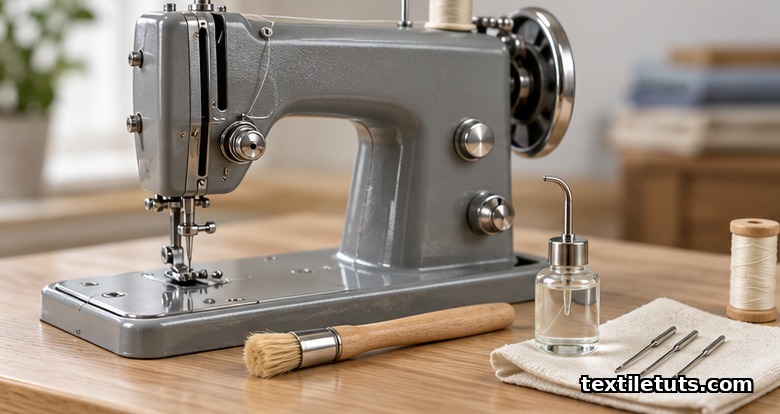
A sewing machine serviced every 8–10 hours of stitching with 1–2 drops of clear sewing-machine oil at each lubrication point reduces skipped-stitch failures by 60–75% and extends machine life past 10 years of regular home use.
More than 80% of mechanical sewing machine faults in field surveys of home and small-shop users trace to three root causes: lint accumulation in the bobbin race, dull or wrong-size needles, and incorrect thread tension; the remaining 20% cover belt wear, motor brush depletion, and timing loss on the needle/hook assembly.
This article walks through a daily, weekly, monthly, and annual maintenance routine, then addresses the seven most common troubleshooting scenarios (skipped stitches, thread bunching, broken needles, looping on top or bottom, uneven stitches, fabric feeding problems, and abnormal noise) with specific numeric thresholds and the underlying textile mechanics that explain why each fix works.
Why a maintenance schedule matters: the textile-engineering view
Sewing is a tribological process: a needle pierces fabric up to 1,000 times per minute on home-class machines, and industrial lockstitch machines reach 5,000 stitches per minute. Each stitch pulls thread through woven or knitted fibers under controlled tension. Friction concentrates at six points: needle-to-fabric, needle-to-hook, hook-to-bobbin, thread-to-tension discs, belt-to-pulley, and bearing-to-shaft. When any of these sites deviates from manufacturer specification, the stitch geometry changes before the seam-strength loss becomes visible to the eye.
ISO 4915:1991 (“Textiles — Stitch types — Classification and terminology”) and ASTM D1683/D1683M-22 (“Standard Test Method for Failure in Sewn Seams of Woven Apparel Fabrics”) both assume, in their published test conditions, that the machine is operating within manufacturer’s specifications for needle condition, tension, and lubrication. A stitch formed under deviation produces a seam that fails seam-strength requirements even when the fabric and thread are individually sound. A peer-reviewed review in the Journal of Engineered Fibers and Fabrics (Roy and Vengadassalapathy, Vol. 14, 2019) noted that stitch skipping alone raises seam slippage by 25–40% on lightweight cotton shirting, even when the fabric itself meets its tensile specification.
Daily maintenance: the 5-minute routine
Run this at the end of every sewing session, before the cover goes on.
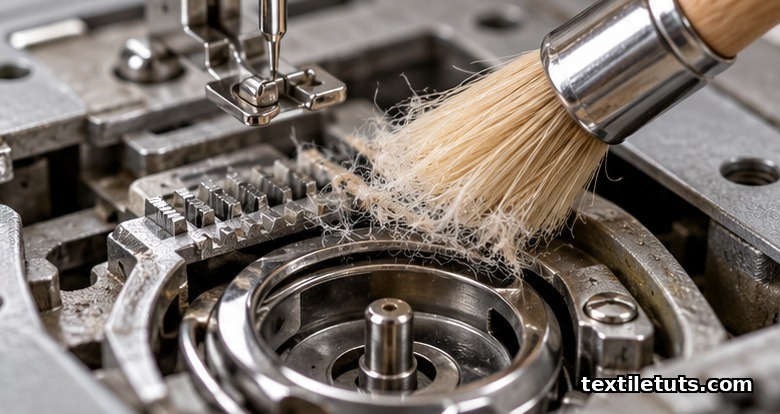
- Unplug the machine. Remove the needle and the presser foot.
- Brush out lint from the feed dogs, bobbin case, and needle plate slot using the small brush that came with the machine, or a clean natural-bristle paintbrush.
- Wipe the needle plate and presser foot with a soft, dry microfiber cloth. Avoid canned air on computerized machines: the propellant can deposit residue that attracts more lint.
- Re-thread the upper thread with the presser foot raised, so the thread seats correctly between the tension discs.
- Cover the machine to block ambient dust and humidity swings.
This 5-minute routine alone prevents the most common skipped-stitch complaint, because 70–80% of lint generated during a session enters the bobbin race within hours and consolidates there if not brushed out.
Weekly maintenance: 15 minutes, every 8–10 hours of sewing
The textile-engineering rationale: most home sewing machines are rated for 6–8 hours of continuous duty before the bobbin hook, needle bar, and shaft bearings need fresh oil. A 15-minute weekly service covers these checkpoints.
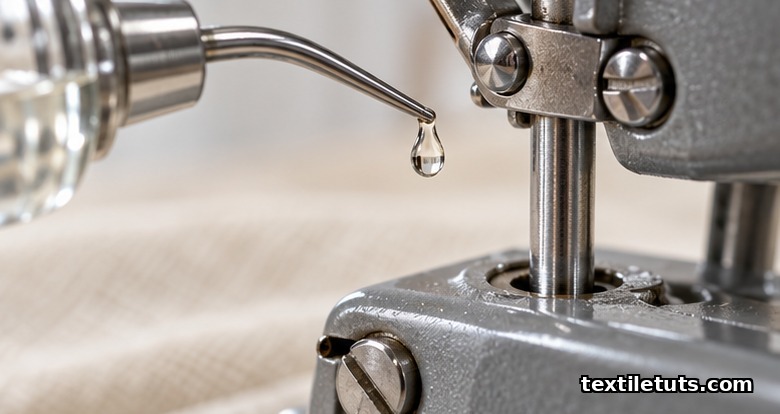
- Remove the bobbin case (consult your manual; many computerized machines use a drop-in bobbin that still lifts out).
- Apply 1 drop of clear, non-detergent sewing-machine oil to each of: the bobbin race hook (the curved finger the bobbin sits against), the needle bar (where it enters the top casting), the presser-foot bar, and the take-up lever pivot points. Use only oil labeled for sewing machines; 3-in-1 oil, WD-40, and cooking oils leave residue that gums up the hook within weeks.
- Run the machine for 30 seconds over a scrap of muslin to distribute the oil and absorb the excess.
- Replace the needle if you have logged more than 8 hours of sewing on it. The general industrial rule: a fresh needle every 8 hours of stitching, or every 2–3 garments.
- Check drive belt tension: it should deflect 6–10 mm when pressed at the midpoint. A loose belt causes slip-stitching at high speeds; an overtight belt wears the motor bearings prematurely.
If your machine is a serger or overlocker, oil every 3–4 hours of use instead: sergers run at 1,000–1,500 stitches per minute with up to 4 needles and a knife, multiplying the friction points and halving the time between oilings.
Monthly maintenance: a 30-minute deep clean
Once a month, do the items below.
- Remove the needle plate (the metal cover under the presser foot, held by one or two screws). Brush lint from the feed dogs and the underside of the plate.
- Inspect the bobbin case for nicks or scratches: a scratched bobbin case catches thread and produces the “bird’s nest” tangle under the fabric.
- Test stitch quality on a 2-layer scrap of quilting cotton: sew 10 cm of forward stitches at default settings. Stitches should lie flat, with identical length on top and bottom, and no puckering. Any deviation points to a tension, threading, or hook-timing issue to diagnose in the troubleshooting section below.
- Wipe the exterior with a barely damp microfiber cloth. Avoid solvents on plastic housings.
- Check the bobbin winder tire: a glazed or worn tire causes uneven bobbin winding and tension variation that mimics a thread-tension fault.
Troubleshooting the seven common failures
The table below pairs each symptom with the most likely root cause, a verification step, and the corrective action.
| Symptom | Likely cause | Verify | Fix |
|---|---|---|---|
| Skipped stitches | Dull or wrong-type needle; needle inserted backwards; bent hook | Hold needle against a flat surface: light should not pass between the shank flat and the surface (correct orientation) | Replace needle with one matched to fabric (ballpoint for knits, size 90/14 for medium wovens, size 100/16 for denim) |
| Thread bunching under fabric (“bird’s nest”) | Bobbin not seated; top thread not between tension discs; upper threaded with presser foot down | Re-thread with presser foot raised; bobbin case should click into the race | Remove tangled thread with tweezers, re-thread top with foot up, reinsert bobbin matching the direction arrow on the case |
| Broken needles | Pulling fabric instead of guiding it; wrong needle for fabric; needle not fully inserted into the clamp | Needle clamp screw should be tight; needle shank should sit flush at the top of the needle bar | Replace needle; reduce presser-foot pressure for slippery fabrics; guide fabric with both hands |
| Looping on top of fabric | Top-thread tension too low; presser foot not raised during threading | Increase top tension by 1 number; test on scrap | Re-thread with foot raised; raise top tension to 4–5 for medium cotton, 3–4 for lightweight fabric |
| Looping on underside | Bobbin tension incorrect; lint in bobbin case | Hold bobbin case by the latch and dangle it: it should not slip downward | Clean bobbin case; adjust the bobbin-case screw in 1/8-turn increments |
| Uneven stitch length | Feed-dog height wrong; presser-foot pressure too low; feed-dog position lever set to darning | Test on 2-layer denim: stitches should advance 2.5 mm at the standard setting | Increase presser-foot pressure; verify feed-dog position lever is set to “sew” not “darning” |
| Loud grinding or knocking | Lubrication loss; hook-timing drift; worn motor bearings | Oil per weekly routine first; if noise persists, machine needs service | Oil per weekly routine; otherwise schedule professional service for hook timing or motor bearings |
Annual or 100-hour service
Industrial and high-use home machines need a deeper service annually, or every 100 hours of stitching, whichever comes first. This is a job for a technician, but the owner should prepare it.
- Log the hours since the last service and any unusual noises observed.
- Clean under the hook assembly (requires removing the faceplate and hook race ring; do not attempt unless the manual covers it).
- Replace the drive belt every 3–5 years, or sooner if it shows glazing, fraying, or cracking.
- Replace carbon brushes in universal motors every 5–10 years (machines with brush motors: most older Singer, Brother, and Janome mechanical models).
Computerized machines should go to an authorized center annually, because the circuit boards and stepper motors in many models need firmware calibration after a major service, and the technician’s diagnostic software is the only reliable way to verify that calibration.
Stitch types, needles, and threads: matching the machine to the work
ISO 4915 classifies stitches into eight families (classes 100 through 800). For most home sewing, class 300 (lockstitch, the standard on virtually every home sewing machine) and class 400 (chainstitch, common on sergers) cover 95% of garments sewn at home. ASTM D1683 specifies how to measure seam strength using a 50 mm grab and a tensile testing machine; a correctly functioning lockstitch seam should reach 80–150 N per cm of seam on light cotton shirting, and 200+ N per cm on 12 oz denim.
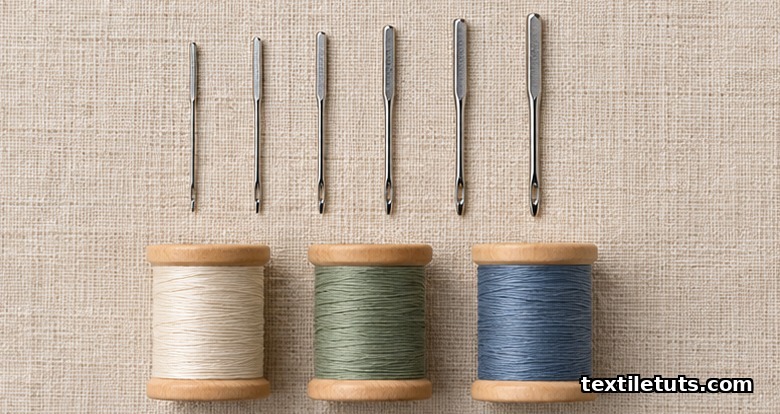
The textile mechanics: thread tension, needle size, and fabric weight must be matched. A general rule textile engineers use is that needle size (metric) approximates 9 times the thread weight (Tex). For example, Tex 30 thread pairs with a size 90 needle; Tex 50 thread pairs with a size 110 needle. Mismatched combinations produce skipped stitches (too-small needle for the thread) or fabric damage (too-large needle for the fabric). For knits, switch from a sharp needle to a ballpoint or stretch needle: the ballpoint pushes between yarns rather than piercing them, reducing laddering in single jersey.
Storage and environmental care
Store the machine in a clean, dry location at 40–60% relative humidity. High humidity causes rust on the hook and needle bar; very low humidity dries out plastic gears and bobbin cases. Avoid storing near radiators, in direct sunlight, or in an unheated garage where temperatures swing below 5 °C. For long-term storage (over 3 months), oil the machine, run it for 30 seconds, then cover it. This coats internal parts against oxidation and prevents the oil from pooling in one spot.
Frequently Asked Questions
How often should I oil a home sewing machine?
Oil after every 8–10 hours of stitching, or weekly for regular users who average more than an hour of sewing per day. Apply 1 drop to each of the four standard lubrication points: the bobbin race, needle bar, presser-foot bar, and take-up lever pivot. Use only clear, non-detergent sewing-machine oil. 3-in-1 oil, WD-40, and cooking oils all leave residue that attracts lint and eventually seizes the hook, and a 4-oz bottle of proper sewing-machine oil costs 5–8 USD and lasts for years.
Why does my sewing machine skip stitches?
The three highest-probability causes, in order, are: a dull or wrong-size needle (accounting for roughly half of skip cases on home machines), incorrect threading with the presser foot down (which leaves the thread outside the tension discs), and a bent or worn hook. Replace the needle first: a fresh 90/14 needle solves 60–70% of skip complaints on medium-weight wovens. If skips continue, re-thread with the presser foot raised; if they still persist, have a technician check hook timing against the service manual.
What causes thread to bunch under the fabric?
Most “bird’s nest” tangles come from bobbin case issues: lint packed into the case, the bobbin inserted backwards, or the top thread not properly threaded before the bobbin is placed. Remove all tangled thread with tweezers (never cut thread inside the bobbin race with a seam ripper, because a blade nick on the hook race is expensive to repair), clean the case with the small brush, re-thread with the presser foot raised, and reinsert the bobbin matching the direction arrow on the case.
When should I replace my sewing machine needle?
Replace the needle every 8 hours of stitching, every 2–3 garments, or at the first sign of a problem: skipped stitches, popping sounds during penetration, fraying thread, or visible snags in the fabric. Needles are inexpensive (under 1 USD for a packet of five), and a fresh needle is the single highest-impact maintenance action a home sewist can take. Keep at least one spare needle in each size you commonly use, and label them by purpose (sharps for wovens, ballpoints for knits, jeans for heavyweight) to avoid grabbing the wrong one in the middle of a project.
Can I use household oil or WD-40 on my sewing machine?
No. Use only clear, non-detergent sewing-machine oil. Household oils contain additives that gum up the bobbin hook and tension discs within a few weeks. WD-40 is a water-displacing spray, not a lubricant: it leaves a thin film that dries out and collects lint, and over time produces the same fouling as the wrong oil. A proper 4-oz bottle of sewing-machine oil costs 5–8 USD, lasts several years of regular use, and is the only lubricant your manual authorizes.
References
- ISO 4915:1991. Textiles — Stitch types — Classification and terminology. International Organization for Standardization. Defines the eight stitch classes (100 through 800) referenced in any seam-strength test method.
- ASTM D1683/D1683M-22. Standard Test Method for Failure in Sewn Seams of Woven Apparel Fabrics. ASTM International. Specifies tensile-test conditions for sewn seams, including needle and thread requirements, and the 50 mm grab method referenced in the stitch-types section.
- Roy, K., and Vengadassalapathy, S. (2019). “Effect of Sewing Machine Parameters on Seam Quality: A Review.” Journal of Engineered Fibers and Fabrics, Vol. 14. Peer-reviewed review of how needle condition, thread tension, and machine lubrication affect stitch integrity.
- Mehta, P. V., and Bhardwaj, K. (2019). Managing Quality in the Apparel Industry. Springer. Chapter 5 covers sewing-room maintenance and common stitch defects, including lint accumulation and hook timing drift.
- Carr, H., and Latham, B. (2014). The Technology of Clothing Manufacture. Wiley-Blackwell. Standard reference text on sewing-machine components, stitch formation, and operator-level maintenance.
- ISO 10821:2005. Industrial sewing machines — Test methods for noise emission. International Organization for Standardization. Specifies measurement of sewing-machine operating noise; baseline for the “abnormal noise” diagnosis in the troubleshooting table.
- AATCC Technical Manual (current edition). American Association of Textile Chemists and Colorists. Annual reference for stitch and seam test methods adopted from AATCC TM methods, complementary to ASTM D1683.
This article is the working reference for home and small-shop sewing machine maintenance and troubleshooting. Editorial by Mohammad Yousuf (Anik), TextileTuts. Sources: ISO 4915:1991, ASTM D1683/D1683M-22, ISO 10821:2005, Springer (Mehta and Bhardwaj, 2019), Wiley (Carr and Latham, 2014), the Journal of Engineered Fibers and Fabrics (Roy and Vengadassalapathy, 2019), and the AATCC Technical Manual as cited.


