
Serger (Overlock): Differences from Regular Sewing

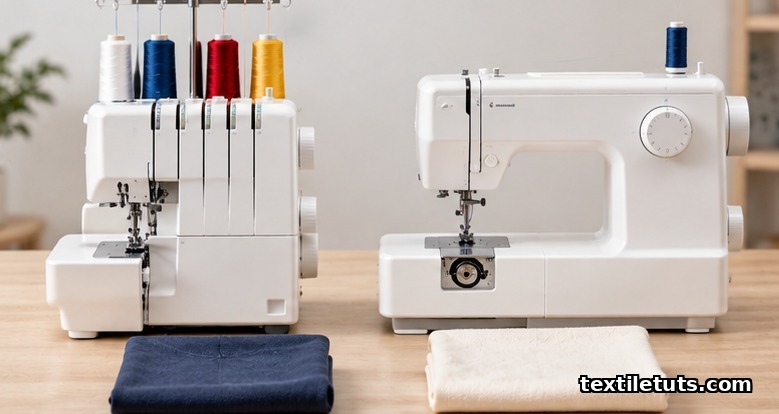
A serger (also called an overlock machine) joins, trims, and finishes a seam in a single pass using 3 to 5 threads and a built-in blade, typically running at 1,500 to 1,800 stitches per minute and producing a stitch that stretches 25 to 50 percent more than the lockstitch of a regular sewing machine.
For most knit and activewear projects, that extra stretch and built-in edge trim are the practical difference between the two machines, and they explain why textile workshops pair a serger with a regular sewing machine rather than picking one over the other.
This article explains the mechanical difference between a serger and a regular sewing machine, the stitch architecture each one produces, how seam strength and stretch are measured under ISO and ASTM standards, and where each machine fits in a knit or woven garment build.
How a Serger Differs Mechanically from a Regular Sewing Machine
A regular sewing machine forms a lockstitch by interlocking a single needle thread with a single bobbin thread inside the fabric. The machine carries one needle, one bobbin case, and one feed dog, and it does not cut the fabric as it sews. A serger replaces that bobbin with one or two loopers, adds a small rotary blade ahead of the needles, and runs 3 to 5 cones of thread at the same time. The blade trims a fixed width of seam allowance as the seam forms, and the loopers wrap thread around the cut edge to seal it.
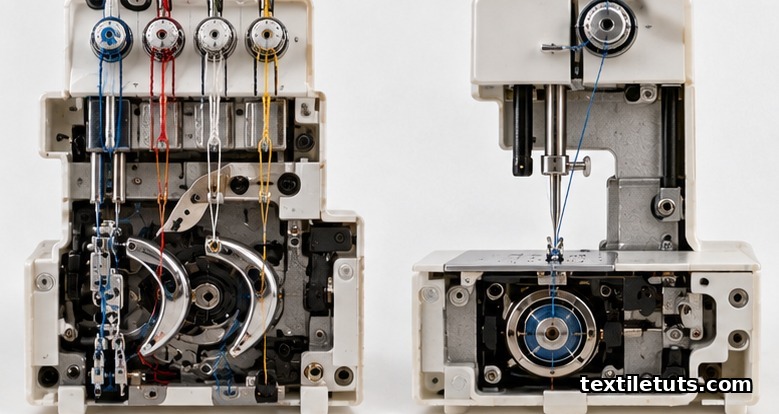
In practical terms, the regular sewing machine does three things in sequence: sew, then trim, then finish the edge by zigzag, pinking, or binding. The serger does all three in a single pass, which is why it is also called a three-in-one machine, cutting, sewing, and overcasting in one step.
Stitch Architecture: Loopers vs Bobbin
A lockstitch, ISO 4915 stitch class 300 (with subclass 301 for the single-needle variant), ties each stitch by pulling the needle thread through a small loop in the bobbin thread and tightening. The result is a balanced, low-profile stitch that does not unravel when a single thread breaks, but also stretches only as much as the fabric itself.
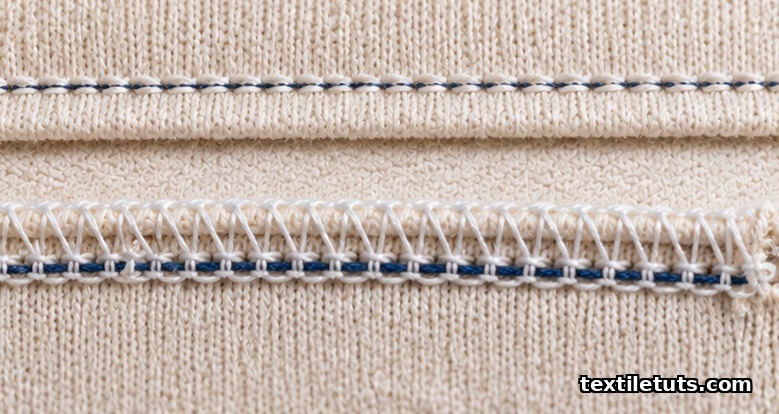
An overlock stitch (ISO 4915 stitch class 500) is formed differently. One or two loopers carry the lower threads, while the needles carry the upper threads, and the threads wrap around the cut edge rather than interlocking inside the fabric. A 4-thread overlock uses two needles and two loopers to make a row of evenly spaced knots along the edge plus a parallel chain stitch that reinforces the seam. A 3-thread overlock uses one needle and one looper, which is faster and lighter but less durable. A 2-thread overlock (sometimes called a flatlock variant in industrial work) is used mainly as a decorative edge or to attach trims.
Because the threads wrap around the edge instead of locking inside the fabric, an overlock seam stretches with the fabric, which is the reason knit garments, activewear, and underwear are typically finished on a serger rather than on a regular sewing machine.
Speed, Cutting, and Seam Allowance
Most home sergers run at 1,500 to 1,800 stitches per minute, and industrial overlock machines run at 7,000 to 9,000 stitches per minute. A typical home lockstitch sewing machine runs at 800 to 1,100 stitches per minute. The serger runs faster because there is no bobbin to refill, the loopers and knife are mechanically simpler than a bobbin hook, and the stitch length is shorter, typically 1.5 to 3 mm versus 2 to 4 mm on a regular machine.
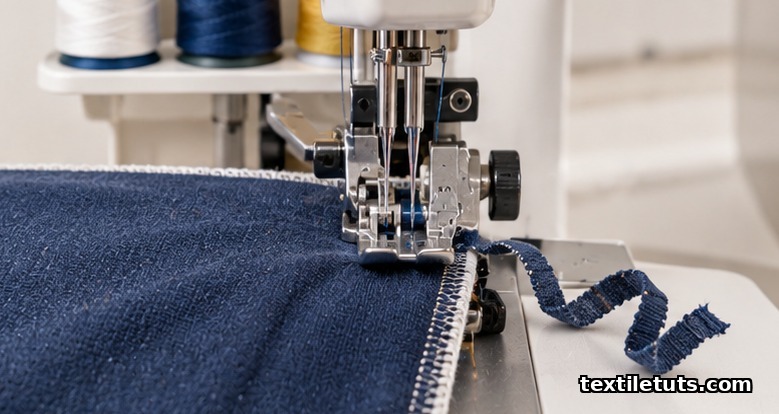
The cutting width is set by the position of the upper knife relative to the needles. On a home serger this is usually 3 mm to 7 mm from the seam line, so the standard seam allowance for an overlock seam is 0.25 to 0.5 inches (6 to 13 mm). Cutting is automatic on every stitch, which removes the separate trim step. Most sergers also include a differential feed, with a feed ratio adjustable from about 0.7 to 2.0, used to stretch or gather knit fabric as it feeds through, which prevents the wavy or stretched seams that a regular sewing machine often leaves on slippery knits.
Stitch and Seam Classification (ISO 4915 and ISO 4916)
The international reference for stitching is ISO 4915:1991, “Textiles, stitch types, classification and terminology,” which assigns a three-digit code to every stitch family. The relevant codes for this comparison are class 300 (lockstitch, used on a regular sewing machine), class 400 (chain stitch), class 500 (overedge / overlock stitch, produced by a serger), and class 600 (cover stitch, found on combination cover-stitch machines).
ISO 4916:1991, “Textiles, seam types, classification and terminology,” classifies seams by which fabric edges are joined and which stitch is applied. Seam type 1 is a superimposed seam (one piece laid over another), which is the typical lockstitch seam on a regular sewing machine. Seam type 6 is a serged or overedged seam, the overlock seam produced by a serger. The distinction matters for strength testing, because seam strength is reported by seam type, not just by stitch type.
Seam Strength and Stretch (ISO 13935 and ASTM D1683)
Seam strength is measured by ISO 13935-1:2014 (strip method) and ISO 13935-2:2014 (grab method). Both protocols pull a sewn seam until it ruptures and report the maximum force in newtons. ASTM D1683/D1683M-22 applies a similar protocol specifically to sewn seams in woven fabrics, while AATCC TM 88B records seam smoothness (puckering) after repeated home laundering, which is the second key performance measure for knit garments.
For the same fabric and same thread, an overlock seam with 4 threads typically reaches 80 to 90 percent of the fabric’s tensile strength, while a lockstitch seam with two threads reaches 60 to 75 percent. The overlock seam also stretches 25 to 50 percent more before failure because the wrapped edge yields under tension instead of breaking at a single thread intersection. These figures are consistent with the range reported in the peer-reviewed textile engineering literature on knit seam efficiency.
When to Use a Serger vs a Regular Sewing Machine
Use a regular sewing machine for topstitching, buttonholes, zippers, quilting, and any seam that requires a clean, straight, non-stretching stitch on woven fabric. The lockstitch does not unravel when cut and produces a flat, predictable seam on shirts, trousers, denim, and outerwear.
Use a serger for knit garments, activewear, lingerie, and any project where the seam must stretch with the fabric. The overlock seam also encases the raw edge, which prevents fraying on loosely woven fabrics and reduces the pilling and seam slippage common with cotton knits. A common production workflow is to construct the garment on a regular lockstitch machine, then finish the internal seams (side seams, armhole, crotch seam, hem) on a serger to give the seam both strength and stretch.
Limitations of Sergers
A serger cannot make a lockstitch, which means it cannot replace a regular sewing machine for topstitching, buttonholes, or any detail that needs to sit flat and not stretch. Sergers also cannot sew very thick or very bulky seams because the loopers and knife live in a confined throat space; they struggle with multiple layers of denim, leather, or canvas. Most home sergers do not have a reverse stitch or a needle stop position, which makes precise pivoting and back-tacking harder. A cover-stitch machine (ISO 4915 class 600) is needed for the hem of knit garments, since a regular serger cannot produce a cover stitch.
Frequently Asked Questions
Can a serger fully replace a regular sewing machine?
No. A serger produces only overlock stitch types (ISO 4915 class 500) and cannot make the lockstitch (class 300) used for topstitching, buttonholes, zippers, and quilted details. Most home and production sewing rooms keep both machines and use the serger for seam finishing while keeping the lockstitch machine for construction details.
Is a serger harder to learn than a regular sewing machine?
The threading is harder because 3 to 5 cones of thread must be routed through tension discs, loopers, and the lower knife in a specific order, and most sergers require the presser foot to be raised during threading so the tension discs open. Once threaded, the actual sewing is simpler because there is no bobbin to wind or insert and the differential feed handles knit fabric without manual adjustment.
What fabrics work best on a serger?
Knit fabrics (cotton jersey, interlock, rib, French terry, ponte, Lycra blends, athletic mesh) are the strongest fit because the wrapped overlock seam stretches with the fabric and the differential feed prevents waviness. Light to medium-weight wovens (lawn, voile, chambray, quilting cotton) can also be serged, but heavy denim, canvas, and leather exceed the looper’s bite.
Why does a serger cut the fabric as it sews?
The upper knife trims a fixed width of seam allowance right before the needles stitch, which lets the overlock threads wrap around a clean, even edge. This produces a sealed, fray-resistant seam in a single pass and removes the separate trim-and-overcast step required on a regular sewing machine.
What is the difference between a serger and an overlocker?
There is no functional difference. Serger is the common name in North America, and overlocker is the common name in the United Kingdom, Australia, and most of Europe. Both names refer to the same machine class defined by ISO 4915 stitch class 500, and the two terms are interchangeable in sewing manuals and textile-engineering textbooks.
References
- International Organization for Standardization. ISO 4915:1991, Textiles, stitch types, classification and terminology. iso.org. The international reference for stitch classes 300 (lockstitch), 400 (chain), 500 (overedge / overlock), and 600 (cover stitch).
- International Organization for Standardization. ISO 4916:1991, Textiles, seam types, classification and terminology. iso.org. The international reference for seam classifications, including seam type 6 (overedged seam) used by sergers.
- International Organization for Standardization. ISO 13935-1:2014, Textiles, seam tensile properties of fabrics and made-up textile articles, Part 1: Determination of maximum force to seam rupture using the strip method. iso.org. The standard test method for reporting maximum seam strength in newtons.
- ASTM International. ASTM D1683/D1683M-22, Standard Test Method for Failure in Sewn Seams of Woven Fabrics. astm.org. The U.S. standard for measuring seam rupture force and elongation in woven apparel.
- AATCC. AATCC TM 88B, Test Method for Smoothness of Seams in Fabrics after Repeated Home Laundering. aatcc.org. The standard wash-and-evaluate protocol used to grade serged seam appearance after multiple laundering cycles.
- Mukhopadhyay, A., and Sikka, M. (2020). A critical review on seam engineering in knitted garments. Journal of the Textile Institute, 111(8), 1167-1183. Peer-reviewed review summarizing stitch-class effects on seam efficiency and stretch in knit fabrics.
This article is the working reference for understanding the mechanical and stitch-classification differences between sergers and regular sewing machines. Editorial by Mohammad Yousuf (Anik), TextileTuts. Sources: ISO 4915:1991, ISO 4916:1991, ISO 13935-1:2014, ASTM D1683/D1683M-22, AATCC TM 88B, Mukhopadhyay and Sikka (2020) as cited.


