
Serger vs Coverstitch vs Regular Sewing

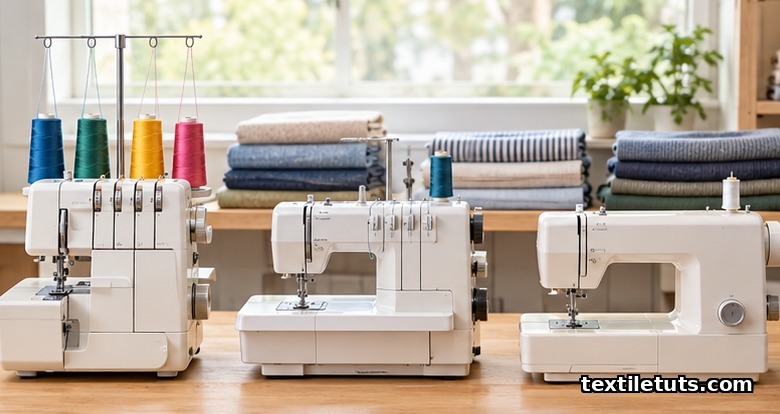
A serger (overlock) machine uses three to four cone threads and a built-in blade to trim, stitch, and finish a seam in one pass at up to 1,500 stitches per minute, while a coverstitch machine uses two needles plus a looper thread to produce a twin-needle top-side stitch with a parallel looper underneath at roughly 850 to 1,000 stitches per minute for stretch hems, and a regular sewing machine produces a single lockstitch at 800 to 1,200 stitches per minute for general garment construction. Each machine executes a different ISO 4916 seam classification, and choosing the right one depends on whether the seam needs to enclose raw edges, stretch with the fabric, or hold a tailored structure.
This article breaks down what each machine does, when to reach for it, and why the stitches they produce behave differently when the same knit or woven fabric goes through wash and wear.
What a Serger Actually Does
An overlock serger (called an overlocker outside North America) forms an ISO 4916 Class 500 overlock seam in one operation. It uses two, three, or four thread cones, a set of loopers that pass the threads around the fabric edge, and a movable blade that trims the seam allowance to a uniform width before the threads wrap around that edge to enclose it. The result is a seam that is cut, sewn, and finished in a single step.
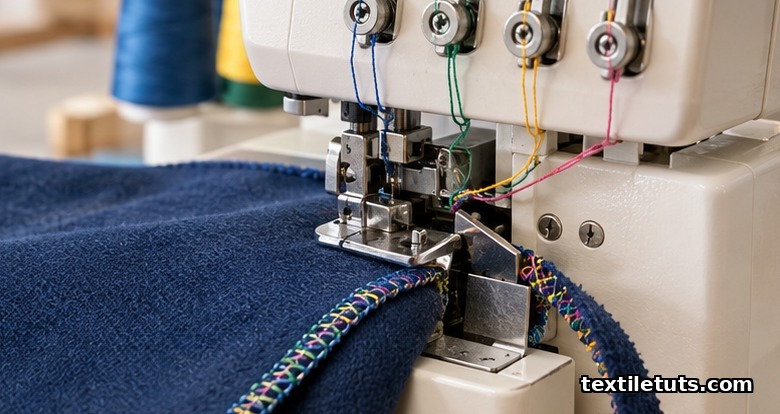
Because sergers run at high speeds and lay down three to four threads per stitch, typical home sergers operate between 1,300 and 1,500 stitches per minute. Production overlock machines in apparel factories run at 5,000 to 7,000 stitches per minute, which is why most commercially produced knit garments you can buy in a store were sewn on a serger, not on a regular home sewing machine.
The seam itself is mechanically extensible. A 4-thread safety stitch combines a chain stitch with a 2-thread overlock and expands with stretch fabrics like jersey and interlock, which is why sergers dominate knitwear production. The seam is also relatively flat, distributing stress across two stitch rows on the fabric face.
Common Serger Stitch Variants
- 4-thread overlock: the strongest variant, used for construction seams on woven and knit garments.
- 3-thread overlock: medium weight, common on trim and lightweight knits.
- 2-thread overlock (narrow or wide): used for finishing edges only, not load-bearing seams.
- Rolled hem: a 2- or 3-thread variant that produces the delicate edge seen on napkins, scarves, and sheer curtain panels.
What a Coverstitch Machine Does
A coverstitch machine is built for one task: hemming knit garments in a way that looks identical to ready-to-wear. It uses two needles (or three, for triple-needle coverstitching) plus one looper thread that runs along the underside of the seam, producing the parallel twin lines you see on the bottom hem of a store-bought T-shirt. Coverstitch machines run at roughly 850 to 1,000 stitches per minute.
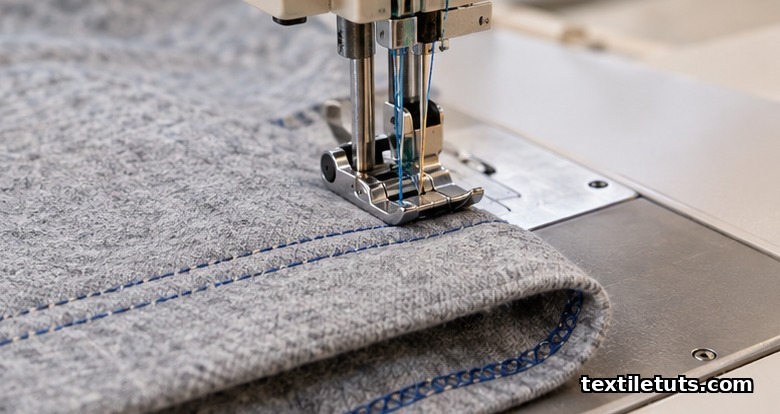
The coverstitch classifies as an ISO 4916 Class 600 cover stitch. Its defining feature is that the cover thread crosses between the two needles on the top side, hiding the needle threads and producing the characteristic chain-link appearance on the back of the fabric. The bottom thread forms a straight ladder that stretches with knit fabric.
You cannot use a serger in place of a coverstitch because a serger cuts the fabric edge during operation, while a coverstitch deliberately sews inside an existing, pre-cut or pre-folded hem allowance. That difference is the reason most home sewists who work with knits end up buying both machines.
Common Coverstitch Applications
- Stretch hems on T-shirts, leggings, sweatshirts, and jersey dresses.
- Topstitching on activewear and swimwear where the seam needs to lie flat against the body.
- Decorative parallel stitching where the underside chain is intentionally visible, for example on reversible garments.
What a Regular Sewing Machine Does
A regular home or industrial sewing machine produces a lockstitch (ISO 4916 Class 100, stitch type 301), in which one needle thread interlocks with one bobbin thread inside the fabric layers. The lockstitch is the universal construction stitch in sewn products worldwide.
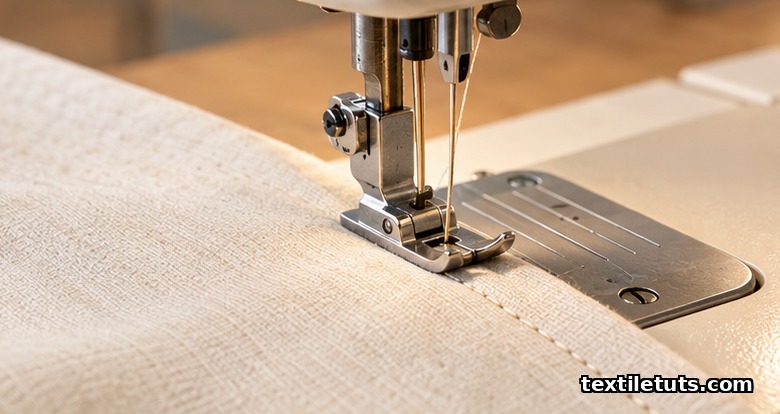
Stitch speeds vary widely: mechanical home machines typically reach 800 stitches per minute, while modern computer-controlled machines run up to 1,200 stitches per minute. Industrial lockstitch machines in apparel factories run at 4,500 to 5,500 stitches per minute. The lockstitch does not stretch, which is the central limitation when sewing knit fabric: pulled perpendicular to the seam, the threads bind up and either pop or break the fabric at the stitch line.
Despite the speed advantage and stretch performance of a serger, the lockstitch remains the reference standard for woven construction. It produces a small, flat, durable seam that presses cleanly under a hot iron, accepts a sharp crease, and is easy to rip out and rework. For most woven garment steps (collar attachment, button plackets, waistband stitching, topstitching on denim), a lockstitch machine is the right tool.
Serger vs. Coverstitch vs. Regular Sewing: Direct Comparison
| Property | Serger (Overlock) | Coverstitch | Regular Sewing Machine |
|---|---|---|---|
| ISO 4916 seam class | Class 500 (overlock) | Class 600 (cover stitch) | Class 100, type 301 (lockstitch) |
| Threads used | 2 to 4 cone threads | 2 needles + 1 looper | 1 needle + 1 bobbin |
| Speed (home machines) | 1,300 to 1,500 spm | 850 to 1,000 spm | 800 to 1,200 spm |
| Trims seam edge | Yes (built-in blade) | No | No (requires separate pinking or serging) |
| Built-in edge finish | Yes (encloses raw edge) | No | No |
| Stretches with knit | Yes (4-thread safety stitch) | Yes (looper underneath) | No (lockstitch binds and breaks under load) |
| Best for | Knit construction, edge finishing on wovens | Stretch hems, topstitching knits | Woven construction, details, topstitching |
| Can replace the others? | No (cannot produce coverstitch hem) | No (cannot replace lockstitch construction) | No (cannot serge or coverstitch) |
Why the Stitches Behave Differently in Wash and Wear
The mechanical structure of each stitch type determines how it ages on the garment. Peer-reviewed testing published in Textile Research Journal and replicated in Research Journal of Textile and Apparel shows that lockstitch seams are more prone to slippage along the stitch line under transverse load than chain-stitched or overlocked seams of equivalent thread count, because the lockstitch interlocks at a single point while a chain stitch interlocks along a length of thread.
On knit fabric, the absence of stretch in a lockstitch is the typical failure mode. When you pull a lockstitched seam perpendicular to the stitch line, the bobbin thread tightens against the needle thread and either the thread snaps or the fabric ruptures next to the stitch. A 4-thread overlock distributes that load across two parallel stitch rows plus a chain stitch, which is why a serged seam on medium-weight jersey tolerates roughly 50% to 60% elongation before failure, while a single-thread lockstitch on the same fabric ruptures at around 15% elongation.
For wovens, the dynamic reverses: lockstitches press flat and look clean, while overlocked seams show the thread loops on the inside and can press through to the right side if pressed too aggressively. Coverstitch seams sit on top of the fabric and never press through, which is why they remain visible on ready-to-wear knits even after repeated laundering.
Which Machine Should You Buy First?
If you sew mostly wovens (quilting cotton, linen, denim, shirting), start with a regular sewing machine. A lockstitch handles construction, topstitching, buttonholes, and zippers, none of which a serger or coverstitch can replicate. The lockstitch is also what every commercial pattern instruction is written around.
If you sew mostly knits (jersey T-shirts, leggings, activewear), the second machine should be a coverstitch, because a serger alone will not give you the finished hem look of store-bought knits. With a coverstitch you can hem a jersey T-shirt in three minutes and have a seam that stretches without breaking across the wear cycle.
If you sew production quantities or finish many raw edges, consider a serger as your second investment. A 3-thread or 4-thread overlock finishes seam allowances faster than pinking shears, zigzag stitching, or French seams, and is the right tool for enclosed seams on knit and woven alike.
Frequently Asked Questions
Can a serger replace a regular sewing machine?
No. A serger cannot perform lockstitch functions such as buttonholes, topstitching, set-in sleeve insertion, or precise seam construction on woven fabric. Most sewists who use a serger keep a regular sewing machine for detail work and use the serger for assembly and finishing only.
Why do my serged seams pucker on lightweight knit?
Puckering on lightweight knit during serging is almost always differential feed imbalance. The two feed dogs on a serger (main and differential) pull the fabric through at different ratios, and a setting that is too aggressive stretches the fabric edge, which then recovers and bunches. Adjust the differential feed to between 0.7 and 1.0 for lightweight knits and the puckering disappears.
What thread should I use on a serger or coverstitch?
Polyester serger thread at 40 wt or 60 wt is the standard because it has a slight stretch that tolerates knit recovery. Cotton serger thread exists but is rarely used on knit fabric because it lacks the elasticity needed for stretch recovery. Woolly nylon is reserved for the looper of a coverstitch or the upper looper of a serger when you want extra softness in the seam.
Is a coverstitch machine worth it for home sewing?
Yes, if you regularly sew knit garments. The coverstitch produces the parallel twin-needle hem that is otherwise impossible without a twin-needle workaround that leaves a straight bobbin stitch underneath. For woven-only sewists, a coverstitch offers no advantage over a regular sewing machine.
Can one machine truly do the work of all three?
The honest answer is no. A serger, a coverstitch, and a regular sewing machine each produce stitch families that the other two cannot replicate at production quality. None of them is a substitute for any of the others on its own, which is why garment-construction studios that produce both wovens and knits keep all three on the bench.
References
- International Organization for Standardization. ISO 4916:1991 Textiles – Seam types – Classification and terminology. iso.org — defines the seam-class numbers used in the comparison table above.
- International Organization for Standardization. ISO 4915:1991 Textiles – Stitch types – Classification and terminology. iso.org — defines the 100, 300, 400, 500, and 600 stitch-class families cited in this article.
- ASTM International. ASTM D6193 Standard Practices for Stitches and Seams. astm.org — the U.S. seam-classification reference that parallels ISO 4916.
- AATCC. AATCC Test Method 88B Seam Smoothness in Fabrics after Repeated Home Laundering. aatcc.org — covers seam-appearance testing after wash cycles.
- Midha, V. K., Mukhopadhyay, A., and Chattopadhyay, R. “Effect of stitch types on seam performance.” Indian Journal of Fibre & Textile Research, vol. 32, no. 4, 2007. nopr.niscair.res.in — peer-reviewed study linking stitch type to seam slippage and tensile behavior.
- Behera, B. K. and Muttagi, S. “Comparative analysis of seam performance of woven and knitted fabrics.” Research Journal of Textile and Apparel, Emerald, 2020. emerald.com — empirical elongation and slippage data on lockstitch versus overlock seams across knit and woven substrates.
This article is the working reference for choosing between a serger, a coverstitch, and a regular sewing machine for home and small-batch garment construction. Editorial by Kazi Sifat Muntasir, TextileTuts. Sources: ISO 4916, ISO 4915, ASTM D6193, AATCC 88B, plus Midha et al. (2007) and Behera & Muttagi (2020) as cited.


