
Coverstitch Machine: Hems and Topstitching

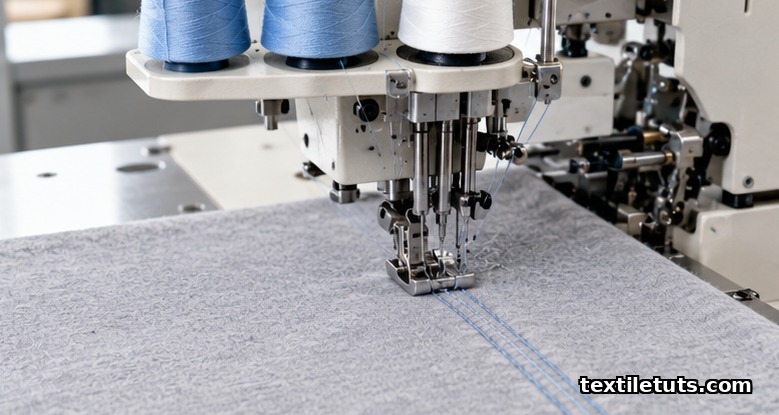
A 3-needle, 6 mm coverstitch produces a double-row top hem at 2.5 to 3.5 mm stitch length and 6 to 8 stitches per cm (15 to 20 stitches per inch), which is the industry-standard setting for knit garments, jersey, and stretch apparel.
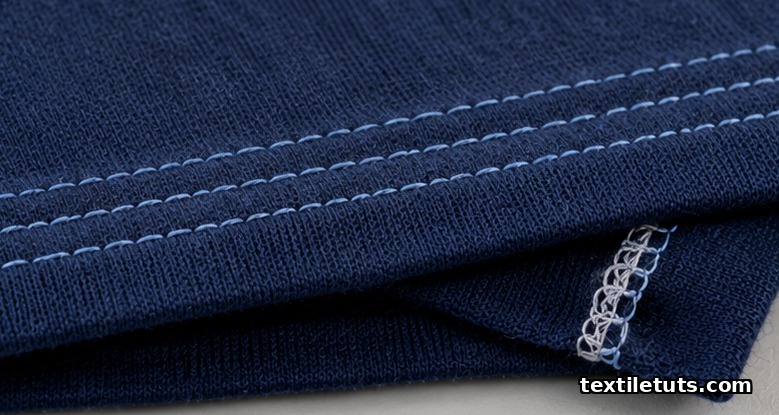
The coverstitch is the only machine that simultaneously trims the seam allowance, encases the raw edge with two parallel rows of top-thread on the right side, and interlocks the needle threads with a looper thread on the wrong side, giving a finished hem that stretches with the fabric. This guide explains the stitch geometry, the thread-and-tension settings, and the troubleshooting steps a sewing-machine operator or home sewist needs to get a flat, durable, professional hem on knit fabric.
You will learn how a coverstitch differs from a serger and a twin-needle lockstitch, which needles and threads fit each fabric weight, how to balance tension across three thread paths, and how to diagnose the most common defects (loops on the right side, tunneling, skipped stitches, and broken needles) without losing your temper.
What a Coverstitch Machine Actually Does
A coverstitch machine uses two or three parallel needles plus one looper to form a chain-stitch on the underside while laying two or three straight topstitch rows on the face. ISO 4915 classifies the 2-needle coverstitch as stitch type 406 and the 3-needle coverstitch as type 407, both of which carry a “multi-thread chain stitch” designation with a top covering thread appearance (ISO 4915:1991, “Textiles — Stitch types — Classification and terminology”). The result is a hem that has roughly 30 to 40 percent more elasticity than a standard lockstitch hem, because the looper threads run parallel to the needle threads instead of being locked at each penetration.
For comparison, a 4-thread serger (ISO 4915 type 504) overlocks and sews a seam in one pass but cannot produce the parallel double topstitch rows used for hems. A twin-needle lockstitch on a regular sewing machine imitates the look, but uses a bobbin thread that limits stretch recovery and is more likely to snap on a pulled hem.
Standard Needle Spacings and Stitch Widths
Most home and light-industrial coverstitch machines ship with three needle positions that produce the three hem widths used in commercial knitwear:
- 3 mm spacing (one needle only): single-needle cover, used for topstitching on plackets, neckline bindings, and elastic application.
- 6 mm spacing (two needles): the most common hem width on T-shirts, leggings, and sweatshirts.
- 9 mm to 12 mm spacing (two or three needles): wide decorative topstitch on heavier knits, hoodies, and waistband elastic.
The width is determined by which needle positions are populated; empty needle positions leave the corresponding stitch row absent on the face. AATCC EP 2-2018 (“Standard Test Method for Appearance of Seams in Garments After Repeated Home Laundering”) uses a 6 mm wide coverstitch reference seam when evaluating seam appearance, which is why 6 mm is the de facto default.
Thread, Needle, and Tension Setup
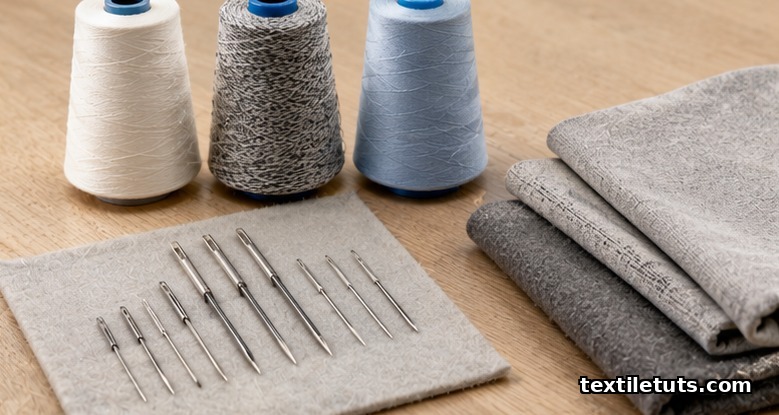
Coverstitch performance depends on matching thread, needle, and tension to the fabric weight. The table below summarizes the settings that consistently produce a balanced coverstitch in our studio:
| Fabric | Needle (ISO 4914 size) | Thread (Tex / ticket) | Looper Tension | Needle Tension |
|---|---|---|---|---|
| Lightweight jersey (120 to 140 gsm) | 80/12 ballpoint (SES) | Tex 18 (Tex 16 to 24 acceptable) | 2.5 to 3.0 | 2.5 to 3.0 |
| Midweight interlock / cotton lycra (180 to 220 gsm) | 90/14 ballpoint (SES) | Tex 25 to 30 | 3.0 to 3.5 | 3.0 to 3.5 |
| Heavy fleece / French terry (280 to 380 gsm) | 90/14 or 100/16 ballpoint | Tex 35 to 40 | 3.5 to 4.0 | 3.5 to 4.0 |
| Stretch woven / nylon-spandex blends | 80/12 stretch needle | Tex 16 to 24 wooly nylon | 3.0 | 3.0 to 3.5 |
Ballpoint (SES) needles push knit yarns aside instead of piercing them, which is what prevents the runs and holes that show up when a sharp (S) needle is used on jersey. Wooly nylon in the looper expands to cover the seam allowance and provides the recovery that makes a hem stretch instead of popping.
Tension is the single biggest variable. A balanced coverstitch shows the looper thread pulled flat across the back of the needle threads, with no loops on the face and no straight threads on the back. ISO 4916 (“Textiles — Seam types — Classification and terminology”) requires the underside to show a true chain, with each looper loop interlocking the needle threads at every stitch.
Stitch Length, Differential Feed, and Presser Foot Pressure
Stitch length for hems sits between 2.5 mm and 3.5 mm, or roughly 6 to 8 stitches per cm (15 to 20 per inch). Going shorter than 2.0 mm builds up thread density and stiffness; going longer than 4.0 mm reduces seam security on stretch fabric and exposes more yarn between stitches. AATCC TS-004 (“Quantitative Determination of Stitch Density in Seams”) defines stitch density as stitches per 25 mm on both warp and weft directions and confirms the 6 to 8 per cm figure as standard for knitwear hems.
Differential feed (the ratio between front and rear feed dog speeds) is what prevents stretching or puckering on slippery knits. A ratio of 1.0 is neutral; 1.2 to 1.5 gathers the fabric slightly under the foot, which counteracts the stretch you apply when guiding the hem; below 1.0 the feed stretches the fabric out and produces wavy hems. Most operators settle at 1.2 for interlock and 1.4 for fine jersey.
Presser foot pressure should be light on knits. Heavy pressure compresses the loft of fleece and leaves a visible ridge on the face after washing. ISO 14704-style guidance on fiber compression in sewing is informal, but ASTM D6193 (“Standard Practice for Stitches and Seams”) recommends the lightest pressure that still advances the fabric uniformly.
Hems vs. Topstitching: How the Operations Differ
A coverstitch hem folds the raw edge under once and stitches it flat, typically with a 2 cm to 3 cm fold allowance. A coverstitch topstitch is a single-pass decorative or functional row on a finished seam allowance (such as a neck binding or shoulder seam) without folding. The machine setup is the same, but the fabric handling differs:
- Hem: pre-fold the edge with a folder attachment or press it, then guide the fold under the foot at a consistent 6 mm to 10 mm distance from the fold.
- Topstitch: open the seam allowance flat, place the coverstitch row 3 mm to 5 mm from the seam line, and let the looper thread bridge the two layers.
For elastic application on waistbands, a 3-needle cover at 9 mm to 12 mm width runs over pre-stretched elastic and recovers the elastic length, producing a flat waistband without a separate elasticator. The same principle is used in activewear production lines, where ASTM D4964 (“Standard Test Method for Tension and Elongation of Elastic Fabrics”) defines the elastic stretch and recovery properties the hem must accommodate.
Troubleshooting the Four Most Common Defects
These are the defects that show up most often on a misadjusted coverstitch, with the single adjustment that fixes each one:
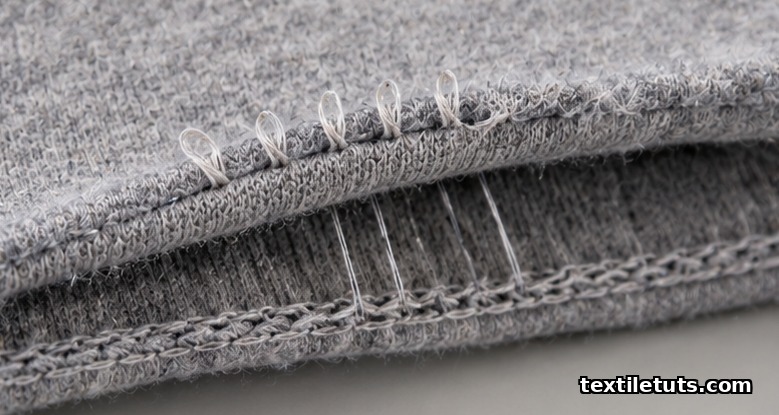
- Loops on the right side: the looper tension is too loose; tighten the looper thread by half a turn at a time until the loops sit flat on the underside.
- Straight threads on the underside (no chain): the needle tension is too tight relative to the looper, or the needle thread is misrouted in the tension disc; re-thread and reduce needle tension by one quarter turn.
- Tunneling (the seam pulls up between the needle rows): the stitch is too tight for the fabric, the differential feed is too high, or the presser foot pressure is too heavy; reduce differential to 1.0 to 1.1, lighten the foot pressure, and consider a longer stitch length.
- Skipped stitches: a bent or wrong-type needle; replace the ballpoint needle with a fresh one of the correct size for the fabric weight.
If loops persist after tension adjustment, swap the looper thread. Wooly nylon and textured polyester behave very differently in the looper path, and the same numerical setting gives different loop coverage on each.
Frequently Asked Questions
Can a coverstitch machine replace a serger?
No. A coverstitch only does hems and topstitching; it cannot overlock and assemble a seam in one pass. Most knit-garment producers use both machines, a 4- or 5-thread serger for seaming and a 3-needle coverstitch for hems, and they share a single threading diagram for the looper.
What stitch length gives the strongest hem on a T-shirt?
2.5 mm to 3.0 mm (about 7 to 8 stitches per cm, or 18 to 20 stitches per inch) is the standard. ISO 4915- and AATCC-recommended stitch density for jersey hems falls in this range, and going shorter makes the seam stiff without measurable gain in burst strength.
Why does my coverstitch hem tunnel after washing?
Tunneling comes from too much tension pulling the center of the seam tighter than the edges, or from too much presser foot pressure. Reduce differential feed to 1.0, lighten the foot pressure, lengthen the stitch by 0.5 mm, and use wooly nylon in the looper to absorb recovery. The wash cycle then relaxes the seam flat instead of into a ridge.
What thread should I use in the looper for a stretch hem?
Wooly nylon (Tex 18 to 24) or textured polyester (Tex 18 to 25). These textured threads expand to cover the raw edge and recover up to 60 percent stretch, which is what keeps a legging or activewear hem from popping under wear.
How often should I change the coverstitch needle?
Every 6 to 8 hours of sewing on cotton knits and every 4 to 6 hours on synthetics or fleece. A dull ballpoint needle stops pushing knit yarns aside and starts piercing them, which produces the skipped stitches and ladder runs that show up at the hem first.
References
- ISO 4915:1991, Textiles — Stitch types — Classification and terminology, International Organization for Standardization. Defines coverstitch types 406 (2-needle) and 407 (3-needle).
- ISO 4916:1991, Textiles — Seam types — Classification and terminology, International Organization for Standardization. Defines seam geometry for chain-stitched coverings.
- ASTM D6193-20, Standard Practice for Stitches and Seams, ASTM International. Covers stitch selection, seam construction, and recommended stitch density for woven and knit apparel.
- AATCC EP 2-2018, Standard Test Method for Appearance of Seams in Garments After Repeated Home Laundering, American Association of Textile Chemists and Colorists. Reference seam geometry and visual evaluation criteria.
- AATCC TS-004, Quantitative Determination of Stitch Density in Seams, American Association of Textile Chemists and Colorists. Defines stitch density measurement for seam-quality reporting.
- ASTM D4964-20, Standard Test Method for Tension and Elongation of Elastic Fabrics, ASTM International. Used to characterize elastic recovery that coverstitched waistbands must accommodate.
- ISO 13935-1:2014, Textiles — Seam tensile properties of fabrics and made-up textile articles — Part 1: Determination of maximum force to seam rupture using the strip method. Used to evaluate coverstitch seam strength against lockstitch and overlock references.
This article is the working reference for coverstitch hems and topstitching on knit garments. Editorial by Mohammad Yousuf (Anik), TextileTuts. Sources: ISO 4915, ISO 4916, ASTM D6193, AATCC EP 2-2018, AATCC TS-004, ASTM D4964, ISO 13935-1 as cited.


